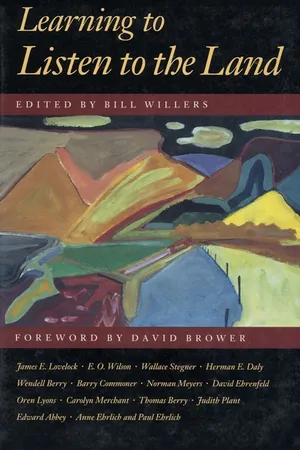
In this inspired collection, some of America's most provocative thinkers and writers reflect on nature and enviornmetnal science--reaching compelling conclusions about humanity's relationship to the earth. Balanced by science and fact, Learning to Listen to the Land explains the significance of our modern environmental crisis. The authors underscore the necessity forworking within, rather than counter to, our larger ecosystem.
Learning to Listen to the Land represents the sounding of an alarm. It's authors call on us to recognize the consequences of our actions, and inactions, and to develop a sense of connection with the earth.
- English
- ePUB (mobile friendly)
- Available on iOS & Android
eBook - ePub
Learning to Listen to the Land
About this book
Information
PART ONE
Nature and Biodiversity
Accuse not nature, she hath done her part; do thou but thine.
—John Milton
Paradise Lost
Paradise Lost
Becoming familiar with the Gaia Hypothesis and then ruminating about it for some months foster an attitude toward the planet that is at odds with the prevailing attitude. The notion of Earth as a living entity, rather than as a big spherical rock with living creatures on it, is a kind of heresy in a society geared, as is ours, to exploitation.
But the notion is seductive, and once planted it flourishes. There is an inherent rightness about viewing Earth, hanging in the void, vibrantly ruddy and blue, wreathed in cottony swirls, as alive. It’s as though the idea wasn’t really new for us—that it was there all along, only temporarily suppressed, needing but a faint nudge to blossom again in the mind. The very thought elicits a sense of unity; holism becomes inescapable.
A common misconception about Gaia, though, is that, in the manner of a good mother, it must have a special fondness for us humans, and that it exists primarily to nurture our species. This may be a normal assumption for beings who have become as divorced from the natural world as we have become. But to hold to such a view is to avoid the central point that Gaia’s processes are directed toward maintaining the well-being of Gaia, and there is every indication that, were it necessary in order to maintain its own good health, Gaia would dispatch us as dispassionately as we might wipe out weeds in a garden.
The realization that from the standpoint of Gaia we are co-equal with other resident species is a step that we must take before it is possible to see clearly that we are parts of something rather than masters of something. The realization is both humbling and comforting. We enjoy, we use, we belong; we are not, however, at the helm.
Having taken such a mental journey, we are able to apprehend wilderness for what it really is—not a collection of parks for our vacation enjoyment, but intact ecosystems that, like Gaia itself, are discrete entities having inherent integrity. Intuition will then tell us that all constituent parts, from microbes to redwoods, from worms to top-level predators, from groundwaters to mountaintops, have rights to exist by virtue of the fact that Gaia’s processes have caused them to come into being.
A sketch by Sir James Lovelock of his concept of Gaia begins the part. Thereafter, pieces by E. O. Wilson, Reed Noss, and Chris Maser deal with biological diversity on the planet. While Wilson takes a global view, Maser concentrates on the concept of ancient forest, and Noss focuses on ill-conceived policy within our country that, in favoring diversity of “weed species” in local pockets, actually diminishes diversity overall. Norman Myers then writes about the implications of impending mass extinctions. And Joan Bird’s essay brings together information about the fragmentation of ecosystems, the resulting isolation of “island populations,” and the dangers faced by those populations that have become genetically isolated.
The last two essays deal with human attitudes. David Ebrenfeld’s “The Conservation Dilemma” is from his book The Arrogance of Humanism, this latter title neatly describing his thesis. Humanists, he contends, are not willing to save any “fragment of Nature” that lacks usefulness to humankind. Wallace Stegner’s “The Gift of Wilderness” is the best of possible pieces to end this part. One of the finest prose stylists ever to write about Nature, he makes a point that, in many ways, is the point of the anthology. “We need,” he maintains, “to learn to listen to the land.”
—BW
The Earth as a Living Organism
The idea that the Earth is alive may be as old as humankind. The ancient Greeks gave her the powerful name Gaia and looked on her as a goddess. Before the nineteenth century even scientists were comfortable with the notion of a living Earth. According to the historian D. B. McIntyre (1963), James Hutton, often known as the father of geology, said in a lecture before the Royal Society of Edinburgh in the 1790s that he thought of the Earth as a superorganism and that its proper study would be by physiology. Hutton went on to make the analogy between the circulation of the blood, discovered by Harvey, and the circulation of the nutrient elements of the Earth and of the way that sunlight distills water from the oceans so that it may later fall as rain and so refresh the earth.
This wholesome view of our planet did not persist into the next century. Science was developing rapidly and soon fragmented into a collection of nearly independent professions. It became the province of the expert, and there was little good to be said about interdisciplinary thinking. Such introspection was inescapable. There was so much information to be gathered and sorted. To understand the world was a task as difficult as that of assembling a planet-size jigsaw puzzle. It was all too easy to lose sight of the picture in the searching and sorting of the pieces.
Biodiversity (Washington, D.C.: National Academy Press, 1988).
When we saw a few years ago those first pictures of the Earth from space, we had a glimpse of what it was that we were trying to model. That vision of stunning beauty; that dappled white and blue sphere stirred us all, no matter that by now it is just a visual cliché. The sense of reality comes from matching our personal mental image of the world with that we perceive by our senses. That is why the astronaut’s view of the Earth was so disturbing. It showed us just how far from reality we had strayed.
The Earth was also seen from space by the more discerning eye of instruments, and it was this view that confirmed James Hutton’s vision of a living planet. When seen in infrared light, the Earth is a strange and wonderful anomaly among the planets of the solar system. Our atmosphere, the air we breathe, was revealed to be outrageously out of equilibrium in a chemical sense. It is like the mixture of gases that enters the intake manifold of an internal combustion engine, i.e., hydrocarbons and oxygen mixed, whereas our dead partners Mars and Venus have atmospheres like gases exhausted by combustion.
The unorthodox composition of the atmosphere radiates so strong a signal in the infrared range that it could be recognized by a spacecraft far outside the solar system. The information it carries is prima facie evidence for the presence of life. But more than this, if the Earth’s unstable atmosphere was seen to persist and was not just a chance event, then it meant that the planet was alive—at least to the extent that it shared with other living organisms that wonderful property, homeostasis, the capacity to control its chemical composition and keep cool when the environment outside is changing.
When on the basis of this evidence, I reanimated the view that we were standing on a superorganism rather than just a ball of rock (Lovelock, 1972; 1979), it was not well received. Most scientists either ignored it or criticized it on the grounds that it was not needed to explain the facts of the Earth. As the geologist H. D. Holland (1984, p. 539) put it, “We live on an Earth that is the best of all possible worlds only for those who are well adapted to its current state.” The biologist Ford Doolittle (1981) said that keeping the Earth at a constant state favorable for life would require foresight and planning and that no such state could evolve by natural selection. In brief, scientists said, the idea was teleological and untestable. Two scientists, however, thought otherwise; one was the eminent biologist Lynn Margulis and the other the geochemist Lars Sillen. Lynn Margulis was my first collaborator (Margulis and Lovelock, 1974). Lars Sillen died before there was an opportunity. It was the novelist William Golding (personal communication, 1970), who suggested using the powerful name Gaia for the hypothesis that supposed the Earth to be alive.
In the past ten years these criticisms have been answered—partly from new evidence and partly from the insight provided by a simple mathematical model called Daisy world. In this model, the competitive growth of light- and dark-colored plants on an imaginary planet is shown to keep the planetary climate constant and comfortable in the face of a large change in heat output of the planet’s star. This model is powerfully homeostatic and can resist large perturbations not only of solar output but also of plant population. It behaves like a living organism, but no foresight or planning is needed for its operation.
Scientific theories are judged not so much by whether they are right or wrong as by the value of their predictions. Gaia theory has already proved so fruitful in this way that by now it would hardly matter if it were wrong. One example, taken from many such predictions, was the suggestion (Lovelock, 1972) that the compound dimethyl sulfide would be synthesized by marine organisms on a large scale to serve as the natural carrier of sulfur from the ocean to the land. It was known at the time that some elements essential for life, like sulfur, were abundant in the oceans but depleted on the land surfaces. According to Gaia theory, a natural carrier was needed and dimethyl sulfide was predicted. We now know that this compound is indeed the natural carrier of sulfur, but at the time the prediction was made, it would have been contrary to conventional wisdom to seek so unusual a compound in the air and the sea. It is unlikely that its presence would have been sought but for the stimulus of Gaia theory.
Gaia theory sees the biota and the rocks, the air, and the oceans as existing as a tightly coupled entity. Its evolution is a single process and not several separate processes studied in different buildings of universities.
It has a profound significance for biology. It affects even Darwin’s great vision, for it may no longer be sufficient to say that organisms that leave the most progeny will succeed. It will be necessary to add the proviso that they can do so only so long as they do not adversely affect the environment.
Gaia theory also enlarges theoretical ecology. By taking the species and the environment together, something no theoretical ecologist has done, the classic mathematical instability of population biology models is cured.
For the first time, we have from these new, these geophysiological models a theoretical justification for diversity, for the Rousseau richness of a humid tropical forest, for Darwin’s tangled bank. These new ecological models demonstrate that as diversity increases so does stability and resilience. We can now rationalize the disgust we feel about excesses of agribusiness. We have at last a reason for our anger over the heedless deletion of species and an answer to those who say it is mere sentimentality.
No longer do we have to justify the existence of the humid tropical forests on the feeble grounds that they might carry plants with drugs that could cure human disease. Gaia theory forces us to see that they offer much more than this. Through their capacity to evapotranspire vast volumes of water vapor, they serve to keep the planet cool by wearing a sunshade of white reflecting clouds. Their replacement by cropland could precipitate a disaster that is global in scale.
A geophysiological system always begins with the action of an individual organism. If this action happens to be locally beneficial to the environment, then it can spread until eventually a global altruism results. Gaia always operates like this to achieve her altruism. There is no foresight or planning involved. The reverse is also true, and any species that affects the environment unfavorably is doomed, but life goes on.
Does this apply to humans now? Are we doomed to precipitate a change from the present comfortable state of the Earth to one almost certainly unfavorable for us but comfortable to the new biosphere of our successors? Because we are sentient there are alternatives, both good and bad. In some ways the worse fate in store for us is that of becoming conscripted as the physicians and nurses of a geriatric planet with the unending and unseemly task of forever seeking technologies to keep it fit for our kind of life—something that until recently we were freely given as a part of Gaia.
Gaia philosophy is not humanist. But being a grandfather with eight grandchildren I need to be optimistic. I see the world as a living organism of which we are a part; not the owner, nor the tenant, not even a passenger. To exploit such a world on the scale we do is as foolish as it would be to consider our brains supreme and the cells of other organs expendable. Would we mine our livers for nutrients for some short-term benefit?
Because we are city dwellers, we are obsessed with human problems. Even environmentalists seem more concerned about the loss of a year or so of life expectation through cancer than they are about the degradation of the natural world by deforestation or greenhouse gases—something that could cause the death of our grandchildren. We are so alienated from the world of nature that few of us can name the wild flowers and insects of our locality or notice the rapidity of their extinction.
Gaia works from an act of an individual organism that develops into global altruism. It involves action at a personal level. You well may ask, So what can I do? When seeking to act personally in favor of Gaia through moderation, I find it helpful to think of the three deadly Cs: combustion, cattle, and chain saws. There must be many others.
One thing you could do, and it is no more than an example, is to eat less beef. If you do this, and if the clinicians are right, then it could be for the personal benefit of your health; at the same time, it might reduce the pressures on the forests of the humid tropics.
To be selfish is human and natural. But if we chose to be selfish in the right way, then life can be rich yet still consistent with a world fit for our grandchildren as well as those of our partners in Gaia.
References
Doolittle, W. F. 1981. Is nature really motherly? CoEvol. Q. 29:58—63.
Holland, H. D. 1984. The Chemical Evolution of the Atmosphere and the Oceans. Princeton University Press, Princeton, N.J. 656 pp.
Lovelock, J. E. 1972. Gaia as seen through the atmosphere. Atmos. Environ. 6:579–580.
Lovelock, J. E. 1979. Gaia. A New Look at Life on Earth. Oxford University Press, Oxford. 157 pp.
McIntyre, D. B. 1963. James Hutton and the philosophy of geology. Pp. 1— 11 in Claude C. Albritton, ed. The Fabric of Geology. Addison-Wesley, Reading, Mass.
Margulis, L., and J. E. Lovelock. 1974. Biological modulation of the Earth’s atmosphere. Icarus 21:471-489.
The Current State of Biological Diversity
Biological diversity must be treated more seriously as a global resource, to be indexed, used, and above all, preserved. Three circumstances conspire to give this matter an unprecedented urgency. First, exploding human populations are degrading the environment at an accelerating rate, especially in tropical countries. Second, science is discovering new uses for biological diversity in ways that can relieve both human suffering and environmental destruction. Third, much of the diversity is being irreversibly lost through extinction caused by the destruction of natural habitats, again especially in the tropics. Overall, we are locked into a race. We must hurry to acquire the knowledge on which a wise policy of conservation and development can be based for centuries to come.
To summarize the problem in this chapter, I review some current information on the magnitude of global diversity and the rate at which we are losing it. I concentrate on the tropical moist forests, because of all the major habitats, they are richest in species and because they are in greatest danger.
Biodiversity (Washington, D.C: National Academy Press, 1988)
THE AMOUNT OF BIOLOGICAL DIVERSITY
Many recently published sources, especially the multiauthor volume Synopsis and Classification of Living Organisms, indicate that about 1.4 million living species of all kinds of organisms have been described (Parker, 1982; see also the numerical breakdown according to major taxonomic category of the world insect fauna prepared by Arnett, 1985). Approximately 750,000 are insects, 41,000 are vertebrates, and 250,000 are plants (that is, vascular plants and bryophytes). The remainder consists of a complex array of invertebrates, fungi, algae, and microo...
Table of contents
- About Island Press
- Title Page
- Dedication
- Copyright Page
- Epigraph
- Table of Contents
- Foreword
- Introduction
- PART ONE - Nature and Biodiversity
- PART TWO - The Impossibility of Endless Growth
- PART THREE - Toward Holism and Sustainability
- About the Contributors
- About the Editor
- Permissions
- Index
- Also Available from Island Press
- Island Press Board of Directors
Trusted by 375,005 students
Access to over 1.5 million titles for a fair monthly price.
Study more efficiently using our study tools.
Frequently asked questions
Yes, you can cancel anytime from the Subscription tab in your account settings on the Perlego website. Your subscription will stay active until the end of your current billing period. Learn how to cancel your subscription
No, books cannot be downloaded as external files, such as PDFs, for use outside of Perlego. However, you can download books within the Perlego app for offline reading on mobile or tablet. Learn how to download books offline
Perlego offers two plans: Essential and Complete
- Essential is ideal for learners and professionals who enjoy exploring a wide range of subjects. Access the Essential Library with 800,000+ trusted titles and best-sellers across business, personal growth, and the humanities. Includes unlimited reading time and Standard Read Aloud voice.
- Complete: Perfect for advanced learners and researchers needing full, unrestricted access. Unlock 1.5M+ books across hundreds of subjects, including academic and specialized titles. The Complete Plan also includes advanced features like Premium Read Aloud and Research Assistant.
We are an online textbook subscription service, where you can get access to an entire online library for less than the price of a single book per month. With over 1.5 million books across 990+ topics, we’ve got you covered! Learn about our mission
Look out for the read-aloud symbol on your next book to see if you can listen to it. The read-aloud tool reads text aloud for you, highlighting the text as it is being read. You can pause it, speed it up and slow it down. Learn more about Read Aloud
Yes! You can use the Perlego app on both iOS and Android devices to read anytime, anywhere — even offline. Perfect for commutes or when you’re on the go.
Please note we cannot support devices running on iOS 13 and Android 7 or earlier. Learn more about using the app
Please note we cannot support devices running on iOS 13 and Android 7 or earlier. Learn more about using the app
Yes, you can access Learning to Listen to the Land by William B. Willers in PDF and/or ePUB format, as well as other popular books in Biological Sciences & Environmental Science. We have over 1.5 million books available in our catalogue for you to explore.