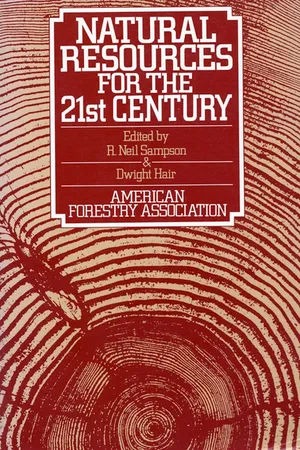
Natural Resources for the 21st Century is an in-depth assessment by natural resource experts that offers a reliable status report on water, croplands, soil, forests, wetlands, rangelands, fisheries, wildlife, and wilderness.
eBook - ePub
Natural Resources for the 21st Century
- English
- ePUB (mobile friendly)
- Available on iOS & Android
eBook - ePub
Natural Resources for the 21st Century
About this book
Information
PART I
An Inventory of Renewable Natural Resources
Introduction
This book began with a vision. Simply stated, we think that the most important ingredient in framing the future of America is people and the decisions they make as part of their daily lives. As natural resource professionals, we are dedicated to the idea that people who use the natural bounty of the world wisely will prosper in many ways, in matters of the soul as well as in matters of practical survival and economic prosperity. We further believe that people who have a realistic view of the facts surrounding their situation, and the most likely results of their actions, will make better decisions than those working without good information.
The present moment offers some exceptional opportunities to the American people. New political leadership is taking charge of the federal agencies, and the “environment,” as a political issue, has come back into public consciousness after a few years on the back burner. At the local level, many recent elections in the past year have turned on the public’s perception of the quality of their lives, with the main issues often surrounding growth, development, land use, transportation, pollution, and related topics.
On the private scene, farmers in 1988 came through a significant drought that added to a decade of economic stress, and forest products industries are now going through intensive pressures from corporate realignments. Fishermen are running into depleted or pollution-poisoned populations, and cattlemen fear that lowered per-capita red meat consumption will cause their industry problems for years to come. Clearly, people need to make strategic decisions in natural resource management, and the idea that better decisions will be based on better information is easy to reach.
On the other side of the decision ledger, the recent months have seen an exceptional flurry of natural resource information studies. In the Department of Agriculture, the Resources Planning Act (RPA) assessment carried out by the Forest Service was recently released for public review, as was the Resources Conservation Act (RCA) assessment done by the Soil Conservation Service. In the Department of the Interior, a major assessment of waterfowl population dynamics is underway in connection with the North American Waterfowl Plan, and there is widespread concern over growing evidence of population problems in several major fisheries. At the Environmental Protection Agency, concerns for air and water quality, the impact of the greenhouse effect, and other topics are resulting in a series of assessment reports.
Thus, we seem to be at a critical juncture — a time when a significant need for reliable information occurs in conjunction with the release of dozens of major natural resource studies that could, if properly interpreted, be put to very good use. The challenge is to get the information to those who need it, in a form that they can use. Massive scientific or government documents produced by teams of credible scientists may, by their very bulk, hide information from the “end users” rather than make it readily available.
This book is one attempt to break down that communications gap. It is based on the premise that there is a cadre of “natural resource educators” in both public and private service whose education or job role places them in the position of being part-scientist, part-educator. They are asked to plow through the heavy scientific or data-laden reports, then translate that information into usefully abbreviated versions that retain their scientific honesty, but cut away as much of the “overhead” information as possible. One such cadre is contained in the Cooperative Extension Service. In adopting “Conservation and Management of Natural Resources” as one of its primary issue initiatives, the Service has signaled that it expects its employees and cooperative partners at the state universities to increase their knowledge of and attention to natural resource issues.
This book presents these educators with a resource, from which we hope many new and improved natural resource information and education programs will emerge.
Another major audience is composed of those who actually manage land and water: farmers, ranchers, foresters, fishermen, and others. There are significant needs in the corporate boardrooms of America, where major decisions affecting natural resources are made. And, in the minds of many, the most important audience of all is that vast majority of the American people who do not work directly with natural resources, but who frame the public opinion that drives actions in both the private and public sectors.
We make no pretense to having covered all of the relevant information on natural resources in this book. Some critical topics weren’t even explored, simply to keep the scope of the project within manageable limits. Energy is probably the most notable omission, accompanied by minerals and related non-renewable resource facts. Even on the topics covered, the information is carefully chosen and limited, and not everyone will agree that what has been selected is the most important. But with those caveats, we believe much is to be learned from the following assessments.
In working with over 100 people to put together the conference which led to this book, we learned a great deal, both about natural resources and about how the natural world has reacted to the actions of people. We learned that, when viewed as objectively as possible, things aren’t all that bad. Neither are they all good. Unfortunately, too many times we are given one or the other of these messages by people who want us to join them in one or another type of policy action. But when scientists look at the natural resource situation, what they find is a very complex situation. Easy, simple answers aren’t common. Most renewable resources respond to good management, and there are many examples where the actions of people have resulted in improved conditions. In many respects, the natural world is remarkably resilient. Even after significant insult, it can bounce back if given the proper investment, care and treatment.
The forests of the United States have responded well to a century of increasing knowledge and attention to management, for example. But there are some problems, many opportunities for improvement that would be both economically and environmentally beneficial. The same can be said of rangelands. In other resource areas things aren’t going very well at all — some fisheries are seriously depleted and the waterfowl situation in North America indicates a significant need to make some changes in both land use and human activities. The potential threat to ecosystems posed by global warming is a long-term concern that concerns natural resource experts.
We have more information about natural resources than ever before in history, but data and the wisdom to make the best management decisions are not automatically linked. People still strive to do their best in the midst of a complex stream of events — political, economic, natural, social. They don’t always think about the long-term impacts of their actions on the natural resource base, and might not be able to accurately assess the true impacts in every case, even if they tried. So, in large measure, natural resource management is a people problem. More people, making more significant impacts on their environment, need more and better information if they are to live without ruining the natural resource base upon which all life depends.
There are many ways to go about managing resources, and it is not always clear that some management techniques are right and others are wrong. Often, scientists and educators will find it both easy and honest to be fairly neutral on the means of achieving society’s goals. But few can afford the luxury of being neutral on the goals themselves. There are right and wrong ways to use land and water, and their renewable resources. Identifying the boundary between prudent use and waste is not always easy. But it can be done, and it must be done. So natural resource education programs must teach people how to make those judgments, and how to identify those boundaries. In the process, the education program must show people what the boundary is, why it is where it is, and how to tell when you are approaching it. There’s little room for neutrality here.
Nobody has magic answers. Political leaders and scientists alike work most of the time on sketchy information that too often gives few clues about future outcomes. They make recommendations or decisions because they are forced to do so by circumstances, not because all of the evidence is at hand, or the best course of action plainly shown. The least productive strategy may be the “we-they” construct, where people attempt to show that the reason problems exist is because “they” (whoever “they” are) refuse to be reasonable or do the right thing. Just like there are few true prophets, there are few clearly identifiable ogres.
Truly integrating resource understandings into a “holistic” point of view is hard work, and it takes a lot of people — well-trained and talented people. But it is critical if we are to try to really understand the world and what is happening to it as a result of human activities. We must, therefore, try to train ourselves in two skills at once: a technical skill where we truly understand one aspect of the natural world; and an integrative skill where we gain the ability to relate that aspect to the rest of the world around it. It may not be a matter of being either a “specialist” or a “generalist,” so much as the challenge to be some of each.
At the same time, we must build many more bridges between professional disciplines, agencies and institutions. The boundaries built to protect “turf” impose heavy penalties on society, because they deprive the ultimate users — private land users and public decisionmakers — of the full range of integrated and holistic resource information that they need. That is a cost burden that was never helpful, but is rapidly becoming unacceptable.
At the conference which led to this book, we asked four panels of experienced leaders to share with us their insight into the meaning of resource trends and needed directions for future management. As well, we asked four experienced natural resource writers and several analysts to add their insights to those panels and present the results here in reflective articles. These are gathered at the back of the volume as an opening to dialogue on the implications of the data.
In reading the material that follows, both in Part I, which contains chapters assessing resource trends and situations, and in the second section, which interprets the interactions and importance of those trends, keep in mind that the authors have tried to minimize value judgments, predictions, and alarm bells. Those are, for the most part, left to the reader. It is our hope that what you find here will be the basis for you to make reasoned judgments about natural resources. Whether the facts presented herein alarm or comfort you, we hope they bring you new information and insight into ways that people can work to make natural resources more productive and plentiful.
In the final analysis, we believe that the difference between a society that will survive and one whose future is in doubt will be the difference between a people whose actions (intended or otherwise) destroy the natural resources on which they depend, and one whose people and institutions take intentional, constructive actions to use natural resources for human benefit, and to protect and improve their sustainable productivity through wise stewardship. It is hoped that the information presented in this book will help Americans attain that goal.
CHAPTER 1
Population and Global Economic Patterns
Natural resources are the physical context for all human activity. They facilitate, constrain, embody what we as human beings do with or to each other. With population changes over time come inevitable changes in the natural resource context, exerting new constraints or providing new opportunities for people. The purpose of this chapter is to help clarify future natural resource consequences of two major forces— population and global economics. Beginning with an identification of key concepts, it reviews evidence of demographic and economic patterns and identifies policy needs of highest priority for the 21st century.
Futurist Daniel Bell has observed that the only real “time bombs” associated with people and natural resources of the future are polity and demography. The former concerns how people in meaningful public entities such as counties, states, provinces, or nations organize themselves to solve natural resource problems. The latter concerns both the number of people and their distribution relative to natural resource systems. More people within any natural resource setting implies a greater frequency of interaction with resources, greater likelihood of scarcity or conflict, and greater challenge for political and economic institutions.
IMPORTANCE OF RESOURCES
The inevitable controversies over natural resource policy will center on the various ways in which those resources generate utility for people. Resource conflict means a difference of opinion about the rate, form and spatial character of resource-based utility. The apparent tautology needs restating— natural resources are relevant to policy only because of what they do for, or to people. No one truly speaks for resources. They argue to protect resource use patterns that they prefer. Resource utility comes in many forms.
Resources as Production Inputs
Farmers and foresters have learned how to facilitate the conversion of soil, water, sunlight, and vari...
Table of contents
- ABOUT ISLAND PRESS
- Title Page
- Copyright Page
- Table of Contents
- Acknowledgments
- Foreword
- PART I - An Inventory of Renewable Natural Resources
- PART II - Perspectives and Analyses
- Contributors
- Index
- ALSO AVAILABLE FROM ISLAND PRESS
- ISLAND PRESS BOARD OF DIRECTORS
Trusted by 375,005 students
Access to over 1.5 million titles for a fair monthly price.
Study more efficiently using our study tools.
Frequently asked questions
Yes, you can cancel anytime from the Subscription tab in your account settings on the Perlego website. Your subscription will stay active until the end of your current billing period. Learn how to cancel your subscription
No, books cannot be downloaded as external files, such as PDFs, for use outside of Perlego. However, you can download books within the Perlego app for offline reading on mobile or tablet. Learn how to download books offline
Perlego offers two plans: Essential and Complete
- Essential is ideal for learners and professionals who enjoy exploring a wide range of subjects. Access the Essential Library with 800,000+ trusted titles and best-sellers across business, personal growth, and the humanities. Includes unlimited reading time and Standard Read Aloud voice.
- Complete: Perfect for advanced learners and researchers needing full, unrestricted access. Unlock 1.5M+ books across hundreds of subjects, including academic and specialized titles. The Complete Plan also includes advanced features like Premium Read Aloud and Research Assistant.
We are an online textbook subscription service, where you can get access to an entire online library for less than the price of a single book per month. With over 1.5 million books across 990+ topics, we’ve got you covered! Learn about our mission
Look out for the read-aloud symbol on your next book to see if you can listen to it. The read-aloud tool reads text aloud for you, highlighting the text as it is being read. You can pause it, speed it up and slow it down. Learn more about Read Aloud
Yes! You can use the Perlego app on both iOS and Android devices to read anytime, anywhere — even offline. Perfect for commutes or when you’re on the go.
Please note we cannot support devices running on iOS 13 and Android 7 or earlier. Learn more about using the app
Please note we cannot support devices running on iOS 13 and Android 7 or earlier. Learn more about using the app
Yes, you can access Natural Resources for the 21st Century by American Forestry Association, R. Neil Sampson,Dwight Hair in PDF and/or ePUB format, as well as other popular books in Biological Sciences & Ecology. We have over 1.5 million books available in our catalogue for you to explore.