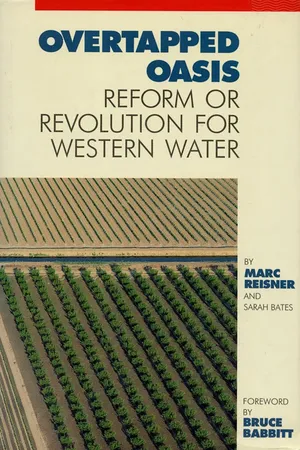
Overtapped Oasis analyzes the West's water allocation system from top to bottom and offers dozens of revolutionary proposals for increased efficiency and policy reform. Marc Reisner and Sarah Bates argue that the West's underlying problem is not a shortage of water but the inefficient use of it, a problem caused by a bewildering tangle of federal subsidy programs, restrictive state water codes, anachronistic irrigation practices and -- perhaps most important -- resistance to reform.
- English
- ePUB (mobile friendly)
- Available on iOS & Android
eBook - ePub
About this book
Information
Part I
A Brief Look at Western Water History
THE American West was explored and settled by the Spanish just half a century after Columbus made landfall, and long before the Jamestown colony and Plymouth Rock. For the next three centuries, however, its colonization proceeded much more slowly than in the East. One reason was distance, but perhaps an equally important one was water. Had the polarities of climate been reversed—had the East been semiarid to arid and the West humid to wet—the landless European masses might well have risked the trip around Cape Horn, and the continental cross-migration could have gone in reverse.
Among all Europeans, the Spanish were best suited to try to build a civilization in the West; they were used to semiarid climates and experienced with irrigation. But the West was much different from Spain. Outside of California and Arizona, the climate is considerably colder, and where there is year-round warmth the West tends to be emphatically dry. Moreover, even though much of Spain receives less than 20 inches of rainfall per year, as California does, precipitation tends to come year-round. California is virtually rainless during most of the growing season. Not just irrigation but constant irrigation was critical to survival. Since Spain was singular in its approach to colonization—its missionaries served as its settlers’ advance men—Indians were desperately needed to help with all the work. But the California Indians, who as hunters and gatherers were utterly unused to such labor and drudgery, tended to rebel and depart, offenses which were severely punished. Punishment made the Indians more hostile, and a vicious cycle was begun. Most historians have attributed Spain’s bewildering loss of interest in the Southwest to its failure to find precious metals. It is just as plausible, however, that the Spanish were drawn to a region that reminded them of home—and then proved to be a far tougher place to settle.
The settlers of northern European origin who were lured from the East by the expansionist railroads (“Rain follows the plow!,” the meteorological fraud of the century, was their clarion call) and the homestead acts learned the same lesson, only more painfully, as they trespassed into the continent’s arid zone and began planting their farms on the western plains. The land boom had been on for barely twenty years (most of them unusually wet) when the Great White Winter of 1886 struck, followed by the drought of 1888-1892. Kansas and Nebraska saw their populations decline by nearly one-half. By 1893, of a million families who had tried to settle the semiarid plains, only 400,000 remained.1 Farther east, farmers had to cut down great virgin hardwoods, yank out the stumps, and clear rubbly, rock-strewn fields; but the homestead acts, despite their promise of virtually rockless and treeless, fertile land, were for the most part a dismal failure west of the hundredth meridian.
The Inevitable Federal Role
Many of the western settlers who prevailed were those who had established homesteads along rivers and streams and begun to irrigate. In the public imagination, irrigation had been consigned to warmer climates like California’s—and to the Mormons—but after Horace Greeley established a successful, non-Mormon irrigation colony north of Denver, interest in this novel type of farming heightened considerably. Scores of private irrigation companies were formed with eastern capital, stocked with eastern engineers, and sent West to subdue the desert. Cooperative irrigation districts were stitched together among landowners. By the early 1890s, some 3.5 million acres had come under irrigation in the West.
That achievement, unfortunately, was not nearly as impressive as it seems. Mormons were responsible for at least half the acreage; their diligence, social cohesiveness, and sheer obstinate will made them difficult to emulate. Most of the rest was in Southern California and along such rivers as the South Platte and Arkansas, whose waters were easily diverted and stored in natural offstream basins for summertime use. (Much of the conservation storage on the plains is still provided by these same playa basins, instead of by mountain reservoirs.) But most western topography is not like that of the plains. The rivers tend to flow in canyons, and in order to regulate and divert their waters one has to build large dams—a task beyond the means and ability of nearly all the early private companies and cooperatives.
The results were predictable. At the eighth National Irrigation Congress in 1898, one speaker compared the western landscape to a graveyard, littered by the “crushed and mangled skeletons of defunct irrigation companies . . . which suddenly disappeared at the end of brief careers, leaving only a few defaulted obligations to indicate the route by which they departed.”2 In some regions, the collapse of private-cooperative irrigation ventures was economically calamitous. When the Newlands Project in Nevada went bust (mainly because of political interference by the legislature and squabbles among the settlers) at the end of the silver boom of the 1870s and 1880s, Francis Newlands, the chief sponsor and funder of the project, announced, “Nevada is a dying state.”3 In fact, the population exodus from Nevada at that time, expressed as a percentage of those who remained, is still the greatest in American history.
Nonetheless irrigation, or “reclamation,” by the late nineteenth century, had attained the status of a movement with a well-organized constituency (the National Reclamation Association and other groups) and strong political support in various quarters. Belatedly recognizing the shortcomings of the eastern-oriented homesteading legislation, Congress tried to align the terms and conditions of subsequent legislation with the realities of western climate—also without much success. The Desert Land Act of 1877 offered 640-acre tracts in the western states and territories to anyone who promised to irrigate them in three years; the standards of “proof” were so lax that the act’s main result was speculation on an almost heroic scale. The Carey Act of 1894 authorized the federal government to donate land to states for the purpose of irrigation farming, but the states proved no more competent at building reservoirs, finding suitable soils, and mastering irrigation’s complex art than the worst of the private companies. Over sixteen years, the Carey Act was responsible for bringing only 288,000 acres under irrigation, some of the time.
By the turn of the century, it had finally become clear that irrigation would achieve very limited success without a far more prominent federal role. As it happens, the nation’s political history was at a juncture that made such a role possible. The progressive movement was gathering strength, a reaction against unfettered capitalism and the social chaos and political corruption it had wrought. Theodore Roosevelt, the incoming president, had lived in the West and owned a scientific mind that understood the formidable obstacles to settlement posed by climate and terrain. Roosevelt was not frightened by federal powers and, moreover, was anxious to build up America’s weak western flank. And Francis Griffith Newlands, who lost half a million dollars in his irrigation venture, was now a congressman who could testify eloquently before his colleagues about the limitations of private enterprise. Everything else had been tried, and with some notable exceptions nothing had worked. Like the Civil Rights and Clean Air Acts, the Reclamation Act of 1902 is enshrined in that special category of legislation marked “inevitable.”
How the Government Watered the West
The Reclamation Act represents—in theory if not always in reality—the application of a Hamiltonian means (strong centralized government) in pursuit of Jeffersonian ends: the preservation and expansion of rural life and rural values, local democracy, and a landed middle class.
A powerful central government has been a fact of American political life for so long that it is hard to appreciate what a radical piece of legislation the Reclamation Act was in its day. At a time when the president was—or had been—something more than a figurehead, it handed remarkable new powers to the executive branch, allowing a presidential appointee, the secretary of the interior, to choose locales where a great deal of federal money would be invested and where, as a result, rapid population growth and economic development were likely to occur. At a time when much of the nation’s road system was still privately owned and maintained, it suddenly authorized the federal government to build huge, expensive dams.
When it came to economic principles, moreover, the Reclamation Act represented a complete departure from the norm. Project beneficiaries would be charged enough for water (again, in theory) to repay the government’s capital costs, but they would be exempted from repaying interest on the government’s investment. It was exactly as if the government loaned someone money for a house interest-free. Some critics have called the act, acerbically but probably correctly, the nation’s first piece of welfare legislation for the common man.
The key provisions of the original act were as follows: A dam site would be chosen and a reclamation district, or water service area, would be designated within the watershed. The government would design and build the dams and canals and associated works; the irrigation districts and farmers would themselves be responsible for getting the water to their land. No one could legally farm more than 160 acres with subsidized reclamation water; recordable contracts were required so that this provision could be enforced. To discourage absentee ownership, farmers were required to live within 50 miles of their land.
As far as some of the Reclamation Act’s detractors were concerned, the interest-free provision was an unwarranted, if not outrageous, subsidy. In reality, however, it was not subsidy enough—at least so long as a ten-year repayment period remained law. Even sponsors such as Newlands and Roosevelt failed to appreciate how expensive irrigation—a profoundly unnatural act—can be. All agriculture is really a battle against nature, but once an eastern farmer had cleared his land of rocks and trees, his major battles were won; he merely had to be frugal, work extremely hard, and pray for rain. In most cases, irrigation farming calls for river regulation, which means dams, which can involve enormous expense. Then the farmers must build, or pay for, canals and ditches that may cost even more. But even then the battle is not won. Canals and laterals are inclined to silt up and fall into disrepair. Accumulated salts must be leached out of the soil; underground drains must sometimes be installed to prevent the increasingly saline water table from rising into the root zones of the crops. That many of the early reclamation farmers had no experience with irrigation agriculture did not help—nor did the Reclamation Service’s inclination to build the dams and canals and leave the farmers to fate.
For these and other reasons, a majority of the reclamation farmers were soon defaulting on their repayment obligations. As a result, the act began to undergo a long and remarkable series of adjustments, commonly referred to as reforms. In 1906, it was amended to allow sales of subsidized hydroelectricity to farmers and unsubsidized power to nearby towns. In 1914, the repayment term was finally stretched out to twenty years. Even so, by 1922 some 60 percent of the reclamation farmers—now a significant minority among the rural population of the West—were still in default. Two years later, Congress commissioned a so-called Fact Finder’s Report to put the program on a stable footing once and for all; the main result was that the repayment period was doubled again, this time to forty years. (Later a ten-year “grace” period was added, making it effectively fifty years.) But many farmers, especially those in high-altitude states (where mainly low-value crops such as alfalfa are grown), were still unable to make a profit and repay the government on the proceeds of 160 acres—so, under a more liberal interpretation of the act, the limit was revised to 320 acres for a man and wife. And in some special cases, repayment periods were stretched out, through congressional action, to seventy and eighty years.4
The motivation for all this legislation was humane, as were the results: The adjustments allowed tens of thousands of hardworking citizens to remain on their land. But in another sense, the adjustments to the act deserve comparison with the renegotiation of Latin American debt and the bailout of savings and loan institutions: They permitted dubious federal investments to continue, encouraged more of them, and made the taxpayers the rescuers of last resort.
Meanwhile, a subtle but profound ideological change was hurrying the reclamation program along. Prior to 1902, much of the opposition to the Reclamation Act had come, ironically, from the West; many westerners saw it, however quixotically, as unwarranted federal interference in their affairs. But by the late 1920s, the whole region was clamoring for more projects, and politicians posturing as enemies of government were lobbying frantically to bring more projects home. Herbert Hoover, who abhorred strong central government and social welfare programs, was also a westerner; he laid the groundwork for not just Boulder (later Hoover) Dam but for Grand Coulee, as well, a project most conservatives loathed. When it came to water development, party affiliation and ideology mattered less and less.
It was the New Deal, however, that shifted the reclamation program—and the entire federal public works bureaucracy— into high gear. The Roosevelt administration’s first priority was to stimulate the nearly paralyzed economy; the quickest and surest approach was to build public works; and the agencies already in business whose business was public works were the Bureau of Reclamation and the Army Corps of Engineers. By 1936, just four years after FDR took office, the world witnessed what ranks, even today, as civil engineering’s finest hour: The five largest modern structures on the planet—Hoover, Bonneville, Fort Peck, Shasta, and Grand Coulee dams—were all going up at the same time. In the East, the Tennessee Valley Authority broke every kind of record by building twenty large dams on the Tennessee River and its major tributaries in twenty years. The Corps of Engineers, meanwhile, was embarking on a reservoir construction program that erected ten large dams a year, on average, for fifty years. In 1944, Congress authorized nearly 300 Missouri Basin projects (the Pick-Sloan program) at a single stroke!
This was no longer “orderly” development, a favorite phrase in the water planners’ vocabulary; it was headlong, almost manic development. There were several motivations behind it. One, obviously, was the Depression and Roosevelt’s secret fear that periodic economic collapse was capitalism’s fatal, self-destructive weakness. As one historian noted, “New Deal planners viewed natural resources primarily as an essential element of general economic planning, necessary to mitigate the effects of the Depression, accomplish recovery, and prevent future depressions.” According to this same historian, New Deal planners held “an almost religious belief in the value of public hydroelectric power development.”5 Economies of scale figure prominently in the economics of hydroelectricity, high dams produce much more power tha...
Table of contents
- About Island Press
- Title Page
- Copyright Page
- Table of Contents
- Foreword
- Preface
- Introduction
- Part I - A Brief Look at Western Water History
- Part II - Water and the Law: How the West’s Most Valuable Resource Is Allocated, Used, and Wasted
- Part III - A Modest Proposal: Modernizing Water Management in the West
- Conclusion
- Appendix A
- Appendix B - Department of the Interior Water Transfer Policy
- Appendix C - Bureau of Reclamation Directory
- Selected Bibliography
- Index
- About the Authors
- Also Available from Island Press
- ISLAND PRESS BOARD OF DIRECTORS
Trusted by 375,005 students
Access to over 1.5 million titles for a fair monthly price.
Study more efficiently using our study tools.
Frequently asked questions
Yes, you can cancel anytime from the Subscription tab in your account settings on the Perlego website. Your subscription will stay active until the end of your current billing period. Learn how to cancel your subscription
No, books cannot be downloaded as external files, such as PDFs, for use outside of Perlego. However, you can download books within the Perlego app for offline reading on mobile or tablet. Learn how to download books offline
Perlego offers two plans: Essential and Complete
- Essential is ideal for learners and professionals who enjoy exploring a wide range of subjects. Access the Essential Library with 800,000+ trusted titles and best-sellers across business, personal growth, and the humanities. Includes unlimited reading time and Standard Read Aloud voice.
- Complete: Perfect for advanced learners and researchers needing full, unrestricted access. Unlock 1.5M+ books across hundreds of subjects, including academic and specialized titles. The Complete Plan also includes advanced features like Premium Read Aloud and Research Assistant.
We are an online textbook subscription service, where you can get access to an entire online library for less than the price of a single book per month. With over 1.5 million books across 990+ topics, we’ve got you covered! Learn about our mission
Look out for the read-aloud symbol on your next book to see if you can listen to it. The read-aloud tool reads text aloud for you, highlighting the text as it is being read. You can pause it, speed it up and slow it down. Learn more about Read Aloud
Yes! You can use the Perlego app on both iOS and Android devices to read anytime, anywhere — even offline. Perfect for commutes or when you’re on the go.
Please note we cannot support devices running on iOS 13 and Android 7 or earlier. Learn more about using the app
Please note we cannot support devices running on iOS 13 and Android 7 or earlier. Learn more about using the app
Yes, you can access Overtapped Oasis by Marc Reisner,Sarah F. Bates in PDF and/or ePUB format, as well as other popular books in Biological Sciences & Ecosystems & Habitats. We have over 1.5 million books available in our catalogue for you to explore.