![]()
CHAPTER 1
The Metropolitan Fringe: America’s Premier Land-Use Battleground
It’s a war. How else would you describe it?
—Til Hazel, Virginia developer
Short-term gains have been defining the character of the battlefield. The short-term gain of a few at the expense of the many—not to mention the inefficient, non-sustainable use of the land—is not right.
—Councilperson, Lorain County, Ohio
One Man’s Struggle: A Cautionary Tale
Next to Clay Peterson’s cattle farm, a developer has proposed building thirty-four houses on a 173-acre tract. Peterson’s rolling farmland is about four miles from Interstate 83 and thirty miles northeast of Baltimore, Maryland. Peterson has owned his property for nearly twenty years, and in 1987 he sold his development rights to restrict the land to farmland and open space. He is worried that dozens of neighbors may threaten his livelihood and his way of life. Thirty-four homes could draw groundwater from the same aquifer, possibly lowering the water table and threatening his own water supply. Peterson expects to hear complaints about the smell of his cattle and is afraid his insurance rates could soar because of neighbors wandering onto his farm and possibly hurting themselves.
Clay Peterson has decided to fight the development in court, hoping either to reduce the number of houses or to force the developer to put them farther from his property line. It’s too late to change the zoning next door, which allowed the houses to be clustered on one-acre lots as in a suburban subdivision. Sooner or later houses will be built next to Clay Peterson’s farm.
“In two years, I’ll see fifteen houses right out my front door,” predicts Allen Moore, a neighbor to Peterson, adding, “this whole issue of development is a very heated one.” 1
Once the Peterson case is settled, Baltimore County planners have vowed to change the zoning to avoid future conflicts between farmers and nonfarm neighbors.
Clay Peterson’s predicament encapsulates the political, legal, social, economic, and environmental struggles that are erupting all across America in the fringe countryside just beyond the suburbs. Politicians want to promote economic growth, yet they have to be sensitive to the wishes of the voters to control taxes, protect the environment, and maintain a good quality of life. Politicians, planners, and developers are trying to decide how much development should be put within cities and towns and how much in the countryside. Local governments are sensitive about imposing land-use controls that may stir up property-rights advocates or be ruled a taking of private property by the courts. For landowners, developers, and concerned citizens not satisfied with the planning process, the courts have become the forum of last resort.
Newcomers from the cities and suburbs can bring pronounced and rapid changes, and long-term rural residents, like Clay Peterson, can feel invaded. Newcomers alter the social mix, reduce the amount of open space in the landscape, and change the local political priorities. As the number of newcomers increases, owners of farmland, timberland, and open ground face rising property taxes to pay for more public services, especially schools. And lucrative offers from developers tempt rural landowners to sell.
Some observers may see the changes to the countryside as a form of “creative destruction,” a term coined by economist Joseph Schumpeter to describe the process of economic growth. Silicon Valley, for example, emerged in the Santa Clara Valley on top of what was once highly productive orchard land. The contribution to economic growth made by the computer industry has far exceeded the value of growing fruit. Others, however, may claim the countryside is worth retaining as a haven from urban life or as a place to produce food and fiber.
Differing opinions about the countryside beyond the suburbs point to the fact that it has become a tremendous economic asset. The strong economy of the 1990s, along with the communications revolution of computers, modems, faxes, and e-mail, has meant that Americans have a greater choice about where to live. The highly concentrated heavy manufacturing economy of the first half of the twentieth century has given way to a global economy dominated by services and high-tech manufacturing. The owners, managers, and employees of these businesses want to live in quality environments. Christopher Leinberger, managing director of Robert Charles Lesser and Company, the nation’s largest independent real estate consulting firm, explains, “In the new knowledge economy, an area’s quality of life translates into economic growth. Yet the places with the highest quality of life are always at risk of being ‘loved to death.’”2
Economists Peter Gordon and Harry Richardson point out that “most job growth, regardless of economic sector, is in the outer suburbs far away from downtowns and transit stations, even in the more transit-oriented metropolitan areas.”3
A home in the country is often perceived as a better investment than one in the city or suburbs. And the rural environment may be more pleasant. There is less traffic and crime and more open space, fresh air, and privacy. But as more people move to the countryside, these amenities begin to disappear.
Much of the new housing and commercial developments in the countryside comes in one of two forms: ( 1 ) a wave of urban or suburban expansion that sweeps into the countryside; or (2) scattered housing, offices, and stores outside of established cities and towns. Both of these forms of development are called sprawl, and sprawl presents a complex and serious challenge to local, county and regional governments seeking to manage their growth.
Growth Management
Growth management describes how people and their governments deal with change. The purpose of growth management is to provide greater certainty and predictability about where, when, and how much development will occur in a community, region, or entire state; how it will be serviced, and the type and style of development. Lack of predictability about the future growth and development of a community leads to costly struggles that may pit governments, developers, and concerned citizens against each other.
Growth management features:
- government land-use regulations, such as zoning;
- public infrastructure spending programs, such as for sewer and water facilities;
- tax policies, such as use-value taxation for farmland;
- incentives, such as a density bonus to allow a developer to build more houses on a site in return for a compact, pedestrianoriented design.
Together these growth management techniques influence the location, amount, type, timing, appearance, quality, and cost of new private development. Growth management must encourage attractive, well-sited, and cost-effective development as much as discourage sprawling, rapid development that can be unsettling and costly to residents. The challenge to local governments is how to accommodate economic and population growth without sacrificing manageable local finances and a sense of place. The search for solutions to growth problems takes time, thoughtful debate, trial and error, and a long-term commitment of both public and private money and personnel.
Community, county, and regional land-use planning is essential for effective growth management. Planning involves the careful study and analysis of current land-use needs and the anticipation of future needs based on population projections. A comprehensive plan provides a sense of direction and goals and objectives to work toward. Planning helps create more predictable, efficient, and sustainable patterns of development.
But the more planned and predictable development becomes, the clearer it is that not every landowner is going to be able to cash in big from selling land for development. Also, some developers may want to build in the wrong place, and some communities within a region may have to accept more development than they want to.
Successful growth management programs have produced community consensus, political strength, creative development, manageable public finances, and effective land protection. Managing growth can soften the collision between urban and rural people and how they use the land. Moreover, protecting the environment while carefully placing new development is emerging as a wise and sustainable economic development strategy.
America: A Metropolitan Nation
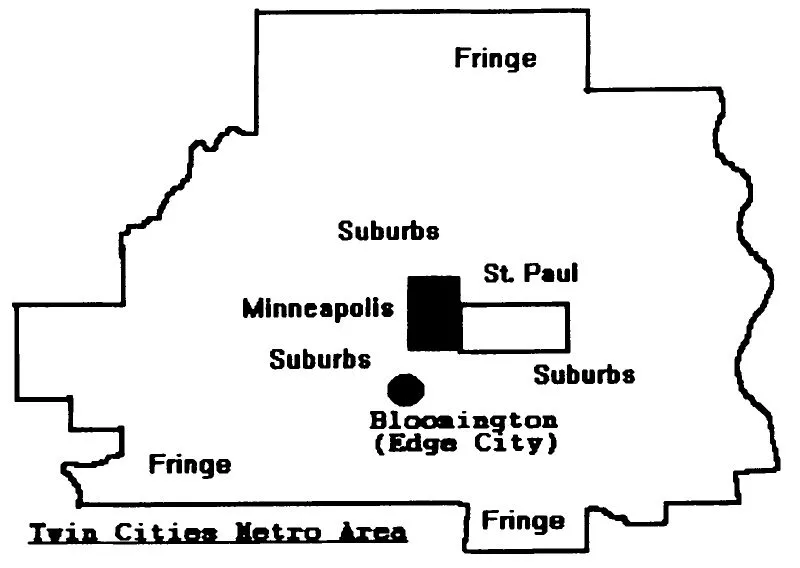
Nearly four out of five Americans live within 273 metropolitan regions (see figure 1.1). These regions include a central city of at least fifty thousand people, suburbs around the central city, suburbs that have grown into “edge cities,” and a fringe of countryside (see figure 1.2).
In the fringe, a vast war zone has erupted. The outer reaches of the metropolitan landscape still display much of the traditional pattern of small towns set amid woods, streams, mountains, and working farms or ranches. But new single-family homes, office complexes, and shopping malls are changing the rural and small town landscape to a patchwork of city, suburb, and open space. Housing subdivisions and commercial strips are sprouting along highways, at the edge of reluctant towns, and far from existing settlements in farm fields and forests.
Figure 1.1 Metropolitan Counties of the United States, 1990.
In 1993, the United States Office of Budget and Management classified more than one-quarter of the nation’s 3,041 counties (and similar government units) as belonging to metropolitan areas.4 Counties included in metropolitan areas are eligible for certain federal programs that rural counties are not, and vice versa. Metropolitan areas are measured in part on the basis of commuting patterns between counties; so the more spread out the population, the greater the metro area tends to be. There is no standard geographic size for a metropolitan area. For example, the Los Angeles metro area is much larger than the Burlington, Vermont, metro area. Moreover, using a county as a unit of measurement can be misleading. Metropolitan counties in the West are often much larger than those in the East or the Midwest. This tends to exaggerate the size of urbanized areas because many western metro counties contain substantial areas of rural and fringe land.
Figure 1.2 The Twin Cities Metropolitan Area.
Two indications of the dispersion of population in a metro region are the percentage of metro population in the core city, and the percentage of metro land area comprised by the core city. In 1993, the largest city in most major metropolitan regions did not contain even half of the region’s population and covered only a small proportion of the region’s territory (see table 1.1).5 For example, Boston’s population made up only 14 percent of the total population in its metro region in 1990 and only 3 percent of the land area.6 Since 1970, only eleven of the thirty largest central cities have gained population. Several central cities, such as Baltimore and Boston, continue to lose residents even as the populations of their metro regions grow. The newer suburbs and the fringe areas both attract new inhabitants, but the low-density settlement patterns in the fringe mean that the land area covered by the fringe increases dramatically and the amount of open space declines in tandem.
A prime example of metro fringe growth is the booming Greater Washington, D.C., area. The rate of population increase has been most rapid in the outlying metro counties of Virginia and Maryland, ...