
- 120 pages
- English
- ePUB (mobile friendly)
- Available on iOS & Android
eBook - ePub
About this book
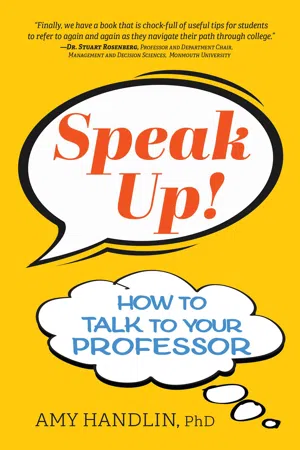
Speak Up! teaches students how and why they should reach out and connect with their professors. Author Amy Handlin provides thoughtful and strategic advice based on her 25+ years of teaching and advising experience. Students know it's important to connect with their professors, since those relationships will pay off immediately and throughout their academic careers. Approaching professors can be intimidating, but this step-by-step guide prepares college and graduate students to advocate for themselves and develop the skills they need to build connections with professors. Speak Up! includes cut-and-paste sample emails, scripts for in-person meetings, and tips for navigating tricky situations.
Frequently asked questions
Yes, you can cancel anytime from the Subscription tab in your account settings on the Perlego website. Your subscription will stay active until the end of your current billing period. Learn how to cancel your subscription.
No, books cannot be downloaded as external files, such as PDFs, for use outside of Perlego. However, you can download books within the Perlego app for offline reading on mobile or tablet. Learn more here.
Perlego offers two plans: Essential and Complete
- Essential is ideal for learners and professionals who enjoy exploring a wide range of subjects. Access the Essential Library with 800,000+ trusted titles and best-sellers across business, personal growth, and the humanities. Includes unlimited reading time and Standard Read Aloud voice.
- Complete: Perfect for advanced learners and researchers needing full, unrestricted access. Unlock 1.4M+ books across hundreds of subjects, including academic and specialized titles. The Complete Plan also includes advanced features like Premium Read Aloud and Research Assistant.
We are an online textbook subscription service, where you can get access to an entire online library for less than the price of a single book per month. With over 1 million books across 1000+ topics, weâve got you covered! Learn more here.
Look out for the read-aloud symbol on your next book to see if you can listen to it. The read-aloud tool reads text aloud for you, highlighting the text as it is being read. You can pause it, speed it up and slow it down. Learn more here.
Yes! You can use the Perlego app on both iOS or Android devices to read anytime, anywhere â even offline. Perfect for commutes or when youâre on the go.
Please note we cannot support devices running on iOS 13 and Android 7 or earlier. Learn more about using the app.
Yes, you can access Speak Up! by Amy Handlin in PDF and/or ePUB format, as well as other popular books in Education & Education Theory & Practice. We have over one million books available in our catalogue for you to explore.
Information
Topic
EducationSubtopic
Education Theory & PracticeCHAPTER 1
Do Professors Really Care About Students?

Opening Quiz
- Why reach out to a professor if youâre doing fine in the course?
- What is unique about adjunct professors?
- Whatâs a disadvantage of relying on TAs (teaching assistants) for help?
Professors are easy targets for criticismânot only from students, but also from society at large. Thatâs because much of what they do is visible only to other professors, who read their articles in scholarly journals or listen to them present their research at conferences. Steeped in the high-level theories of their fields, they use a lot of unfamiliar words and pick on minor errors. For example, a professor might say something to you along these lines: âI liked the part of your paper where you successfully synthesized several conflated paradigms. Now you need to distill dispositive evidence for your argument. Oh, and itâs incorrect to use i.e. and e.g. interchangeably when listing your examples.â Translation: âYouâre doing a great job. I want to help you do better.â
Behind the big words and seemingly picayune criticism, professors (at least the vast majority of them) careâa lotâabout what their students learn and how well they learn it. These things reflect on the quality of their teaching skills, the value of their scholarship, and their overall professional competence. After all, they chose to pursue careers in education, where the ability to share knowledge is celebrated and admired.
Thatâs all very well, youâre probably thinking, but I want to know if they care (or even know) about students as people. Does my professor really care about me?
Hereâs the truth: How much an individual professor cares about an individual student is largely up to the student. Why? Put yourself in that professorâs shoes. Most of the time, she walks into lecture halls filled with hundreds of anonymous learners. After lecturing in front of that ocean of faces, she may conduct seminars with dozens more students, who, while advanced in the field, are also just names on a roster. From among that vast crowd, whom will she get to know on a personal level? Whom will she come to care about? Those who stand out . . . those who speak up!
In this chapter, you will learn:
Section 1: A professorâs job
Whatâs visible to a student is only one part of the complex, demanding job of a professor.
Section 2: Who is your professor?
The more you know about what makes your professor tick, the better your chances are of connecting with her.
Section 3: Adjunct professors, online professors, and TAs
There are some significant differences between on-campus professors, adjuncts, online instructors, and TAs. But all of them play major roles in the academic community and can be very important to you.
Section 4: What a dean can do for you
Deans are administrators, not teachers, but they can offer a wealth of resources.
Section 5: Whatâs in it for themâand for you
When a professor shows that he cares, he benefits himself as well as his students. Itâs a classic winâwin!
Section 1: A Professorâs Job
To get a better understanding of where your professors are coming fromâand why itâs so important for you to take the initiativeâletâs take a look at the typical responsibilities of a full-time professor at a four-year college or university. These responsibilities are divided into three main categories: teaching, research, and service.
A. Teaching
To a casual observer (or student), teaching at the college level looks easy. Professor X breezes into a classroom and runs through her slides or lectures for an hour or so. After answering a few questions and calling attention to upcoming assignments or tests, sheâs done for the day. Or so it seems.
In reality, what that student sees is the end product of many hours of work. Not only does Professor X need to write lectures and prepare slides for each class session during the term, she must also create the syllabus, website, homework, and exams for every course sheâs teaching (usually between two and four, but the number can go higher). At most institutions, professors are expected to grade papers, advise both undergraduate and graduate students, hold office hours, oversee independent studies, and supervise honors or graduate theses. Their teaching responsibilities extend to designing new curricula, degree programs, and coursesâand often involve writing textbooks for those new courses. Of course, Professor X must also find time to respond to the dozens of questions, complaints, and requests for help that can arrive every day from students, administrators, and/or other professors.
B. Research
The amount of time professors spend doing research varies widely. At some research-intensive universities, it may be 75 percent of an average week or more; elsewhere, research may be a lower priority. But at virtually every four-year institution, there is an expectation that each full-time faculty member will engage in serious efforts to advance knowledge in his or her discipline.
While every project is unique, research by professorâs is likely to involve tasks such as the following:
- Conducting studies that lead to new insights in their field
- Writing articles about their studies and preparing them for scholarly journals
- Reviewing the work of their peers
- Applying for and administering grants to support their research
- Giving talks at academic conferences or other institutions
- Collaborating with other researchers both on and off campus
- Supervising the research of PhD candidates
- Conducting research seminars
- Reading journals and books to keep abreast of advances in their field
- Speaking to the media about their area of expertise
And rememberâall of these research tasks must be completed without sacrificing teaching time or quality!
C. Service
As if teaching and research were not enough to fill a professorâs day, he is also responsible for whatâs called âservice.â On a college campus, the term refers mostly to sitting on committees. Faculty committees may meet as often as once a week or as infrequently as once a year; they address issues as different as graduation requirements and hiring policies. Most professors are members of multiple committees at once. Off campus, there is more service workâediting a journal, organizing a conference, or helping to run a professional society.
Hereâs the bottom line: Professors act busy because they are busy. Much as they might love to get to know every one of their students, their schedules make it impossible. However, professors want very much to feel that theyâre making a difference. When a student puts forth the effort to reach out to them, that effort says: âYou matter. Youâre important to my life.â It would be hard to find many professorâs who wouldnât, to the best of their ability, respond in kind.

Question: What does it mean when a professor has tenure?
Answer: Tenure is a guarantee of lifelong employment at the college or university that grants it. Just as important, it is an internationally recognized, highly prized mark of academic achievement. From a studentâs point of view, tenure generally means the professor is extremely knowledgeable in her field and well known on campus. She is likely to have a wide network of contacts who can be of help to her students. Her opinions are sought after and respected. Often (though not always), a letter of recommendation from a tenured professor will carry more weight than one from a more junior faculty member.
Take advantage of every opportunity to introduce yourself, talk informally, and make an impression on your professors. Later in the book, youâll learn about how, when, and why to choose particular communication tools (email, face-to-face meetings, instant messages, and so on), and what to say in common situations. For now, whatâs important is to commit yourself to using one or more of the options soon. Start making these contacts before you need to make a request, lodge a complaint, or ask for a favor. Why the emphasis on timing? Because when or if you do need help, approaching a person with whom youâve had some friendly talks is much more comfortable than pleading your case to a total stranger.
Section 2: Who Is Your Professor?
Whatâs behind the name, title, and office location of that woman or man who holds so much sway over your academic life? How is she different from, or similar to, other professors? And why do you need to know?
To be clear: It isnât necessary (or appropriate) for a student to peer into the details of a professorâs personal life. But itâs very smart to learn enough to find some common ground. Particularly at the beginning, establishing rapport and laying the foundation for a relationship will come a lot easier if you can talk about something beyond the syllabus.
Fortunately, many professors make it simple to get a sense of their interests and priorities. They maintain an active presence on Facebook, Twitter, Instagram, and other social media platforms. If theyâre well-known experts, they may be opinion writers for major newspapers or commentators on television news shows. The point is, a little research into publicly available information should give you more than enough background to start a conversation.
Here are examples of what you might find and how you could build on it:
- Letâs say a professor of politics posts the following: âI spent the summer crisscrossing Europe to interview activists for my study on cross-border grassroots movements.â All you need to know is that he recently visited several countries. If youâve traveled internationally, this would be a great ice breaker: âI noticed that you spent time in Europe last summer. I did too! Where did you go?â
- A professor of zoology is referenced in a magazine article as a âgroundbreaking researcher in the Amazon jungle.â If you can read enough of the article to say something relevant (donât panicâthis can be as simple as âYour research on monkeys in Bolivia sounds really interestingâ), the professor will be struck by your initiative.
- A professor of business is interviewed on television about his work as a consultant for a range of companies. Are you a customer of any of those companies? Have you seen their ads? Even such a tenuous link can be sufficient to kick off a brief and interesting exchange.
- A professor of environmental science informs her Twitter followers: âAppeared as a guest on National Public Radio yesterday to discuss Arctic climate change.â Hereâs a possible comment: âI know youâre an expert in Arctic climate change. When you discussed it on NPR, did you get a lot of feedback from listeners?â
Another approach is to pick up on something the professor saidâor didnât sayâin class. For instance, itâs common to end a lecture by saying something like âIâd like to get into some alternative perspectives on this topic, but weâre out of time.â Why not go up to him and ask, âCould you tell me a little bit about the perspectives you mentioned?â Or, if you found the material engaging, âIâd like to learn more about the topic you covered today. Can you recommend any extra reading?â
A cautionary note: These ice breakers and conversation starters are intended only to lay the groundwork for a relationship. While even a single informal interaction with a professor is far better than none, it will take time to form, and reap the benefits of, a meaningful connection.

Question: Why canât I just start a conversation with my professor by talking about the course assignments?
Answer: You can, and it certainly wonât hurt you. But it wonât help very much either. Talking about the assignments signals only that you want a good grade. Talking about the professorâs work, interests, or accomplishments (or asking him to expand on a lecture) suggests that youâre a curious, creative learnerâthe kind with special potential, the kind heâll want to know better.

The following are quotes from professors who were asked about the nature or importance of their interactions with students. They represent vastly different fields (from English to computer science) and institutions (from Ivy League to big state schools).
âThe students who have over the years found their way to me have been the source of great joy, and many are still friends virtual and actual. We share Facebook photos and actual meals. But when they were still students what we shared was collaboration on what their lives might become.â
âFormer Hunter College and Princeton University dean, quoted in Huffington Post
âThe ideal relationship between a professor and a student is a conversation. One thing everyone needs to understand is that professors chose to be in the profession of teaching, and teaching is part of a conversation that is very large and is between the professor and the subject and the student.â
âNew York University professor, quoted in MetroUS
âI relish the opportunity to interact with my students and get to know them better. My hope is for students to be as successful as possible in my classes.â
âFlorida State University professor, quoted in College Magazine
âInterpersonal interaction in less formal settings can result in greater understanding of concepts taught in class. These interactions also can help put students at ease in class and there...
Table of contents
- Cover Page
- Title Page
- Copyright Page
- About the Author
- Table of Contents
- Introduction: Why You Need to Speak Up
- Chapter 1: Do Professors Really Care About Students?
- Chapter 2: Myths and Truths
- Chapter 3: What You Say and How You Say It
- Chapter 4: Choosing the Right Communication Channel
- Chapter 5: Using Time to Your Advantage
- Appendix I: Guidance for Three Uncomfortable Situations
- Appendix II: Sample Communications and Tools