Benjamim, a young man on the cusp of fatherhood, discovers a disturbing family secret: before his father was born, his paternal grandfather had a child with Benjamim's mother. With both men dead, Benjamim turns to three of their confidantes to piece together his family history: Haroldo, his grandfather's best friend; Isabel, his grandmother; and Raul, a friend from his father's youth.
Through their conflicting testimonies, full of blind spots and contradictions, Benjamim will gradually learn of the secrets and conflicts that shattered his wealthy family; of his father's search for meaning in the poverty of the backlands, and of his slide into madness. In prose of great subtlety and penetrating insight, Beatriz Bracher builds an indelible portrait of a family and a society in decay.
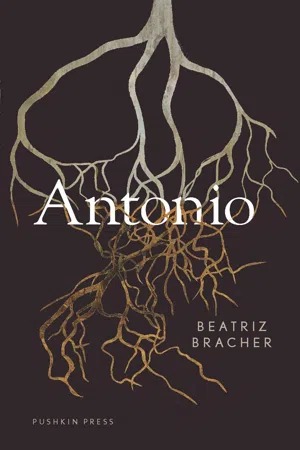
- 192 pages
- English
- ePUB (mobile friendly)
- Available on iOS & Android
eBook - ePub
Antonio
About this book
Information
Isabel
I let them give me morphine. It’s gone now—I’m gone. But at least the pain is gone, too. I have to speak very softly so I don’t irritate my throat. They say that it would be better if I didn’t talk—they’re threatening to take me to the ICU. But I had a chance to speak with Marcelo, my doctor and friend of many years, and he agreed with me. If I can’t die at home, as I’d prefer, if life had turned out differently, I’d at least be able to tell whether it’s day or night, without all these other deaths competing alongside mine. I’d be able to see your face, and remember Teodoro. What’s the point of trying to save my vocal cords? Save them for what, the worms? Yes, I know what they’re saying—don’t believe it, and please, don’t repeat that nonsense to me. It’s over, that’s the truth. There are no more second chances, no afterlife, no new drugs, no reason to save anything for later—that’s all nonsense. It’s over because this has become too much of a drag and I’m ready to throw in the towel.
Leonor called me from Paris yesterday afternoon, and called again today. She has her last concert tomorrow. She wants to cancel it and come home to see me—I think Renata must have given her a scare. I forbade her from doing that. It makes no sense. I told her that you and Renata were taking care of things. Are you staying in my apartment or at Leonor’s house? At Leonor’s, with Renata, that’s what I thought. You always liked your cousin. She’s a sweet girl, she’ll be coming by here this afternoon, and maybe Henrique and Flora, too. Of course Haroldo has tried to meddle with my death, calling my kids and telling them to mind their filial duties—which is too bad, because family obligations were always what annoyed me most. I like to be alone. There’s nothing charming about being seen by your children when you’re so ugly and weak. With you and Renata it’s different—I can tell that you both have a spirit that’s more, more … I don’t know what to call it. There’s a more complicated backstory between us.
Henrique and Flora are like Xavier: they’re not good at confronting illness. Flora was overwhelmed. She’d cry, then calm down, and then make up a story to console herself, a story that fit illness and death into a moment in her life when “Everything was preparing her for this experience.” For Flora, we always end up stronger and wiser and whatever. Even the flood of corruption in this country, the death of her brother, the failure of her little clothing boutique in Vila Madalena, her lack of gumption to continue with her acting career, her drug-addict son—all of it, in some way or another, is “preparation.” Henrique is the practical type: he observes things scientifically, evaluates them, weighs the pros and cons. He believes in science and progress. He did exhaustive research on the Internet about this kind of cancer and its treatments. He knows the names of the medications, he talks to Marcelo—he’s the reason I’m still here, hospitalized. He got really frustrated that we couldn’t do the treatment in the United States, where I’d have access to newer drugs and better chances. The doctors that might help, friends of my father’s—they’re all dead, and I don’t know anyone from the new generation, the ones who could pull some strings. Henrique tried to talk to Haroldo, the last of us who still has money. I was so furious that it put him off the idea.
Henrique reminds me of my father—he became a systematic sort of person. He probably has a big planner where he makes note of all his commitments and the problems he needs to solve. Finding out how I’m doing seems to be an eleven-thirty commitment. Every day he calls me at exactly eleven-thirty in the morning and tells me what he thinks about all Marcelo’s decisions. He tries to convince me that we’re on the right path, that there’s a reasonable chance we’ll kick this thing. I don’t argue with him. I’m grateful from the bottom of my heart for the effort he’s put into lifting this burden off my shoulders—all the negotiations with the hospital bureaucracy, my insurance, listening to Marcelo and arguing with him. But the fact is that we’re not in it together. Dying is intransitive. It’s not something you can share. It’s a singular subject, never compound. Even collective deaths, holocausts, gas chambers, massacres—they’re still individual deaths. Everyone dies alone.
Henrique wastes a lot of time on me, I know that. I recognize it, and I’m comforted by his kind of care—you could even say his kind of love. But he doesn’t come to visit me. For someone who believes in salvation and redemption, for someone whose optimism is a kind of moral obligation, a terminal patient is intolerable.
With Teodoro I saw this solitude of the very end quite clearly. Later I forgot about it and now I recall it again with the same clarity I had back then. When Dona Zefa called to tell me he was sick and in the hospital, I was sincerely grateful for her solidarity as a mother. He’d been hospitalized for fifteen days already and Dona Zefa figured it was something much worse than malaria. Some of the doctors back here in São Paulo speculated about insufficiently cured syphilis, which would explain his later insanity. Teodoro liked to think of that too: the madness of the greats. But he was my most beloved child, not one of history’s great men, and the name of the illness made no difference. While he was in the hospital, Dona Zefa took you to live at the big house and treated you like a son, or a grandson, something that I found deeply moving. To this day it brings tears to my eyes to recall your total helplessness, both of you, and Dona Zefa’s generosity. No matter how rightly we live, there’s always going to be a moment in life when help is needed. I cry when I remember that sometimes there’s someone there on the other side, ready to help. It does happen.
Your gentleness comes from there, from the goodness that you had the luck of finding there in Cipó. Just look: you went to the pharmacy and brought me two different kinds of reading glasses. You thought about me, you weren’t sure which ones I’d like better. You don’t really know me, or you know me so little, but you still thought about me. You see what I’m trying to tell you? It was something that came naturally: I complained about not being able to read anymore, you remembered, and you went to the pharmacy. It’s something so simple, who wouldn’t do that for someone in need? And that’s how you see it.
I didn’t end up using either of them. Even with new glasses I can’t read. My ability to concentrate is totally shot. I get nauseated. I’ve been experiencing strong feelings—images, sounds, things I remember—I don’t miss the printed letters, black and white, the way they jumble around. It’s not a problem with my vision, it’s a lack of desire. But you brought me two pairs of glasses.
I pictured you in the pharmacy, the clerk explaining the difference between one model and the other while you tried to remember the shape of my face and the glasses I used to wear when you lived with me. Maybe an old scene came back to you: one of me putting on my reading glasses and trying to help you with your homework, reading a text along with you so that you could find the answers. And I pictured you in the pharmacy chuckling at the memory, of you saying, do you remember—“This glasses make you look like a grandma.” And I told you, “Those glasses, Benjamim, it’s not this glasses. Glasses is always plural, the plural of glass.” At the pharmacy you probably smiled when you recalled me showing you the word “glass” in the dictionary, and in the end you didn’t really remember exactly what they looked like, those glasses from that afternoon when I didn’t hear you finally make the discovery that I was in fact your grandmother. There’s something funny about it: what I heard was you telling me I was starting to look old, and on top of that I noticed the grammatical error. And the memory came quickly; it was funny and sad, and the image of those glasses I used back then didn’t come along with it, so you decided to buy two pairs. That’s the gentle sweetness I’m talking about. It did you well to grow up and get married far away from here. I’m certain your son will be a good and generous person. He’ll know how to care for you when it’s your turn to get old. If you want my opinion, you should stay in Rio, let Antonio grow up far from this complicated mess I made.
That was one thing I thought about after Teodoro died. I thought that if your father had stayed in Cipó, maybe he’d still be alive and well. I know that everything has changed quite a bit, and that there’s no such thing as a simple place anymore, nowhere on the entire planet. But even so, I think the backlands are a more natural place for the nuts, the crazies, anyone who isn’t quite right in the head. Because it’s somewhere all the roles are more defined. Why is it that anomalies are less threatening in places like that? I don’t really understand it, or maybe there was a time when I did—my head feels hollow, only stories interest me now, explanations are starting to seem too boring, too unreal. I once read an article about a study that explained nature’s tendency toward diversity, especially in the tropical forests. In a limited area, there’s a cycle that plays out between the rare and the common species of trees. When one type of tree becomes commonplace, individual trees start to die off, making the species more scarce. And the species that was rare starts to proliferate, and after a while it becomes commonplace, too. Scientists think that it has to do with distance from relatives. When there are too many close relatives nearby—consuming all the same nutrients, requiring the same quantity of light and water, sensitive to the same types of plagues—the species starts to diminish. But when you’re the only one of your species within a certain area, the tendency is for you to grow stronger and reproduce more easily. In other words, to live long and well, stay away from your relatives. Be scarce.
Teo’s problem, the one that led to his death, was the confluence of two factors: being crazy in a place where insanity isn’t tolerated, and being too close to his relatives. Anyway, the two factors were really one—it’s the relatives who can’t tolerate insanity. Or maybe it’s that the madman can’t tolerate his condition with relatives hanging around. Or maybe it’s that every family needs someone to play the role of the madman. After Xavier’s death, the role fell to Teo, and he didn’t know how to perform it with his father’s savoir vivre, the quality that allowed him to take advantage of that character he played in his profession, in our family, and in the various beds he slept in.
It seems like the Germanic blood of the Kremz family skipped a generation, only to resurge with greater concentration in Leonor and Teodoro. That way of going hammer and tongs at everything, of never doing anything half-assed. Because she’s a woman, Leonor was able to pace her passions. Your father not so much. I wonder if everything that came later, here in São Paulo, wasn’t the product of syphilitic delirium. I don’t think it was ever cured: he had constant headaches. Syphilis passes from person to person through intimate contact, the same as insanity, and I feared for myself and my family.
All that trash in my little apartment, the looks from the neighbors, my conscience. We’ve never talked about this, I don’t know if you ever noticed how I dealt with your father’s madness. I remember the first time I went into the room you shared—which I thought might still be able to serve as my office until I opened the door and saw that trash all over the floor and realized it would never be possible. Standing before that horrible confirmation of Teo’s insanity, the feeling that came over me was one of injustice and revolt. I’d raised my children, watched my husband die, and finally had my own place—smaller than what I’d expected in my youth, but it was mine. I could afford it on my salary, it was conducive to my work, it satisfied my need to be alone and was fine for having company. And at that moment it looked like the trash from every house and every street in São Paulo and all over the world had been dumped in my house to destroy the space I’d worked so hard to create.
I opened the door and saw every single piece of the chaos in microscopic detail. Orange peels, cigarette butts, bits of metal and plastic, parts of electric appliances and broken furniture, shards of glass, pistachio shells, peanut shells, strands of twine, doll heads, arms, and legs, rusty cans, empty boxes and packages of every size and shape, nail clippings, clumps of hair, candle stumps, paper clips, old rubber bands, lumps of wax, clippings of photos and headlines from newspapers and magazines, old pictures of him and his two younger siblings, photos of my wedding, Xavier and I when we were young, linens and rags, tissues dappled with blood and snot and who knows what else, all of it arranged in a way that was similar to those cities he built as a boy. My books were stacked on the floor and the shelves had transformed into a repository of boxes in which he meticulously sorted his stock of human and urban detritus. There was a filthy notebook in which he made an accounting of each piece of refuse, crazy annotations about stock moving in and out, statistics. He planned out the whole project in an equally useless notebook. He said that here in São Paulo nobody worked, they only had projects, and so he was going to develop a project, too. Aside from this trash room, he began to form a crust of filth on his body. In the kitchen he made a flour paste to glue things together. There would be paste on his arms and face and in his hair for days, in addition to the dirt off the street, mixed with sweat and his own saliva. He spat on himself—it was a nervous tic he didn’t even notice anymore. Yes, I know that you were there and witnessed all this. But I have to say it, I need to remember, I need to know.
You know, Benjamim, I forgot so many things just so I could keep going. So, so, so many things. And there was an infinity of things I never wanted to know. Now there’s no-where else for me to go, there’s nothing ahead, and the forgotten things and the never-known things are what I think about. Every day I think more about him and his crisis. I’m like your father now: I need to vomit and spit for days at a time, and there’s still more and it hurts and it stinks, a smell from inside. An interior odor, like the one I’d smell when I was menstruating. Not the smell of blood. It was something else, the smell of something that wasn’t born and never will be, but still exists—the death of something that never came to be. I’d spray perfume, your father would get so filthy. I think it’s the same thing, those strong odors.
After a while he started disappearing. He’d go several nights in a row without coming home. It pained you. I remember your soft steps through the apartment, in the early morning hours. I couldn’t sleep, either, but I was wary of joining you, and having to talk about Teodoro. What could I say to a boy who was just eleven, twelve years old? You were a child, more childlike than the other boys your age in São Paulo, a joyful little boy without any malice and completely open to the world. In just a few months you matured and closed off. When I talked about your father with Leonor or Henrique, you’d run off to that room full of your father’s trash and your grandmother’s books. You were studying, or that’s what you said. We tried psychoanalysis and medication. Teodoro would cooperate, then resist, and it was dangerous for him to be self-medicating like that. It was impossible to talk to him. He’d start to explain his project to me in words that made sense, using solid arguments and well-constructed sentences. But it was all empty. Nothing connected to reality, it was a dry well I got sucked into. His language was sharper than ever. He had the capacity for synthesis, depth, irony, originality, citation, fluency—everything in excess of truth and beauty.
He drew relationships between the material from which a fingernail is made and the material from trees that’s used to make paper, and the process of creating the chemical element from silver that affixes the image of the person whose fingernail it is to the paper made from the bark of trees in the presence of sunlight and of the observer who snaps the photo. All of it was somehow united, in some way I don’t remember, to the banter of bums on the street and the relationship between their speech and the headlines in the papers, on the radio and TV. The upshot was that the beggars’ banter, because it was a random synthesis of the daily news, was capable of predicting future events. All this had to do with how beggars walk around barefoot and experience no interruptions to the flow of energy between the sun and the earth. The permanence of their ability to transmit an essential, organizing energy of human life, especially of the human gaze, combined with the beggar’s rejection of the hollow, immediate flows of urban life: it allowed them to see into the future, the same way that people from the countryside can tell that it’s about to rain, or can sense an earthquake—a beggar, who walks directly on the asphalt, which transmits information faster than the raw earth, is capable of predicting things like car accidents, the contents of a politician’s speech, the results of an election, an assassination.
What else do I remember? Conversations I had with your father, things I heard him say, they come back to me now, mixed together. And I turn them over, searching through them, his endless monologues. They were as beautiful as he was, until the end. I know that Haroldo has a different opinion: that’s one of his defects. Haroldo doesn’t see things clearly. He lost perspective. Just look at the way he tells a story about the past: the images he retains are full of detail, his stories are enveloping because he’s there, completely inhabiting the story he tells. Other times his sensibility carries him away on didactic digressions, defenses of the way he thinks the world should be. Whoever falls outside that order is deformed, ugly. Any delicacy of perception can only exist in those moments when his permanent defense of himself and his way of being in the world is temporarily suspended. That’s the only time Haroldo can see what’s right there in front of him. He gets scared, dumbstruck, angry. He finally feels with the other person’s skin. Haroldo is one of the most intelligent men I ever met, but he’s conservative. He never managed to understand the world I built with Xavier, our marriage—much less believe that we were happy. He only ever saw weakness and madness. At the same time, he was attracted to our radiance. But he wasn’t capable of seeing the real Teodoro, the beauty of a delirious young man, a beauty that didn’t derive from the delirium itself—that’s only beautiful in novels—no, he wasn’t capable of seeing the beauty of the young Teodoro, his eyes brimming and bright, his dark black wavy hair, his thin body, his way of walking and gesturing with his hands, like a thin stray cat, his fine and well-drawn mouth already half-blue. Haroldo could only see Teodoro’s madness as something that was destroying me.
Yesterday I had a dream about Teodoro. I dreamt that what he told me made sense. I can’t remember it exactly, it was a dream of forms and feelings, a perfect incandescent sphere that fluctuated in space and was absorbed by another, larger and less hot sphere, and so on, again and again. Inside the sphere was a violent and threatening motion, but it left the surface harmonious and smooth, like the breath of a sleeping baby.
Your father thought it was possible to decode the elements that make up the human soul, but that it was necessary first to define the concept of what he called the “soul of the planet.” This soul was present in every interaction between men, as well as in every chemical reaction that could occur on or beneath the earth’s crust. He said that art, especially music, deters mankind’s ability to place its soul—humanity’s soul—in contact with the soul of the planet and the universe, which in the end was a single soul. Art was a movement and not a thing, a movement of reunification and recognition for all those who were capable of seeing, hearing, feeling, and performing part of that movement. And for those who experienced the art, creating it or recreating it was in the act of looking, listening, or reading what was created. That is why, Teodoro told me, it doesn’t make sense to talk about an unappreciated or unrecognized artist. An artist is only an artist when he’s recognized. What makes him an artist is not his art, but recognition of his art, because it’s the recognition of what he’s created that generates movement.
I don’t know if he told you about any of his theories, or if you’d remember if he did. When Teodoro resumed his wanderings, the sole of his foot started to look like a horse’s hoof. In those days of dissolution, he’d shut himself up in that room to catalog his collection and organize his data and conclusions in those notebooks. Did the two of you talk? I remember that on another night I wasn’t able to sleep, I went to the kitchen for a glass of water and on the way I found you asleep on the living room sofa, in front of the muted television. The light to your room was on, which probably meant that Teodoro was in there writing and raving. Yes, that’s right: he said whatever he was writing out loud. I’d forgotten about that. He’d let out a few disconnected words at a time, then he’d suddenly get very still, repeating the last word he’d said in various tones and rhythms until he was able to find his way back into the flow of his writing. I don’t know how I could have forgotten that. Listening to your voice now, it’s like I’m able to hear it again. Sometimes he’d write so fast that the words transformed into sounds, like he was playing a woodwind instrument. It really must have been impossible to sleep in the same room as him.
I remember our conversations about the things we needed at home and the little list we kept hanging on the door of the refrigerator. I remember how we divided up the chores, and how whenever I woke up the sofa would already be fixed up again, your bedsheets put away. And how in the afternoons, you’d wipe down the furniture with a rag to clear the grime left by the air pollution while your father’s voice droned on in that room. I’d gotten used to eating out, or buying prepared food, usually pasta. After the two of you came back I had to teach myself to cook all over again. The day I decided to make steaks, your face lit up with so much excitement I almost cried. I hadn’t realized it, but of course, you were an adolescent, going around half-starved with adolescent hunger. I considered taking a leave from the university so that I could care for the two of you. But I couldn’t: Xavier’s illness had liquidated our savings, including what we got from selling the house. And anyway, I knew I wouldn’t be able to expose myself to Teodoro’s madness for twenty-four hours a day. I needed that slice of sanity in my day.
It’s true that you went to stay with Leonor for a while. Then she moved to Paris with her husband and kids so she could continue her studies. We even discussed the idea of sending you along with them—at least to give you six months ...
Table of contents
- Title Page
- Contents
- Raul
- Isabel
- Haroldo
- Raul
- Isabel
- Haroldo
- Raul
- Isabel
- Raul
- Haroldo
- Isabel
- Raul
- Haroldo
- Preparation of the Body
- Available and Coming Soon from Pushkin Press
- Copyright
Trusted by 375,005 students
Access to over 1.5 million titles for a fair monthly price.
Study more efficiently using our study tools.
Frequently asked questions
Yes, you can cancel anytime from the Subscription tab in your account settings on the Perlego website. Your subscription will stay active until the end of your current billing period. Learn how to cancel your subscription
No, books cannot be downloaded as external files, such as PDFs, for use outside of Perlego. However, you can download books within the Perlego app for offline reading on mobile or tablet. Learn how to download books offline
Perlego offers two plans: Essential and Complete
- Essential is ideal for learners and professionals who enjoy exploring a wide range of subjects. Access the Essential Library with 800,000+ trusted titles and best-sellers across business, personal growth, and the humanities. Includes unlimited reading time and Standard Read Aloud voice.
- Complete: Perfect for advanced learners and researchers needing full, unrestricted access. Unlock 1.5M+ books across hundreds of subjects, including academic and specialized titles. The Complete Plan also includes advanced features like Premium Read Aloud and Research Assistant.
We are an online textbook subscription service, where you can get access to an entire online library for less than the price of a single book per month. With over 1.5 million books across 990+ topics, we’ve got you covered! Learn about our mission
Look out for the read-aloud symbol on your next book to see if you can listen to it. The read-aloud tool reads text aloud for you, highlighting the text as it is being read. You can pause it, speed it up and slow it down. Learn more about Read Aloud
Yes! You can use the Perlego app on both iOS and Android devices to read anytime, anywhere — even offline. Perfect for commutes or when you’re on the go.
Please note we cannot support devices running on iOS 13 and Android 7 or earlier. Learn more about using the app
Please note we cannot support devices running on iOS 13 and Android 7 or earlier. Learn more about using the app
Yes, you can access Antonio by Beatriz Bracher, Adam Morris in PDF and/or ePUB format, as well as other popular books in Literature & Literature General. We have over 1.5 million books available in our catalogue for you to explore.