eBook - ePub
Reclaiming The Underground Space - Volume 2
Proceedings of the ITA World Tunneling Congress, Amsterdam 2003.
- 604 pages
- English
- ePUB (mobile friendly)
- Available on iOS & Android
eBook - ePub
Reclaiming The Underground Space - Volume 2
Proceedings of the ITA World Tunneling Congress, Amsterdam 2003.
About this book
This book contains papers, presented at the ITA World Tunnelling Congress 2003 held in Amsterdam, which reflects the state of the art with regard to research, analysis, design and practical experience in almost all fields of tunnelling and underground space construction.
Information
Research and development
Influence of excess pore pressures on the stability of the tunnel Face
W. Broere
A. Broere’s Aannemingsmij. BV, Amsterdam, The Netherlands Geotechnical Laboratory, Delft University of Technology, The Netherlands
ABSTRACT: In shield tunnelling in loose and water bearing soils, a bentonite slurry is often used to help support the tunnel face. During excavation, the bentonite cake, which is intended to seal the face, is removed by the cutter bits and subsequently slurry will infiltrate the soil. This infiltration causes excess pore pressures in front of the TBM, which lower the stability of the face. The effect has been investigated using a stationary model as well as with a time-dependent groundwater flow model, linked to a limit equilibrium face stability model. This model can be used to predict the minimal required support pressure and also the build-up of excess pore pressures in front of the TBM over time. The calculated excess pore pressures compare well with field observations.
1 INTRODUCTION
The use of tunnel boring machines to realise underground works is still continuously extended to conditions that were, until recently, deemed too difficult to work in. A list of examples can be found in the Netherlands alone, such as the tunnel beneath the Green Heart, part of the High Speed Link South from Amsterdam to Brussel. This almost 15 m diameter tunnel is constructed in part in loose sand layers with a high, confined, water table, below a thick stratum of extremely soft peats and clays. The soil conditions can only be characterised as difficult and extremely sensitive to settlements. Yet due to the presence of several roads, railroads, dikes and pipe infrastructure at the surface, the allowable surface settlements are limited to only 10 mm in some locations.
Another example is the proposed construction of the North-South light rail link in Amsterdam, where a twin tunnel will be constructed in the vicinity of the old wooden pile foundations supporting the historic buildings of the inner city. In these conditions the acceptable deformations of the subsoil are even more limited, to avoid damage to the highly sensitive masonry structures. For such projects, a reliable prediction of the required support pressure and, subsequently, a reliable control of the pressure at the tunnel face, is of utmost importance.
2 SUPPORT PRESSURE CALCULATION
The most common tunnel boring techniques used in soft, water bearing soils are the slurry shield and the earth-pressure balance (EPB) shield, as other techniques fail to meet the rigorous settlement criteria outlined above.
In a slurry shield a pressurised slurry is used to stabilise the tunnel face, often combined with an air bubble in the pressure chamber to limit pressure fluctuations. This bentonite slurry is normally injected into the working chamber at a pressure higher than the pore water pressure in the soil. Due to the pressure difference the slurry will infiltrate the soil and form a filter cake at the face (Krause 1987). This filter cake will then seal the face, help to transfer the slurry pressure onto the soil skeleton and protect against microcollapses at the face. Numerous models used to determine the minimal required support pressure at the face implicitly assume this filter cake to be a thin and perfectly impermeable membrane, so that no slurry infiltrates the soil, e.g. the models by Jancsecz & Steiner (1994), Leca & Dormieux (1990) or Murayama, see (Kanayasu et al. 1995).
Anagnostou & Kovári (1994) noticed that during stand-still of the TBM the slurry will infiltrate the soil and the filter cake is no longer a thin membrane. In coarse sands and gravels, the infiltration length of the slurry can reach several decimeters. The support pressure is no longer transferred to the soil at the tunnel face, but gradually over this infiltration zone. The result is a reduced efficiency of the slurry in stabilising the face, which may lead to collapse of the face in very coarse soils.
This infiltration occurs not only during stand-still, but also during the actual excavation process. As the cutter bits constantly remove the established filter cake, there is also a continuous infiltration of slurry into the soil in order to rebuild the filter cake. The time required to establish a perfectly sealing filter cake, however, is normally greater than the time between subsequent passages of the cutter bits. As a result, during excavation, there is a continuous inflow of filtrate water into the soil. This infiltration results in excess pore pressures in front of the TBM and these excess pore pressures lower the effective stresses of the soil. They also lower the effectiveness of the slurry infiltration and the combined effect is a reduced stability of the tunnel face.
In an EPB shield the excavated soil is used to support the tunnel face, often conditioned with additives like bentonite slurry or foam. These additives are injected into the working chamber at pressures above the pore water pressure and will infiltrate the soil in front of the TBM, displacing the pore water present there. Part of the effectiveness of the foam treatment of the soil rests in the fact that the foam replaces part of the pore water, lowering the water content of the soil (Maidl 1995). As a result of this infiltration process excess pore pressure are generated in front of the face. Although the underlying infiltration process differs slightly, the resulting excess pore pressures are much the same as observed for a slurry machine.
2.1 Wedge stability model
The aforementioned stability calculations by Jancsecz & Steiner (1994), as well as Anagnostou & Kovári (1994), are based on the limit equilibrium analysis of a wedge shaped soil body in front of the TBM, as proposed by Horn (1961). The basic wedge stability model is a limit equilibrium analysis, in which the collapsing soil in front of the TBM is schematised as a triangular wedge, loaded by a soil silo (see Figure 1). This wedge is assumed to be a rigid body, loaded its effective weight and the overburden resulting from the soil silo.
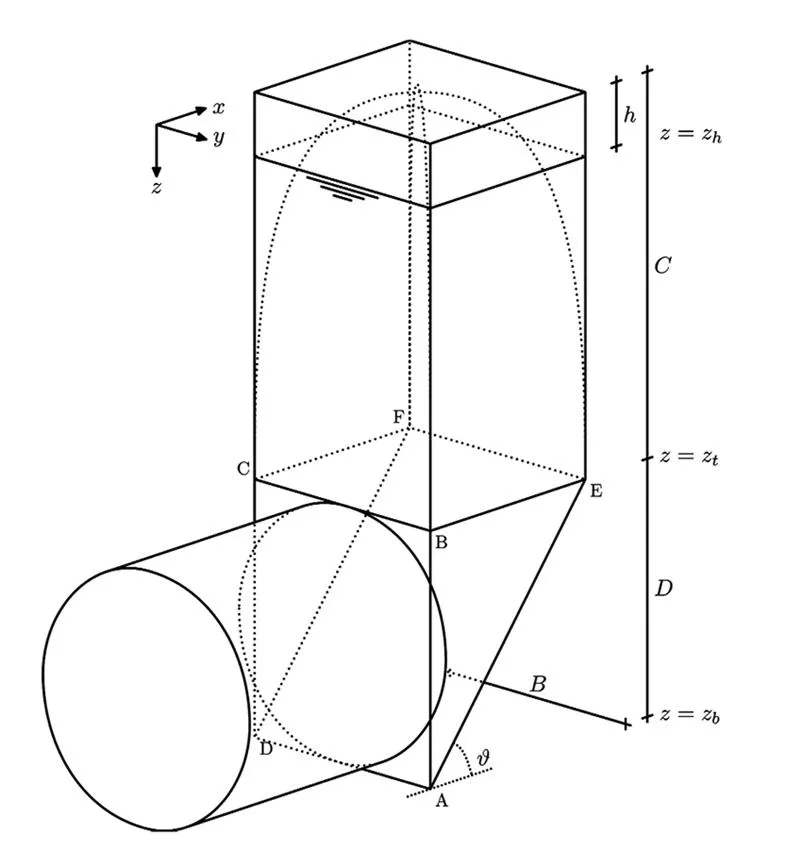
Figure 1. Wedge and silo stability model.
From the equilibrium of the forces acting on the wedge, the effective earth pressure acting towards the tunnel face can be calculated. This force has to be countered by the effective support force, which is the difference between the total support pressure and the pore pressure in the soil. In most models, the effective earth pressure can only be found for a given wedge angle θ, and as a result the required minimal support pressure is then found by iterating over all possible values of the angle θ and maximising the effective earth pressure.
Anagnostou & Kovári (1996) and Broere (2001) have shown that a wedge stability model can also be used to determine the face pressures in EPB shield tunnelling. Although the stability of the face is in general not considered a problem in EPB shield tunnelling, an accurat...
Table of contents
- Cover
- Half Title
- Title Page
- Copyright Page
- Table of Contents
- Preface
- Organisation
- Soft ground tunnelling
- Research and development
- Design aspects and risk analysis
- Contract management and financing
- Author index
Trusted by 375,005 students
Access to over 1.5 million titles for a fair monthly price.
Study more efficiently using our study tools.
Frequently asked questions
Yes, you can cancel anytime from the Subscription tab in your account settings on the Perlego website. Your subscription will stay active until the end of your current billing period. Learn how to cancel your subscription
No, books cannot be downloaded as external files, such as PDFs, for use outside of Perlego. However, you can download books within the Perlego app for offline reading on mobile or tablet. Learn how to download books offline
Perlego offers two plans: Essential and Complete
- Essential is ideal for learners and professionals who enjoy exploring a wide range of subjects. Access the Essential Library with 800,000+ trusted titles and best-sellers across business, personal growth, and the humanities. Includes unlimited reading time and Standard Read Aloud voice.
- Complete: Perfect for advanced learners and researchers needing full, unrestricted access. Unlock 1.5M+ books across hundreds of subjects, including academic and specialized titles. The Complete Plan also includes advanced features like Premium Read Aloud and Research Assistant.
We are an online textbook subscription service, where you can get access to an entire online library for less than the price of a single book per month. With over 1.5 million books across 990+ topics, we’ve got you covered! Learn about our mission
Look out for the read-aloud symbol on your next book to see if you can listen to it. The read-aloud tool reads text aloud for you, highlighting the text as it is being read. You can pause it, speed it up and slow it down. Learn more about Read Aloud
Yes! You can use the Perlego app on both iOS and Android devices to read anytime, anywhere — even offline. Perfect for commutes or when you’re on the go.
Please note we cannot support devices running on iOS 13 and Android 7 or earlier. Learn more about using the app
Please note we cannot support devices running on iOS 13 and Android 7 or earlier. Learn more about using the app
Yes, you can access Reclaiming The Underground Space - Volume 2 by J. Saveur,International Tunnelling Association in PDF and/or ePUB format, as well as other popular books in Technology & Engineering & Civil Engineering. We have over 1.5 million books available in our catalogue for you to explore.