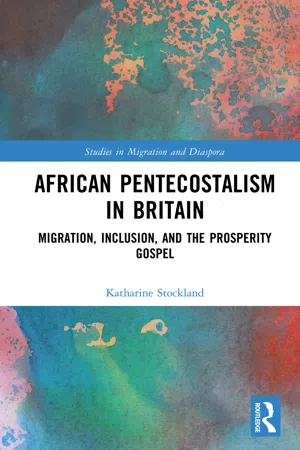
Based on ethnographic research among African Pentecostal Christians living in the UK, this book addresses themes of migration and community formation, religious identity and practice, and social and political exclusion. With attention to strained kinship relationships, precarious labour conditions, and struggles for legal and social legitimacy, it explores the ways in which intimacy with a Pentecostal God – and with fellow Christians – has been shaped by the challenges of everyday life for Africans in the UK. A study of religious subjectivity and the success of the so-called 'prosperity' gospel, African Pentecostalism in Britain examines the manner in which the presence of God is realised for believers through their complex and often-fraught relationships of trust and intimacy with others. As such, it will appeal to sociologists and anthropologists with interests in migration and religion.
eBook - ePub
African Pentecostalism in Britain
Migration, Inclusion, and the Prosperity Gospel
- 192 pages
- English
- ePUB (mobile friendly)
- Available on iOS & Android
eBook - ePub
African Pentecostalism in Britain
Migration, Inclusion, and the Prosperity Gospel
About this book
Information
1Between hope and experienceEveryday life for Africans in Britain
DOI: 10.4324/9781003104834-2
Faith migrated to Britain from Accra, Ghana in 1998, shortly after her 24th birthday. She had trained as a nurse in Ghana but was then recruited by the National Health Service (NHS), who arranged her visa, first nursing placement, and initial accommodation in Britain. A year later, she returned briefly to Ghana to marry Kwame, a man she had met several years earlier. Kwame joined Faith in Britain and, after working as a hospital porter for many years, obtained qualifications and work as an accounting technician. When I met Faith and Kwame in 2014, they were living in a three-bedroom ex-council house in one of the large council estates bordering the city. They had bought their house, with a mortgage, as part of the state's Right to Buy scheme, which allows existing recipients of housing welfare to buy their homes at a discount from the state. They both had British citizenship, as did their son and daughter, who were 11 and 14 years old, respectively. Faith had been working in the NHS for almost 17 years: not only did she feel financially secure, but she also liked her job and felt that it was valuable to others.
As with the majority of African Pentecostals in Destiny House, both Kwame and Faith came from middle-class backgrounds. Their families in Ghana were not wealthy but were economically comfortable. They owned their own homes, had university degrees, and worked in professional jobs. For Kwame and Faith, migration had been a successful strategy for achieving similar, if not higher, ends: indeed, around five years ago they bought a large house in Accra and shipped out a car, which they used when they visited every year. They also hoped to retire in Ghana, living off the proceeds of the sale of their house in the UK. This would make them considerably wealthier than they had been when growing up in Ghana.
I interviewed Faith in her kitchen at home on a weekday evening in October while Kwame and her children watched Eastenders1 on the television in the room next door. There were several delays before our interview started: Faith had to go over the street to the polling station to vote in the local council elections, and then a Ghanaian friend of hers dropped by to borrow some large pans to cater for a children's birthday party. There were also various discussions to be had with the children about school: I noted in particular how Faith reminded them to gift some book tokens to one of their teachers who was leaving for another job. This teacher had been particularly encouraging of her daughter, Faith told me.
When we finally started our interview, I learned about some of the struggles that had also characterised Faith's experiences in Britain. She talked about the hardships of raising two children without the help of wider family members. When the children were young, she had worked night shifts while her husband worked in the daytime, meaning they were both chronically tired and saw little of each other. Faith also told me that it had been challenging for Kwame, particularly before he got his qualifications, to adjust to Faith as the main breadwinner in the family, adding further strain to their marriage. Moreover, while her relationships with her family members at ‘home’ were essentially good, there had been disagreements over the years. A notable example was when she sent money home to her brother to pass along to their elderly mother, only to discover that he had spent it on a new television for himself. In a statement that was fairly typical of many worshippers in Destiny House, Faith told me: “you can't always trust family back home, they are the ones you need to watch!” She added, however, that she did not believe in getting “paranoid” about this and she did not like many of the smaller Ghanaians churches in Britain that often claim that “witches can swim over the water!” In fact, their remittance obligations to kin in Ghana had reduced substantially over the years – they now only sent money home on special occasions, such as for weddings or funerals of kin members. This was partly because they had grown more confident in declining the requests of kin, although it was also because their siblings and cousins had grown older and obtained more secure jobs. Many had migrated themselves.
Faith reported having good relationships with her work colleagues and neighbours and – rather unusually for Destiny House members – she had a small number of “English” colleagues whom she counted as good friends. Yet, Faith seemed resigned to the fact that racism was an unavoidable aspect of life in Britain, particularly in her job as a nurse in which racism was a fairly common experience. She also described other painful memories to me, such as when a childminder had refused to look after her son because of the colour of his skin. It was within this context that Faith told me that, while she did feel at home in Britain, particularly through her family life, work, and church social networks, she could never fully “belong”.
Faith's story is, in some ways, fairly representative of the experiences of many Africans in Destiny House. Like Faith, most Africans struggled with sentiments of social exclusion in Britain, trust in transnational relationships with kin, and the pressure that work and childcare commitments – as well as shifts in gender roles – placed on family life. But, at the same time, Faith experienced a level of material, political, and social inclusion that many did not. She had the particular experience of entering the UK on a work visa which was, moreover, easily renewed as long as she maintained her job in the NHS. Her work visa allowed her – and thus her family – to gain citizenship after a certain number of years in work. This laid the foundation for other modes of inclusion, such as claiming welfare and civic participation. This contrasts with the experience of those entering since the beginning of the 21st century, who have faced an increasingly restrictive visa regime. As a result, most African migrants entering Britain recently have done so on short-term visas and then become undocumented, or so-called ‘over-stayers’ – a status that made their lives precarious in a number of fundamental ways.
Despite these contrasts, I have started this chapter with Faith's story because the kind of life that Faith had built for herself is a good example of what most members of Destiny House aspired to: they wanted to be settled long-term in Britain with their immediate families; to provide social and material opportunities for their children; to maintain relations with kin, and to improve their material and social status at ‘home’; and, finally, to be British citizens or, at the very least, to enjoy the basic respect and rights that citizenship entails. While not typical, Faith's experiences were by no means unique in Destiny House. There were many worshippers who had managed to build relatively secure lives for themselves, sometimes in a fairly straightforward manner, by marrying someone who already had citizenship or by migrating before the progressive tightening of visa restrictions. More commonly, however, they built up secure lives simply by persisting over time – by obtaining papers through a mixture of good fortune and endurance, and then by getting jobs that were in high supply, such as nursing or administrative work. These jobs were not hugely prestigious but they did offer a good basic degree of security. Like Kwame, many worked in low-paid jobs for years while studying for qualifications that could lead to better job prospects. These ‘successful’ people were often promoted to positions of authority in church, so that they were highly visible and well known. This was important because it provided moral motivation to those who were still struggling, and further underscored the much-preached connection between religious commitment and personal prosperity.
In these ways, Faith's story also shows that the wish to obtain a socially meaningful and materially productive life in Britain was not simply a matter of blind hope: rather, it was a set of goals that Africans deemed to be achievable and that were often obtained by their peers. For most, achieving such goals was possible but blocked by two interrelated obstacles: obtaining papers and obtaining secure, well-paid work. This is important to emphasise because the existing literature on African migrants in Europe and North America has tended to focus on experiences of invisibility, powerlessness, and exclusion, while locating agency and resistance in alternative spaces of participation, such as transnational networks, community associations, and religious spaces (Fumanti 2010, MacGaffey and Bazenguissa-Ganga 2000, Stoller 2002).2 By contrast, the story of Faith shows how dominant forms of socio-economic, legal, and political inclusion were, in fact, experienced by Africans as within their reach. Moreover, the successes of those who did achieve such things were highly visible to all.
This chapter begins by providing a brief history of African migrations to Britain and then expands upon some of the hopes and struggles experienced by African worshippers in Destiny House, specifically in relation to immigration papers, employment, transnational life, ethnic communities, and sentiments of home and belonging. I suggest that Africans lived in varying degrees of precarity, defined not simply as economic hardship but also as an inability to predict and plan for the future, either materially or socially (e.g. Millar 2014, Muehlebach 2013). I show how precarity for members of Destiny House was not an absolute state but rather a condition of living characterised by a series of disjunctures created by migration: disjunctures between their current situation on the one hand and, on the other, what might be possible in a different time or a different space. Above all, these disjunctures were a product of labour markets and an immigration regime that offered security, deservingness, and well-being to some but not others. Moreover, the process by which they did so was not a straightforward or an even one: rather, Africans oscillated between moments of security and moments of precarity, often without being able to predict when these shifts may occur. More often than not, they were forced into liminal states between the two.
A brief history of African migrations to Britain
The size of the black African population in Britain has increased almost five-fold in the last 20 years. According to the 2011 decennial census, there were 989 628 people in England and Wales who identified as black African, which was equivalent to approximately 1.8% of the country's overall population – an increase from 0.9% of the population in 2001. Approximately two thirds of those identifying as black African in 2011 had been born in sub-Saharan Africa, while the remaining third had been born in the UK (Aspinall and Chinouya 2016, 12). This meant that in 2011 the black African population was, for the first time, larger than the African-Caribbean population and second only in size to the Indian and Pakistani populations. According to this same census, the most populous group of Africans in England and Wales were Nigerians, followed by Ghanaians, with additional significant numbers of first-generation Africans from Zimbabwe, Somalia, Kenya, Sierra Leone, and Uganda, as well as smaller numbers from a range of other countries, such as Gambia, Rwanda, and the Central African Republic (Aspinall and Chinouya 2016, 14). This speaks to a diversification in migration patterns from the continent in recent decades, as Africans increasingly move to countries where they do not have pre-existing colonial or linguistic ties (Zeleza 2002).
In fact, Africans have been coming to Britain for centuries, thus prompting Peter Fryer's famous remark in the opening of his much-celebrated history of black people in Britain: “there were Africans in Britain before the English came here” (Fryer [1984] 2010, 1). These Africans were soldiers in the Roman imperial army who occupied the island for the first four centuries of the first millennium CE. However, the black population did not grow significantly until the 17th century onwards, when Africans increasingly came to Britain as slaves, servants, seamen, merchants, musicians, performers, prostitutes, and nannies – constituting approximately 10 000 people by the 18th century (Fryer [1984] 2010, 72). Black servants were highly fashionable among the elite in this period, a craze that was part of the broader process of capitalist expansion and the trade of people and goods between Europe, Africa, and the Americas. Even after the abolition of the slave trade in 1807, and of slavery within Britain and its colonies in 1833, Africans continued to come to Britain as servants, traders, and merchants, propelled increasingly by the spread of the British Empire in Africa. Those who settled did so largely in...
Table of contents
- Cover Page
- Half-Title Page
- Series Page
- Title Page
- Copyright Page
- Dedication Page
- Contents
- Acknowledgements
- Introduction
- 1 Between hope and experience: Everyday life for Africans in Britain
- 2 Learning to deserve: Political subjectivity and born-again personhood
- 3 Waiting on God: Temporal uncertainty and Pentecostal agency
- 4 Doing life together: Reciprocity and risk in Pentecostal giving
- 5 Creating God's culture: Cultural diversity and Christian practice
- Conclusion
- Index
Trusted by 375,005 students
Access to over 1.5 million titles for a fair monthly price.
Study more efficiently using our study tools.
Frequently asked questions
Yes, you can cancel anytime from the Subscription tab in your account settings on the Perlego website. Your subscription will stay active until the end of your current billing period. Learn how to cancel your subscription
No, books cannot be downloaded as external files, such as PDFs, for use outside of Perlego. However, you can download books within the Perlego app for offline reading on mobile or tablet. Learn how to download books offline
Perlego offers two plans: Essential and Complete
- Essential is ideal for learners and professionals who enjoy exploring a wide range of subjects. Access the Essential Library with 800,000+ trusted titles and best-sellers across business, personal growth, and the humanities. Includes unlimited reading time and Standard Read Aloud voice.
- Complete: Perfect for advanced learners and researchers needing full, unrestricted access. Unlock 1.5M+ books across hundreds of subjects, including academic and specialized titles. The Complete Plan also includes advanced features like Premium Read Aloud and Research Assistant.
We are an online textbook subscription service, where you can get access to an entire online library for less than the price of a single book per month. With over 1.5 million books across 990+ topics, we’ve got you covered! Learn about our mission
Look out for the read-aloud symbol on your next book to see if you can listen to it. The read-aloud tool reads text aloud for you, highlighting the text as it is being read. You can pause it, speed it up and slow it down. Learn more about Read Aloud
Yes! You can use the Perlego app on both iOS and Android devices to read anytime, anywhere — even offline. Perfect for commutes or when you’re on the go.
Please note we cannot support devices running on iOS 13 and Android 7 or earlier. Learn more about using the app
Please note we cannot support devices running on iOS 13 and Android 7 or earlier. Learn more about using the app
Yes, you can access African Pentecostalism in Britain by Katharine Stockland in PDF and/or ePUB format, as well as other popular books in Theology & Religion & Christian Denominations. We have over 1.5 million books available in our catalogue for you to explore.