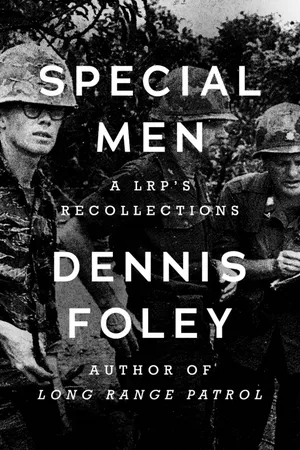
A recipient of two Purple Hearts gives readers an inside view of US Army special forces through his own trial by fire during the Vietnam War.
Days before he was drafted in 1962, Dennis Foley volunteered to join the army in the hopes of someday getting into West Point. He was only eighteen years old. At basic training in Fort Dix, New Jersey, a presentation by two impressive, self-confident special forces sergeants made an indelible impression on him.
His career would come full circle. In 1972, wearing a green beret, Foley would be given command of his own A-Team. But between those two pivotal moments, his determination, loyalty, and mental and physical strength would be tested as never before, fighting in the jungles of Vietnam alongside the bravest men he would ever know.
In
Special Men, Foley describes his experience at the 7th Army NCO Academy in Germany, where he learned more about leadership than at any other school he would later attend. He takes us moment-by-moment on his heart-pounding introduction to combat—a nighttime, amphibious ambush patrol with the South Vietnamese Navy. We see the shock set in upon realizing that conventional training left him unprepared for the guerrilla army he faced in Vietnam. And we share his sadness over fallen comrades and his own relief at surviving his injuries. This is an unvarnished account of horror and heroism and a tribute to the unselfish devotion to duty of the LRPs, Rangers, and Green Berets.
- 350 pages
- English
- ePUB (mobile friendly)
- Available on iOS & Android
eBook - ePub
About this book
Information
Subtopic
Asian HistoryIndex
HistoryChapter 1
I had the privilege of serving in three armies between 1962 and 1982: a post–World War II, atomic-age army; a Vietnam War army; and a post-Vietnam army. During that same span, the United States Army was a draft army for the first half of my years and a volunteer army for the second half.
Change was the only constant. The natural tendency for an organization to evolve and improve was sent into a tailspin by the Cuban Missile Crisis, the Berlin Wall, and the Vietnam War. The army’s responses to these major world events took place during my first ten years in uniform.
My last ten were monopolized by the army’s efforts to eliminate the draft; forget about Vietnam; adjust to the drawdown in manpower; deal with the impact of drug, racial, and disciplinary problems; and the reoriented general mission to defend Europe against a mechanized/armored force in a nuclear environment.
During two decades of service I never served in a unit, or at a post or service school that was not in the process of being organized, reorganized, or disbanded. I never served in a unit whose mission was the same when I left it as it was when I arrived. And I never served in a unit where my immediate superior or subordinate was the same when I left as when I arrived. Alice’s Wonderland was sane, tame, and boring, by comparison.
I was just eighteen and only four days into basic training at Fort Dix, New Jersey, when my platoon was called out of our aging World War II barracks for the third formation of the morning. A cadreman, a young acting corporal, formed up the platoon with an uncharacteristic smirk on his face. Once he was satisfied that we were all there, had handed out a moderate number of pushups for various infractions that we didn’t really understand, and once he had our attention, he told us that we were going to a briefing. He made sure that we understood it was a briefing we were not ready for, and one that the army was wasting time and money on.
He told us we were worthless, and that it was highly unlikely that we could hack it. In his opinion—formed in the six months he had been in the army—the army would be better off sending us to the regimental headquarters to police1 the area.
We were joined by the other platoons, double-timed to a small battalion theater, and hustled into seats. My platoon was lucky to get seats in the front rows. None among us knew the subject of the briefing, and the late-June heat was almost unbearable in the tiny theater as we sat there waiting.
We waited for the longest time, reminded to sit still and be happy that we weren’t out in the sun. In only a few minutes we were getting sleepy and the fight to stay awake was on. Getting caught dozing off would be worth an easy twenty pushups.
Finally, from the back of the room someone yelled, “On your feet!” and we jumped up, having learned the multiplepush-up penalties for anything less than an instant response. We couldn’t see them, but two sets of boots clumped down the aisle, approaching the chin-high stage.
“Gentlemen, please take your seats,” another voice said.
Gentlemen? It was the first time anyone had called us “gentlemen” since our arrival at the reception center on the other side of the post almost two weeks earlier. We’d not been in the army very long, but we knew something was up. And that something mounted the stage in the persona of two sergeants, one a sergeant first class and the other a master sergeant.2
Since our induction we had rarely seen NCOs of that rank. Our days had been controlled by privates first class (PFCs), acting corporals,3 and an occasional three-stripe sergeant. A couple of times a day we would stand a formation led by our field first sergeant4—himself a sergeant first class.
But those two sergeants on the stage were nothing like the sergeants we had all met in recruiting stations, induction centers, and the reception station. They were both tall, lean, and hard looking—yet they were younger than any NCOs we’d seen of comparable rank.
They radiated a sense of self-confidence that would have shown up on an X-ray. But most apparent were their uniforms: spit-shined paratrooper boots, bloused trousers with razor-sharp creases, highly polished brass, and badges that we would come to respect: parachute wings, the Ranger tab, and the Airborne tab over the Special Forces arrowhead patch. To us, they were truly men of iron.
They were there to recruit us into Airborne training and to set the hook for Special Forces. Before the briefing was over, we began to think of those men as much larger than we could ever be. As we listened to them tell us how difficult Airborne training was and how selective Special Forces was, we all were sure that the corporal was right. We were not made of the same stuff that those two soldiers were.
The two NCOs spoke with confidence and authority. Each word was carefully measured for its impact on us and each pause was well rehearsed to let the point that followed sink in.
They showed us a film about parachute training. We sat there in the dark watching soldiers—paratroopers—hurl themselves from aircraft at what seemed like incredible speeds and frightening heights.
No one spoke, and no one in the room missed any parachutes deploying from the pack trays of the jumpers, who seemed to us to be totally out of control as they exited the small doors of the large, silver C-119 Flying Boxcars.
A thought entered my mind for only a fleeting second, and then I quickly wished it away. Hell, I had never even been in an airplane. Stepping out of one at over twelve hundred feet above the ground was more than I could imagine, even though I was watching it happen in that steamy little theater.
The mass jumps were interspersed with scenes from training. It seemed every clip had one of three things in it: soldiers jumping from aircraft, soldiers running in formation, or soldiers practicing landings or exits. Nowhere in the film was there a moment where soldiers were sitting or listening or taking notes or relaxing.
It was very clear that anyone who volunteered for parachute training was in for a month of dawn-to-dusk PT, followed by an evening of spit shining and polishing.
While we were all impressed with the tales of derring-do and the promise of challenges and danger far beyond our imagination, not many of us were interested in falling out to the designated area to fill out the application forms to go to Airborne school at Fort Benning.
I walked out of that briefing unaware of how my life had been changed by the remote possibilities suggested by those two sergeants. Little did I know then that men like the two who had stood on that stage would be such a large part of my life—eventually finding a permanent place in my heart.
Joining the army or playing roulette with the draft had been a frequent topic of discussion among those in my high school class who had little or no hope of being accepted into a college. It was a subject of far less importance to us than it would become in the later half of the decade, after the large-scale commitment of American troops to Vietnam.
Our naïve notion of the gamble was that we could either volunteer and get military service out of the way, or leave it up to the Selective Service system to tell us when we would go. If we rolled the dice we could be pulled off a job, away from a new wife, or out of college with a simple letter from our local draft board. Our graduating class didn’t have the widespread deferments that would suddenly appear during the Vietnam years. For us, being a student or being married were not automatic exemptions. So for us it was a crap shoot.
For those of us who were the sons of army personnel, there was a significant likelihood that we would be drafted before our civilian classmates, whose fathers were members of the community.
Like so many of my peers, I knew that one way or the other, the army was going to get some of my time. So volunteering seemed to be a chance (although slimmer than I would admit) for me to get into college—West Point—but before I could take the West Point Preparatory School exam, I had to be on active duty.
So I volunteered, and while at the reception station at Fort Dix, New Jersey, I got my notice to report for my induction physical. I had guessed right. That summer the army was going to get me anyway.
During basic training I was unable to shake the image of the two Airborne sergeants standing proud and tall on that stage in the stifling hot theater. While we were all sweating profusely, they were calm and cool. Their words faded, but that image never did. Though I had grown up the son of a career army man, I had never been close enough to my father’s business to see images like those struck by the two Airborne recruiters.
I put all my extra energy into trying to convince my company cadre to let me take the West Point Prep School exam. At this point I have to explain that growing up as an army brat, moving frequently, and being a somewhat less than motivated student left me unprepared for college. I attended three high schools in my senior year alone, five in all since leaving junior high.
I never really got into the swing of high school, although I knew that my family expected me to go to college. Still I dragged my feet and found myself far below my classmates on the college-acceptability scale. All the while, I was sure that if I applied myself, I could make up for four years of bad study habits and low grades simply by joining the army and getting into the yearlong West Point Prep School, and then West Point.
Looking back, I am amazed at the response I got from the company cadre. They would have been well within their rights to recommend disapproval of my application. Had they, I’m sure I would never have seen the exam packet. But they didn’t. My company first sergeant and commanding officer recommended approval, and the CO certified that he and other battalion officers would proctor the exam.
I was called in by the first sergeant who explained that I would not miss any training just to take the exams. So I took them at night, after the regular training day was over.
I regret that I never recognized the sacrifice that the company officers were taking for me by proctoring the exams, often from midnight to three A.M. They didn’t have to do it, but they did, and it was one of the first of many small lessons in leadership.
But West Point never happened for me. I didn’t score high enough on the competitive exams and the army felt that they could use me best as an electronics technician. I was sent to Fort Monmouth, New Jersey, for a yearlong school in advanced electronics—radar repair.
That was a real shock to me. I had been so cocky about just taking the exams and waltzing right into West Point without having laid the groundwork of a good high-school education. Like most teenagers, I had no idea how difficult it would be to get into the military academy. And on reflection, I’m sure now that I never would have made it to graduation if by some fluke I had gained admission.
Basic training was no smaller a shock to my teenage system than it was for the other 220 of my classmates. For the most part, we came from the eastern seaboard and New England. Our cadre consisted of young and inexperienced infantry officers, veteran Korean War senior NCOs, and acting NCOs who hadn’t been in the army much longer than we had.
During the first few days at Fort Dix I was singled out as one of the few among us who had had some ROTC training. This changed my status and got me off to a good start in the army.
I had attended a high school that offered Junior ROTC. A young combat veteran by the name of Charles T. Hamner was the professor of military science and technology at the high school ROTC detachment. He hit that place like a flying brick. Before Hamner it had been a boys’ club that was all show and little go. Junior ROTC cadets wore ridiculously garish uniforms and did little in the way of studying military arts and sciences.
Hamner insisted that we learn the basic leadership and tactical skills that a mid-level NCO or a junior officer might master in the army. He immediately changed the curriculum to emphasize dismounted drill, leadership, map reading, customs and courtesies and military history.
He was also a stickler for treating subordinates with dignity and respect rather than the silly high-school hazing that had become a matter of course in the ROTC detachment. He treated each of us in a manner appropriate to our cadet rank. The higher our rank, the more he expected of us. It was a lesson taught, but for me not recognized for some years to come.
Though I only spent a short time in the detachment I learned a lot of the basic skills and customs of soldiering that the others had to absorb while trying to make it through basic training.
That high-school ROTC detachment made my first days in the army quite different than they might have been otherwise. I would get a chance to thank Captain Hamner a few years later, at the Rex Hotel in Saigon.
So, within hours of joining G Company, 5th Battalion, 2d Training Regiment, I became a trainee platoon sergeant. This was my first responsible job in the army.
We rarely saw our real platoon sergeant because he was assigned to us and to the post football team at the same time. The significance of “additional duties” like his would come to haunt me in the years to come. But while I was in that student company I enjoyed taking up most of the responsibilities normally shouldered by the platoon sergeant, as they were known in the days before they were called drill sergeants.
Within days of becoming a trainee platoon sergeant, I was spotted by the aging field first sergeant as being capable of moving the entire trainee company from point A to point B at double time and without causing traffic accidents. So, within the first week of basic training, I took on the added responsibility of being the trainee field first sergeant. This meant that the housekeeping, the scheduling, and the internal details of the operations of my trainee platoon fell to me. When the company assembled for training I would take the report (to determine if we had all the faces), move the company to the training areas, supervise the breaks and the police calls, and generally catch hell if the trainees were not where they were supposed to be.
It was a good deal for the company cadre. They were able to dump some of the easier and more boring tasks of running a basic-training company on me and get away with it.
For me, it was just the beginning of growing up. I had never before been responsible for the behavior and work of other men. It was also the beginning of overcoming a deep-seated shyness that I only realized I had when I had to step out in front of forty—or two hundred—trainees and give them instructions, information, or explanations. The classic fear of public speaking was damn near crippling for me. I got a knot in my gut each morning knowing that I would have to roll the company out, form them up, take the report, and then report to one of the cadremen or to the company commander.
For this I got: less sleep, lots of ass chewings, the chance to be last through the chow line, a little blue arm band with a staff sergeant’s chevron on it, and no time to myself. At the time the trade-off seemed to be a good deal. But I was so involved in the job that it never occurred to me that I might just be learning something about leadership and supervision.
Rarely was there a time that it was not brought to my attention—with emphasis—when I screwed something up in handling...
Table of contents
- Cover
- Title
- Foreword
- Introduction
- Chapter 1
- Chapter 2
- Chapter 3
- Chapter 4
- Chapter 5
- Chapter 6
- Chapter 7
- Chapter 8
- Chapter 9
- Chapter 10
- Chapter 11
- Chapter 12
- Chapter 13
- Chapter 14
- Chapter 15
- Chapter 16
- Chapter 17
- Chapter 18
- Chapter 19
- Chapter 20
- Chapter 21
- Chapter 22
- Chapter 23
- Chapter 24
- Chapter 25
- Chapter 26
- Chapter 27
- Epilogue
- Endnotes
- About the Author
- Copyright
Trusted by 375,005 students
Access to over 1.5 million titles for a fair monthly price.
Study more efficiently using our study tools.
Frequently asked questions
Yes, you can cancel anytime from the Subscription tab in your account settings on the Perlego website. Your subscription will stay active until the end of your current billing period. Learn how to cancel your subscription
No, books cannot be downloaded as external files, such as PDFs, for use outside of Perlego. However, you can download books within the Perlego app for offline reading on mobile or tablet. Learn how to download books offline
Perlego offers two plans: Essential and Complete
- Essential is ideal for learners and professionals who enjoy exploring a wide range of subjects. Access the Essential Library with 800,000+ trusted titles and best-sellers across business, personal growth, and the humanities. Includes unlimited reading time and Standard Read Aloud voice.
- Complete: Perfect for advanced learners and researchers needing full, unrestricted access. Unlock 1.5M+ books across hundreds of subjects, including academic and specialized titles. The Complete Plan also includes advanced features like Premium Read Aloud and Research Assistant.
We are an online textbook subscription service, where you can get access to an entire online library for less than the price of a single book per month. With over 1.5 million books across 990+ topics, we’ve got you covered! Learn about our mission
Look out for the read-aloud symbol on your next book to see if you can listen to it. The read-aloud tool reads text aloud for you, highlighting the text as it is being read. You can pause it, speed it up and slow it down. Learn more about Read Aloud
Yes! You can use the Perlego app on both iOS and Android devices to read anytime, anywhere — even offline. Perfect for commutes or when you’re on the go.
Please note we cannot support devices running on iOS 13 and Android 7 or earlier. Learn more about using the app
Please note we cannot support devices running on iOS 13 and Android 7 or earlier. Learn more about using the app
Yes, you can access Special Men by Dennis Foley in PDF and/or ePUB format, as well as other popular books in History & Asian History. We have over 1.5 million books available in our catalogue for you to explore.