This book presents the mechanics of implementing visuality on the value-add level known as Work That Makes Sense (WTMS). The step-by-step WTMS process described in this book teaches operators a proven method for translating information deficits into visual solutions that take the struggle out of their day-to-day work. As a result, operators transform their work area into a work environment that speaks—a work environment that, by design, shares vital information in the form of visual devices that help them perform their day-to-day work with precision and completeness.
At the heart of this visual conversion approach is an element unique to Galsworth's paradigm called I-driven that recognizes that operators will pursue self-leadership in the company's improvement initiatives if they are given the opportunity to learn how to do so. Also recognized is the fact that this can only happen if associates are taught—and given the opportunity to learn and apply a new system of thinking. The author calls this new system visual thinking.
This book provides that learning pathway, in detail, supported by hundreds of actual visual solutions, developed by operators who have followed that pathway and become visual thinkers for themselves—I-driven. They become self-leaders, in control of their corner of the world and able and willing to share their strengths with others. In this way, the WTMS process produces a deep and abiding change in the company's work culture that builds creativity and ownership. As a result, the organization's leadership framework widens to include operators.
When effectively applied the WTMS process detailed in this book produces 15% to 30% improvement in local KPIs, including productivity, on-time delivery, quality, and costs; these figures are documented and presented in the pages of this book.
Written for operators, this book includes a wealth of color photographs, the majority of which are visual solutions created by visual thinkers who have lived this process for themselves. All are fully captioned and thoughtfully described. The book also includes twelve tasks that managers implement in support that they seek on the operator level. WTMS teaches that visual devices translate information into exact behavior, embedding and sustaining precision through visual solutions. Precision is built in by the same operators who execute it. This is the heart of an I-driven visual enterprise. Once learned and operationalized, this paradigm allows the organization to take on any new improvement effort. Organizational alignment and teamwork have been redefined and operationalized.
Where things are located matters—a lot. It matters so much that we are about to spend three chapters learning how to improve the location of things in order to improve the flow of work, In Chapter 4 you learn the logic’s fundamental formula: Function + Location = Flow. Hand-in-hand, you learn two powerful that is triggered by un smart placement. The second map you make shows you exactly how to remove that struggle by applying the 14 Principles of Smart Placement— a set of powerful, are about to learn and apply the logic of Smart Placement people, and information into and through your work area. You mapping procedures. The first map helps you identify motion insightful tools for change.
Chapter 5 presents the first seven principles. These start you re-thinking the placement of things (of function) in your area. As you will see for yourself, they are far more than simply common sense. They are a fresh, systematic plunge into the tactical logic of location, performance, risk, and flow.
The second set of seven principles are explained in Chapter 6. They focus on larger, more strategic concepts such as design efficiency, the utilization of vertical space, and innovation.
All fourteen principles are made to be applied. When this section concludes, you prepared to undertake the smart improvements you have identified and validated on your maps. The actual increase in the flow, safety, and speed of materials, people, and information in and through your area begins.
Chapter Four Smart Placement: The Logic, Meaning, and Mapping
The Logic: function + Location = Flow
Smart Placement Begins with Thinking
Two Powerful Maps
Ideas, People, and Minority Reports
Your What-Is Map: Step-by-Step
All of us know the value-mantra in the real estate industry: Location, location, location! Location is critical in the workplace, too. This is not just because you need to know where things are—but because, to begin with, those things must be in the right place.
By right place, we do not just mean in a designated home location—as in “a place for everything and everything in its place.” While that is important, it comes later; and it is secondary to the process this chapter describes.
Instead, by right place, we mean the smart place for an item—the right location for it in relationship to every other item in the work area (and eventually in the company). We call this conscious and conscientious location of things—Smart Placement.
When all the items in the workplace are smartly placed in relationship to each other, the entire landscape of work becomes connected, letting material, information, and people flow into and through work areas with a minimum of struggle—a minimum of motion. Smart placement makes it possible to generate a flow of work that can accelerate (and de-accelerate) at will. Whose will? The will of your customer—and therefore yours.
When smart placement is not applied, the opposite is all too often true. When you and the objects in your work area—tools, parts, materials, information, consumables, benches, cabinets, shelves, chairs, and even trash cans—are physically placed without careful thought and intention, the result can be a tangled muddle that feeds motion instead of supporting a smooth and elegant flow of work.
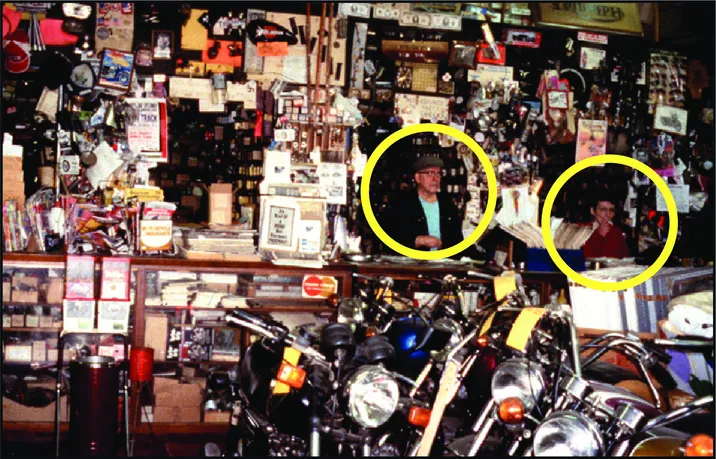
Let’s take a trip to Cycle Hub, a motorcycle shop in Portland, Oregon. The front of the store is filled with Triumphs, Nortons, BSAs, and other English motorcycles (Photos 4.1 and 4.2).
Behind the counter stand Mr. and Mrs. John Mahjor, shop owners and expert motorcyclists in their own right (Photo 4.3; see yellow circles).
Photo4.1 Cycle Hub.
Photo4.2 The showroom.
Photo4.3 The Mahjors, store owners/cycle experts.
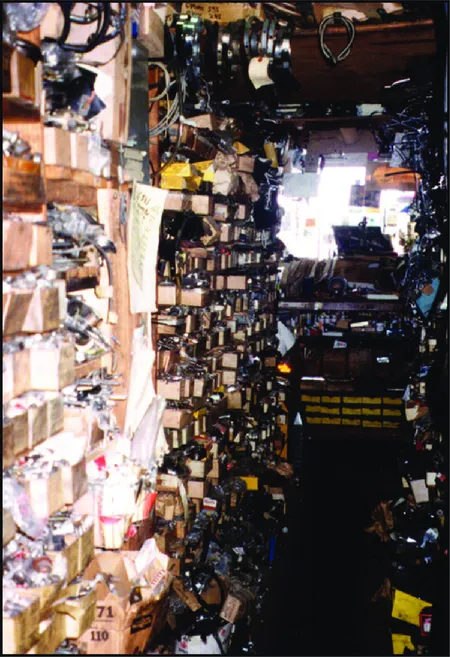
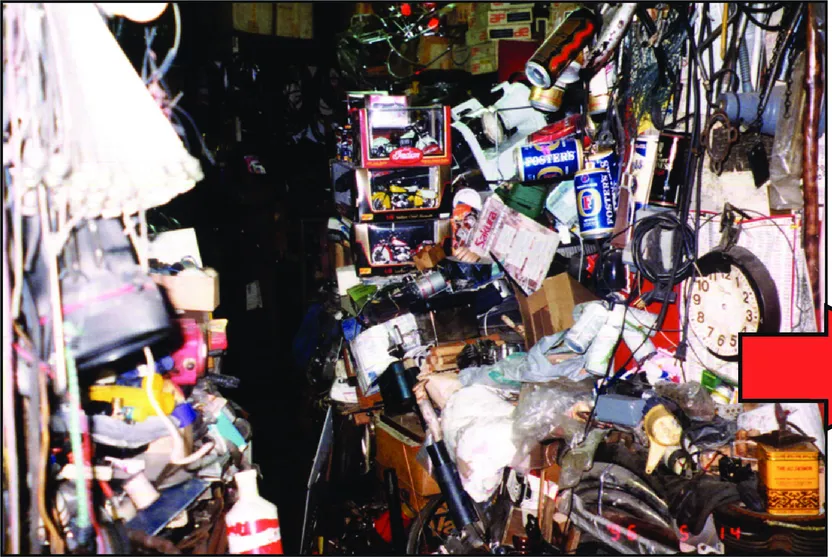
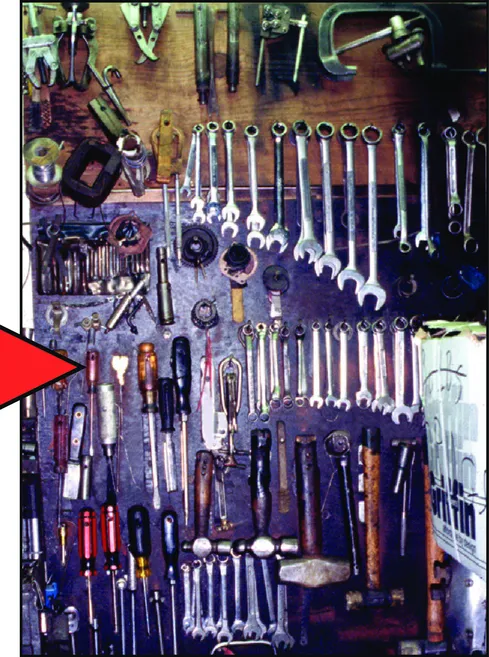
In the store’s back rooms are mountains of astonishing clutter—monuments to motion (Photos 4.4 and 4.5). Smack in the middle of that clutter, on the side wall (just where the red arrow is pointing) is an oasis of order: the tool board (Photo 4.6). All of the tools needed to keep a bike in good repair are on that board—and orderly.
Photo4.4 Just behind counter.
Photo4.5 Chaos in the back room.
Photo4.6 Smart Placement on the Cycle Hub tool board.
The tools are in smart placement (though, as you will discover, they are not yet visual), reflecting the importance Mr. and Mrs. Mahjor assign to the function those tools provide: to keep their cycles running. Yes, the location of function at work matters—a lot. Improve the location of function and you automatically improve the flow of material, information, and people into and through the area. The result? Mo-tion takes a nose dive.
In this chapter, we learn about the logic of smart placement. The two chapters that follow this one then present the fourteen principles of smart placement and show you how to use them to build smart location into the physical landscape of work. No matter where you work—in a bank, factory, medical center, military depot, office, or open-pit mine—when you apply this logic, you create powerful improvements in the design of your work area that pave the way to excellent visuality and superior performance.
The Logic: Function + Location = Flow
The smart placement process begins when you evaluate the current location of the items (things) in your work area—or as we say it: the current location of function.
In a manufacturing cell, for example, this means we look at the individual location of each machine, bench, tool set, incoming raw material, outgoing WIP, dies rack, commodity part storage, desk, and so on. In a hospital, this means the location of charts, medicines, consumable supplies, beds, desks, cabinets, racks, and so on.
In all cases, we recognize that each work item (thing) represents a specific function—a specific and particular use or purpose. A desk, for example, represents the paperwork function whereas a machine represents the conversion function—the conversion of material into product specifications, thereby adding value.
The concept of function plays a big ...
Table of contents
Foreword: Brent Allen
Foreword: Rhonda Kovera
About Gwendolyn Galsworth
Acknowledgements
Introduction to the Second Edition
Section One Visual Workplace Basics
Section Two Smart Placement
Section Three The Visual Where
Section Four People and Results
Section Five Drilling Deeper
Section Six Appendix
Index
Trusted by 375,005 students
Access to over 1.5 million titles for a fair monthly price.
Study more efficiently using our study tools.
Frequently asked questions
Yes, you can cancel anytime from the Subscription tab in your account settings on the Perlego website. Your subscription will stay active until the end of your current billing period. Learn how to cancel your subscription
No, books cannot be downloaded as external files, such as PDFs, for use outside of Perlego. However, you can download books within the Perlego app for offline reading on mobile or tablet. Learn how to download books offline
Perlego offers two plans: Essential and Complete
Essential is ideal for learners and professionals who enjoy exploring a wide range of subjects. Access the Essential Library with 800,000+ trusted titles and best-sellers across business, personal growth, and the humanities. Includes unlimited reading time and Standard Read Aloud voice.
Complete: Perfect for advanced learners and researchers needing full, unrestricted access. Unlock 1.5M+ books across hundreds of subjects, including academic and specialized titles. The Complete Plan also includes advanced features like Premium Read Aloud and Research Assistant.
Both plans are available with monthly, semester, or annual billing cycles.
We are an online textbook subscription service, where you can get access to an entire online library for less than the price of a single book per month. With over 1.5 million books across 990+ topics, we’ve got you covered! Learn about our mission
Look out for the read-aloud symbol on your next book to see if you can listen to it. The read-aloud tool reads text aloud for you, highlighting the text as it is being read. You can pause it, speed it up and slow it down. Learn more about Read Aloud
Yes! You can use the Perlego app on both iOS and Android devices to read anytime, anywhere — even offline. Perfect for commutes or when you’re on the go. Please note we cannot support devices running on iOS 13 and Android 7 or earlier. Learn more about using the app
Yes, you can access Work That Makes Sense by Gwendolyn D. Galsworth in PDF and/or ePUB format, as well as other popular books in Business & Industrial Management. We have over 1.5 million books available in our catalogue for you to explore.