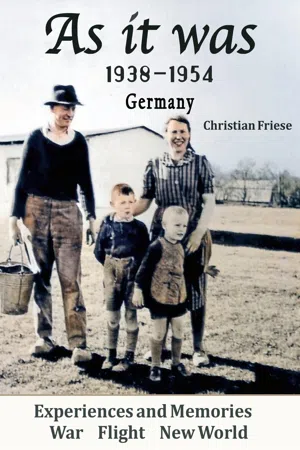
"As it was 1938 to1954 Germany" is the captivating coming - of - age story of a boy during the most tumultuous period of the 20th Century on a farm near Berlin. As North Americans we have little opportunity to know about that period except from the Allied perspective. It is enlightening to learn about the human struggles of a farm family through and in the early years after the war. Readers will be rewarded by immersing themselves in Christians detailed memoir of his childhood years. The book is an easy read, both suspenseful and humorous. A most enjoyable and engaging read.Robert McFetridgeBowser, BC, CanadaChristian's book is an amazing collection of his childhood memories growing up during WW2. The incredible detail in which he recollects the many twists and turns made this book a real page turner. I couldn't put it down and it reminded me of the stories my father shared of his childhood during the same time period. Anyone who wants to understand how this generation learned how to make the best out of the most difficult situations and to never lose hope will enjoy Christian's book.Michel LuhnauCalgary, AB, Canada
eBook - ePub
As it was 1938 bis 1954 Germany
Experiences and Memories War Flight New World
- 272 pages
- English
- ePUB (mobile friendly)
- Available on iOS & Android
eBook - ePub
As it was 1938 bis 1954 Germany
Experiences and Memories War Flight New World
About this book
Information
Chapter 1: Christian Friese
GERMANY
1938 – 1954

The Friese Family 1953
Heinz Friese leaves for Africa
Heinz Friese leaves for Africa
1 - ME
I saw the light of day on the 17th of September 1938 in the hospital in Rathenow. I have been told it was a warm and a sunny Sunday. The time was 1.30 p.m.; the birth was natural and normal and the weight adequate. No other statistic or information is available.
My father tells the following story:
When he was finally allowed into the delivery room, I had been cleaned up and swaddled and lying in a basket on my back, so he could see my face. Then to the amusement of all in the room he said to me: “Jüngchen, mach mir keinen Ärger” – Little guy, don’t give me any grief.
My father was not a funny man but that bit of humour must have been very successful since he told it to me often.
The day of my baptism came on the 6th of October 1938. One of my mother’s brothers, Onkel Heini (Heinrich Assmann) was appointed godfather. I never got to know Onkel Heini well enough to say anything about his inside, but from the outside he was a very direct and sometimes impolite person. His standard telephone greeting was: “Ja?” He wanted me to have his name since he was the godfather, but my parents had already named me, Christian Karl Felix (Felix after ancestors on my father’s side). So, when the priest asked the godfather what this child should be named, he answered with defiant assurance, Christian Karl Heinrich. My parents, actually my mother I have been told, were furious, and Onkel Heini was evicted from the small party that followed. As a result, my baptism paper reads Christian Karl Heinrich, and the civil registration, Christian Karl Felix. This mix-up created complications and a certain amount of bother when I later was sent to an unfamiliar school away from home.

Ilse and Christian
Possibly my earliest recollection is a physically painful one. I had a small cut on the inner side of my left ankle. To clean the wound Ilse, a young helper in the house, found, I am told, what was carbolic acid to clean the wound. It burned the skin and flesh and was extraordinarily sore. I remember the small white enamel tub my foot was soothed in afterwards. I remember the exact location in the kitchen, the white floor tiles. I still have the very distinctive burn scar – if you ever have to identify my body look at my inner left ankle.I was, I have been told, two and a half years old.
Other random early memories include sitting on a potty and not being allowed to get off until I had done something. Again, I see distinctly the brown, curvaceous receptacle and pushing myself backwards around the room getting under the feet of the adults. Outside against the left side of the barn was a pile of river sand where my brother and I often played. In the main part of the barn was a black private car (Opel P4). I remember playing in it but not actually seeing it on the road. My mother never got a driving licence and my father was away on war business. I remember certain outfits like a knitted, beige, tight-fitting sweater with knitted matching tights that came right down over my shoes and a matching knitted cap. I see myself playing outside on the sandy part of the street dressed in a finely checkered sleeping tricot of colors orange and blue. At the back it had a bottom flap held up with three buttons. I do not remember ever using that flap.

Behind the barn

Bernhard & Opel P4
I do not know where I slept in those early days. I also only vaguely remember my older brother, Bernhard, being around. I recall the incubator in the barn. I loved the barn: so much activity, always warm and so many hiding places.
My parents related two incidents that happened on the same Sunday and must have happened around that early time. Bernhard was missing. They looked for him everywhere without success. Then my father saw bubbles coming out of the depth of the very muddy and dirty duck pond very close to the house. He jumped into the waist-deep water and searched, again without success. Apparently, my brother was eventually found hiding in the car in the barn. When that excitement was over, it was discovered that I had vanished. After a frantic search and loudly calling my name, I was discovered hiding under the kitchen table with a freshly baked cake.
Upstairs in the house lived my father’s parents. I do not remember much about them then. I don`t think they played with us. They must have come down to eat with us though, as there was no kitchen upstairs. One clearly remembered morning, Opa came running down the stairs shouting: “Oma is dot, Oma is dot” (Berlin slang, Oma is dead). I had never seen Opa in anything but civil servant outfits, ironed trousers, white shirt with a stiff detached collar, a vest with a pocket watch and a looped gold chain. Jacket and tie I guess depended on the occasion and the weather. But there he was in a white night dress that exposed his white spindly legs to halfway up his knees. On his head was some kind of a white skull cap. I think my best effort to describe my reaction to this was then, and is still now, perplexed wonderment. Later that day my mother asked us to pick some flowers. There were lots of wild violets in bloom. She went upstairs with us and we put our little bunches into the folded fingers of Oma. Oma lay there, although unnaturally white, she had a surprisingly calm and composed bearing about her. It was not a scary experience in any way.

Grandma and Grandpa Friese
The next day a fairytale hearse came: two black beautiful horses, the hearse black with red tussels hanging down at the opening of the hearse housing on either side. It was the most fairy story sight I had ever observed. I was not allowed to watch the bringing down of the body and the loading of the coffin into the hearse, but I remember distinctly the magnificence of the scene when the coachman took the reins and the horses obediently and proudly took off. Oma died on the 27th of March, 1943. I was four and a half years old.
2 - WORLD WAR II
Preparations for survival
Looking back, one of the astonishing realities was that I was fully aware of my parents and all the other adults being against the war and dead against the Nazis and Hitler. But all talk was highly secret because if they found you disloyal to Hitler and the party, you would be shot or at least sent to a concentration camp. I remember being fully aware of that secrecy and I suspect it gave me a certain confidence and even boldness stemming from belonging to a secret plot.
I knew exactly what information was clandestine and who you must not talk to because they might report you. One of them was my father’s halfsister’s husband, Uncle Georg Druse, an officer in Hitler’s army. When I say I felt a certain boldness, I have to add that at the same time the adults had made me very scared of Uncle Georg. I viewed him as a cruel, cold monster - a disguise the devil might take. Fortunately we saw very little of him. Another person not to trust was my Opa, living upstairs. But with him it was more a question of his contrariness and of his not really understanding what was going on. Nobody really knew what went on in his head.
The code was in general: Do not talk to strangers and we all knew it; we grew up with it. A comical aspect to it all was that on billboards and other public places there were placards with inscriptions such as: Feind hört mit – Psst (The enemy listens – don’t talk). These proclamations were put out by the party to stop citizens from revealing secrets to the enemy, and we were another enemy, the enemy within. I knew it at five years of age.
In April 1944 the city was heavily bombed by Americans. It was the first time that the war had any direct impact in our region. I do not remember that event, but an urgent consequence was that from then on there was absolute blackout. No light was allowed to escape into the darkness of night. All rooms with windows that might be used after dark were curtained and shuttered. I remember those evenings as cozy and intimate affairs. I see us - my mother, Lieselotte, Bernhard, Alfred (my cousin) and myself - in the corner of the “gute Stube” (the good room) under a heavily shaded standing lamp. My mother in an easy chair knitting socks or gloves and, to our awkward amusement, a woollen natural-colour bloomer. Lieselotte also sitting in a chair, forever darning socks with the help of a darning mushroom. Us children sitting and lying on the carpeted floor reading or playing a game. My favourite activity was drawing an aeroplane flying over some houses shooting down and cannons shooting up at the plane. Then pulling or cutting the paper into small pieces to make it into a jigsaw puzzle. I must have drawn a hundred versions of that scene.

Christian, Bernhard, Rita, Alfred, Lieselotte
Another very obvious display of the hidden goings-on: in all the years in the house in Rathenow I never had a bed to call my own. Upstairs in the house there were five rooms: a living room with a small room adjoining (after Oma died Opa moved into that); a nice size bedroom also with an adjoining small room (my mother and Bernhard moved there), and a small separate room that became Lieselotte’s room. I was left out. In those years Germans were unfamiliar with big beds like Queen and King-sized beds. The arrangement for husband and wife was two identical single beds pushed together with separate bedding. The headboard would be a single unit covering both beds. The obvious consequence was that I slept very happily and securely in my absent father’s bed. This arrangement went on for years. Even years later, when my father was back, I often slept in between them on the crack between the two beds. The Germans call that the visitors’ crack (Besucherritze). It is not a comfortable space.
On my mother’s bedside table stood a shaded night light and a small radio. Compared to today’s small radios it was quite bulky. The radio was used for Nazi news only and other propaganda. But at midnight, hidden under the blanket with minimum light allowed from the bedside lamp, the radio would get set to the Voice of America news. My mother had learned to speak English when she was in America as an au pair. This was treason, and the station had to be changed after every listening just in case somebody with Nazi sympathies stumbled across that station. Of course the volume had to be very low and often that was not so easy. The radio would make all kinds of hissing and squeaking noises before it found the right wavelength. Again and again I watched my mother in this ritual. I clearly remember my mother looking at me sternly and putting a finger on her lips to show me that I must not talk when I first woke up to that activity. Again, I was quite comfortable and actually enjoyed that complicity.
Food was only available on ration cards though I am sure there were lots of black market dealings as well. I have a picture in my mind of us sitting around the dining table in the living room in the evenings, dim lights, on the table bread and some spread to put on the bread, and a plate with a flattened chunk of butter. The butter was divided into unequal parts by grooves allocating each housemember their share. I felt special getting the biggest piece because I was the youngest and I would make deals: I’ll give you some of my butter if you give me some this or that. I think it was Lieselotte who was my most active trader. Also, living on the land and being surrounded by chickens, we had a good supply of provisions. As well Opa had quite a big vegetable garden behind the house, all fenced and well-tended by him. So we really never went hungry.
My father was conscripted in 1941. He really did not want to be a soldier so, with his farming experience, he asked to serve in essential services producing agricultural necessities. I guess our farm was too small, for he was assigned a job with a large duck-producing farm by the name of Bölts Ducks. I believe it was sometime in 1943 that he was ordered to join the army as a regular soldier. Although he now had to wear a uniform and had his own gun, he still managed to avoid combat by looking after the army’s livestock, which consisted mostly of pigs. He was with a battalion that operated in Romania and Albania. It was right at the end of the war that he was consigned to a fighting unit, but even then he never actually fired a single shot. I wish he had told us more about his experiences of that time. Of course I knew nothing of all that then. All I knew was that he was not at home because he was a soldier fighting in the war.

Soldier Heinz Friese
In the meantime the farm activities and in particular the incubating continued with my mother in charge. She had a helper, Mr. Fiankowski, an older very nice man - too old to be conscripted. I remember him walking around, in the last days before the Russians came, with a broad white band around his arm. Opa also wore a white band in the last days. It means, “I give up”.
There was also Schura living in the barn and helping on the farm. She was a wild-looking, big Russian woman. I don’t know how she came to us and what happened to her. She was rough but very nice. I find myself smiling when I think of her.
And then there was Lieselotte. She must have been about fifteen and was sent to us by the authorities to do her “compulsory year” (Pflichtjahr). All girls of a certain age and not going to school had to help the cause by performing assigned work stints. Lieselotte fitted very well into our family culture and became quite indispensable to us all, especially to me.

Lieselotte with two dog puppies
There was the odd troop movement past our house on our country street, soldiers marching, trucks and tanks. It was so rare though that we would run to see it. The radio downstairs was set on a local station that sent out constant information on enemy movements and propaganda in between. When aeroplanes were heading in our direction there would be a certain beep-beep alarm warning on the radio. When planes came near Rathenow the city siren would come on, wailing up and down, up and down, for ten minutes or so. It was surprisingly loud and always frightening. To this day when I hear that sound my heart contracts.
I had started school sometime in 1944. I started with the traditional “Schultüte” (school bag). The Tüte looks like an ice cream cone but is much larger, made of decorated cardboard; it is some fifty centimetres high. There are assorted presents inside, mostly related to school, like a set of coloured pencils, a blackboard with the special pencil to write on the board, and an attached sponge to clean the board. There were also toys and candy. I remember a wooden truck sticking out at the top. Somewhere there is still a photo taken by a very good friend of my parents, Herr Oberstudienrat Specht (all that just means Senior Teacher Specht). I am sorry that I neglected to carry on the tradition with the children and grandchildren. Of course now there would have to be something like an iPad inside the Tüte.
There are not many memories of that time, but let me relate two. Our class teacher was an elderly man, a good teacher and very strict. He was greatly respected but not loved. On his left hand he was missing the three fingers between the little finger and the thumb. His favourite method of admonishing you was to grab your right cheek between the little finger and thumb and squeeze. He had an unexpectedly strong grip. If you were being punished, he would hold you like that with his left hand and give some good slaps on your other cheek with his right hand. He was also fond of carrying a menacing ruler- corporal punishment was part of keeping good discipline. I had my share of that discipline over the years. Was I damaged? Personally, I do not think so.

Christian 1944 – first day at school
The other lasting impression of that first year was my first reading book. It had typical big writing and pictures that I loved. One of the little stories was of a colourful rural scene with a stream lazily meandering through a lush meadow. Hans, a little boy, was playing by the water. He saw a white, blue and red boat with a sail being carried along in the middle of the stream. He was in love with the boat immediately. He ran along in step with the boat going down the stream, hoping it would come near enough to catch. He tried to snare it with a stick he found. At last he could not follow anymore and had to let the boat sail away. The caption at the end of the story was: Hans sees one cannot have all the things one wishes to have. A little story that made a big impression. I would say that this was my very first conscious reality check that you can’t have everything, just as the caption says, and that you must be content with what you have got and what you get along the way. I so intensely identified with Hans and the whole (for me) attractive scenario that I have never forgotten it. Over the years I have recited those words many times to myself.
I think I also saw the first movie in my life at that time. It was some children’s story, probably Grimm or Hans Christian Andersen. I still see myself sitting quite close to the screen. At one point the young girl in the story looks at us in the audience and says that we should call her when the bucket standing under the running water tap is getting full. So when the water reaches the top, we the children, start to shout for her. She doesn’t come and the bucket overflows. The water is now running seemingly straight into the audience. I was so near and so engrossed that I lifted my feet up and looked at the floor to see the water. The whole experience left me quite shook up and I think a little confused and frightened.
Whenever the city siren went off, school would be dismissed. Most children lived in the city and they just ran home. For me the arrangement was that I would wait at the entrance of the school gate and somebody, mostly Lieselotte, would come on my mother’s bicycle and pick me up. We would race home with me on the bicycle carrier. I still feel something like guilt that I do not remember anything of what happened to Bernhard, my brother, and Alfred, my cousin, at those times. They did go to a different school and I think they had bicycles. Alfred was Tante Paula’s, my mother’s sister’s son. They lived in the city of Hanover, which was one obvious target for bombing raids as it had also a lot of industry. Children in these big centres were sent to the countryside where they were less likely to be bombed. Alfred was my brother’s age and was at school in the same class as Bernhard. He came to us in 1942. Erna, Alfred’s sister, also stayed with us for a time. I still see her going back and forth on the swing by the duck pond singing one tune after another. My mother was especially intrigued by all the songs she knew.
A quite exciting distraction for me at that time was...
Table of contents
- Table of Contents
- PREFACE
- Chapter 1: Christian Friese
- Chapter 2: Heinz Friese The full Story
- Copyright
Trusted by 375,005 students
Access to over 1.5 million titles for a fair monthly price.
Study more efficiently using our study tools.
Frequently asked questions
Yes, you can cancel anytime from the Subscription tab in your account settings on the Perlego website. Your subscription will stay active until the end of your current billing period. Learn how to cancel your subscription
No, books cannot be downloaded as external files, such as PDFs, for use outside of Perlego. However, you can download books within the Perlego app for offline reading on mobile or tablet. Learn how to download books offline
Perlego offers two plans: Essential and Complete
- Essential is ideal for learners and professionals who enjoy exploring a wide range of subjects. Access the Essential Library with 800,000+ trusted titles and best-sellers across business, personal growth, and the humanities. Includes unlimited reading time and Standard Read Aloud voice.
- Complete: Perfect for advanced learners and researchers needing full, unrestricted access. Unlock 1.5M+ books across hundreds of subjects, including academic and specialized titles. The Complete Plan also includes advanced features like Premium Read Aloud and Research Assistant.
We are an online textbook subscription service, where you can get access to an entire online library for less than the price of a single book per month. With over 1.5 million books across 990+ topics, we’ve got you covered! Learn about our mission
Look out for the read-aloud symbol on your next book to see if you can listen to it. The read-aloud tool reads text aloud for you, highlighting the text as it is being read. You can pause it, speed it up and slow it down. Learn more about Read Aloud
Yes! You can use the Perlego app on both iOS and Android devices to read anytime, anywhere — even offline. Perfect for commutes or when you’re on the go.
Please note we cannot support devices running on iOS 13 and Android 7 or earlier. Learn more about using the app
Please note we cannot support devices running on iOS 13 and Android 7 or earlier. Learn more about using the app
Yes, you can access As it was 1938 bis 1954 Germany by Christian Friese,Heinz Friese in PDF and/or ePUB format, as well as other popular books in Literature & Literature General. We have over 1.5 million books available in our catalogue for you to explore.