An essential piece of Disney history has been largely unreported for eighty years.
Soon after the birth of Mickey Mouse, one animator raised the Disney Studio far beyond Walt's expectations. That animator also led a union war that almost destroyed it. Art Babbitt animated for the Disney studio throughout the 1930s and through 1941, years in which he and Walt were jointly driven to elevate animation as an art form, up through
Snow White,
Pinocchio, and
Fantasia.
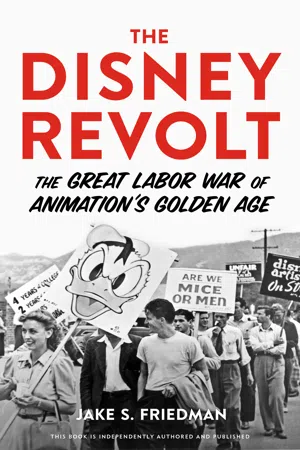
But as America prepared for World War II, labor unions spread across Hollywood. Disney fought the unions while Babbitt embraced them. Soon, angry Disney cartoon characters graced picket signs as hundreds of animation artists went out on strike. Adding fuel to the fire was Willie Bioff, one of Al Capone's wiseguys who was seizing control of Hollywood workers and vied for the animators' union.
Using never-before-seen research from previously lost records, including conversation transcriptions from within the studio walls, author and historian Jake S. Friedman reveals the details behind the labor dispute that changed animation and Hollywood forever.
The Disney Revolt is an American story of industry and of the underdog, the golden age of animated cartoons at the world's most famous studio.
- 320 pages
- English
- ePUB (mobile friendly)
- Available on iOS & Android
eBook - ePub
About this book
Information
PART I
INNOVATION

The Snow White and the Seven Dwarfs float in Pasadena’s Tournament of Roses Parade, 1938. Marge Babbitt (née Belcher) sits atop the float dressed as the character she modeled for the film.
1 My Father Was a Socialist
IN JULY 1896 THE DEMOCRATIC National Convention was held in the grand Chicago Coliseum. Forty thousand citizens filled the Coliseum’s seven-acre interior from the floor to the wings as William Jennings Bryan took the stage. A member of both the Democratic Party and the Populist Party, Bryan was the progressive candidate of the common man.
“Upon which side will the Democratic Party fight,” he asked, “upon the side of ‘the idle holders of idle capital’ or upon the side of the struggling masses?”1
When Bryan finished his speech, men hooted and threw their hats. Women waved handkerchiefs. The cheering lasted for thirty minutes, while delegates hoisted Bryan on their shoulders and carried him around the floor.
As Bryan was departing on his buggy, a man chased after him. This man was a laborer—lean, gaunt, and thirty-seven years old. Just a few years before, he had failed as an orange grower in Florida and had come to Chicago to work as a carpenter.
The man made it to Bryan’s buggy. He extended his hand in admiration, and Bryan shook it. For the rest of his life, Elias Disney would tell his children how he got to shake the hand of William Jennings Bryan.2
Bryan became the presidential nominee for both the Democratic and Populist Parties. But after he lost the 1896 election to Republican William McKinley, the Populist Party started to disintegrate, polarizing liberal voters. Many of Bryan’s supporters followed him into the slightly more moderate Democratic Party. The more radical contingents eventually gravitated toward the newly formed Socialist Party and its front man, Eugene Victor Debs. Faced with the choice, Elias Disney went with Debs and became a member of the Socialist Party.
“My father was a Socialist,” Walt Disney would say at the comfortable age of fifty-eight. Walt and his interviewer, journalist Pete Martin, had something in common: each could say his father was “a Debs man.” Walt would recall it with dissociated wonder from his perch of commercial fame and fortune. But during the years growing up in his father’s home, the Socialist Party was the predominant influence—not only politically but as a way of life. Elias Disney allowed his politics to dictate how he managed his money and his family as well.3
In January 1905 Debs led a Chicago convention for a larger Socialist movement. As it became more radicalized that summer, Debs stepped away and a new, more militant leader stepped up. His name was William D. Haywood, and the group, the Industrial Workers of the World (IWW), was later suspected of being behind a terrorist bombing that almost killed Walt Disney.
Crowded, smoky—that was Chicago in 1906. It was the second most populous city in the United States, with around 1.9 million people.4 Horse-drawn buggies clip-clopped through the streets, and gas-powered streetlamps burned every night. The Industrial Revolution was still in full swing, and factories along the skyline billowed exhaust into the sky. For a four-year-old child named Walter Elias Disney, that was life.
Walter, born December 5, 1901, was the youngest of four sons of Elias and Flora. Elias had been born in Ontario, Canada, the son of Irish immigrants; Flora was from Ohio and was of German and English descent. Their sons Herbert, Ray, and Roy predated Walter by several years. Two years after Walter came his baby sister Ruth.
Crime was rampant in the Disneys’ Chicago neighborhood, and Elias’s brother Robert beckoned him to the Missouri farmland. Fearing for the safety of his two eldest sons, now teenagers, and with hopes of farming a fortune, Elias moved his family to a farm in Marceline, Missouri.
The town was the home to fewer than four thousand citizens and was unlike anything Walter had ever known.5 His family moved into a white farmhouse with green trim on forty-five acres of land. There were fruit trees, berries, wild animals, creeks and brooks, and a main street that led into the quaint small town. Past the farmhouse was a tall and twisted cottonwood tree that Walter dubbed his Dreaming Tree, and he and Ruth would climb its branches or just sit in its shade in contemplation.6 Walt Disney would later credit Marceline as his primary creative inspiration, saying, “Those were the happiest days of my life.”7
Because it was easier for Elias and Flora to manage, Walter began school at the same time as his little sister Ruth. Thus, while he had two extra years of childhood freedom, he would remain old for his grade throughout his schooling.
He could remember things from his childhood with a clarity that astounded even his own family. There was the bliss of receiving his first drawing tablet and crayons from his Aunt Maggie and her endless compliments on Walter’s artistry.8 There was the wisdom of his elderly neighbor, Doc Sherwood, who warned him, “Don’t be afraid to admit your ignorance.”9
This was advice that Walt would cleave to throughout his life. As an adult, he would put almost blind trust in his appointed advisors. This, he figured, would free his creativity, like the unhindered child in Marceline.
That’s not to say that that child couldn’t get into big trouble. Out of a rain barrel he scooped wet tar and smeared a mural on the side of the white farmhouse. Flora gave him a “bawling out,” but Elias spanked Walter with his leather razor strop.10
Elias was strict in his ethos and in his authoritarianism. “Churchy,” a neighbor called him.11 Yet Elias, at least in those days, was able to express his own creativity as an amateur musician. Some nights, the family gathered at Doc Sherwood’s, and Elias played his fiddle while Mrs. Sherwood accompanied on the piano.
Elias hosted his own gatherings at the Disney farmhouse, but their purpose was to spread the doctrine of agricultural socialism. He was a member of the American Society of Equity, a socialist cooperative of midwestern farmers. It pressured lay leaders like Elias to run meetings and enlist other members. “Dad was always meeting up with strange characters to talk socialism,” remembered Walt. “They were tramps, you know? They weren’t even clean.” Flora tried to support her husband but fed the strangers on the doorstep to keep them out of the house.12
Nonetheless, the Equity had many harsh critics, even among the progressives in the farming community. For one thing, the Equity never committed to concrete goals for crop-withholding, price-fixing, or striking; its tactics remained strictly theoretical. For another, the Equity’s founder was neither a laborer nor a farmer but an Indianapolis businessman and the editor-in-chief of an agricultural newspaper. Most important, the Equity pocketed the money paid in membership dues, whereas a bona fide union uses dues to pay its leaders. Instead of receiving a steady paycheck, Equity organizers like Elias were paid on a commission basis. He was explicitly instructed to grow membership through the Equity’s aggressive methods of word of mouth and chain letters—which, by 1940, were remembered as “myriad schemes.” The Equity required a $1.50 membership fee, $1 annual dues, and a subscription to the Equity newsletter. At the time of Elias’s involvement, the Equity had already been publicly condemned as the “Society of Inequity.”13
Even Walt remembered his dad as victim of his own credulity. “He believed people,” Walt said later. “He thought everybody was as honest as he was. He got taken many times because of that.”14
This was Walt Disney’s first encounter with the organized labor movement.
Elias must have been awfully unsuccessful as a Socialist organizer; he couldn’t even convince his own family of the movement’s merits. By 1910 the Disney farm was failing, and Elias demanded everyone pool their earnings together for the family farm. The eldest Disney brothers, Herb and Ray, resented this passionately. Little Walter was witness to many a scorching argument between his big brothers and his father. One evening, Herb and Ray returned to the Disney farmhouse having spent half their earnings on new pocket watches. Elias was livid. The fury that erupted was the final straw for Herb and Ray. The next day they emptied their bank accounts and ran away from the Disney home, leaving the rest to manage on their own. Elias’s stubbornness had broken the family.
Without the eldest brothers’ help, the family sank more quickly into debt, and soon they had to sell the farm. That November of 1910, eight-year-old Walter and sixteen-year-old Roy had to post bills around town for the family’s estate sale. For Walter, it was heartbreaking.15
In May 1911 the family moved to Kansas City, Missouri, a city with a population of a quarter-million people. The Disneys lived in one of the small houses on a densely occupied street,16 a far cry from the paradise of a forty-five-acre farm. Their “orchard” was now a single tree; their...
Table of contents
- Cover Page
- Title Page
- Copyright Page
- Dedication Page
- Contents
- Author's Note
- Prologue
- Map
- Part I: Innovation
- Part II: Turmoil
- Epilogue
- Acknowledgments
- Image Credits
- Appendix The Strikers
- Notes
- Index
Trusted by 375,005 students
Access to over 1.5 million titles for a fair monthly price.
Study more efficiently using our study tools.
Frequently asked questions
Yes, you can cancel anytime from the Subscription tab in your account settings on the Perlego website. Your subscription will stay active until the end of your current billing period. Learn how to cancel your subscription
No, books cannot be downloaded as external files, such as PDFs, for use outside of Perlego. However, you can download books within the Perlego app for offline reading on mobile or tablet. Learn how to download books offline
Perlego offers two plans: Essential and Complete
- Essential is ideal for learners and professionals who enjoy exploring a wide range of subjects. Access the Essential Library with 800,000+ trusted titles and best-sellers across business, personal growth, and the humanities. Includes unlimited reading time and Standard Read Aloud voice.
- Complete: Perfect for advanced learners and researchers needing full, unrestricted access. Unlock 1.5M+ books across hundreds of subjects, including academic and specialized titles. The Complete Plan also includes advanced features like Premium Read Aloud and Research Assistant.
We are an online textbook subscription service, where you can get access to an entire online library for less than the price of a single book per month. With over 1.5 million books across 990+ topics, we’ve got you covered! Learn about our mission
Look out for the read-aloud symbol on your next book to see if you can listen to it. The read-aloud tool reads text aloud for you, highlighting the text as it is being read. You can pause it, speed it up and slow it down. Learn more about Read Aloud
Yes! You can use the Perlego app on both iOS and Android devices to read anytime, anywhere — even offline. Perfect for commutes or when you’re on the go.
Please note we cannot support devices running on iOS 13 and Android 7 or earlier. Learn more about using the app
Please note we cannot support devices running on iOS 13 and Android 7 or earlier. Learn more about using the app
Yes, you can access The Disney Revolt by Jake S. Friedman in PDF and/or ePUB format, as well as other popular books in History & North American History. We have over 1.5 million books available in our catalogue for you to explore.