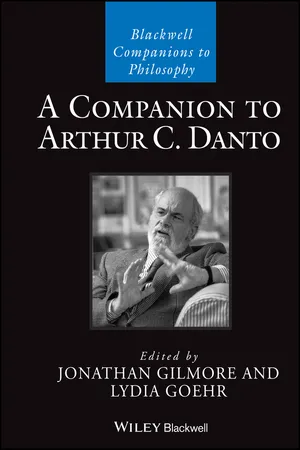
A Companion to Arthur C. Danto paints a detailed portrait of one the most significant figures in twentieth-century philosophy and art criticism, offering unparalleled coverage of all aspects of Danto's writings, artworks, and thought. Edited by two long-time colleagues of Arthur Danto, this interdisciplinary resource presents more than 40 original essays from both prominent Danto scholars and leading practitioners from various sub-fields of philosophy.
The Companion illuminates Danto's many contributions to the artworld, aesthetics, criticism, and philosophy of knowledge, action, science, history, and politics. The essays explore central concepts and intersecting themes in Danto's writings while providing new interventions into the areas of philosophy in which Danto engaged. Topics include Danto's mode of writing and art production, his critical engagement with artists and philosophers, conflicts in Danto's views and in interpretations of his works, and much more.
An important addition to Danto studies, A Companion to Arthur C. Danto is essential reading for practitioners, scholars, and advanced students looking for a critical, provocative, and insightful treatment of Danto's philosophy, art, and criticism.
My sister and I were little. We rode in the scratchy backseat of a mustard-colored Citroën sedan. No seatbelts. It was 1962, the south of France. The countryside was raw, the villages small and closed, the only sign of life smoke coming from the chimneys. Grandmothers were home cooking. Men were in the fields.
For my father’s first sabbatical year from Columbia University, my parents settled in the tiny, sloping village of Roquebrune-Cap-Martin, probably because of the house, that had not just a kitchen with a terrace and a view of the sea, but a spare upper room where my father could write. It was the Côte d’Azur before it was the Côte d’Azur. Life was slow, simple. Celebrities were still only interested in the yachting playgrounds of Monaco and Monte Carlo.
My father was by then keen on philosophy: it was his subject as an academic, the analytical his trade as a professor. But art and art making still held sway from his formative career as an artist of moderate success in our hometown of New York City. That was where he made woodcuts, in the apartment where we grew up, with the dusty perfume of woodchips everywhere littering the floor, splashes of ink on the wood panels and sheets of luminous rice paper for printing, rolled and ready for use.
He didn’t have any of this when we traveled, however, much less a studio. Just a blue black Olivetti and a battered briefcase, the same one he carried around on campus. But among the books and manuscripts was invariably a sketchbook, or a portfolio of Sennelier paper, with somewhere a bottle of ink, a pen, and a set of watercolors.
Reading my father describe his early life as an artist, particularly his famous discussion of giving it up, I was surprised to see him say categorically that he never used color. Or that color didn’t interest him. That his medium was all prints, all black and white.
Certainly, the woodcuts were his signature and what afforded a certain income, beyond his professor’s salary, that he admitted “meant a lot.” But when we traveled as a young family as we did summers as well as sabbatical years, to France and Italy and parts of New England, my father went beyond drafting mere sketches, in pencil or pen and ink, to filling these with color—dots and dashes of light, luminous pastel—pale washes of color reminiscent of the very Cezannes that in their ultimate perfection eventually closed the door for him, he said, to ever making art again.
I remember the reflex he had when we would stop somewhere for lunch, of taking out his sketchpad, and while my mother unpacked a picnic of salads in little waxed paper boxes from the local épicerie, with the requisite baguette and log of sweet butter, he would sit and make a study of whatever scenery we found ourselves in. Or, if that proved uninspiring, he would ask one of us to pose, and in my infinite ennui as a child more interested in playing with my stuffed animals than sitting perfectly still, I suffered there on some rock or bench as my father sketched and squinted and I must say—smiled—until we were both released by the communal call to eat.
He worked very fast; it was my sister Elizabeth who remembered this, who at age ten or eleven accompanied him around Rome in the afternoons to this or that architectural site for what my father called “analytical sight-seeing.” As the resulting architectural pen and ink effigies were not leisurely studies but rather attempts to interpret information drawn from books by Janson and Rudolf Wittkower, the Columbia art historian who became a close friend, and whose “Architectural Principles in the Age of Humanism,” my father wrote in his 2013 intellectual autobiography, “had the greatest philosophical influence on me of anything I had read about art.”
In this exhibit there are other edifices, notably Borromini’s San Carlo alle Quatro Fontane, where the artist was interested in the convex and the concave. “The idea that it was something invisible that gave structure to the visual turned me around completely in my way of looking at art,” my father wrote later on, recalling these epiphanies, that for him had echoes in Oriental philosophy, for example, and that occurred on these repeated Roman excursions in the footsteps of the Baroque.
What I remember is that once he was home – whether the ramshackle villa in Roquebrune or the apartment in Rome – he disassembled his road sketches of fresh ink or swaths of color, leaving them to dry on some surface that would soon enough be reclaimed for more domestic use: the maid’s ironing, somebody’s homework, a meal or an evening glass of wine shared with my mother.
In an essay written to accompany an online exhibit of his woodcuts established several years ago by his alma mater, Wayne State University, my father wrote of his oeuvres: “I had no interest in just making art, I wanted them to enter life, and hang on other people’s walls. I wanted them to be a part of life.” And so they are, decades later, courtesy of CAFA and a dedicated consortium of colleagues, to be seen by people from all over the world, a thousand miles from where their life began.
The essay is reprinted with gracious permission from CAFA, Beijing, China. CAFA published a catalog on the occasion of its 2014 Arthur Danto symposium and exhibit.
2 Boundaries Crossed
ANDRÁS SZÁNTÓ
1 Times Square
There is a pedestrian island in front of the Marriott Marquis Hotel, in Times Square, between 45th and 46th streets. After recent design upgrades and the elimination of vehicle traffic, it is a far more welcoming place than it was in the late summer of 1988, when I arrived in Manhattan from Budapest to pursue a PhD in sociology. It so happened that my first accommodations in New York, provided by the City University’s Graduate School and University Center, were in a single-room-occupancy building a stone’s throw from the square, on West 44th Street. Some of my neighbors were former prostitutes. The neon signs in Times Square – still made of neon back then – would paint red spirals on my white walls at night.
The overpowering visual and cultural landscape of Times Square fascinated me. A whole universe of sinister and sublime surprises awaited me steps from my front door. The aforementioned pedestrian island, I soon learned, was not just any island. It was part of a site-specific artwork. A mysterious drone emanated from underneath the metal grille covering its triangular surface. The sound arose from somewhere deep below, like an invisible sonic tower, comingling with the cacophony of taxi honks, subway screeches, and all the human clamor of the “Crossroads of the World.” Once you caught on, it was impossible to tune out its mood and mind-altering presence.
The installation, titled Times Square, had been designed for that spot by an experimental composer and percussionist named Max Neuhaus (1939–2009). The sound sculpture, as the artist called it, had been running more or less continuously since 1977, under the care of the Dia Art Foundation. Together with a fellow student, I set about documenting it. We interviewed a homeless man who lived on top of the work, seemingly oblivious to its presence. We met a woman who came there often to meditate. We asked tourists what they thought about the sound as a form of public art. We filmed pedestrians from rooftops. When we were done, we presented our work at a visual-anthropology conference in Amsterdam, in a documentary film titled Sound from the Ground.1
It was armed with a videocassette copy of Sound from the Ground that I entered Arthur Danto’s office for the first time, in 1991. I had since transferred to Columbia University, where I was working on a dissertation about art galleries and the transformation of the visual-art world into a modern cultural industry. The only hitch was, few of my professors in the sociology department knew much about art or its institutions and markets. It made sense to walk over to Philosophy Hall to seek out the advice of Arthur C. Danto. He was, after all, the man who coined the term artworld. And he was part of that world. At the peak of his powers as a teacher, theoretician, and critic, Danto was an intellectual rock star. A frequent presence in Manhattan’s glittering art scene, he had achieved an aura of public fame that is rarely attached to academics. As a 27-year-old student at the time, it took some nerve to knock on his door.
Arthur had just published an essay about Neuhaus in The Nation, where he famously held the art-critic post formerly occupied by Clement Greenberg. In a characteristic switching of gears from “mere” criticism to something deeper and more profound, he described Neuhaus’s sound sculpture as “a portable tabernacle, a bubble of sacral space encapsulated in midtown life, which flows unheedingly around it, save for those attracted as a momentary congregation” (Danto 1991). I was confident that my documentary would claim his interest. Not only was it about an artist he cared about, but it directly probed the categorical distinction between art and the ordinary world – Arthur’s driving preoccupation in the field of aesthetics. What better example of his “transfiguration of the commonplace” could one find than an artistic intervention that elevated Times Square, in all its grime and decrepitude, to a sacramental shrine?
Times Square was precisely the kind of art Arthur relished thinking about. It was about boundaries: between the traditional and the modern, the familiar and the transcendent, the aesthetic and the everyday. Such boundaries were for him always both philosophical and political, and he demonstrated exceptional skill in pinpointing them and explaining why they were relevant. He was, in this sense, a virtuoso of scrutinizing boundaries. As a person, he was fond of stepping over them.
2 Opening Doors
I became, as far as I know, Arthur’s last graduate student. He helped guide me into the art world conceptually, and also by opening doors in a practical sense, using his connections. Arthur approached his duties as a dissertation adviser with a light touch and in a spirit of avuncular generosity. He steered clear of the confrontational approach that some feel compelled to adopt in such circumstances. I got the feeling that he was somewhat bemused by sociology, a young discipline that operated on a more mundane plane than his own. But he was more than willing to come along for the ride.
In a way, I set out to pick up where Arthur had left off, to drill into the layers that his theoretical inquiry left untouched. For me, the art world was not a mental construct, but a living-breathing site of human and organizational interactions. As a sociologist, it behooved me to ask how, as an empirical matter, the transfiguration of the commonplace actually happened – as a product of the daily functioning of real-world institutions. It was clear to me that a key site of this organizational alchemy was the art gallery, where values were nurtured in a dual sense. It was in galleries that the first rough version of art history was written, much as newspapers have been said to have drafted the first version of our collective history. And it was in galleries that art, for better or for worse, intertwined with commerce. The value of each work would now be reflected in a sometimes exceptionally high price, which in turn denoted the artwork – in the currency of the marketplace – as belonging to a class apart from ordinary things. Arthur encouraged this investigation and took evident pleasure in crossing over to another discipline to see a world that fascinated him from a diff...
Table of contents
Cover
Series page
Title page
Copyright
Table of Contents
Preface
Notes on Contributors
Introduction: Five Pieces for Arthur Danto (1924–2013) In memoriam
1 Roquebrune, 1962
2 Boundaries Crossed
3 Writing with Style
4 Sartre, Transparency, and Style
5 Nietzsche and Historical Understanding
6 Pragmatism between Art and Life
7 Danto on Dewey (and Dewey on Danto)
8 Thought Experiments: Art and Ethics
9 A Normative Perspective on Basic Actions
10 Cognitive Science and Art Criticism
11 Perception
12 The Anthropology of Art
13 The Birth of Art
14 The End of Art
15 Representation, Truth, and Historical Reality
16 History and Retrospection
17 Action in the Shadow of Time
18 The Sixties
19 Criticism and the Pale of History
20 Postmodernism and Its Discontents
21 Shakespeare and the Repetition of the Commonplace
22 Engaging Henry James: The Metaphorical Perspective
23 Literature, Philosophy, Persona, Politics
24 Moving Pictures
25 Photography and Danto’s Craft of the Mind
26 Transfiguration/Transubstantiation
27 Embodiment and Medium
28 The Style Matrix
29 Disenfranchisement
30 Definition
31 Danto and Dickie: Artworld and Institution
32 Danto and Wittgenstein: History and Essence
33 Censorship and Subsidy
34 Amnesty International and Human Rights
35 Random Noise, Radical Silence
36 Mad Men and Pop Art
37 Vija Celmins: Nature at Art’s End
38 The Meaning of Ugliness, The Authority of Beauty
39 Feminist Criticism: On Disturbatory Art and Beauty
40 Beauty and Politics
41 Public Art: Monuments, Memorials, and Earthworks
42 On Architecture
43 Aliveness and Aboutness: Yvonne Rainer’s Dance Indiscernibles
44 Arthur and Andy
45 Letter to Posterity
Index
Trusted by 375,005 students
Access to over 1.5 million titles for a fair monthly price.
Study more efficiently using our study tools.
Frequently asked questions
Yes, you can cancel anytime from the Subscription tab in your account settings on the Perlego website. Your subscription will stay active until the end of your current billing period. Learn how to cancel your subscription
No, books cannot be downloaded as external files, such as PDFs, for use outside of Perlego. However, you can download books within the Perlego app for offline reading on mobile or tablet. Learn how to download books offline
Perlego offers two plans: Essential and Complete
Essential is ideal for learners and professionals who enjoy exploring a wide range of subjects. Access the Essential Library with 800,000+ trusted titles and best-sellers across business, personal growth, and the humanities. Includes unlimited reading time and Standard Read Aloud voice.
Complete: Perfect for advanced learners and researchers needing full, unrestricted access. Unlock 1.5M+ books across hundreds of subjects, including academic and specialized titles. The Complete Plan also includes advanced features like Premium Read Aloud and Research Assistant.
Both plans are available with monthly, semester, or annual billing cycles.
We are an online textbook subscription service, where you can get access to an entire online library for less than the price of a single book per month. With over 1.5 million books across 990+ topics, we’ve got you covered! Learn about our mission
Look out for the read-aloud symbol on your next book to see if you can listen to it. The read-aloud tool reads text aloud for you, highlighting the text as it is being read. You can pause it, speed it up and slow it down. Learn more about Read Aloud
Yes! You can use the Perlego app on both iOS and Android devices to read anytime, anywhere — even offline. Perfect for commutes or when you’re on the go. Please note we cannot support devices running on iOS 13 and Android 7 or earlier. Learn more about using the app
Yes, you can access A Companion to Arthur C. Danto by Jonathan Gilmore, Lydia Goehr, Jonathan Gilmore,Lydia Goehr in PDF and/or ePUB format, as well as other popular books in Philosophy & Aesthetics in Philosophy. We have over 1.5 million books available in our catalogue for you to explore.