Probing the relationship between modernist literary experimentation and several key strands of occult practice which emerged in Europe from roughly 1894 to 1944, this book sets the work of leading modernist writers alongside lesser known female writers and writers in languages other than English to more fully portray the aesthetic and philosophical connections between modernism and the occult.
Although the early decades of the twentieth century-the era of cocktails, motorcars, bobbed hair, and war-are often described as a period of newness and innovation, many writers of the time found inspiration and visionary brilliance by turning to the mysterious occult past. This book's principle intervention is to reimagine the contours and boundaries of literary modernism by welcoming into the conversation a number of significant female writers and writers in languages other than English who are often still relegated to the fringes of modernist studies. Well-remembered poets and novelists such as Ezra Pound, W.B. Yeats, and Aleister Crowley were tied to occult beliefs, and this book sets these leading figures alongside less well-remembered but equally splendid modernists including Paul Brunton, Mary Butts, Alexandra David-Neel, Florence Farr, Dion Fortune, Hermann Hesse, and Rudolf Steiner.
From the little magazines where occultism and Fabianism were comfortable companions, to consulting rooms of psychoanalysts where archetypes were revealed to be both mystical and mundane, to the forbidden mountain trails that led to formidable spiritual teachers, the conditions of modernism were invariably those conditions which inspired a return to the occult traditions that many thinkers believed had long evaporated. Indeed, in many ways these traditions were the making of the modern world. By uncovering hidden hopes and anxieties that faced a newly modern Western Europe, this book demonstrates how literary modernists understood occultism as a universal form of cultural expression which has inspired creative exuberance since the dawn of civilisation.
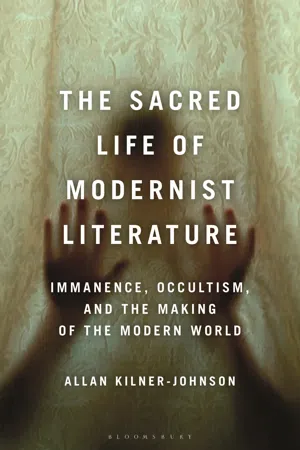
eBook - ePub
The Sacred Life of Modernist Literature
Immanence, Occultism, and the Making of the Modern World
- 184 pages
- English
- ePUB (mobile friendly)
- Available on iOS & Android
eBook - ePub
The Sacred Life of Modernist Literature
Immanence, Occultism, and the Making of the Modern World
About this book
Information
1 Divine reading: Absence and elision as occult form in modernist literature
In all kinds of ways, the figuratively absent kitchen table of Virginia Woolf’s To the Lighthouse (1927) offers the paradigmatic expression of a modernism invested in magical ways of knowing:
Whenever she ‘thought of [Mr Ramsay’s] work’ she always saw clearly before her a large kitchen table. It was Andrew’s doing. She asked him what his father’s books were about. ‘Subject and object and the nature of reality’, Andrew had said. And when she said Heavens, she had no notion what that meant. ‘Think of a kitchen table then’, he told her, ‘when you’re not there’.1
Andrew describes to the painter Lily Briscoe the manoeuvres of a modern phenomenologist (one who, like Husserl and Heidegger, recognizes that matter is in a state of formation) in a domestic allegory, one which he presumably imagines she will grasp. But Lily, whose own creative practice requires the existence of tables, people and chairs, bristles at the sophistry until, later, her artistic sensibilities lead her to a representational style similarly established by elision. The haunting allegory becomes even more poignant when the reader is forced to think of Andrew when he is not there following his death in the First World War or to think of Mrs Ramsay, also, when she is not there. William R. Handley says of this famously absent kitchen table that Woolf ‘is laughing … at Mr. Ramsay as a philosopher who cannot see the objects in front of him, paradoxically including his wife’.2 Alex Zwerdling draws attention to Woolf’s juxtaposing of psychological interiority and the ‘real world’, that is, the dangerous gap between what people ‘want and what is expected of them’,3 and Allen McLaurin aligns Woolf’s portrayal of domestic space such as this alongside the notions of fellow Bloomsbury thinker Roger Fry: ‘In many ways Virginia Woolf tries to right the balance between the literary and visual by allowing a great deal of the spatial element in her art – as much, indeed, as words can accomplish in this direction.’4 There is no mistaking that the kitchen table ‘when you’re not there’ offers a composite emblem of both Mr Ramsay’s failings as a modern paterfamilias and the negotiation of loss which Woolf’s text mediates. But also, and more urgently, this famous scene condenses Woolf’s primary method of conveying meaning through elision and of hovering at the void of signification, a technique at the very heart of modernist literary experimentation. The table allegory might accurately capture the daunting philosophy of a modern thinker, but, by the text’s final lines, Lily’s opportunity to enter into a collaborative production of meaning where the world says none exists becomes too enticing for her to resist.
Woolf should no means be described as an occultist, but her inspired engagement with the abstractness of language and expression unmistakably calls upon occult modes of thought that seek to engage with the participant in a form of collaborative understanding that emerges from the active involvement in the creation of meaning. ‘If one were to catalogue the various types of “mystical” experience appearing in the writings of Virginia Woolf’, Julie Kane points out, ‘the list would be virtually indistinguishable from the topics of interest to the Theosophists and spiritualists of her day: telepathy, auras, astral travel, synaesthesia, reincarnation, the immortality of the soul, and the existence of a Universal mind’.5 In Modernism and Magic, Leigh Wilson echoes this point when she recognizes that ‘Woolf’s attempts to articulate what happens during artistic creation hover around the transformations of magic’.6 Woolf, although publicly inimical towards mystical thought, understood synchronic and collective forms of knowledge in ways markedly similar to occult groups of her time and recognized that the most powerful way to capture the ineffable qualities of human experience is to not even portray them at all but, instead, to offer the reader opportunities to ruminate on arrays of language and meaning that build towards a personally realized design. It is precisely this invitation to the reader to enter into the co-construction of meaning that is so often at the centre of charges against modernism of elusiveness, snobbery and impenetrability.
This chapter examines the occult intimations of the modernist turn to elision and absence, and, more specifically, the role that this semantic and conceptual refusal of meaning played in the development of modernist sensibilities. The rarefied elusiveness of literary modernism, both then and now, may have excluded many readers, but its principal aim was to invest within the reader a quality of cooperative knowledge production in a radically reshaped global landscape. Delicately observed, Terry Eagleton explains that the modernists ‘were developing their own closed symbolic systems, in which Tradition, theosophy, the male and female principles, medievalism and mythology were to provide the keystones of complete “synchronic” structures, exhaustive models for the control and explanation of historical reality’.7 As Vicki Mahaffey contends of this ‘closed’ nature of much of literary modernism, ‘stylistically such obfuscation may serve to express the elusiveness and even the horror of reality; one could argue that it symbolically forces its readers to bear witness to the unspeakable incoherences and violence nonsense of the real’.8 Eliot’s objective correlative, Joyce’s epiphanies, Hemingway’s iceberg theory and Woolf’s moments of being, each in their own way, highlight the affective potential of absence and elision and emphasize a sacred reading practice which exists as the ‘end-result of a dynamic, generative paradox or antimony (a stark contradiction between two principles) that structures and in some sense determines the invention of difficult or strange language’.9 Perhaps the most pressing influence of occultism on modernist literature is not subject and imagery but the reconstitution of the literary text as an object of immanent creation in which gaping holes of denotation provide the richest sites of meaning and purpose.
Throughout much of the history of Western literature, textual art has been viewed as a mimetic form of communication, with the artist ascribed the task of recreating the universe; imitation of life was not only the method but also the goal of the writer. And within the Anglo-American literary tradition, fictional prose to a great extent and lyric poetry to an even greater extent have been evaluated on the degree to which the textual image conjures a scene or sensibility that is, if not familiar, at least partly recognizable. However, ‘the post-Jamesian artist or intellectual’, Christopher Knight points out, ‘has made it something akin to a practice to imagine the work as incomplete, except as this completion is understood as taking place in a realm outside of, or invisible to, common understanding’.10 William Franke positions the apophatic burden of modernism as less inherently rooted in the implications of a new literary style but merely a reminder that ‘periodically in intellectual history, confidence in the Logos, in the ability of the word to grasp reality and disclose truth, flags dramatically’.11 But it bears pointing out that literature has also been powerfully associated with the imaginary and visionary throughout literary history, particularly during periods of providential innovation and change. Sharing in this recognition, Anthony L. Johnson explains that in the context of literary elision, ‘the reader is called upon to become actively involved in bridging the gaps so created and in devising morpho-syntactic, semantic or pragmatic by-passes to reconstitute textual continuity. Since internal fragmentariness disrupts discursive unity-cum-continuity, it invariably “vertically” attracts readerly attention away from a text’s discursivity (a series of sign-events in praesentia) towards retrievals of sense.’12
Within the context of these discussions of stylistic elision, the common claims regarding the ‘esoteric’ language (as in, comprehensible only to those with specialist knowledge) of modernists such as Pound, Joyce and Woolf deserve further attention. In Am I a Snob?: Modernism and the Novel (2003), Sean Latham points out that ‘modernism has thrived on a smug sense of cultured superiority … for modernism’s mythologized autonomy derives from the illusion of disinterestedness, from the conviction that aesthetic pleasure exists in a realm completely antithetical to the vulgar self-promotion of the marketplace’.13 Pushing such claims further, Andreas Huyssen reads the forbidding quotient of modernist writing more polemically as ‘a conscious strategy of exclusion, and [evidence of] anxiety of contamination by its other: an increasingly consuming and engulfing mass culture’.14 Joshua Gunn specifically explores the parallels between occultism and the ‘esoteric’ language of the modernists:
Occult discourse – which I define broadly as the study of secret or previously secret knowledge, which subsumes the revelations of so-called ‘New Age’ literature – can be understood as the end-result of a dynamic, generative paradox or antimony (a stark contradiction between two principles) that structures and in some sense determines the invention of difficult or strange language.15
Tellingly, Gunn’s initial example is the Scylla and Charybdis episode of Ulysses (1922), in which Stephen Dedalus comes head-to-head with the Theosophical raillery of the mystic and poet AE (George William Russell), to whom he is indebted financially and perhaps aesthetically as well. John Bramble similarly imagines an innate affinity between the projects of modernism and occultism, which both sought to push away the seemingly repressive and levelling forces of modernity: ‘To be able to know the world differently – as a kind of Gnostic, a stance which entailed mystical nihilism as much as affirmative transcendence – was an asset for modernism’s quarrel with positivism, uniformity, bourgeois master-narratives, materialist progress, and the Westernization of the earth.’16 Gnosticism holds on to the view that there exist sparks of innate divinity within the individual which are seeking to return to the greater source, and this form of embodied knowledge, which is neither communicable nor verifiable, becomes a useful symbol for modernist stylistic sensibilities. While certainly not all modernists were occultists, modernism celebrates the hidden and can be comprehended in refreshed ways through attention to the occult compulsions that delineate boundaries of meaning. The innovations of literary modernism are dependent upon the collective consciousness, that is, the shared reasoning (or performative and productive nonreasoning) that burst forth as nodes of creative output. As the readings of Marinetti, Pound, Eliot and Butts that follow in...
Table of contents
- Cover
- Half-title Page
- Title Page
- Contents
- Acknowledgements
- Introduction
- 1 Divine reading: Absence and elision as occult form in modernist literature
- 2 The return to ritual: Embodiment and initiation in modernist drama
- 3 The modernist shadow: Psychoanalysis, occultism and the taming of the unconscious
- 4 The making of an overman: The superman and superwoman in modernist literature
- 5 The other East: The Philosophia Perennis and the modern pilgrim
- Conclusion
- Bibliography
- Index
- Copyright Page
Trusted by 375,005 students
Access to over 1.5 million titles for a fair monthly price.
Study more efficiently using our study tools.
Frequently asked questions
Yes, you can cancel anytime from the Subscription tab in your account settings on the Perlego website. Your subscription will stay active until the end of your current billing period. Learn how to cancel your subscription
No, books cannot be downloaded as external files, such as PDFs, for use outside of Perlego. However, you can download books within the Perlego app for offline reading on mobile or tablet. Learn how to download books offline
Perlego offers two plans: Essential and Complete
- Essential is ideal for learners and professionals who enjoy exploring a wide range of subjects. Access the Essential Library with 800,000+ trusted titles and best-sellers across business, personal growth, and the humanities. Includes unlimited reading time and Standard Read Aloud voice.
- Complete: Perfect for advanced learners and researchers needing full, unrestricted access. Unlock 1.5M+ books across hundreds of subjects, including academic and specialized titles. The Complete Plan also includes advanced features like Premium Read Aloud and Research Assistant.
We are an online textbook subscription service, where you can get access to an entire online library for less than the price of a single book per month. With over 1.5 million books across 990+ topics, we’ve got you covered! Learn about our mission
Look out for the read-aloud symbol on your next book to see if you can listen to it. The read-aloud tool reads text aloud for you, highlighting the text as it is being read. You can pause it, speed it up and slow it down. Learn more about Read Aloud
Yes! You can use the Perlego app on both iOS and Android devices to read anytime, anywhere — even offline. Perfect for commutes or when you’re on the go.
Please note we cannot support devices running on iOS 13 and Android 7 or earlier. Learn more about using the app
Please note we cannot support devices running on iOS 13 and Android 7 or earlier. Learn more about using the app
Yes, you can access The Sacred Life of Modernist Literature by Allan Kilner-Johnson in PDF and/or ePUB format, as well as other popular books in Literature & English Literary Criticism. We have over 1.5 million books available in our catalogue for you to explore.