Oxidative Eustress in Exercise Physiology
eBook - ePub

Oxidative Eustress in Exercise Physiology

  1. 228 pages
  2. English
  3. ePUB (mobile friendly)
  4. Available on iOS & Android
eBook - ePub

Oxidative Eustress in Exercise Physiology

About this book

Oxidative Eustress in Exercise Physiology unravels key physiological responses and adaptations to different redox-regulated exercise paradigms at the cell, tissue, and whole-body level in model systems and humans in health and disease. While the mechanistic details are still unclear, key intracellular redox indices seem to be dysregulated with age. Consequently, beneficial molecular responses to acute endurance exercise decline in older individuals. Recent research suggests that manipulating mitochondrial redox homeostasis by supplementing with the mitochondria-targeted coenzyme Q10 for six weeks markedly improves physical function in older adults; i.e. it may be possible to maximise the benefits of exercise by manipulating the redox environment. The research described in this book suggests that significant translational potential exists with respect to cardiovascular disease, neurodegeneration and cancer. An international team of researchers documents the importance of redox biology in health and disease, especially when exercise is a clinically useful tool for the treatment of many diseases and conditions.

Features

  • Defines essential redox biology reactions and concepts in exercise physiology
  • Assesses key redox parameters in an in vivo human exercise context
  • Identifies the challenges, opportunities and boundaries of current knowledge
  • Includes a critique of the underlying mechanisms
  • Summarises examples of translationally important research relating to disease states

Related Titles

Draper, N. & H. Marshall. Exercise Physiology for Health and Sports Performance (ISBN 978-0-2737-7872-1)

Wackerhage, H., ed. Molecular Exercise Physiology: An Introduction (ISBN 978-0-4156-0788-9)

Frequently asked questions

Yes, you can cancel anytime from the Subscription tab in your account settings on the Perlego website. Your subscription will stay active until the end of your current billing period. Learn how to cancel your subscription.
At the moment all of our mobile-responsive ePub books are available to download via the app. Most of our PDFs are also available to download and we're working on making the final remaining ones downloadable now. Learn more here.
Perlego offers two plans: Essential and Complete
  • Essential is ideal for learners and professionals who enjoy exploring a wide range of subjects. Access the Essential Library with 800,000+ trusted titles and best-sellers across business, personal growth, and the humanities. Includes unlimited reading time and Standard Read Aloud voice.
  • Complete: Perfect for advanced learners and researchers needing full, unrestricted access. Unlock 1.4M+ books across hundreds of subjects, including academic and specialized titles. The Complete Plan also includes advanced features like Premium Read Aloud and Research Assistant.
Both plans are available with monthly, semester, or annual billing cycles.
We are an online textbook subscription service, where you can get access to an entire online library for less than the price of a single book per month. With over 1 million books across 1000+ topics, we’ve got you covered! Learn more here.
Look out for the read-aloud symbol on your next book to see if you can listen to it. The read-aloud tool reads text aloud for you, highlighting the text as it is being read. You can pause it, speed it up and slow it down. Learn more here.
Yes! You can use the Perlego app on both iOS or Android devices to read anytime, anywhere — even offline. Perfect for commutes or when you’re on the go.
Please note we cannot support devices running on iOS 13 and Android 7 or earlier. Learn more about using the app.
Yes, you can access Oxidative Eustress in Exercise Physiology by James N. Cobley, Gareth W. Davison, James N. Cobley,Gareth W. Davison in PDF and/or ePUB format, as well as other popular books in Biological Sciences & Biochemistry in Medicine. We have over one million books available in our catalogue for you to explore.

Information

CHAPTER ONE Introduction to Oxidative (Eu)stress in Exercise Physiology

Gareth W. Davison and James N. Cobley
DOI: 10.1201/9781003051619-1

CONTENTS

  1. Introduction
  2. Oxygen and Its Derivatives
  3. Superoxide Anion
  4. Hydrogen Peroxide
  5. Hydroxyl Radical
  6. Reactive Nitrogen Species
  7. Brief Overview of Indirect and Direct Biomarkers of Exercise-Induced Oxidative Stress
  8. Brief Overview of ROS as Eustress Regulators of Skeletal Muscle
  9. Conclusion
  10. Acknowledgement
  11. References

Introduction

Exercise-induced oxidative (eu)stress has received considerable attention over the last four decades, with circa 900 original investigations published since 1978. Indeed, redox research per se is a contemporary feature of biomedical journals and conferences, with a plethora of exciting new information relating to health and disease being presented.
The discovery that free radicals (i.e., molecules capable of existing independently, and containing one or more unpaired electrons) exist in living biological organisms occurred in 1954 when Commoner and colleagues (Commoner et al., 1954) first used electron paramagnetic resonance (EPR) spectroscopy to detect free radicals in growing seeds. Around this time, Gerschman et al. (1954) proposed that free radicals damage cells, and second, when mice are exposed to hyperoxia, the biological injury that ensues is likely related to increased free radical production. Following the publication of this work in the mid-1950s, a series of seminal studies confirmed the biological importance (Powers et al., 2016). For example, the work of Chance and Williams (1956) demonstrated that respiring mitochondria can generate hydrogen peroxide, which can diffuse in cells. Then, McCord and Fridovich (1969) discovered the metalloenzyme superoxide dismutase (SOD), showing in the process that superoxide radicals are spontaneously degraded to hydrogen peroxide. The milestone discovery of SOD not only provided much of the basis of our current understanding of antioxidant defence systems, but it is also credited with providing the first convincing evidence that biological reactive oxygen species (ROS) exist and that they are likely salient regulators of cell biology (Powers et al., 2016).
Since these landmark discoveries, the exercise physiology and redox field have grown exponentially with prominent work enhancing our understanding of the role that free radicals (e.g., superoxide) and non-radicals (e.g., hydrogen peroxide), collectively termed ROS, play in systemic and intracellular muscle biology. It is now known, for example, that both different exercise modalities generate ROS and their production is associated with molecular biomarkers of oxidative stress. To the contrary, exercise-induced low-levels of ROS activate key signalling pathways leading to exercise-induced skeletal muscle adaptations. This chapter is designed to introduce the basic concept of oxidative (eu)stress, and in doing so, a brief overview of the key studies pertaining to exercise-induced oxidative stress and those identified as eustress regulators of skeletal muscle will be highlighted. A brief introduction to ground state molecular dioxygen and its derivatives (i.e., ROS) will also provide context to the general area of interest.
‘Oxidative stress’ is a popular term among exercise physiologists and is widely used in the literature, but rarely defined. Sies and Cadenas (1985) defined the term oxidative stress as ‘a disturbance in the prooxidant–antioxidant balance in favour of the former’. Although this definition was widely accepted for over two decades, this description of oxidative stress has undergone scrutiny (Powers et al., 2016), and subsequently, Jones and Sies revised the definition of oxidative stress to ‘an imbalance between oxidants and antioxidants in favour of the oxidants, leading to a disruption of redox signalling and control and/or molecular damage’ (Sies & Jones, 2007). On the latter, the basic premise is that, in an open metabolic system, a steady-state redox balance is maintained at a particular setpoint, providing a basal redox tone, and any deviation away from the steady-state redox balance is regarded as a stress response. This oxidative distress concept, which explains supraphysiological disruption to redox signalling and/or oxidative stress damage to biomolecules, however, only explains one end of the continuum. At the other end, the term oxidative eustress may be used to connect low levels of oxidative stress to intracellular redox signalling and regulation (Sies 2020a).

Oxygen and Its Derivatives

Arguably the most important free radicals in biological systems are radical derivatives from oxygen, and although oxygen is necessary for survival, it has the potential to become toxic when supplied at concentrations higher than normally encountered (i.e., the toxicity of molecular oxygen is primarily due to the production of ROS). Ground state molecular oxygen is, in fact, a di-radical, with two unpaired electrons located in a different antibonding orbital with the same directional spin. Consequently, oxygen can only react with non-radicals by accepting a pair of electrons that spin in an anti-parallel manner (McCord, 1979).
Free radicals in biological organisms include, but not limited to superoxide (O2.), hydroperoxyl (HO2.), hydroxyl (OH.), carbonate (CO3.), peroxyl (RO2.), alkoxyl (RO.) and nitric oxide (NO) radicals (Table 1.1). Hydrogen peroxide (H2O2) and hypochlorous acid (HOCL) have no unpaired electrons, and by definition they are non-radicals, but nevertheless these ROS can be powerful oxidants that are often involved in free radical reactions.
TABLE 1.1 Reactive Oxygen Species Present in Biological Systems
Free Radical Chemical Formula Half-Life (seconds)
Hydroxyl OH
1 × 10⁻⁹
Superoxide O2
1 × 10⁻⁶
Singlet oxygen 1O2 1 × 10⁻⁶
Alkoxyl RO
1 × 10⁻⁶
Molecular oxygen O2 > 102
Hydrogen peroxide H2O2 10
Peroxyl ROO
17
Hydroperoxyl HO2
?
Carbonate CO3
?
Semiquinone Q
Days

Superoxide Anion

Superoxide (O2) is a commonly known oxygen-centred free radical. The reduction of a single electron to an O2 molecule produces the superoxide anion. O2 is relatively unreactive with non-radical species in comparison to other radical types (e.g., hydroxyl radical); however, if O2 is generated near the site of any biochemical molecule it can be damaging. The reactivity of O2 in aqueous solutions is more likely to occur in vivo (Halliwell and Gutteridge, 2015). In this environment, O2 can act as a base, accepting a proton to form the hydroperoxyl radical (HO2.). The pKa for this reaction is 4.8, indicating that approximately only 1% of O2 is in the HO2 form at physiological pH (Pryor, 1986). However, there may be more HO2 at comparatively acidic membrane nanodomains. O2 under a normal metabolic response is dismutated by SOD, which can increase the rate of intracellular dismutation by a factor of 10−9 M−1s−1 to form hydrogen peroxide...
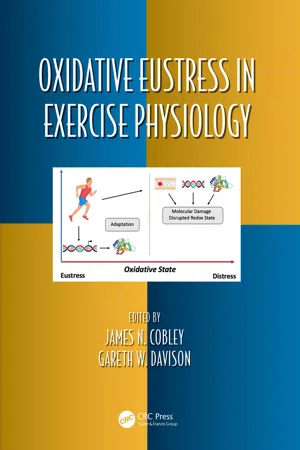
Table of contents

  1. Cover
  2. Half Title
  3. Series Page
  4. Title Page
  5. Copyright Page
  6. Table of Contents
  7. Series Preface
  8. Editors
  9. Contributors
  10. 1 • Introduction to Oxidative (Eu)stress in Exercise Physiology
  11. 2 • Measuring Oxidative Damage and Redox Signalling: Principles, Challenges, and Opportunities
  12. 3 • Exercise Redox Signalling: From ROS Sources to Widespread Health Adaptation
  13. 4 • Oxygen Transport: A Redox O2dyssey
  14. 5 • Mitochondrial Redox Regulation in Adaptation to Exercise
  15. 6 • Basal Redox Status Influences the Adaptive Redox Response to Regular Exercise
  16. 7 • Time to ‘Couple’ Redox Biology with Exercise Immunology
  17. 8 • Exercise and RNA Oxidation
  18. 9 • Exercise and DNA Damage: Considerations for the Nuclear and Mitochondrial Genome
  19. 10 • Nutritional Antioxidants for Sports Performance
  20. 11 • Antioxidant Supplements and Exercise Adaptations
  21. 12 • Nitric Oxide Biochemistry and Exercise Performance in Humans: Influence of Nitrate Supplementation
  22. 13 • (Poly)phenols in Exercise Performance and Recovery: More Than an Antioxidant?
  23. 14 • Exercise: A Strategy to Target Oxidative Stress in Cancer
  24. 15 • Oxidative Stress and Exercise Tolerance in Cystic Fibrosis
  25. 16 • Ageing, Neurodegeneration and Alzheimer’s Disease: The Underlying Role of Oxidative Distress
  26. 17 • Exercise, Metabolism and Oxidative Stress in the Epigenetic Landscape
  27. Index