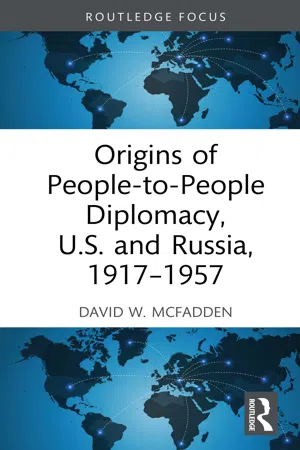
Although there have been many studies of U.S.–Soviet diplomacy in the twentieth century, most explorations of people-to-people diplomacy begin in the 1980s and to not take into account the early contacts in the revolutionary period and 1920s. This study explores in greater depth the religious figures, radical activists, entrepreneurs, engineers, social workers, and others in both the U.S. and the Soviet Union who reached across the barriers of ideology and culture and history to forge tentative but real human connections in an attempt to further better understanding between the two countries. All of these efforts prefigured the much more heralded "citizen diplomacy" efforts of the 1980s, which helped end the Cold War.
- 86 pages
- English
- ePUB (mobile friendly)
- Available on iOS & Android
eBook - ePub
Origins of People-to-People Diplomacy, U.S. and Russia, 1917-1957
About this book
Information
1 Early American Contacts with Soviet Russia
DOI: 10.4324/9781003190967-2
Raymond Robins, chief of the American Red Cross mission to Russia from December 1917 until his departure in mid-May 1918, pursued an extraordinary array of contacts with Bolshevik leaders in his single-minded efforts to establish a modus operandi between the United States and the new Soviet government in opposition to German efforts to penetrate and control Russia. Although other official and semi-official American representatives held discussions with the Bolsheviks during this period, Robins’ efforts were the dominant force, and without him very few meetings would have been held. For nearly six months Robins was able to maintain a degree of trust of both the Bolsheviks and the official American community in Petrograd and Moscow. In fact, the diversity of people testifying to his effectiveness and integrity during these months fully supports the considered judgment of Arthur Bullard that Robins was “the most important, the most intelligent, the most single-minded in his patriotism, the most sympathetic to democracy … [a man] who had done more than any other American to win a little respect for our country.” People as diverse in their work and their judgments as Felix Dzerzhinsky, Cornelius Kelleher, Theodore Roosevelt, V. I. Lenin, Leon Trotsky, Arthur Bullard, William V. Judson, and David Francis all affirmed the integrity and intentions of Robins during his time with the Red Cross in Russia, even when they disagreed strongly concerning his objectives, effectiveness, or conclusions about the Bolshevik government.1
Robins had unprecedented access to the Bolshevik leaders during much of this time. His interpreter, Alexander Gumberg, was a Russian-American Jew whose brother was a Bolshevik and who knew Trotsky when the latter was working on the Russian paper Novy Mir in early 1917 in New York. Gumberg helped Robins get early access to Trotsky and later to Lenin. Once the contact was made and trust developed, Robins had practically carte blanche access to Trotsky and Lenin. Robins and Gumberg’s papers are full of letters and notes from Trotsky and Lenin to Bolshevik functionaries, asking that one or another small favor be done or access granted for Robins or Gumberg. Trotsky also saw that Robins was given access to all of the direct telephone numbers of himself, Lenin, Dzerzhinsky Bonch-Bruyevich, y.k. Peters (Military Revolutionary Committee), and other Bolshevik leaders.2
From January to April of 1918, the struggle for a working relationship between the United States and Bolshevik Russia revolved around Raymond Robins and his discussions with Trotsky, Lenin, and other Bolshevik leaders. A comprehensive review of Robins’ own writing and those of others about him and an analysis of his actions during those critical six months in Bolshevik Russia underline clearly the broad and fear-reaching goals he pursued in reference to American interests in Soviet Russia. Reestablishment of Russia as a fighting force or, failing that, creation of as many obstacles to German domination of Russia as possible, were clearly uppermost in his mind. As General William V. Judson often reiterated, one of Robins’s accomplishments was “to sow dissension between the Germans and the Russians.”3
Yet to view all of Robins’ work in this light is to seriously misunderstand it. It ignores Robins’ own fundamental commitments to long-range Soviet–American understanding, and it undervalues several of the broader political and economic initiatives launched by Robins.4
As far back as 1897, Robins defined his life by what he called “Christian humanitarianism,” or the Christian social gospel. This animated his approach to the Bolsheviks. The Christian commitment never left him. It can be seen vividly in his diary from Russia. Many entries include a partial prayer or reference to “God our Father.” Morning entries often began, “Awake with Purpose! To do His Will – to do God’s will in the power the Holy Spirit.”5 The two social gospel proponents most important to Robins were Washington Gladden’s Social Salvation (1902) and Walter Rauschenbusch’s Christianity and the Social Crisis (1911). As the biographer of robins, Neil Salzman notes, “Robins’s unique experience, outlook and charisma allowed him to fashion a message of Christian social responsibility with a practical immediacy that was missing from most social gospel declarations at that time.”6
Alexander Gumberg’s role in the negotiations between Trotsky, Lenin, and Robins has often been overlooked. Robins himself defended Gumberg strongly in his testimony to the Overman Committee, and a recent study by James K. Libby has brought out the details of Gumberg’s lifelong commitment to both America and Russia.7
Gumberg cannot be fairly categorized as a Bolshevik sympathizer. Rather, he had a deep love for the two countries and two peoples, American and Russian, and devoted his life to bringing them together. As he said in a letter to Governor Goodrich of Indiana in 1921, “my only ambition is to be useful in this tremendous problem of reconciliation between Russia and the rest of the world, particularly the United States.”8
After Robins’ departure in the spring of 1918, another Red Cross representative, Allen Wardwell, pursued an array of contacts with Bolshevik representatives, mostly on behalf of Americans. In August, he made several visits to the office of Jacob Peters, the head of the Moscow office of the committee on counter revolution and a close associate of Felix Dzerzhinsky. He was singularly unsuccessful in his attempts to receive any assurances regarding safety from arrest for any remaining Americans. Wardwell also met regularly with Chicherin, Karakhan, and Yakov Sverdlov. Wardwell’s relationship with Sverdlov seemed to be most positive, and he often exchanged information with the Bolshevik commissar regarding conditions for prisoners. By the end of August, all Americans were out of Bolshevik Russia.9
No substantial contact between Americans and Bolshevik representatives would occur until the 1919 trip of envoy William C. Bullitt (accompanied by William Pettit and Lincoln Steffens) to Moscow. Bullitt worked out some tentative agreements with Lenin which he took back to Paris (to be rejected summarily by Woodrow Wilson). In the process, both Pettit and Steffens filed accompanying reports on their impressions. Pettit argued in a March 29 memo that he was “firmly convinced that though a majority of the population of Petrograd may not be communist, most of the intelligent citizens realize that there is no other government which can preserve order.” He also stressed the friendliness of the people toward the United States, in spite of “our activities during the past 18 months,” and he argued that “the United States has the opportunity of demonstrating to the Russian people its friendship and cementing bonds which already exist.”10
Steffens also reported to Bullitt in a long memo, in which he argued that Lenin and the Bolshevik leadership were interested in making peace.11
With the collapse of the Bullitt Mission and the close of the Paris Peace Conference, Lenin and the Bolsheviks intensified their efforts to achieve a breakthrough with the United States. But now they shifted to a concentration on a predominantly economic strategy. Ludwig C.A.K. Martens had been appointed in January 1919 as the representative of the People’s Commissariat for Foreign Affairs for the purpose of economic and diplomatic contact in New York. He attempted to present his credentials to the State Department in late March at nearly the time the Bullitt proposals were pending. Following a rebuff by the State Department, Martens devoted almost his entire attention to contacts with American businessmen. Bolshevik attempts to reach the U.S. State Department during the remainder of 1919 and 1920 were limited to occasional press interviews, radio, and written appeals. The waning months of the Wilson administration only strengthened their Bolshevik tendency to emphasize economic approaches, as the Soviets devoted their attention to preparation for what they believed would be a new Republican administration, motivated by the primacy of economic considerations.12
Lenin persisted in the belief that some kind of working relationship with the United States could be affected by economic incentives and negotiation. His strategy for a breakthrough with the United States depended on an integration of economic and political approaches designed to exploit every opening and seize any opportunity to break down capitalist and governmental resistance to contacts and weaken the interventionist forces. Although political goals included diplomatic recognition in the long run, in the short run the more pragmatic aims of a working relationship and the reduction of U.S. assistance to counterrevolution predominated. In either case, Lenin believed that economic ties would assist political breakthroughs.13
The various Bolshevik efforts to establish serious economic relations with the United States in 1919 and 1920, led by the Martens mission, have often been obscured by the Red Scare and the political climate of this period. This is unfortunate because the careful and persistent contacts and negotiation of Martens, Heller, and Nuorteva conducted with a wide range of American businesses did much to allay the suspicions of at least a sector of American capitalism. They also did much to lay the groundwork for the breakthroughs in Soviet–American trade under the New Economic Policy of the Soviet government.
These discussions also continued the story of the efforts begun by Raymond Robins. Soviets and Americans insisted on pursuing discussion on the spot, whether in Moscow or New York, that put into practical form their belief that a working relationship must be developed between the two countries, regardless of the formal policies of either of their governments.14
In summary, the first three years after the Bolshevik Revolution were filled with halting efforts to maintain contact between the United States and Soviet Russia. Although none of these efforts resulted in a clear and uncluttered path toward full or lasting cooperation, this period of mutual exploration, testing, and probing kept open the possibility of constructive dialogue in these years. In fact, a surprising number of agreements were reached between the two sides. These include continued operation of the American Red Cross in Soviet Russia, the transfer of war material from the Russian Army to the American, the sale of strategic supplies of platinum from the Bolsheviks to the United States, the exemption of a number of U.S. corporations from Bolshevik nationalization decrees, soviet agreement to the enlargement of the U.S. consular corps in Russia, and the signing of nearly 100 provisional trade contracts between the Soviet government and American firms.
Even more significant than these agreements were the substantive discussions of political and economic relations which foreshadowed later agreements reached in 1933. Most important is the fact that Americans and Bolsheviks, on behalf of their societies and often their governments, carried on an unprecedented array of interactions at a time of great uncertainty and in the face of official government-to-government hostility. This was on-the-spot diplomacy in Petrograd, Moscow, Stockholm, Paris, and New York. These encounters struggled with problems of military supplies, Red Cross medical aid currency exchange, and contracts for goods. Soviet and American representatives, official and unofficial, talked about the future, often with very poor instructions from their governments. Their attempts to forge agreements for the end of a state of war and the renewal of constructive relationships, both economic and political, laid the groundwork for future diplomatic breakthroughs.15
Three years of probing resulted in a considerable body of experience amassed through direct contact between the two countries’ representatives, even in the face of mutual denunciations. A remarkable number of American and Soviet representatives insisted on solving, in the most pragmatic fashion, problems between them. In the process they forged constructive personal and governmental relationships. The informality of these contacts and their often unofficial nature should not obscure their very real importance. Far from a state of isolation and complete hostility, U.S.–Bolshevik relations in the Wilson–Lenin years were marked by a considerable degree of mutual accommodation. Proponents of constructive relations in both soviet Russia and the United States succeeded in restoring contact when it was broken and in keeping alive the idea that their opposite number had to be dealt with, even when it was distasteful or flew in the face of popular prejudice.16
Notes
- David McFadden, Alternative Paths: Soviets and Americans, 1917–1920 (New York: Oxford University Press, 1993), 80.
- McFadden, 80 2.
- Judson to Burleson, 4/10/19 as quoted in McFadden, 82.
- McFadden, 82.
- Robins Diary, 9/17/17 Raymond Robins Papers as quoted in McFadden, 84.
- Neil Salzman, Reform and Revolution: The Life and Times of Raymond Robins (Kent, OH: Kent State University Press, 1991), 105.
- McFadden, 89.
- Gumberg to Goodrich, 5/6/21 Gumberg papers as quoted in McFadden, 89.
- McFadden, 155.
- Pettit to Bullitt and Ammission, 3/29/19, Henry White Papers, Library of Congress, as quoted in McFadden, 236.
- McFadden, 238.
- This story is told fully in McFadden, 267–293.
- McFadden, 267–268....
Table of contents
- Cover
- Half Title Page
- Series Page
- Title Page
- Copyright Page
- Table of Contents
- Introduction
- 1 Early American Contacts with Soviet Russia
- 2 Quakers and Bolsheviks, 1917–1931
- 3 Social Gospel Origins
- 4 YMCA, Fellowship of Reconciliation, and Study Trips
- 5 The 1930s: Fellow Travelers, Social Workers, Entrepreneurs, and Engineers
- 6 1940s and 1950s: From the Grand Alliance to the Cultural Agreement
- 7 Looking Forward
- Conclusion
- Bibliography
- Index
Trusted by 375,005 students
Access to over 1.5 million titles for a fair monthly price.
Study more efficiently using our study tools.
Frequently asked questions
Yes, you can cancel anytime from the Subscription tab in your account settings on the Perlego website. Your subscription will stay active until the end of your current billing period. Learn how to cancel your subscription
No, books cannot be downloaded as external files, such as PDFs, for use outside of Perlego. However, you can download books within the Perlego app for offline reading on mobile or tablet. Learn how to download books offline
Perlego offers two plans: Essential and Complete
- Essential is ideal for learners and professionals who enjoy exploring a wide range of subjects. Access the Essential Library with 800,000+ trusted titles and best-sellers across business, personal growth, and the humanities. Includes unlimited reading time and Standard Read Aloud voice.
- Complete: Perfect for advanced learners and researchers needing full, unrestricted access. Unlock 1.5M+ books across hundreds of subjects, including academic and specialized titles. The Complete Plan also includes advanced features like Premium Read Aloud and Research Assistant.
We are an online textbook subscription service, where you can get access to an entire online library for less than the price of a single book per month. With over 1.5 million books across 990+ topics, we’ve got you covered! Learn about our mission
Look out for the read-aloud symbol on your next book to see if you can listen to it. The read-aloud tool reads text aloud for you, highlighting the text as it is being read. You can pause it, speed it up and slow it down. Learn more about Read Aloud
Yes! You can use the Perlego app on both iOS and Android devices to read anytime, anywhere — even offline. Perfect for commutes or when you’re on the go.
Please note we cannot support devices running on iOS 13 and Android 7 or earlier. Learn more about using the app
Please note we cannot support devices running on iOS 13 and Android 7 or earlier. Learn more about using the app
Yes, you can access Origins of People-to-People Diplomacy, U.S. and Russia, 1917-1957 by David W. McFadden in PDF and/or ePUB format, as well as other popular books in Politica e relazioni internazionali & Storia del XX secolo. We have over 1.5 million books available in our catalogue for you to explore.