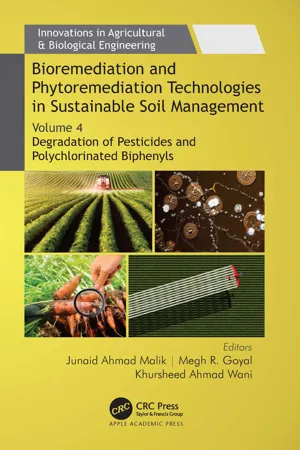
This 4-volume set focuses on the use of microbial bioremediation and phytoremediation to clean up pollutants in soil, such as pesticides, petroleum hydrocarbons, metals, and chlorinated solvents, which reduce the soil's fertility and renders it unfit for plant growth. The volumes cover the many diverse eco-friendly microbial bioremediation and phytoremediation techniques for sustainable soil management.
Volume 4: Degradation of Pesticides and Polychlorinated Biphenyls addresses pesticide degradation, PCBs degradation, and genetic interventions. It begins by describing environmental pesticide degradation, mechanisms and sustainability, microbes and microbial enzymes, plant microbe interactions, organophosphorus degradations and endosulfan degradation. It then goes on to discuss PCBs and degradation, cypermethrin, degradation by Phanerochaete chrysosporium, and carvone and surfactants for degradation of PCBs. The book also advocates for genetic systems for degradation of PCBs and pesticides, with discussion of the different advantages and disadvantages for each strategy and the various techniques.
Other volumes in the 4-volume set: • Volume 1: Fundamental Aspects and Contaminated Sites • Volume 2: Microbial Approaches and Recent Trends • Volume 3: Inventive Techniques, Research Methods, and Case Studies
Together, these four volumes provide in-depth coverage of the mechanisms, advantages, and disadvantages of the bioremediation and phytoremediation technologies for safe and sustainable soil management.
CHAPTER 1 ENVIRONMENTAL PESTICIDE DEGRADATION: MECHANISMS AND SUSTAINABILITY
MUZAFAR RIYAZ, PRATHEESH MATHEW, RAUF AHMAD SHAH, K. SIVASANKARAN, and S. M. ZUBER
ABSTRACT
Pesticides are the chemical compounds that are used to control various pests and disease spreading vectors like mosquitoes, ticks, and household pests such as rats and cockroaches. Majority of the pesticides are used in agriculture to control various types of insect pests as well as non-insect pests like ticks and mites, weeds, and fungal infestations and other crop diseases. Pesticides assume a comparative job in saving the crops from notorious pests thereby boosting the economy of a country. However, with the rise in global population, the crops are being cultivated in large-scale resulting in unrestricted utilization of the pesticides. Pesticides have been linked to various environmental contaminations like soil, water, and air. In addition to removing the insects, weeds, vectors, and other household pests, there has been a great impact of pesticide use on the beneficial insects like pollinators, birds, fishes, non-target plants and on the human health as well. Removing pesticides from the environment, abiotic, and biotic transformations play an important role in cleansing the pesticide residues from the environment. Environmental degradation of pesticides involves biotic transformation processes facilitated by microorganisms or plants and by the abiotic processes such as chemical and photochemical reactions.
1.1 INTRODUCTION
From the dawn of ancient agriculture to the modern-day precision farming; our earth has witnessed a number of famines and over millions of people have died due to lack of food triggered either by pest outbreaks, wars, or crop failure. But with the passage of time, mankind has avoided such catastrophes with the development of pesticides back in 1948 [1]. Pesticides are usually man-made chemicals which are used to control pests which include mostly insect pests followed by fungi, viruses, bacteria, weeds, rodents, etc. The range of consumption of these pests may vary as many pests either consume a full crop or a portion of it. Therefore, directly or indirectly, may threaten our food supply. In the present time, our food system is totally dependent on the pesticides, since with the rise in global populations across the planet, food supply is one of the major issues to be taken care of. Although, monoculture (single crop farming) taken care of it, however it also left our crops exposed to extensive attack by the pests which in turn has added more utilization of pesticides in our farm fields [86]. For safeguarding crops, mankind has been in battle with pests since ages, when ancient Sumer used sulfur dusting to save the crops from the pests which date back 4,500 years in Mesopotamia [44]. From the evolution of pesticides to the progression of modern agriculture, the widespread use of pesticides by farmers and the general public has been linked to various environmental contaminations like soil, water, and air. In addition to removing the insects, weeds, vectors, and other household pests, there has been a great impact of pesticide use on the beneficial insects like pollinators, birds, fishes, non-target plants and on the human health as well [158]. While utilizing the pesticides, the residues can remain in the environment for a long period of time and can be dispersed over a long distance. Pesticide residues in soil and water can pose a threat to the biological diversity and human health. After subsiding in the environment, the pesticides start to break down and forms new chemicals that are more or less toxic [29]. To enter into the environment, pesticides are having many possible sources after getting sprayed at large quantities. When exposed to sunlight or microorganisms in soil, most modern pesticides degrade easily however, the utmost number of pesticides after application scatter into non-target areas or leach into groundwater or move in surface run off by misuse and misapplication while handling or spraying. While spraying these chemical pesticides, a series of reactions a pesticide can undergo; plants can take up pesticides through leaves and roots, atmosphere can take up pesticides as vapors, pesticides can get ingested by insects, worms, and microorganisms, carried off as drift (Figure 1.1). In some cases, soil particles are the factors that pesticides can adhere with or rainwater and irrigation can dissolve can provide a quick transportation to carry the pesticides in nearby water streams and rivers which in turn can pose serious threats to our water bodies, aquatic organisms, and environment as well [95, 99, 139].
FIGURE1.1 After application, pesticides can be taken up by non-target organisms (plants, insects, earthworms, microorganisms).
Source: Photos: Muzafar Riyaz.
Pesticides have improved over time and are currently regulated by the strict safety standards. However, with the large-scale utilization they still hold the potential to contaminate our ecosystems, pollute soil, water, air, impact on wildlife, beneficial pollinators, and human health. There are number of properties that pesticide can establish within the environment that can affect the behavior of a particular ecosystem. The pesticide and its degree of risk to the environment depend upon four factors. Environmental risks of the pesticides can be summarized by analyzing these four factors. These are the properties of pesticides which after application can cause short-term or long-term effects on the environment and other organisms as well by either persisting at a long period or by drifting to places other than target sites [74] (Figure 1.2):
FIGURE1.2 Factors affecting pesticide and its degree of risk to the environment.
Persistence: How long the pesticide remains active in the environment.
Mobility: How easily the pesticide can move from where its applied.
Non-Target Toxicity: How toxic is the pesticide to other organisms other than pest.
Volume of Use: How much of that pesticide is used in the environment.
A number of properties of pesticides can affect their behavior in their environment and can cause a multiple number of environmental contaminations which include persistence, degradation, bio-accumulation, volatility, adsorption, and absorption [143]. Sooner or later, pesticides are broken-down in the environment by a process called degradation. Depending upon the nature of pesticide and environmental conditions of a particular area, the process of degradation can be rapid or deliberate. However, microorganisms present in soil, chemical reactions and sunlight play a key role in the degradation of pesticides. On the other hand, pesticide molecules can be a food source of microbes while taking the advantage of moist and warm soils; microbes can turn the pesticide molecules into carbon dioxide and water. Some pesticides such as chlordane and DDT (dichlorodiphenyltrichloroethane) do not break down quickly; this class of pesticides are called persistent pesticides [56]. Persistence can be greater in heavy clay or organic soil than in sandy soil. Some pesticides after intake through food, water or air may accumulate or build-up in body tissues or body fat of humans and animals by a process called bio-accumulation [196]. If the organism cannot eliminate the p...
Table of contents
Cover Page
Half-Title Page
Title Page
Copyright Page
About the Editors
Table of Contents
Contributors
Abbreviations
Foreword
Preface
Part I: Microbial Degradation of Pesticides
Part II: Polychlorinated Biphenyl (PCBS) Degradation
Part III: Genetic Intervention
Index
Trusted by 375,005 students
Access to over 1.5 million titles for a fair monthly price.
Study more efficiently using our study tools.
Frequently asked questions
Yes, you can cancel anytime from the Subscription tab in your account settings on the Perlego website. Your subscription will stay active until the end of your current billing period. Learn how to cancel your subscription
No, books cannot be downloaded as external files, such as PDFs, for use outside of Perlego. However, you can download books within the Perlego app for offline reading on mobile or tablet. Learn how to download books offline
Perlego offers two plans: Essential and Complete
Essential is ideal for learners and professionals who enjoy exploring a wide range of subjects. Access the Essential Library with 800,000+ trusted titles and best-sellers across business, personal growth, and the humanities. Includes unlimited reading time and Standard Read Aloud voice.
Complete: Perfect for advanced learners and researchers needing full, unrestricted access. Unlock 1.5M+ books across hundreds of subjects, including academic and specialized titles. The Complete Plan also includes advanced features like Premium Read Aloud and Research Assistant.
Both plans are available with monthly, semester, or annual billing cycles.
We are an online textbook subscription service, where you can get access to an entire online library for less than the price of a single book per month. With over 1.5 million books across 990+ topics, we’ve got you covered! Learn about our mission
Look out for the read-aloud symbol on your next book to see if you can listen to it. The read-aloud tool reads text aloud for you, highlighting the text as it is being read. You can pause it, speed it up and slow it down. Learn more about Read Aloud
Yes! You can use the Perlego app on both iOS and Android devices to read anytime, anywhere — even offline. Perfect for commutes or when you’re on the go. Please note we cannot support devices running on iOS 13 and Android 7 or earlier. Learn more about using the app
Yes, you can access Bioremediation and Phytoremediation Technologies in Sustainable Soil Management by Junaid Ahmad Malik,Megh R. Goyal,Khursheed Ahmad Wani in PDF and/or ePUB format, as well as other popular books in Technology & Engineering & Biology. We have over 1.5 million books available in our catalogue for you to explore.