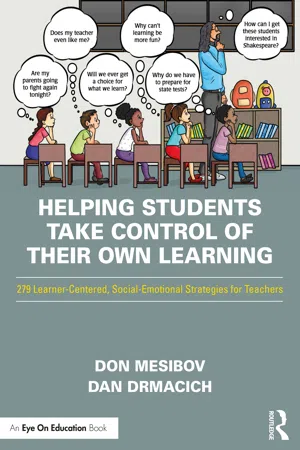
What does learner-centered education look like, and how can we best put it into practice? This helpful book by experienced educators Don Mesibov and Dan Drmacich answers those questions and provides a wide variety of strategies, activities, and examples to help you with implementation. Chapters address topics such as positioning students at the center of the lesson and teachers as coaches, making tasks relevant and engaging, incorporating the affective domain and social-emotional learning, assessing learning, and more. Appropriate for new and experienced teachers of all grades and subjects, this book will leave you feeling ready to help students take control of their own learning so they can reach higher levels of success.
Section Two How Do the Teachers’ and Students’ Roles Change?
It All Starts with the Teacher
Prioritize What Impacts Student Learning
Student Needs, Interests, and Learning: Styles Should Be at the Center of a Lesson
Motivation Is Derived from What Students: Find Interesting, Relevant, or Just Plain Fun
Teachers Are Classroom Coaches
Critical Thinking Is the Main Focus for Student Learning
Advisories, Journaling, and Conferencing Are Essential
Music and Art Facilitate Learning in All Disciplines
Students Need a Vision
Introverted (or Quiet) Children Require Special Strategies
Educators Can Make Use of Lectures and Be Effective
Student-centered learning encourages and
allows for individualizing and personalizing
instruction; the needs of all learners—high performing,
identified, introverted, artistically or
musically intelligent, or slower learning—
can be addressed in a single classroom by
a single teacher
6 It All Starts with the Teacher
DOI: 10.4324/9781003284697-8
The school principal, Ms. Wonderly, gazed upon the classroom and saw students sitting quietly in rows as Mr. Glade spoke with little expression or movement except for his mouth. A few students appeared to be paying complete attention. Several were talking to the student behind or across from them. One was designing paper planes, waiting for Mr. Glade to look away, and then throwing them at predetermined targets throughout the room. Two kept their heads on their desks with no pretense of paying any attention to what Mr. Glade was saying.
It took a good deal of restraint for Ms. Wonderly to resist the temptation to stick her head in the door and ask, “Why is there no learning taking place in this class?”
Understanding Student-Centered Schools
Call it learner-centered, student-centered, or constructivist-based, what counts is the school’s commitment to encouraging teachers to empower students to take responsibility for their own learning. There must be a priority to improve students’ academic growth, citizenship, and ethical/moral behaviors.
What Is Missing from These Recommendations for School Reform?
Revise the curriculum
Improve and expand training for school administrators
Reduce student loan requirements
Reduce or increase the number of state and federal mandates
Significantly increase, and equalize, school funding
Raise teacher pay
Increase or decrease the number of charter schools
HINT: All of these are important to consider, but something more important is missing from this list. Any idea what it is? If you had to name one factor that is more important to a child’s education than any other, what would it be?
Got it yet? Missing from this list of critical factors in a child’s formal education is what happens in the classroom.
Nothing can influence student success more than the impact of the classroom teacher. That is why it is of the utmost importance to ensure teachers thoroughly understand the concept of learner-centered pedagogical practices (“Eliciting Engagement in the High School Classroom: A Mixed-Methods Examination of Teaching Practices,” Cooper, 2014).
In a perfect world, all children would be in classrooms with the latest technology, expensive resources, an ideal schedule, a forward-looking administration, and a passionate, effective teacher. But we do not live in a perfect world yet. If it came down to a forced choice in which only one of the aforementioned could be in a classroom, wouldn’t we all choose that passionate, effective teacher?
School reform must focus on support for the classroom teacher because this is the person with the most significant impact on student learning.
Traditional vs. Learner-Centered Teachers
Traditional teacher: Abraham Lincoln is considered to be one of our greatest presidents because he opposed slavery and led the country during the Civil War. Take careful notes and be prepared for this to be on the unit test.
Strategy 3: Ranking-by-Priority Activity
Learner-centered teacher: Rank all the presidents we have studied so far from most effective to least effective and write an essay that explains your ranking for each. You may work with a partner or work alone. Either way, please keep a daily journal that records how your research is attempting to address this assignment's criteria. The criteria will be posted by the class’s student website committee, where you will also find a list of readings, videos, and other resources that may help you in your research. Feel free to use other sources.
Commonsense Conclusion
A child’s most valuable school-based resource is a learner-centered teacher, especially given that all students need to be appropriately engaged.
7 Prioritize What Impacts Student Learning
DOI: 10.4324/9781003284697-9
After he denied some of his teachers’ requests to attend a workshop on learner-centered practices, Principal Miles Archer prepared himself for pushback. “After all,” he thought to himself, “the ones I turned down are the same teachers who attended a two-day workshop on the same topic a year ago, and our budget isn’t elastic.”
At home, Mr. Archer complained to his spouse, “These teachers just want to get out of the classroom for a few days, and they just don’t understand that substitutes cost money.” When Ms. Archer, a high school teacher in another district, tried to explain how difficult it is for a teacher to feel comfortable with learner-centered practices, he lamented, “I didn’t have learner-centered teachers when I was in school, and I turned out OK, didn’t I?” Ms. Archer, herself a believer in active learning, just looked toward the ceiling and didn’t say a word.
If we can agree that the single most important factor for a student’s in-school development is the teacher, doesn’t it follow that the most significant step a school administrator can take is to ensure sufficient learner-centered professional development opportunities and resources to support classroom teachers and specialists?
Most administrators and teachers did their own learning in traditional classrooms, were trained to teach by professors who modeled traditional teaching practices, and got jobs at schools where a majority of instructors taught using traditional methods. The skills required to manage a learner-centered classroom differ significantly from those required in traditional classrooms, where students are expected to sit quietly and speak only when called upon. It takes an understanding of learner-centered research and practice to become proficient in actively engaging students in developing the skills needed to become active, critical-thinking citizens.
Administrators have an important role to play in helping staff recognize the importance of learner-centered education and understand where the design of a learner-centered school or district ranks among their school’s priorities. For an example of a process for helping teachers design a learner-centered activity, lesson, or unit, visit www.learningcentered.org or email [email protected].
Moving learner-centered, social-emotional classrooms to the top of a school’s or district’s list of priorities need not be accompanied by new costs. Funding is already provided for professional development, conferences, and classroom supplies in every district, although in varying degrees. Prioritizing learner-centered practices simply requires shifting these resources in alignment with a determination that every classroom shall be as learner-centered as possible, as quickly as possible. It also requires recognizing the difficulty that most teachers encounter when they begin the journey from traditional to learner-centered teaching. This professional goal is not one that can be accomplished overnight. Teaching in a learner-centered classroom requires a significantly different skillset, one that is not part of the average teacher’s bag of tools.
Constructivist practice requires teachers to put in substantial time creating learning experiences that engage students. It is the teacher's “scaffolding” assistance throughout these experiences that enables students to learn to think critically, not just memorize or regurgitate existing formulas and information. When first engaging students in cooperative work, or any other learner-centered activity, teachers often feel they are losing control. But with sufficient practice and support, they can master the art of learner-centered teaching and witness the positive difference it will make for their students.
Commonsense Conclusion
Administrators need to focus on what’s most essential—supporting teachers in developing the skills to facilitate learner-centered instruction in their classrooms and communicating to staff that they understand this will be a lengthy, though worthwhile, journey.
8 Student Needs, Interests, and Learning Styles should be at the Center of a Lesson
DOI: 10.4324/9781003284697-10
Joel Cairo grew up idolizing Jackie Robinson. So when his teacher, Effie Perone, assigned the class Silas Marner, a book in which he had no interest, he asked if he could choose another book. When Ms. Perone explained she wanted him to write about plot, character, setting, and conflict in Silas Marner, Joel asked, “Why can’t I write about those things in The Jackie Robinson Story?”
Ms. Perone refused to even offer a compromise. When Joel couldn’t find a movie about Silas Marner, he located a summary of the story on the internet and completed the assignment in less than an hour.
In a student-centered learning space, students are often involved in choosing what they will learn, how they will learn, and how they will assess their own learning. The teacher mainly controls the environment and makes final decisions where necessary and appropriate. However, the teacher empowers students by turning over a significant amount of control of the learning process. A learner-centered classroom is tightly structured and allows for what may initially appear, to unaware observers, to be chaos.
Consistent with constructivist theory, a learner-centered classroom should
Cognitively challenge students,
Experientially engage students (physically, mentally, and emotionally), and
Use inquiry-based techniques that challenge students with teacher and student questions.
The following is another example of the difference between a typical teacher-directed and learner-centered classroom activity:
Teacher-centered: “Review the first ten amendments to the Constitution and prepare for a test.”
Strategy 4: Ranking-in-Order Activity
Learner-centered: “Rank the ten amendments from most important to least important. Then, pair with another student and compare your lists. You must either reach consensus on one combined list or be prepared to share where you disagree and offer your reasoning. Then pair with another pair and try to reach consensus on one list. If you cannot, you must once again be prepared to defend your positions. Having a rationale is more important than whether I, as the teacher, agree with you.”
One teacher explained the shift in his thinking as he transitioned from traditional methods of teaching to learner-centered:
I used...
Table of contents
Cover Page
Half Title page
Series Page
Title Page
Copyright Page
Dedication
Contents
Frontispiece
Acknowledgments
A Message from the Authors
Introduction
Section One Why Do Schools Need to Change?
Section Two How Do the Teachers’ and Students’ Roles Change?
Section Three Is There Room for the Affective Domain?
Section Four Do Students Find School Relevant?
Section Five How Do We Test What Students Should Be Learning?
Section Six What Should All Teachers Understand?
Section Seven Is Meaningful School Reform Possible?
Epilogue: Opportunities for Students Are Inequitable
Appendix A: Resources for Advocacies and Journaling
Appendix B: Resources for Teaching Good Citizenship
Appendix C: Resources for Teaching Social Justice (Titles Contain URLs)
Bibliography
Trusted by 375,005 students
Access to over 1.5 million titles for a fair monthly price.
Study more efficiently using our study tools.
Frequently asked questions
Yes, you can cancel anytime from the Subscription tab in your account settings on the Perlego website. Your subscription will stay active until the end of your current billing period. Learn how to cancel your subscription
No, books cannot be downloaded as external files, such as PDFs, for use outside of Perlego. However, you can download books within the Perlego app for offline reading on mobile or tablet. Learn how to download books offline
Perlego offers two plans: Essential and Complete
Essential is ideal for learners and professionals who enjoy exploring a wide range of subjects. Access the Essential Library with 800,000+ trusted titles and best-sellers across business, personal growth, and the humanities. Includes unlimited reading time and Standard Read Aloud voice.
Complete: Perfect for advanced learners and researchers needing full, unrestricted access. Unlock 1.5M+ books across hundreds of subjects, including academic and specialized titles. The Complete Plan also includes advanced features like Premium Read Aloud and Research Assistant.
Both plans are available with monthly, semester, or annual billing cycles.
We are an online textbook subscription service, where you can get access to an entire online library for less than the price of a single book per month. With over 1.5 million books across 990+ topics, we’ve got you covered! Learn about our mission
Look out for the read-aloud symbol on your next book to see if you can listen to it. The read-aloud tool reads text aloud for you, highlighting the text as it is being read. You can pause it, speed it up and slow it down. Learn more about Read Aloud
Yes! You can use the Perlego app on both iOS and Android devices to read anytime, anywhere — even offline. Perfect for commutes or when you’re on the go. Please note we cannot support devices running on iOS 13 and Android 7 or earlier. Learn more about using the app
Yes, you can access Helping Students Take Control of Their Own Learning by Don Mesibov,Dan Drmacich in PDF and/or ePUB format, as well as other popular books in Education & Education General. We have over 1.5 million books available in our catalogue for you to explore.