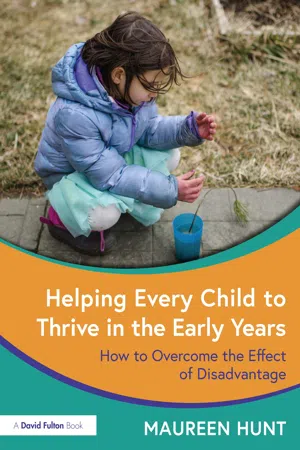
Helping Every Child to Thrive in the Early Years shows how a personalised and relationship-based approach to education and care can help overcome the 'disadvantage gap' in the early years. It examines the challenges that children from disadvantaged backgrounds face and looks at what settings and practitioners can do to enable every child to succeed.
Drawing on the latest research and using the insight gained from many years of working in early education the book considers the impact that disadvantage can have on children's development and argues that building strong relationships with children and families is key to closing the gap.
Chapters cover:
The different kinds and effects of disadvantage
The importance of having a clear vision and shared values
The culture of early years and how it has shaped practice
Developing strong parent partnerships
Supporting children with additional needs
Smooth transitions
Full of practical advice and supporting anecdotes and case studies, this is essential reading for early years practitioners, setting managers and teachers working with children in Reception and KS1.
Early on in my teaching career I did some supply work and found myself working in a Y3 class with seven and eight year olds and I was accompanying them on a visit to a local farm. There was the usual excitement and noise, and it was clear that for some of these children it was a really big event – some said they had never been on a coach before and others chatted about what they might see at the farm. One boy – Joe, was very quiet and stayed close to me, I had been made aware that he was a ‘slow learner’, so I decided to sit with him and try to get to know him a bit more. I asked if he had been to a farm and he shook his head, and as he stared out of the window we talked about the things he could see. I could tell he hadn’t been very far away from home before, especially when we drove over the bridge about two miles from school and suddenly his eyes widened as he shouted, ‘I’ve seen this on the telly’.
By the time we arrived at the farm he was animated with excitement, they all were, and the first animals we saw were the sheep. The farmer came to meet us and said he was rounding up the sheep for shearing – a great educational opportunity for us so we went to watch. It was at that point that Joe shouted and pointed –
‘look Miss there’s a sheep over there with no hair on!’
My heart sank as I said the words ‘no Joe that’s a pig’. I was really shocked – how could a child get to seven years of age and not know what a pig looked like? How small had his world been that he had never learnt to recognise basic farm animals? To me it summed up disadvantage, this boy went nowhere and did very little and was nevertheless expected to be able to make sense of the world in the same way as others who took trips like this for granted.
Looking back this was really a pivotal moment for me, as from then on I made every effort to ‘keep it real’ – with as many first-hand experiences planned in for children as possible, it became a personal challenge and one I thoroughly enjoyed trying to meet. It was at this point that I stopped planning meaningless activities – for example, cut and stick, or worksheets that did little more than keep children busy. All topics that were planned had to have some kind of real experience as a starting point and as many hands-on purposeful activities as possible. The vocabulary that developed from these experiences was really encouraging and the children seemed really engaged; undoubtedly this was one of the best decisions of my career – it really did make a difference, especially for children who had limited life experiences.
It wasn’t all plain sailing though; once when studying the life cycle of a frog we hit trouble. I previously taught this by developing a life cycle wheel with pictures for children to colour in of the various stages – frogspawn, tadpole, froglet and frog – but of course we weren’t going to do that now so I collected frog spawn and had a tank in the classroom for children to watch as they developed and they could record what they could see happening. Of course, young children are curious, that’s what makes them so exciting to teach, and so I shouldn’t have been surprised when one day a small child reached up to the tank and pulled it over. The screams as she was drenched in water were horrendous, as was the hysteria which quickly spread across the classroom, but this was in no way as bad as me having to spend the next half an hour trying to scoop up frogspawn and tadpoles from the carpet and put them back in the tank, convinced somehow that I would be prosecuted under some animal rights law for murdering tadpoles. It still haunts me.
What is disadvantage?
Disadvantage in education terms ‘encompasses not only income poverty, but also a lack of social and cultural capital and control over decisions that affect life’ (Crenna-Jenkins, 2018).1 It describes the children that are unable to benefit from the full opportunities that the education system can offer because of a variety of barriers that prevent them from doing so and have a detrimental effect on their outcomes. These disadvantages can be due to a wide variety of complex issues including poverty, the impact of disability or health issues, or as a result of trauma through neglect, abuse or abrupt changes in circumstances.
Children can be disadvantaged due to a number of cultural and societal barriers – gender, ethnic minorities, EAL, Gypsy/Roma/Traveller families, children in care, children with emotional and social development difficulties, children who have no play skills to name a few. This chapter outlines the need for children who are disadvantaged in some way to be given something additional and different to the others, an approach that works to identify the barriers, and practice that goes some way to mitigating the risks that they pose on that child’s future – in short it is an individual approach that works to overcome disadvantage.
In England, disadvantage in education is measured by those eligible for free school meals and Pupil Premium funding although this can often hide the true figures as these are reliant on parents registering and not all parents are willing to do this. The relationship between disadvantage and attainment is well documented in the UK and the data clearly shows that children eligible for the Pupil Premium start school behind their better off peers and the gap widens as they go through school.
‘Progress is beginning to stall in tackling inequalities in our education system.If current 5 years trends continue,it would take over 500 years for the overall disadvantage gap to close by the end of secondary school’ (Fair education alliance, 2019).2
Disadvantage and the brain
If we are going to tackle disadvantage we need to start early. As soon as a child is conceived, a wide variety of factors related to poverty and disadvantage come into play which affect the health and well-being of the child. Maternal stress levels and poor nutrition can adversely affect a child’s brain development even before birth.
Once a child is born, brain development is rapid, especially in the first three years of life but healthy brain development is dependent on a nurturing environment and stress in the Early Years can have a long-term effect on the architecture of the developing brain.
Impoverished children have less access to medical care, increased exposure to toxins, violence and income inequality. Having to deal with all of these factors is more than any one person can deal with. It’s stressful, and subsequently affecting developmental growth.
(Pollak, 2016)3
The development of the amygdala and hippocampus brain regions that support learning, memory, mood and stress reactivity is suppressed in disadvantaged children (Brody et al., 2017), so it is not hard to understand why brain development and educational achievement are linked, why some children struggle to learn and how this adversely affects their life chances.
Attachment
Attachment is like an invisible thread linking the baby and the young child to the significant adults in their life. It is a major aspect of early childhood development and forming secure attachments and is vital for good emotional development. It is from these emotional bonds that the child gains security, becomes resilient and able to form positive relationships with others. The relationships young children form act as a blueprint for their future relationships and learning, so it is important to get it right from the start as this is key to closing the disadvantage gap. All Early Years settings should not only be aware of Attachment but should have active processes for developing secure attachments with children as well as recognising where a child may have poor attachments outside of the setting.
If broken attachments and serial carers are to be the norm then we are disregarding all we know about the importance of stable, healthy, secure relationships with just a few special people to nurture children’s wellbeing, health and dispositions for learning.
Dorothy Y. Selleck4
Babies are completely dependent for everything on their principle carer. As they try to make sense of the way their world works it is the reciprocal relationships and the unconditional love and care they receive that makes this possible. They soon become attached to their main carer in a special way. Steve Biddulph (Biddulph, n.d.)5 in his book ‘raising boys’ comments on the difference between our culture and what he calls wiser cultures and how they form strong attachments with their children. One Balinese tradition is the first ‘setting down to earth’ of a new baby does not take place until the child is six months old. Before this the child is never out of someone’s arms or in a sling; it is obvious that this culture values attachment highly. The meeting of basic physical needs, and building a sense of personal security, forms the bedrock of intellectual, social, emotional and physical development. This idea is central to the theories of the developmental psychologist Maslow, first proposed in 1943, and still very relevant today.
Maslow6 stated that people are instinctively motivated to achieve certain needs. When one need is fulfilled a person seeks to fulfil the next one, and so on. This is why his model is often depicted as a pyramid. Maslow’s Pyramid (Figure 1.1) shows that the degree of ‘self-actualisation’, that is, being a strong resilient capable learner will not happen if basic needs remain unfulfilled.
Figure1.1 Maslow’s hierarchy of needs.
The role of the key person
The key person is a designated person who takes on a very special responsibility for individual children in the setting while those on whom the child usually depends are not there. The key person approach in all settings makes a massive difference to children and parents when it is well planned and thoughtfully implemented and is key to understanding the barriers that are preventing children from learning. The key person finds out all about the child, helps them to settle when they first start and works out with the parents their individual settling in procedures that will best suit the child. In a setting the key person forms the strongest relationship between the setting, child and family.
Each child must be assigned a key person. Their role is to help ensure that every child’s care is tailored to meet their individual needs, to help the child become familiar with the setting, offer a settled relationship for the child and build a relationship with their parents.
Statutory Framework for the Early Years Foundation Stage. Page 21. 3.27
The Early Years Foundation Stage (EYFS) acknowledges this very important role that practitioners have to play. It has become a statutory requirement because ensuring children’s emotional security is paramount to a child’s well-being.
Coupled with this is an important neuro-scientific fact: an anxious brain will not learn!
‘The key person makes sure that, within the day-to day demands of the setting each child feels individual, cherished and thought about by someone in particular while they are away from home’.7
Early Years Pupil Premium
The UK government’s answer to closing the disadvantage gap is to provide additional funding for pupils in schools who are disadvantaged in the form of pupil premium and followed it up with Early Years Pupil Premium (EYPP) funding in 2015. EYPP is given to providers of Early Years education to support their most disadvantaged three and four year olds. This was a long time coming, since Pupil Premium in schools was introduced in 2011, and was warmly welcomed by the Early Years sector, as it went some way towards the recognition that disadvantage does not start at the school gate and there is much that can be done in early education to ensure better outcomes for those most at risk. It says something about our education system if Early Years is the last place to receive funding and that funding equates to only an additional 53p per hour compared with £1,345 per annum for children in primary school, and an even greater amount for looked after children. Indeed, most interventions to close the gap are funded at school level, but surely if we started to address the issues much earlier there would be less need later on.
A 2017 DfE report showed that although many settings were getting used to the process and finding it easier to navigate the system, they still reported that it remained a challenge to be able to evidence the spend against outcomes:
…there was broad consensus that providers would welcome additional support and guidance to monitor spending and assess effectiveness, including at a more strategic level and across settings.8
To meet growing demand and to capitilise on opportunity, a wide variety of resources and services have popped up on the market that support the spending of the EYPP, but this can have the effect of adding to the dilemma surrounding decision making, as they all claim to be the answer, but how do you address the key issue – how do you really know what you need?
A survey9 undertaken by the Department for Education (DFE) found that the funding was commonly used to provide targeted support for individual children, to pay for literacy and numeracy resources, to support staff development and purchase outdoor resources. The report also outlines that the group-based providers, that is, those outside of the maintained sector, were more likely to use the funding to benefit all the children in the setting (60%) and the highest expected impact reported (28%) was that it would raise the quality for all children in the setting.
Anything that supports raising quality and providing better resources is undoubtedly good news, but the EYPP needs to go further than this if it is really going to fulfil its core purpose of reducing inequality between children from lower-income families and their better off peers.
The Social Mobility Commission’s10 State of the Nation report in 2016 warns that Britain’s deep social mobility problem is getting worse. It reports that children in deprived areas are twice as likely to be in childcare that is not good enough, compared with the most prosperous areas and recommends the Government double EYPP funding as part of an overall strategy to raise quality. This raises the issue for the whole sector that greater investment is needed in order to drive up quality by ensuring the profession is highly valued and it is an attractive option for those who are interested in pursuing a career in early education. This will only happen if the sector can attract and retain qualified practitioners and it is hard to s...
Table of contents
Cover
Half Title
Title Page
Copyright Page
Table of Contents
Lists of figures
Introduction
1 What Is Disadvantage?
2 The Culture of Early Years
3 Inclusion
4 Vision and Values
5 Parent Partnerships
6 Children with Additional Needs
7 Ready to Read?
8 Transitions
Conclusion
Index
Trusted by 375,005 students
Access to over 1.5 million titles for a fair monthly price.
Study more efficiently using our study tools.
Frequently asked questions
Yes, you can cancel anytime from the Subscription tab in your account settings on the Perlego website. Your subscription will stay active until the end of your current billing period. Learn how to cancel your subscription
No, books cannot be downloaded as external files, such as PDFs, for use outside of Perlego. However, you can download books within the Perlego app for offline reading on mobile or tablet. Learn how to download books offline
Perlego offers two plans: Essential and Complete
Essential is ideal for learners and professionals who enjoy exploring a wide range of subjects. Access the Essential Library with 800,000+ trusted titles and best-sellers across business, personal growth, and the humanities. Includes unlimited reading time and Standard Read Aloud voice.
Complete: Perfect for advanced learners and researchers needing full, unrestricted access. Unlock 1.5M+ books across hundreds of subjects, including academic and specialized titles. The Complete Plan also includes advanced features like Premium Read Aloud and Research Assistant.
Both plans are available with monthly, semester, or annual billing cycles.
We are an online textbook subscription service, where you can get access to an entire online library for less than the price of a single book per month. With over 1.5 million books across 990+ topics, we’ve got you covered! Learn about our mission
Look out for the read-aloud symbol on your next book to see if you can listen to it. The read-aloud tool reads text aloud for you, highlighting the text as it is being read. You can pause it, speed it up and slow it down. Learn more about Read Aloud
Yes! You can use the Perlego app on both iOS and Android devices to read anytime, anywhere — even offline. Perfect for commutes or when you’re on the go. Please note we cannot support devices running on iOS 13 and Android 7 or earlier. Learn more about using the app
Yes, you can access Helping Every Child to Thrive in the Early Years by Maureen Hunt in PDF and/or ePUB format, as well as other popular books in Education & Early Childhood Education. We have over 1.5 million books available in our catalogue for you to explore.