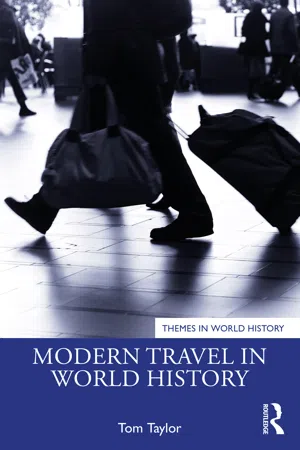
Modern Travel in World History uses three themes–technology, mass movements and travelers–to examine the history of the modern world from the fifteenth-century transatlantic explorations to the impact of the global COVID pandemic of the twenty-first century.
This book focuses on both the evolving nature of travel, from land and sea routes in the 1500s to the domination of planes and cars in the modern world, and the important stories of travelers themselves. Taking a global perspective, the text places travel within the larger geopolitical, social, religious and cultural developments throughout history. It emphasizes not only the role of technology innovation in the ways people travel but also how those changes affect social structures and cultural values. Tom Taylor explores the journeys of well-known travelers as well as ordinary people, each with different perspectives, through the lens of gender, social class and cultural background, and considers how fictional travelers define the importance of travel in the modern world. Why people set out on the sojourns they did, what they experienced, who they met and how they understood these cross-cultural encounters are important to not only understanding the travelers themselves but the world they lived in and the world their travels made. Several maps help illustrate important routes and destinations.
This book will be of interest to students of world history and literature.
For many years, October 12 was observed as the Columbus Day holiday across the Americas. In Latin America it is now celebrated under different terms. It was a day to commemorate when the small Spanish flotilla, captained by Christopher Columbus, landed on the shores of the Bahamas in 1492. Today, it is a day of reflection and remembrance. In Mexico it is now called Indigenous Peoples and Intercultural Dialogue Day. Venezuela heralds it as the Day of Indigenous Resistance. It no longer celebrates worlds coming together but rather worlds and peoples lost by the consequences of that day.
Even though the history of that day has been called into question, it is a day that changed the world forever. The Atlantic Ocean, a vast body of water that had separated the American and the Afro-Eurasian continents, was bridged, and continents were now connected. Europeans viewed the Columbus voyage as pivotal in order to reposition themselves in the larger world, to gain access to the wealth and trade of Asia that had largely alluded them. Although Columbus never expected to discover new worlds, his voyage did succeed in creating unfathomable opportunities that aligned with European colonial ambitions. In the wake of his voyage, France, England, Holland and others joined the exploration and colonial fray into the Americas and Asia.
By the end of the sixteenth century, travel across the Atlantic and Pacific Oceans, that was once infrequent and often accidental, had become regular and intentional. The European empires that dominated the Atlantic world carried with them a zealous ambition to discover, convert, colonize and conquer new worlds. This effort fundamentally reshaped the history of the modern world.
Ocean Travel and World History
World historians now consider the role that oceans have played in shaping global events through a field of study known as Thalassology. Rather than being seen as vast blue spaces between the land, they are increasingly analyzed as connectors not barriers. David Armitage’s World History as Oceanic History: Beyond Braudel offers an introduction to this evolving field. When Thalassology first took hold, it focused on the Mediterranean world, the Atlantic World or the Indian Ocean. It has evolved to better understand relevant connections between bodies of water, peoples from distant lands and shared experiences. “The English East India Company,” Armitage notes, “could not have functioned in the Indian Ocean without its Atlantic outpost on St. Helena. Until the opening of the Suez Canal, the Cape of Good Hope was the pivot between the Atlantic world and the Indian Ocean, a ‘tavern of the seas’ where empires joined, and oceans connected.”
Map1 Voyages of Columbus and Magellan
Transoceanic travel radically transformed the world during this period, building on land-travel routes that existed. The fabled Silk Road connecting Europe, the Near East and East Asia, while diminished in importance nonetheless continued to be used by traders, missionaries and travelers. The Inca roads that traversed the Andes continued to be used by Spanish conquistadors long after the Incan empire was destroyed. The peoples of North America traveled routes across the Rockies, across the Great Plains and into the Mississippi River Valley. Many Saharan routes continued to be used to as conduits for goods and ideas across Africa.
Setting the Stage: Oceanic Travel in the 1400s
Prior to the Spanish and Portuguese, in the late fifteenth century China was positioned to indeed become the global maritime power. In the early 1400s, a new Ming Emperor Yongle (r. 1402–1424) decided to enhance his prestige by establishing contact with and influence in territory outside of China. He did so by building a massive fleet of Chinese junks and ordering them to explore the Asian and Indian Ocean worlds. The voyages were referred to as the Chinese Treasure fleets.
Many of the ships were huge vessels that dwarfed other ships afloat. The largest ships of the fleet measured 400 feet long and over 150 feet wide with four decks and watertight chambers. Nine masts with sails of silk rose high above the decks. (By comparison, Columbus’ ship, the Santa Maria, built close to one hundred years later, was 80 feet long and had only three masts.) Some voyages used over sixty of these ships and numerous support vessels; there were seven voyages in total that sailed between 1405 and 1433.
Carrying precious goods produced by the empire—silks, porcelains and tea—the fleet hoped to impress the distant kingdoms it sailed to with the wealth and sophistication of the Chinese. The ships also carried soldiers, thousands of them. Their presence was intended to also make the wider world aware of the empire’s military strength and for it to be acknowledged accordingly. It is important to note that these fleets did not attempt to establish colonies or seize lands; they were more interested in establishing trading connections and proving their power rather than expanding China’s empire.
The Treasure fleet brought back medicines, spices and other precious commodities. Three of the six expeditions sailed across the Indian Ocean to the coasts of East Africa; some brought back giraffes to be displayed in the imperial court. While they largely succeeded in fulfilling the Emperor’s goals when he died in 1424, a new emperor, with new concerns and priorities, began to ignore and later abandon the fleets. The last voyage was in 1433, and when it came back to Nanjing Harbor it was ordered scuttled. Historians continue to debate the reasons why the new emperor turned away from the opportunities China had to be a transregional/global naval power, but what is clear is that that decision opened the doors for the emerging European maritime empires to fill the void left by China.
Europe Enters the Global Stage
Transoceanic travel was not new, but the developments of the second half of the fifteenth century and into the sixteenth century were different. New maritime technologies in ship design, navigational methods and cartography facilitated travel in unprecedented ways. These developments reshaped global trade, cultural exchanges and systems of political and military power that still influence the world over a half a millennium later.
Prior to the ‘voyages of discovery’ by Portuguese and Spanish adventurers in the later 1400s, Europeans had largely been limited in their transcontinental exploration. Various African kingdoms controlled key ports along the West and Swahili Coasts. The rise of the Ottoman Empire, marked by the capture of Constantinople in 1543, effectively shut off any direct access between Europe and the lucrative land routes that had been traveled by Marco Polo and others in prior centuries. Arab, Indian and Asian traders sailed on the monsoon winds across the Indian Ocean and South China Sea, largely controlling and benefiting from profitable trades in spices, medicines and other highly desired products.
Europe’s changing position in the world was predicated by three key developments. First, Spanish and Portuguese military success against the Islamic states along the Iberian Peninsula freed them to pursue transregional goals, convinced that their Catholic/Christian dominance over Islam was divinely ordained. When Christopher Columbus wrote to the Spanish crown trying to convince them of the opportunity to make connections with the riches of the Indies, he was inspired by such thinking. He penned his letter while looking over the recently breached walls of the last Muslim stronghold on the Peninsula, Granada. “The present year of 1492 after Your Highnesses had brought to an end the war with the Moors who ruled Europe… ,” he wrote, “had now made the Peninsula free ‘of all idolatries and heresies.’ Please consider sending me, Christopher Columbus, to the said regions of India … and to see how their conversion to our Holy Faith may be undertaken.” Similarly, the Portuguese were successful after decades of incessant warfare against Muslim forces in gaining footholds along the West African coast and offshore islands. Success led to even greater hope that expansion would garner heavenly favor and earthly riches. Eventually, rivalry between these two Iberian powers spurred desire for expansion in order to outmaneuver and ultimately defeat the other.
Ambition and religious conviction were not sufficient to accomplish the global domination that Spain and Portugal desired; they also needed the technology to traverse open oceans. In the minds of most mid-fifteenth-century Europeans, the Atlantic Ocean was, “a desolate place.” Even though Scandinavian Vikings had sailed across the Atlantic using the bridges of the North Atlantic islands centuries before, that knowledge had been largely forgotten, replaced with ancient tales of monsters and danger that lurked beyond the safety of the coast.
Given the challenges of navigating the ocean and the inadequacies of their ships, these treacherous conditions did not augur well for sailors who ventured outside the relative safety of coastline travel in the Mediterranean and Baltic Seas. Whether powered by oarsmen or by a single sail, galley ships used in these areas were simply not designed for longer open water voyages. Rough ocean conditions rendered small side-oar rudders useless as they had limited contact with the sea.
Poorly designed ocean-going vessels were only one of the technological impediments that European seafarers faced; they also needed better methods of navigation. Most medieval maps were highly schematic and tended to represent the world in relationship to the divine plan rather than with geographic accuracy. There were accurate maps of some trades routes frequented by European merchants, but these maps, called portolan charts, while useful for navigating Europe’s coastline, were worthless if one lost sight of land. A quadrant coupled with knowledge of the constellations visible in the northern hemisphere gave European sailors a good sense of latitude (their north-south position), but this knowledge was of little use once they sailed south of the equator, and the often stormy, cloudy weather made celestial observation impossible.
Over the course of several centuries, European sailors developed or borrowed the technology and knowledge necessary to make ocean travel possible. Historians debate exactly which innovations came from where and when. For example, they know that the magnetic compass that allowed sailors to determine direction in any kind of weather was first used by the Chinese and probably came to European travelers via their contacts with Arab sailors. They still speculate, however, as to whether the rear-keel rudder, which allowed ships to sail in rough waters and against the wind, came to Iberian sailors through contacts with Baltic sailors or possibly through knowledge of Arab ships in the Indian Ocean; both had used them for centuries. They wonder whether use of multiple sails and lateen, or triangular sails, which allowed their ships greater maneuverability, was developed from a process of trial and error or whether it came via sources that had seen Arab and Chinese ships in the Indian Ocean. Although questions remain, historians are confident that by the late medieval period Iberian fisherman and sailors developed the caravel, which eventually made transoceanic travel a reality. The caravel, a relatively small ship holding a maximum crew of fifty, could sail against the wind and was maneuverable enough to sail tight to the coast and even up larger rivers. Its rounded bottom also made it faster and therefore able to withstand longer voyages. Speed of travel, in turn, lessened at least some of the maladies—scurvy and tensions from the cramped, fetid conditions—that scuttled earlier voyages.
The Voyages of Christopher Columbus
The Christopher Columbus fleet was comprised of three caravels that sailed across the Atlantic in 1492. Columbus was named admiral of the venture, but given the size of the three caravels and a crew of eighty-seven men, the title seems every bit as exaggerated as his later claims of success. Columbus had a less-than-accurate understanding of geography. As his son later wrote: “The Admiral inferred that since the whole sphere (world) was small, of necessity that space of the third part which Marinus [a geographer who adopted Ptolemy’s maps] left as unknown had to be small and therefore could be navigated in less time.”
Columbus and his crew left their Spanish port of Palos de la Frontera on August 3, 1492, and headed south to the Canary Islands where they resupplied. From there, they headed west across the Atlantic. As days ticked by, with endless water ahead, his crew became increasingly nervous and questioned whether he knew what he was doing. Threats of mutinies surfaced but finally, after thirty-five days at sea, in the early morning hours of October 12, 1492, the crew of the Pinta, the fastest of the fleet’s ships, issued the signal that land had been sighted. A faint light, indicative (the crew surmised) of fires from a distant village or town, had been spotted. Together with the captains of the other ships and a small crew, they splashed into the water and walked to the beach. They thought they were in the Indies, but they were somewhere in the Caribbean, in the Bahamas.
Most of what we know about what happened that day comes from a version of Columbus’ diary. The original diary does not exist. The copy we have, while based on his original journal, was excerpted and summarized by his friend Bartolemé De Las Casas some thirty years later. The entries/journals abstracted by Las Casas challenge how historians understand the first encounters by Columbus. However, even given these caveats the journal remains an indispensable source for understanding these historic events.
According to the journal, as they approached land the admiral “called the two captains and to the others who had jumped ashore … and said that they should witness, in the presence of all, he would take, in fact he did take, possession of the said island for the king and queens his lords.” It was a gesture that would be repeated by European explorers over the next decades and centuries as they ventured further into the world. This act of declaring possession of a foreign land is widely known as colonization.
On January 4, the Niña set sail for home. A few months later Columbus pulled into safe harbor in Spain and presented the wonders of his voyage to King Ferdinand and Queen Isabella. It was not much, some gold, but not nearly the amount they likely anticipated. A few samples of cotton, spices and fauna were put on display. So, too, were several Indians that Columbus had kidnapped and dragged back to Spain. They were presented as symbols of the exotic voyage he had undertaken, with the hope of using them as interpreters for the return trip he had already started to plan. Despite the meager treasures he brought home, Ferdinand and Isabella agreed to finance another trip.
Shortly after Columbus returned and word of his success leaked out, the Portuguese crown appealed to the pope to protect the land claims that the papacy had previously granted them in return for their fight against Islam. In 1494, the Treaty of Tordesillas drew a line of demarcation 370 kilometers west of the Canary Islands. Everything to the west was to be Spanish territory and everything east, Portuguese. The race to stake claim was on. Amerigo Vespucci captained a...
Table of contents
Cover
Half Title
Series
Title
Copyright
Contents
List of Maps
Introduction
1 Global Travel and the Making of the Modern World
2 The Jesuits and the Making of a Global Missionary Order
3 Travelers and Travel in the Islamic World
4 The Atlantic Slave Trade
5 Enlightened Travelers and the Search for the Laws of Nature
6 The Industrial Revolution and the Global Transportation Revolution
7 Global Migration in the Nineteenth Century
8 Political and Social Reformers in the Nineteenth Century
9 Travel and Imperialism
10 Cars, Planes and Cargo Ships: The Twentieth-Century Transportation Revolution
11 War and Revolutions in the Early Twentieth Century
12 Dictatorships, the Great Depression and World War Two
13 Cold War Conflicts, Youth Rebellions and Decolonization Movements
14 Continuity and Change After the End of the Cold War
Afterword
Index
Trusted by 375,005 students
Access to over 1.5 million titles for a fair monthly price.
Study more efficiently using our study tools.
Frequently asked questions
Yes, you can cancel anytime from the Subscription tab in your account settings on the Perlego website. Your subscription will stay active until the end of your current billing period. Learn how to cancel your subscription
No, books cannot be downloaded as external files, such as PDFs, for use outside of Perlego. However, you can download books within the Perlego app for offline reading on mobile or tablet. Learn how to download books offline
Perlego offers two plans: Essential and Complete
Essential is ideal for learners and professionals who enjoy exploring a wide range of subjects. Access the Essential Library with 800,000+ trusted titles and best-sellers across business, personal growth, and the humanities. Includes unlimited reading time and Standard Read Aloud voice.
Complete: Perfect for advanced learners and researchers needing full, unrestricted access. Unlock 1.5M+ books across hundreds of subjects, including academic and specialized titles. The Complete Plan also includes advanced features like Premium Read Aloud and Research Assistant.
Both plans are available with monthly, semester, or annual billing cycles.
We are an online textbook subscription service, where you can get access to an entire online library for less than the price of a single book per month. With over 1.5 million books across 990+ topics, we’ve got you covered! Learn about our mission
Look out for the read-aloud symbol on your next book to see if you can listen to it. The read-aloud tool reads text aloud for you, highlighting the text as it is being read. You can pause it, speed it up and slow it down. Learn more about Read Aloud
Yes! You can use the Perlego app on both iOS and Android devices to read anytime, anywhere — even offline. Perfect for commutes or when you’re on the go. Please note we cannot support devices running on iOS 13 and Android 7 or earlier. Learn more about using the app
Yes, you can access Modern Travel in World History by Tom Taylor in PDF and/or ePUB format, as well as other popular books in History & World History. We have over 1.5 million books available in our catalogue for you to explore.