"Epic indeed, this is the definitive biography of Fitzgerald, plain and simple. There's no reason to own another." —
Library Journal
The Great Gatsby,
The Beautiful and Damned,
Tender Is the Night, "The Curious Case of Benjamin Button." These works and more elevated F. Scott Fitzgerald to his place as one of the most important American authors of the twentieth century. After struggling to become a screenwriter in Hollywood, Fitzgerald was working on
The Last Tycoon when he died of a heart attack in 1940. He was only forty-four years old.
Fitzgerald left behind his own mythology. He was a prince charming, a drunken author, a spoiled genius, the personification of the Jazz Age, and a sacrificial victim of the Depression. Here, Matthew J. Bruccoli strips away the façade of this flawed literary hero. He focuses on Fitzgerald as a writer by tracing the development of his major works and his professional career. Beginning with his Midwest upbringing and first published works as a teenager, this biography follows Fitzgerald's life through the successful debut of
This Side of Paradise, his turbulent marriage to Zelda Sayre, his time in Europe among The Lost Generation, the disappointing release of
The Great Gatsby, and his ignominious fall. As former US poet laureate James Dickey said, "the spirit of the man is in the facts, and these, as gathered and marshalled by Bruccoli over thirty years, are all we will ever need. But more important, they are what we need."
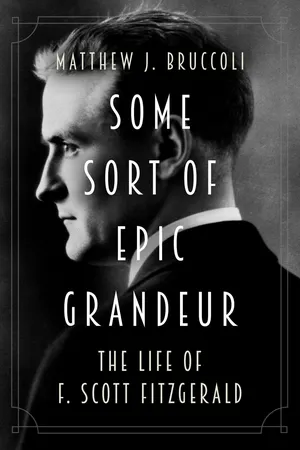
- 692 pages
- English
- ePUB (mobile friendly)
- Available on iOS & Android
eBook - ePub
About this book
Trusted by 375,005 students
Access to over 1.5 million titles for a fair monthly price.
Study more efficiently using our study tools.
Information
Subtopic
Literary BiographiesIndex
LiteratureAPPENDIX 1
Summary Movie Treatment for Tender Is the Night
by F. Scott Fitzgerald and Charles Warren*
There were no immediate movie offers for Tender Is the Night when the novel was published. Hoping to make the property more attractive to the studios, Fitzgerald prepared a movie treatment in 1934 with Charles Marquis Warren, a young Baltimore writer. Lacking the manuscript, it is impossible to differentiate the collaborators’ contributions; but this treatment had Fitzgerald’s approval. As such, it shows how Fitzgerald tried to satisfy Hollywood’s requirements by providing melodramatic action and the obligatory happy ending. Even so, no studio was willing to buy Tender Is the Night at that time.
CAST OF CHARACTERS in the Treatment
Richard Diver | Paklin Troubetskoi |
Nicole Diver | Prince from the Balkans |
Baby Warren | Rosemary Hoyt |
POSSIBLE CASTING OF THE ROLES
Dick Diver—Frederick March | Baby Warren—Kay Francis |
Herbert Marshall | Ina Claire |
Robert Montgomery | |
Richard Barthelmess | Paklin Troubetskoi— |
Paul Lukas | George Raft |
Douglas Fairbanks, Jr. | Ronald Colman |
Ronald Colman | Charles Bickford |
Leslie Howard | Douglas Fairbanks, Jr. |
Nicole Diver—Katherine Hepburn | |
Miriam Hopkins | |
Helen Hayes | |
Ann Harding | |
Myrna Loy | |
Delores Del Rio | |
Nora Gregor | |
Marlene Dietrich | |
Constance Bennett |
Prince Paklin Troubetskoi, exiled Russian nobleman and ex-Cossack, has established a fashionable girls’ riding school on the shores of Lake Geneva in Switzerland. It is his habit every afternoon to take his pupils, girls from a nearby school, for a short, hilarious gallop through the surrounding country side. It is on one of these escapades that Nicole Warren, seventeen year old American heiress and Troubetskoi’s pet (though Troubetskoi is not cast as the type that would quite appeal to the average man as a son-in-law), loses control of her mount, and despite the valiant efforts of the Russian riding master to save her, is thrown in a nasty fall and dashed against the base of a tree. After having worked frantically to revive the unconscious girl, Troubetskoi dispatches one of his pupils to bring a doctor immediately.
A charity hospital is near the scene of the accident. Richard Diver, Assistant Resident therein, promising young brain surgeon and psychiatrist, is just completing a delicate operation. When word is brought to him of the accident he feels he is too busy to go, but when he is informed that the girl is an American and badly hurt he throws off his preoccupation and taking another horse rides to the scene. While hurriedly examining the injured girl, Dr. Dick Diver finds out what he can from the anxious Russian, Troubetskoi, and the distraught girl pupils. He learns that Nicole evidently suffered a severe blow on the head, and while she is still unconscious he has her removed to the hospital.
Word is sent to Nicole’s elder sister, “Baby” Warren, living in Vienna. Two days later Baby arrives. Tall, handsome and distinctly conscious of the prominence of the Warren name in America; she is slightly more irritated than sympathetic over her sister’s accident. Although X-rays prove that the skull is not fractured or any obvious damage done Nicole remains in a coma for two days. At Dick’s suggestion Baby puts up at a hotel not far from the hospital. Returning to consciousness Nicole shows some disturbing outward signs of mental disorder—nothing violent, but a tendency toward exaggerated elation and exaggerated melancholy, a sort of confusion. At the end of a week Dr. Dick Diver permits Baby to take Nicole to a cottage that she has found not far from the hospital and on the shore, where Nicole will get rest and quiet. At first only the anxious Troubetskoi and Dr. Diver are permitted to visit Nicole—Troubetskoi in the role of a man fast falling in love and Dick Diver purely as a physician. Even then, Dr. Diver calls rarely and only because he has a suspicion that there is some definite physical lesion in Nicole’s brain, whether or not caused by the accident—a suspicion, however, that he does not reveal to anyone.
But it is a different case with Nicole. She finds this young doctor fascinating. And in the course of three months she falls in love with him. This has been a monotonous three months for Baby Warren and when she learns of Nicoles attraction to Dick she formulates a plan to “buy” Dick as Nicoles husband, thus insuring her sister’s health and taking Nicole off her own hands.
In appreciation for his fine work at the hospital and out of respect for his tired condition, Dick Diver is granted a vacation. He plans to bicycle through Switzerland—and it is evening when he calls on the Warrens to say good-bye. Baby Warren, realizing that her plans to capture Dr. Dick Diver might run aground if she lets him get away, decides to put her proposition before him immediately. She takes Dick aside and in no uncertain terms tells him of the wealth of the Warren family, the sickness of her sister, the need of a medical man to take care of her, and the decision that, in return for Dick’s marriage to Nicole, he will be supplied with the money he needs to continue his work. Dick flatly refuses. The cold indifference of this older sister has stunned him. What about Nicole? Hasn’t Baby Warren considered her sister’s feelings in this matter? Nicole, though a patient, is still a human being. Baby explains casually that Nicole thinks she is in love with him.
To Dick the entire proposition is preposterous. Nicole is only a child—but quite a lovely child. He leaves Baby Warren but on his way out of the cottage runs into Nicole. The various influences of the evening on the lakeside, of Nicole’s beauty, and of her new-found love for him are not to be denied, and though he leaves somewhat abruptly with a few formal instructions for her as a patient, she has registered big on Dick Diver’s heart.
Bicycling is not the best thing in the world to take a man’s mind off a woman, and Dick finds himself constantly haunted by the girl, who has blossomed forth in his mind as a young woman. So, when by coincidence he meets Baby and Nicole in a funicular making the trip up a mountain for pleasure, his gaiety is somewhat forced. A casual conversation between two of the passengers about the possibilities of the cables that pull the car breaking seems to upset Nicole, and Dick again finds himself concerned about this delicate girl. Something goes wrong with the cable. The car begins to tremble and amid the terror of the passengers, Dick’s one thought is for Nicole’s safety. The cable splits and the funicular is precipitated down the incline for a horrible moment, then derailed. It crashes over on its side and amid the confusion that follows, Dick clutches Nicole tightly to his heart. Thankful that she is safe, and realizing that this girl and her future mean everything to him, he looks across her still body at Baby Warren, who is slightly shaken up and holding in his arms the girl that he now realizes is his love, indicates to Baby Warren his acquiescence in her proposition that he is to be her husband and private doctor for life.
This treatment must be broken off for a moment to explain the intention of what comes next. In the book, Tender Is the Night, there is much emphasis on the personal charm of the two Divers and of the charming manner in which they’re able to live. In the book this was conveyed largely in description, “fine writing”, poetic passages, etc. It has occurred to us that a similar effect can be transferred to the spectator by means of music, and to accomplish this we have interpolated in the way shown below a melody written and copyrighted by Charles M. Warren.
Now go on with the treatment.
There is a view of the frayed end of the split cable, which gradually changes into a thick dangling rope. This rope is suspended over a cliff ledge and falls down to the shore below. At the top of the cliff is “Villa Diana”, the luxurious house of the Divers. With the Warren money, Dick and Nicole have literally bought an old mountain village and converted it into the most charming place in Southern France. At the bottom of the cliff two French workmen contemplate the possibilities of using this suspended rope to hoist a giant grand piano to the house above.
“Who lives up there?”
“The Divers, and believe me they tip well.”
“They better.” (Adjusting rope to piano) “Look at the size of the thing. It ought to be worth plenty to have this baby hauled up to that house.” (They look up at the cliff, that mounts like a wide staircase to the “Villa Diana”.)
“If the road hadn’t been washed away we could a used a truck. What do they want it for now? You said they already had one piano.”
“These crazy rich Americans! They’re giving a party tonight.”
“Well, it’s a good piano, anyway.”
Perching himself precariously on top of the piano he leans down and fingers the keys.
[music]
“Watch yourself!” comes a sharp caution from his co-worker.
But it is too late. On the top level of the cliff, eight farm horses, harnessed together and driven by a farmer, have begun to pull, and the piano is rising. Against his will the man is carried up with it. His fellow workman runs up a zig-zag staircase, cut on the side of the stone hill, crying in alarm to the driver on top to “Stop the horses!” The driver does so and the piano swings into one of the indentations higher up on the cliff where it is allowed to come gently to rest. The danger over, the frightened workman hops off the piano and with forced bravado says:
“It wasn’t anything. See—I’ll play the rest of the tune.”
He plays with one hand:
[music]
“It doesn’t go like that,” says the first workman.
“Sure it does.”
They are interrupted by a woman’s voice:
“No, it goes like this:“
[music]
It is Nicole, happy and the picture of health. She has played the tune more fully than the workmen, who stand respectfully, listening. Dick joins her and with one arm around Nicole improves on her version of the music. As Nicole diminishes the melody to pianissimo Dick speaks to the workmen:
“Careful with this piano! Don’t let it bang now as it goes up!”
“We’ll follow it, Monsieur Diver, and see that it won’t scrape against the stone, so it’ll be in good condition for your party tonight.”
Dick turns to Nicole. “Come along, young lady. You have to get some good rest before the party—remember! Papa doesn’t consider you entirely strong yet.”
As they start trailing upward along the zig-zag walk we hear:
“… so damn glad to get a few minutes alone with you. We won’t have much time when that crowd comes.” Upon Nicole’s encouragement they sit down and kiss then and there …
… Throughout this the tinkle of the piano is heard continuing as if by itself. But now there is just the suggestion of an ominous note in its melody as it reaches a still higher level, and swings from side to side and then comes to rest like a pendulum might.
OVER THE HEADS OF:
Baby Warren and her latest “royalty”. He is a small pudgy individual, a Prince Somebody from the Balkans—a type with whom Baby is invariably involved, and just as invariably discards.
Due to some difficulty overhead, the piano is temporarily lowered, and, giggling, Baby’s boy friend plays a repetition of the previous melody but now comically in the highest octave of the piano. Again there is an ominous note in the score as Baby Warren walks over to his side and finishes the tune in the bass cleff.
[music]
The workmen, impatient to get their job done, signal the man above, who lifts, and so almost snatches the piano from under Baby’s hands.
“Crude fellow. Might hurt someone doing that sort of thing.”
“That reminds me. As I was telling you—you might say we—well, why not come out with it—you’ll understand—we bought this doctor, and now it seems—” Their voices fade as they begin climbing—
—And up above, the driver looks over the edge and blusters down to his companions:
“What is this—anyhow? You’re hired to help them get the piano to the house ‘Villa Diana’?—or do you wa...
Table of contents
- Cover
- Title
- Contents
- Note for the Second Revised Edition
- Preface to the First Edition
- Chronology
- TAPS AT REVEILLE, 21 DECEMBER 1940
- THE ROMANTIC EGOTIST, 1896–1913
- SPIRES AND GARGOYLES, 1913–1917
- THE LAST OF THE BELLES, 1917–1920
- EARLY SUCCESS, 1920–1925
- THE DRUNKARD’S HOLIDAY, 1925–1931
- THE LONG WAY OUT, 1931–1934
- IN THE DARKEST HOUR, 1934–1937
- THE LAST OF THE NOVELISTS, 1937–1940
- AFTERWORD The Colonial Ancestors of Francis Scott Key Fitzgerald by Scottie Fitzgerald Smith
- APPENDIX 1 Summary Movie Treatment for Tender Is the Night by F. Scott Fitzgerald and Charles Warren
- APPENDIX 2 From Fitzgerald’s Ledger
- APPENDIX 3 F. Scott Fitzgerald’s Publications, Zelda Fitzgerald’s Publications, Principal Works about Fitzgerald
- APPENDIX 4 Literary Works Published 1913–1940
- Notes
- Acknowledgments
- About the Author
- Copyright
Frequently asked questions
Yes, you can cancel anytime from the Subscription tab in your account settings on the Perlego website. Your subscription will stay active until the end of your current billing period. Learn how to cancel your subscription
No, books cannot be downloaded as external files, such as PDFs, for use outside of Perlego. However, you can download books within the Perlego app for offline reading on mobile or tablet. Learn how to download books offline
Perlego offers two plans: Essential and Complete
- Essential is ideal for learners and professionals who enjoy exploring a wide range of subjects. Access the Essential Library with 800,000+ trusted titles and best-sellers across business, personal growth, and the humanities. Includes unlimited reading time and Standard Read Aloud voice.
- Complete: Perfect for advanced learners and researchers needing full, unrestricted access. Unlock 1.5M+ books across hundreds of subjects, including academic and specialized titles. The Complete Plan also includes advanced features like Premium Read Aloud and Research Assistant.
We are an online textbook subscription service, where you can get access to an entire online library for less than the price of a single book per month. With over 1.5 million books across 990+ topics, we’ve got you covered! Learn about our mission
Look out for the read-aloud symbol on your next book to see if you can listen to it. The read-aloud tool reads text aloud for you, highlighting the text as it is being read. You can pause it, speed it up and slow it down. Learn more about Read Aloud
Yes! You can use the Perlego app on both iOS and Android devices to read anytime, anywhere — even offline. Perfect for commutes or when you’re on the go.
Please note we cannot support devices running on iOS 13 and Android 7 or earlier. Learn more about using the app
Please note we cannot support devices running on iOS 13 and Android 7 or earlier. Learn more about using the app
Yes, you can access Some Sort of Epic Grandeur by Matthew J. Bruccoli in PDF and/or ePUB format, as well as other popular books in Literature & Literary Biographies. We have over 1.5 million books available in our catalogue for you to explore.