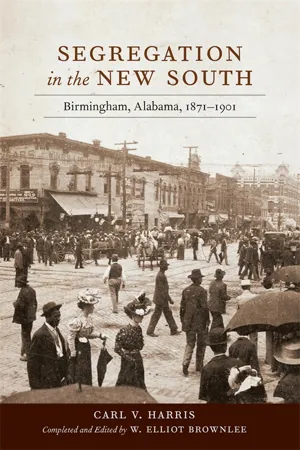
Carl V. Harris's Segregation in the New South, completed and edited by W. Elliot Brownlee, explores the rise of racial exclusion in late nineteenth-century Birmingham, Alabama. In the 1870s, African Americans in this crucial southern industrial city were eager to exploit the disarray of slavery's old racial lines, assert their new autonomy, and advance toward full equality. However, most southern whites worked to restore the restrictive racial lines of the antebellum South or invent new ones that would guarantee the subordination of Black residents. From Birmingham's founding in 1871, color lines divided the city, and as its people strove to erase the lines or fortify them, they shaped their futures in fateful ways. Social segregation is at the center of Harris's history. He shows that from the beginning of Reconstruction southern whites engaged in a comprehensive program of assigning social dishonor to African Americans—the same kind of dishonor that whites of the Old South had imposed on Black people while enslaving them. In the process, southern whites engaged in constructing the meaning of race in the New South.
eBook - ePub
Segregation in the New South
Birmingham, Alabama, 1871–1901
- 328 pages
- English
- ePUB (mobile friendly)
- Available on iOS & Android
eBook - ePub
About this book
Information
Subtopic
African American HistoryIndex
HistoryTable of contents
- Cover
- Title Page
- Copyright Page
- Contents
- EDITOR’S PREFACE
- INTRODUCTION: The Social History of Jim Crow
- CHAPTER 1. City of Opportunities and Boundaries
- CHAPTER 2. Transition to the New South: Reconstructing Boundaries
- CHAPTER 3. Protocols, Sanctions, and Mob Terror
- CHAPTER 4. School Segregation
- CHAPTER 5. Urban Residential Segregation
- CHAPTER 6. The Economic Realm: Work and Property
- CHAPTER 7. The Economic Realm: Social Space
- CHAPTER 8. The Political Realm, 1871–1888: Organizing and Voting
- CHAPTER 9. The Political Realm, 1888–1901: Excluding Black Voters
- CODA: Historians and the Interplay of Class, Race, and Caste
- APPENDIX: Social Psychology, Color Lines, and the Blumer Model
- NOTES
- INDEX
Trusted by 375,005 students
Access to over 1.5 million titles for a fair monthly price.
Study more efficiently using our study tools.
Frequently asked questions
Yes, you can cancel anytime from the Subscription tab in your account settings on the Perlego website. Your subscription will stay active until the end of your current billing period. Learn how to cancel your subscription
No, books cannot be downloaded as external files, such as PDFs, for use outside of Perlego. However, you can download books within the Perlego app for offline reading on mobile or tablet. Learn how to download books offline
Perlego offers two plans: Essential and Complete
- Essential is ideal for learners and professionals who enjoy exploring a wide range of subjects. Access the Essential Library with 800,000+ trusted titles and best-sellers across business, personal growth, and the humanities. Includes unlimited reading time and Standard Read Aloud voice.
- Complete: Perfect for advanced learners and researchers needing full, unrestricted access. Unlock 1.5M+ books across hundreds of subjects, including academic and specialized titles. The Complete Plan also includes advanced features like Premium Read Aloud and Research Assistant.
We are an online textbook subscription service, where you can get access to an entire online library for less than the price of a single book per month. With over 1.5 million books across 990+ topics, we’ve got you covered! Learn about our mission
Look out for the read-aloud symbol on your next book to see if you can listen to it. The read-aloud tool reads text aloud for you, highlighting the text as it is being read. You can pause it, speed it up and slow it down. Learn more about Read Aloud
Yes! You can use the Perlego app on both iOS and Android devices to read anytime, anywhere — even offline. Perfect for commutes or when you’re on the go.
Please note we cannot support devices running on iOS 13 and Android 7 or earlier. Learn more about using the app
Please note we cannot support devices running on iOS 13 and Android 7 or earlier. Learn more about using the app
Yes, you can access Segregation in the New South by Carl V. Harris, W. Elliot Brownlee in PDF and/or ePUB format, as well as other popular books in History & African American History. We have over 1.5 million books available in our catalogue for you to explore.