eBook - ePub
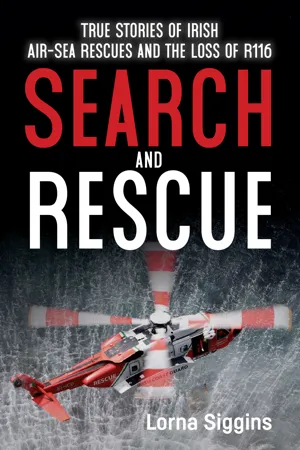
Search and Rescue
True Stories of Irish Air-Sea Rescues and the Loss of R116
- 320 pages
- English
- ePUB (mobile friendly)
- Available on iOS & Android
eBook - ePub
About this book
On 13 March 2017, the Rescue 116 crew of Capt. Dara Fitzpatrick, Capt. Mark Duffy, Paul Ormsby and Ciarán Smith took off from Dublin airport just after 2300 hours for a medical evacuation off the west coast. The first indication of disaster came when the crew failed to answer a radio call at 12.46 a.m. At 02.16 hours, sister helicopter Rescue 118 spotted a casualty and debris in the water. There would be no survivors from R116, and extensive searches failed to locate the bodies of two of the four crew. The crash occurred just six months after the loss of another experienced volunteer, Caitriona Lucas from Doolin Coast Guard in Co Clare; and 18 years after the loss of four Air Corps crew who were returning from a night rescue in thick fog off the south-east coast. In Search and Rescue, Lorna Siggins exposes the shocking systemic flaws that led to these tragic deaths, but also looks at successful rescues where, despite all the odds, the courage and dedication of members of the Irish Coast Guard and the volunteers who work with them have saved countless lives, including the dramatic rescue of paddleboarders Sara Feeney and Ellen Glynn off the coast of Clare in 2020.
Information
PART 1
A Black Year: Lives Lost Off Clare’s Kilkee and Mayo’s Blacksod
1
A DARK DAY
Bernard Lucas couldn’t stay at home. The County Clare farmer was well used to dropping everything to respond to a vessel in trouble off the coast. As an experienced volunteer with the Irish Coast Guard unit at Doolin, he had done so many times before.
When his pager went off on 12 September 2016, details were sketchy. A boat had capsized off Kilkee, farther north up the coast, and he was initially asked to drive up there to assist. He was en route to Kilkee in his car, close to Miltown Malbay, when he was asked if he could turn around and go back to Doolin to provide crew for his unit. He did so and found officer-in-charge Mattie Shannon and colleagues waiting for him with the unit’s D-class rigid inflatable boat (RIB).
Bernard and fellow Doolin volunteers Conor McGrath and Davy Spillane launched, and he was on the VHF radio and close to Kilkee when advised to head directly for the pier. Bernard was puzzled and checked to confirm this over the radio. He thought they should be heading straight for the capsize.
As they approached, two gardaí were standing at the foot of the pier steps; they asked if Bernard was on board. Spillane remembered feeling a distinct sense of disquiet as his friend and colleague was escorted ashore and into a Coast Guard vehicle.
Bernard barely remembered being driven to a nearby clifftop. Only a few hours before, his wife, Caitríona (41), had left home for Kilkee to assist in a search for a missing man. She had anticipated she would be walking the shore with members of Kilkee Coast Guard. Now, just several hours later, Bernard could see paramedics working to stabilise a casualty before they were all airlifted by the Rescue 115 Shannon helicopter to hospital.
The casualty was his wife.
***
Spillane and McGrath stood off Kilkee pier in the Doolin RIB, listening to the VHF radio. They knew from the terminology, and a reference to ‘vital signs’, that something was seriously wrong. Their first confirmation of this was when the RNLI Aran all-weather lifeboat approached them. The lifeboat crew lined up on deck to offer their sympathies to the two Doolin men.
By then, Bernard had been flown with his wife to hospital in Limerick. Caitríona was pronounced dead several hours later. As news of the fatality filtered out, those who knew the Lucas couple and their work with the Irish Coast Guard were lost for words. Caitríona had been one of the most respected and competent volunteers with her unit in County Clare. Her qualifications ranged from coxswain and navigation to climbing, first aid and emergency response, along with suicide-prevention training. She was also national secretary and an active member of the Search and Rescue Dog Association (SARDA). Some striking photos of her, which appeared subsequently in the press and on social media, reflected a woman who loved her family and her dogs, the people around her and the great outdoors. One SARDA volunteer recalled later how her calming presence had helped trained search and rescue dogs to cope with the roaring engines of a helicopter.
Caitríona Lucas was the first Coast Guard volunteer to die while on active service.
***
The Doolin unit to which the Lucas couple were attached had earned a reputation as one of the top Coast Guard teams around the coast. Led by Mattie Shannon, it was also one of the busiest, meeting a diverse and challenging range of call-outs ‒ from vessels in trouble at sea to climbers and walkers in difficulty, and people reported missing off the Cliffs of Moher.
School teaching advisor David McMahon from Lissycasey had been missing for the best part of a week when Caitríona had travelled to Kilkee to help with the search. Both the Civil Defence and Kilkee Coast Guard had been tasked with finding the missing man. However, the Kilkee unit was having difficulty mustering volunteers due to internal tensions.
Some traced these tensions back to 2013, when a 30-year-old community marine rescue service founded by Manuel Di Lucia was incorporated into the Coast Guard. The community had initially favoured the state takeover, since it was finding it difficult to raise funds and Coast Guard involvement would guarantee its future and equipment. However, the transition did not run smoothly.
As the Independent Clare TD Dr Michael Harty subsequently told the Dáil on 15 February 2018, many Kilkee volunteers with experience and local knowledge were not accepted on the new roster. Harty also noted that a plaque commemorating the activities of the former community service was removed, and the number of people involved had dropped from twenty-six to twelve. This loss of valuable experience included qualified coxswains. Di Lucia later said he tried repeatedly to highlight the issues which arose, and noted that there were several public demonstrations.
Coast Guard management had appointed Doolin Coast Guard unit member Martony Vaughan as officer-in-charge at Kilkee in 2013, initially for six months. It was felt that a skilled outsider could best deal with any issues arising during the transition. However, Vaughan had a direct management style that did not always sit well with volunteers. Despite this, he continued in the position for the next few years. On 24 March 2016, Coast Guard manager Michael O’Toole was formally alerted to problems when four members of the Kilkee unit forwarded him a memo after several informal contacts. The memo referred to problems with communication, lack of clear definition of roles and responsibilities, and inadequate supervision of training. It also referred to an ‘air of distrust’ over the use of CCTV to ‘monitor people’ and identified a need for head office training for new officer roles, along with familiarisation of policies, procedures and protocols. It said there should be full debriefings with all crew in relation to incidents and occurrences, and ‘no more one-on-one chats’.1
The memo continued, ‘While we are acutely aware that we are an emergency service which requires a professional, safe and efficient response … the social aspect of the unit no longer exists.’ It suggested that ‘an active training plan and more openness within the entire team’ would ‘help in rectifying this issue’. It also said, ‘Morale and enthusiasm are at an all-time low within the unit, and there is a danger of a significant number of people exiting the unit which could severely hamper our ability to respond to taskings.’
Coast Guard management held a meeting with the Kilkee volunteers in July 2016 to discuss the issues raised. At another meeting, on Friday 9 September, Kilkee volunteers were told that Vaughan was stepping aside and, from Monday 12 September, taking up another position. The unit’s deputy, Orla Hassett, would be appointed interim officer-in-charge until a permanent replacement was found. That Friday also, a search for the missing man was initiated.
There were several search launchings over the weekend of 10‒11 September, which Vaughan co-ordinated, and on the Sunday evening he asked volunteers to be at the station early on Monday, when Hassett was due to take over. Launching involves a ‘triple lock’ system of approval by a Coast Guard rescue co-ordination centre, along with the unit’s officer-in-charge and the coxswain. As there was a shortage of available qualified boat crew, Valentia Coast Guard was asked to request assistance for Kilkee from the Doolin unit.
A small craft warning had been issued for Monday and specified that southerly winds would reach force 6 or 7 on coasts from Donegal to Dublin and on southerly coasts to Roche’s Point off Cork. However, its forecast for the south-west and west coasts was for a less severe westerly force 3, with wind speeds further decreasing in the afternoon.
There was an early launch that day, and then a second at 10.30 a.m. Kilkee coxswains Jenny Caraway and James Lucey, who was on the helm, required one more crew member for their second launch of the Kilkee Delta RIB. Doolin’s Caitríona Lucas had the necessary qualifications. She had her own drysuit and helmet but was given a life jacket at Kilkee. The search plan was to head towards Intrinsic Bay and then north of George’s Head to Chimney Bay.
The Delta RIB was returning to base when it reported on VHF radio at 1.06 p.m. that it was just off the back of the Pollock Holes, a popular Kilkee swimming spot, and would do ‘one search around underneath the shelter’, then ‘head in’. It entered a small cove north-east of Foohagh Point – a shallow area and potential ‘surf zone’. Local knowledge has it that the seabed rises in ‘sharp cliff faces’, rather than a gradual shelving, and this can cause confused seas, with unexpected sudden uprisings and large swells. The previous Friday, Hassett had been asked by her officer-in-charge to search in this area but had refused, as she believed it was too hazardous. She remembered she was reprimanded for this over the VHF radio.
The Delta RIB was 20 metres from the shoreline on that Monday when a large breaking wave directly to starboard tipped it over, throwing all three crew overboard, before it righted itself again off Knockroe Point. Coxswain Caraway had the only functioning radio, her personal hand-held VHF, and issued a ‘Mayday’ call on channel 16.
Her broadcast was not picked up by Valentia because of transmission difficulties involving hand-held devices. However, an eyewitness on the shoreline phoned Kilkee station, which in turn contacted Valentia. It tasked the Shannon-based Rescue 115 helicopter, the RNLI Aran Island lifeboat, the Civil Defence and the local fire service to assist.
Martony Vaughan arrived at Kilkee Coast Guard station sometime after noon and began liaising with other agencies and with the Coast Guard helicopter. He then left to go up to the nearest headland, leaving Hassett in the station. Recognising an ‘imminent threat to life’, she asked the local gardaí to requisition a privately owned RIB, which she joined and took to sea.
Initially, all three of the Delta RIB crew had been able to form a huddle in the water, staying as close as they could to their vessel, which was now upright again. But before they had a chance to try to reboard it, they were separated in the confused seas close to the rocky shoreline. As Caraway was swept towards a cave, she saw Lucey trying to reach Lucas, but without success. By now, all three had lost their helmets in the turmoil.
Lucey, who had now also been swept towards the cave, managed to haul himself up onto a ledge near its mouth. Meanwhile, Caraway, an experienced diver, was being pounded off the cliff face and knew she had to try to swim out to sea. Her best chance of doing so was to keep her life jacket deflated. Civil Defence drone video footage recorded Lucas trying to hold onto the port bow section of the RIB, with the waves repeatedly breaking her grip. After three minutes, she lost her grip entirely and was next seen lying face down in the water. Her life jacket was not inflated. She was unconscious when airlifted from the water by the Irish Coast Guard’s Rescue 115.
At this point, the Doolin RIB, with Spillane and McGrath on board, was standing off the cave, with dozens of rescue agency personnel watching from the clifftop above. Gary Kiely and Adrian Kenny of Kilkee Marine Rescue, who were both experienced in using jet skis for surfing, were asked by Vaughan to try to gain access to the cave. They tried twice, at great personal risk, losing gear in the white breakers. Spillane remembered putting a space blanket around one of the two men after these attempts to protect him against hypothermia.
Caraway was at the base of a cliff face and still trying to swim out when Hassett spotted her. When there was a break in the waves, she managed to reach the RIB and Hassett pulled her on board. She had ingested a lot of water and required hospital treatment.
It would take more than four hours to rescue Lucey from his precarious position, after another team from Lahinch, including Dave Ainsworth and Steve Thomas, had been asked to attempt to swim into the cave. Doolin Coast Guard and Kilrush Fire Service cliff teams eventually managed to get Lucey a line and he was winched to safety by the Rescue 117 helicopter from Waterford.
It was dusk when Spillane and McGrath in the Doolin RIB headed back south for home, in a gathering Atlantic swell. There had been issues with their boat taking water throughout the day and it was not handling well as they passed under the Cliffs of Moher. They stopped the engine and raised the outboard to check the propeller, but nothing was found – the boat was taking water underneath. After they berthed, Spillane remembered there was no debriefing, ‘hot’ or ‘cold’, as would be normal procedure in such an incident. It effectively meant ...
Table of contents
- Cover
- Half Title
- Author Bio
- Title Page
- Copyright
- Contents
- List of Abbreviations
- Acknowledgements
- Introduction
- Part 1: A Black Year: Lives Lost Off Clare’s Kilkee and Mayo’s Blacksod
- Part 2: Hours of Boredom, Moments of Terror: Irish SAR from the Early Years
- Epilogue
- Appendix: Military Search and Rescue Awards
- Endnotes
- Select Bibliography
- Index
- Picture Section
Trusted by 375,005 students
Access to over 1.5 million titles for a fair monthly price.
Study more efficiently using our study tools.
Frequently asked questions
Yes, you can cancel anytime from the Subscription tab in your account settings on the Perlego website. Your subscription will stay active until the end of your current billing period. Learn how to cancel your subscription
No, books cannot be downloaded as external files, such as PDFs, for use outside of Perlego. However, you can download books within the Perlego app for offline reading on mobile or tablet. Learn how to download books offline
Perlego offers two plans: Essential and Complete
- Essential is ideal for learners and professionals who enjoy exploring a wide range of subjects. Access the Essential Library with 800,000+ trusted titles and best-sellers across business, personal growth, and the humanities. Includes unlimited reading time and Standard Read Aloud voice.
- Complete: Perfect for advanced learners and researchers needing full, unrestricted access. Unlock 1.5M+ books across hundreds of subjects, including academic and specialized titles. The Complete Plan also includes advanced features like Premium Read Aloud and Research Assistant.
We are an online textbook subscription service, where you can get access to an entire online library for less than the price of a single book per month. With over 1.5 million books across 990+ topics, we’ve got you covered! Learn about our mission
Look out for the read-aloud symbol on your next book to see if you can listen to it. The read-aloud tool reads text aloud for you, highlighting the text as it is being read. You can pause it, speed it up and slow it down. Learn more about Read Aloud
Yes! You can use the Perlego app on both iOS and Android devices to read anytime, anywhere — even offline. Perfect for commutes or when you’re on the go.
Please note we cannot support devices running on iOS 13 and Android 7 or earlier. Learn more about using the app
Please note we cannot support devices running on iOS 13 and Android 7 or earlier. Learn more about using the app
Yes, you can access Search and Rescue by Lorna Siggins in PDF and/or ePUB format, as well as other popular books in Medicine & Military & Maritime History. We have over 1.5 million books available in our catalogue for you to explore.