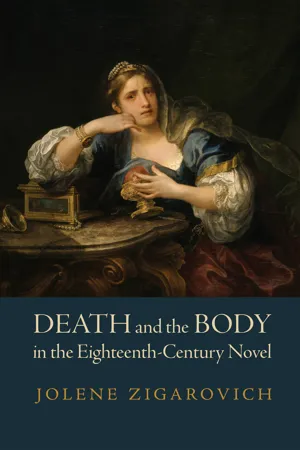
Death and the Body in the Eighteenth-Century Novel demonstrates that archives continually speak to the period's rising funeral and mourning culture, as well as the increasing commodification of death and mourning typically associated with nineteenth-century practices. Drawing on a variety of historical discourses—such as wills, undertaking histories, medical treatises and textbooks, anatomical studies, philosophical treatises, and religious tracts and sermons—the book contributes to a fuller understanding of the history of death in the Enlightenment and its narrative transformation.
Death and the Body in the Eighteenth-Century Novel not only offers new insights about the effect of a growing secularization and commodification of death on the culture and its productions, but also fills critical gaps in the history of death, using narrative as a distinct literary marker. As anatomists dissected, undertakers preserved, jewelers encased, and artists figured the corpse, so too the novelist portrayed bodily artifacts. Why are these morbid forms of materiality entombed in the novel? Jolene Zigarovich addresses this complex question by claiming that the body itself—its parts, or its preserved representation—functioned as secular memento, suggesting that preserved remains became symbols of individuality and subjectivity. To support the conception that in this period notions of self and knowing center upon theories of the tactile and material, the chapters are organized around sensory conceptions and bodily materials such as touch, preserved flesh, bowel, heart, wax, hair, and bone. Including numerous visual examples, the book also argues that the relic represents the slippage between corpse and treasure, sentimentality and materialism, and corporeal fetish and aesthetic accessory.
Zigarovich's analysis compels us to reassess the eighteenth-century response to and representation of the dead and dead-like body, and its material purpose and use in fiction. In a broader framework, Death and the Body in the Eighteenth-Century Novel also narrates a history of the novel that speaks to the cultural formation of modern individualism.
- 320 pages
- English
- ePUB (mobile friendly)
- Available on iOS & Android
eBook - ePub
Death and the Body in the Eighteenth-Century Novel
About this book
Information
Table of contents
- Cover Page
- Title Page
- Copyright
- Dedication
- Contents
- List of Illustrations
- Introduction
- Chapter 1. Secularism, Materialism, and Death in the Eighteenth Century
- Chapter 2. Preserving Clarissa: Eighteenth-Century Embalming Practices
- Chapter 3. Waxen Encounters: Flesh, Anatomy, and Autonomy
- Chapter 4. Circulating Bodies: Secular Mementos, Jewelry, and Hairwork
- Chapter 5. Osseous Matter: Bones, Relics, and Mourning Miniatures
- Afterword
- Notes
- Bibliography
- Index
- Acknowledgments
Trusted by 375,005 students
Access to over 1.5 million titles for a fair monthly price.
Study more efficiently using our study tools.
Frequently asked questions
Yes, you can cancel anytime from the Subscription tab in your account settings on the Perlego website. Your subscription will stay active until the end of your current billing period. Learn how to cancel your subscription
No, books cannot be downloaded as external files, such as PDFs, for use outside of Perlego. However, you can download books within the Perlego app for offline reading on mobile or tablet. Learn how to download books offline
Perlego offers two plans: Essential and Complete
- Essential is ideal for learners and professionals who enjoy exploring a wide range of subjects. Access the Essential Library with 800,000+ trusted titles and best-sellers across business, personal growth, and the humanities. Includes unlimited reading time and Standard Read Aloud voice.
- Complete: Perfect for advanced learners and researchers needing full, unrestricted access. Unlock 1.5M+ books across hundreds of subjects, including academic and specialized titles. The Complete Plan also includes advanced features like Premium Read Aloud and Research Assistant.
We are an online textbook subscription service, where you can get access to an entire online library for less than the price of a single book per month. With over 1.5 million books across 990+ topics, we’ve got you covered! Learn about our mission
Look out for the read-aloud symbol on your next book to see if you can listen to it. The read-aloud tool reads text aloud for you, highlighting the text as it is being read. You can pause it, speed it up and slow it down. Learn more about Read Aloud
Yes! You can use the Perlego app on both iOS and Android devices to read anytime, anywhere — even offline. Perfect for commutes or when you’re on the go.
Please note we cannot support devices running on iOS 13 and Android 7 or earlier. Learn more about using the app
Please note we cannot support devices running on iOS 13 and Android 7 or earlier. Learn more about using the app
Yes, you can access Death and the Body in the Eighteenth-Century Novel by Jolene Zigarovich in PDF and/or ePUB format, as well as other popular books in Literature & English Literary Criticism. We have over 1.5 million books available in our catalogue for you to explore.