The desire to know the body is a powerful dynamic of storytelling in all its forms. Peter Brooks argues that modern narrative is intent on uncovering the body in order to expose a truth that must be written in the flesh. In a book that ranges widely through literature and painting, Brooks shows how the imagination strives to bring the body into language and to write stories on the body.
From Rousseau, Balzac, Mary Shelley, and Flaubert, to George Eliot, Zola, Henry James, and Marguerite Duras, from Manet and Gauguin to Mapplethorpe, writers and artists have returned in fascination to the body, the inescapable other of the spirit. Brooks's deep understanding of psychoanalysis informs his demonstration of how the "epistemophilic urge"--the desire to know-guides fictional plots and our reading of them.
It is the sexual body that furnishes the building blocks of symbolization, eventually of language itself-which then takes us away from the body. Yet mind and language need to recover the body, as an other realm that is primary to their very definition. Brooks shows how and why the female body has become the field upon which the aspirations, anxieties, and contradictions of a whole society are played out. And he suggests how writers and artists have found in the woman's body the dynamic principle of their storytelling, its motor force.
This major book entertains and teaches: Brooks presumes no special knowledge on the part of his readers. His account proceeds chronologically from Rousseau in the eighteenth century forward to contemporary artists and writers. Body Work gives us a set of analytical tools and ideas-primarily from psychoanalysis, narrative and film studies, and feminist theory-that enable us to read modern narrative afresh.
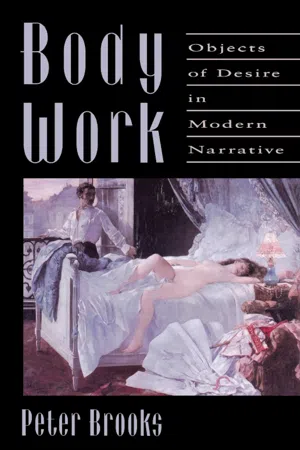
- 342 pages
- English
- PDF
- Available on iOS & Android
eBook - PDF
About this book
Information
Publisher
Harvard University PressYear
2009Print ISBN
9780674077256
9780674077249
eBook ISBN
9780674028869
Table of contents
- Contents
- Preface
- 1 Narrative and the Body
- 2 Invasions of Privacy: The Body in the Novel
- 3 Marking Out the Modern Body: The French Revolution and Balzac
- 4 The Body in the Field of Vision
- 5 Nana at Last Unveil’d? Problems of the Modern Nude
- 6 Gauguin’s Tahitian Body
- 7 What Is a Monster? (According to Frankenstein)
- 8 Talking Bodies, Delicate Vessels
- 9 Transgressive Bodies
- Notes
- Index
Trusted by 375,005 students
Access to over 1.5 million titles for a fair monthly price.
Study more efficiently using our study tools.
Frequently asked questions
Yes, you can cancel anytime from the Subscription tab in your account settings on the Perlego website. Your subscription will stay active until the end of your current billing period. Learn how to cancel your subscription
No, books cannot be downloaded as external files, such as PDFs, for use outside of Perlego. However, you can download books within the Perlego app for offline reading on mobile or tablet. Learn how to download books offline
Perlego offers two plans: Essential and Complete
- Essential is ideal for learners and professionals who enjoy exploring a wide range of subjects. Access the Essential Library with 800,000+ trusted titles and best-sellers across business, personal growth, and the humanities. Includes unlimited reading time and Standard Read Aloud voice.
- Complete: Perfect for advanced learners and researchers needing full, unrestricted access. Unlock 1.5M+ books across hundreds of subjects, including academic and specialized titles. The Complete Plan also includes advanced features like Premium Read Aloud and Research Assistant.
We are an online textbook subscription service, where you can get access to an entire online library for less than the price of a single book per month. With over 1.5 million books across 990+ topics, we’ve got you covered! Learn about our mission
Look out for the read-aloud symbol on your next book to see if you can listen to it. The read-aloud tool reads text aloud for you, highlighting the text as it is being read. You can pause it, speed it up and slow it down. Learn more about Read Aloud
Yes! You can use the Perlego app on both iOS and Android devices to read anytime, anywhere — even offline. Perfect for commutes or when you’re on the go.
Please note we cannot support devices running on iOS 13 and Android 7 or earlier. Learn more about using the app
Please note we cannot support devices running on iOS 13 and Android 7 or earlier. Learn more about using the app
Yes, you can access Body Work by Peter Brooks in PDF and/or ePUB format, as well as other popular books in Languages & Linguistics & Linguistics. We have over 1.5 million books available in our catalogue for you to explore.