Clinical Dentistry Daily Reference Guide
eBook - ePub

Clinical Dentistry Daily Reference Guide

  1. English
  2. ePUB (mobile friendly)
  3. Available on iOS & Android
eBook - ePub

Clinical Dentistry Daily Reference Guide

About this book

CLINICAL DENTISTRY DAILY REFERENCE GUIDE

The first and only practical reference guide to clinical dentistry

Clinical dentistry involves the practice of preventing, diagnosing, and treating patients' oral health conditions. Clinical Dentistry Daily Reference Guide is a one-stop resource loaded with critical information for day-to-day decision making regarding a myriad of clinical scenarios. This invaluable resource saves time by eliminating the need to search through websites, textbooks, and phone apps to find answers.

This book offers step-by-step assistance on health history treatment modifications, oral cancer screening, radiographic interpretation, treatment planning, preventive dentistry, periodontics, operative dentistry, endodontics, oral surgery, toothaches, crown and bridge, dentures, partials, implant crowns, occlusal guards, pharmacology, pediatric dentistry, nitrous sedation, and more.

This comprehensive guide:

  • Provides quick access to information in an easy-to-read bulleted format
  • Includes hundreds of high-quality clinical images, illustrations, and tables
  • Answers real-life patient questions
  • Contains procedural steps including post-operative instructions, lab prescriptions, troubleshooting, and clinical pearls
  • Features alphabetized medical conditions and treatment modifications, evidence-based guidelines including the dental traumatology guidelines, tables of common medications converted to pediatric dosages, and more.
  • Helps dentists gain confidence in their decision making

Clinical Dentistry Daily Reference Guide is a must-have book for all dental students and practicing dentists, both new and seasoned. Other dental professionals that will benefit from this book include dental educators, expanded function dental assistants, and dental hygienists.
Frequently asked questions

Yes, you can cancel anytime from the Subscription tab in your account settings on the Perlego website. Your subscription will stay active until the end of your current billing period. Learn how to cancel your subscription.
No, books cannot be downloaded as external files, such as PDFs, for use outside of Perlego. However, you can download books within the Perlego app for offline reading on mobile or tablet. Learn more here.
Perlego offers two plans: Essential and Complete
  • Essential is ideal for learners and professionals who enjoy exploring a wide range of subjects. Access the Essential Library with 800,000+ trusted titles and best-sellers across business, personal growth, and the humanities. Includes unlimited reading time and Standard Read Aloud voice.
  • Complete: Perfect for advanced learners and researchers needing full, unrestricted access. Unlock 1.4M+ books across hundreds of subjects, including academic and specialized titles. The Complete Plan also includes advanced features like Premium Read Aloud and Research Assistant.
Both plans are available with monthly, semester, or annual billing cycles.
We are an online textbook subscription service, where you can get access to an entire online library for less than the price of a single book per month. With over 1 million books across 1000+ topics, we’ve got you covered! Learn more here.
Look out for the read-aloud symbol on your next book to see if you can listen to it. The read-aloud tool reads text aloud for you, highlighting the text as it is being read. You can pause it, speed it up and slow it down. Learn more here.
Yes! You can use the Perlego app on both iOS or Android devices to read anytime, anywhere — even offline. Perfect for commutes or when you’re on the go.
Please note we cannot support devices running on iOS 13 and Android 7 or earlier. Learn more about using the app.
Yes, you can access Clinical Dentistry Daily Reference Guide by William A. Jacobson in PDF and/or ePUB format, as well as other popular books in Medicine & Dentistry. We have over one million books available in our catalogue for you to explore.

Information

Year
2022
Print ISBN
9781119690719
eBook ISBN
9781119690771
Edition
1
Subtopic
Dentistry

1
Health History Treatment Modifications

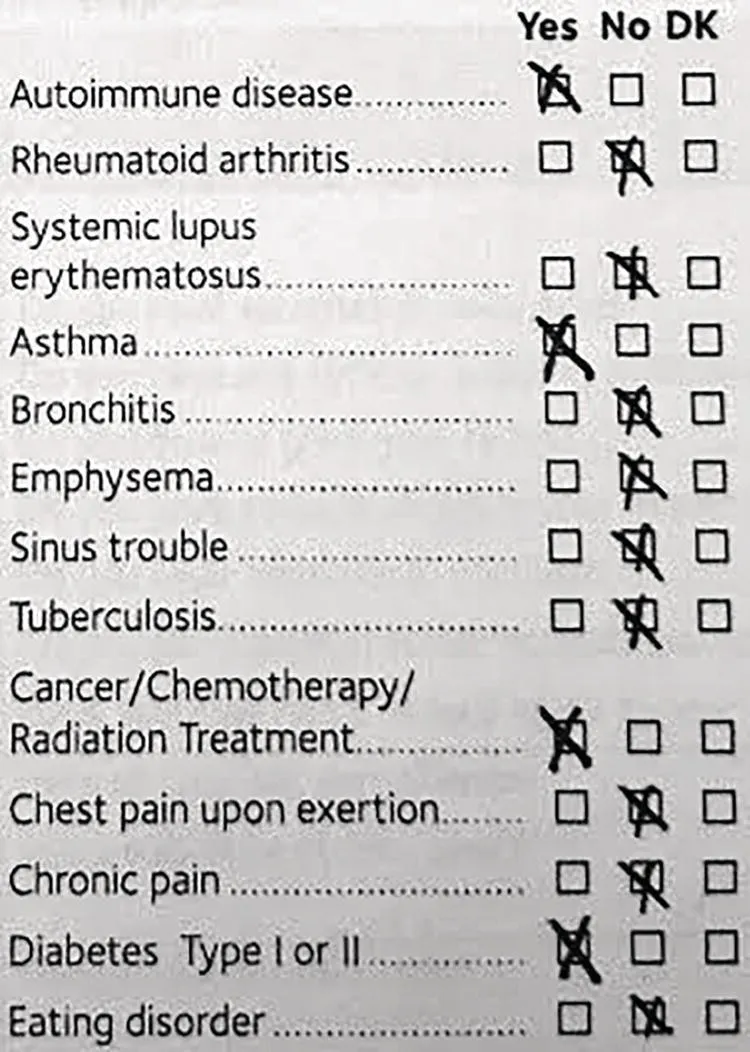
Photo depicts a sample health history form filled out by a patient.
Figure 1.1 A sample health history form filled out by a patient. DK, Don't know.

Chapter Outline

  • Real‐Life Clinical Questions
  • Relevance
  • Treatment Planning
  • ADA Health History Form
  • General Guidelines
  • Demographic Data
  • Dental Information
  • Medical History
  • Alphabetized Conditions with Treatment Modifications
  • Medications
  • Lab Values
    • Miscellaneous Terms
  • ASA Physical Status Classification System
  • Medical Consultations
    • Sample Form
  • Charting Template
  • Clinical Pearls
    • Troubleshooting
    • Tips
  • Real‐Life Clinical Questions Answered
  • References

Real‐Life Clinical Questions

Dental Student's Comment

    • “My patient has asthma and is here for a filling.”

Dental Assistants' Questions

    • “Doc, how often do we have the patient fill out the health history form?”
    • “Doctor, the pulse is really high, is that OK?”
    • “If I take his temperature, what temperature is considered a fever?”

Patient's Daughter's Comment

    • “She [the patient] is my mother and I will translate for her.”

Patients' Comments

    • “Yeah I take medications, but you don't need to know which ones I'm taking, you're just working on my teeth.”
    • “I stopped my blood thinner medication a few days before this appointment.”
    • “I took about 10 aspirin the last two days before today's extraction appointment.”
    • “My INR is always 2 so I'll be fine.”
    • “I have a newborn!”
    • “I have HIV but I'm undetectable.”
    • “I had radiation to my head.”
    • “I had a heart attack last week but don't worry about it, I'm fine just pull the tooth.”
    • “I feel fine so I'm not going to the emergency room because of my blood pressure.”

Patients' Questions

    • “I'm pregnant. Is it safe to get dental treatment?”
    • “I'm just here for my denture, so why do you need to take my blood pressure?”
    • “I was diagnosed with cancer and I need a dental clearance signed.”

Relevance

While you are not expected to be a physician, as a dentist you are expected to understand the patient's health history well enough to know:
  • if any treatment modifications are necessary
  • when to obtain a medical consultation and what to ask
  • when to refer the patient to another provider for consultation and/or treatment.

Treatment Planning

Obtaining and updating patients’ health histories is critical and occurs at various treatment planning phases. See Table 1.1
Table 1.1 Treatment planning phases related to health history.
Treatment phase Description (may or may not apply)
Emergency phase Urgent treatment of pain, infection, trauma, and/or esthetic emergency (provide a health history form and medical consultation as necessary)
Data gathering phase Medical history: medical consultation as necessary
Stabilization phase (to control disease) At every appointment ask if any changes to health history (document)
Definitive phase At every appointment ask if any changes to health history (document)
Maintenance phase New health history form every two years (document date) [1]

ADA Health History Form

See figure 1.2

General Guidelines

  • Follow up with any questions marked “Yes” or “DK” (i.e. “Don’t Know). See Figure 1.1.
  • Do not allow the patient to leave any response unanswered.
  • Do not allow the patient to mark one long line through all the “No” answers.
  • Make sure the patient signs and dates.
  • Do not provide any dental treatment to the patient until you review the entire health history form.

Demographic Data

Name: Ask “How would you like to be addressed?” Some patients are offended if they are not addressed as Mr., Mrs., Miss, Dr., etc.
Pronouns: It's important to respect and affirm a patient's identity. If unsure which pronoun to use, ask “What pronouns would you like me to use when I refer to you?” (e.g. she/her/hers, he/him/his, they/them/theirs).
Address: If the patient is homeless, when writing a prescription write “general delivery” [2]. However controlled substances requires an address...

Table of contents

  1. Cover
  2. Table of Contents
  3. Title Page
  4. Copyright Page
  5. About the Author
  6. Preface
  7. Acknowledgments
  8. List of Abbreviations
  9. How to Read this Book
  10. 1 Health History Treatment Modifications
  11. 2 Extraoral Exam, Intraoral Exam, and Oral Cancer Screening
  12. 3 Radiographs and Interpretation
  13. 4 Treatment Planning
  14. 5 Preventive Dentistry
  15. 6 Periodontics
  16. 7 Operative Dentistry
  17. 8 Endodontics
  18. 9 Oral Surgery
  19. 10 Toothaches
  20. 11 Crown and Bridge
  21. 12 Complete Dentures
  22. 13 Removable Partial Dentures
  23. 14 Implant Crowns
  24. 15 Occlusal Guards
  25. 16 Dental Pharmacology
  26. 17 Pediatric Dentistry
  27. 18 Nitrous Oxide and Oxygen Sedation
  28. Appendix A: Appendix AInternational Association of Dental Traumatology Guidelines
  29. Appendix B: Appendix BBasic Life Support
  30. Appendix C: Appendix CEvidence‐based Dentistry Pyramid
  31. Appendix D: Appendix DErgonomics for the Dentist, Patient, and Dental Assistant
  32. Appendix E: Appendix E“CAMBRA” CAries Management By Risk Assessment *
  33. Index
  34. End User License Agreement