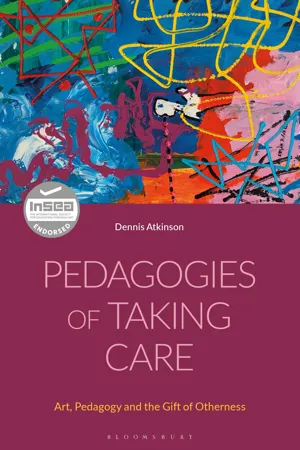
This book traces the notion of care and civic values in education that are largely devalued today by neoliberal economic concerns. Through a discussion of educators and philosophers including Arendt, Foucault, Guattari, Patocka, Simondon, Stengers and Whitehead, Atkinson explores the 'gift of otherness' in relation to an ethico-politics of pedagogic practice and learning, including art education. He argues for pedagogical practices that facilitate and support each learner's pathways through what is called a pedagogy of taking care. This involves paying due attention, with empathy, to each learner's pathway of learning and to the difference and divergence of such pathways. It also requires the teacher to take care, to be vigilant towards their own pedagogical frameworks that inform pedagogical work, particularly when a student or child produces work that does not accord with such frameworks. Atkinson not only critiques current educational policy but advocates possible futures of being, not dominated by the neoliberal tools of force and power. Pedagogies of taking care allow us to think differently about education and art education, and revaluate it's meaning within research, classrooms, non-formal contexts of education and cultural institutions.
- 272 pages
- English
- ePUB (mobile friendly)
- Available on iOS & Android
eBook - ePub
About this book
Information
1 Education, Politics and Subjectivity: An Ethico-Aesthetic Project for a Pedagogy of Taking Care
Introduction
The task of this chapter is to develop a position statement that advocates a particular approach to the purpose of education and the practices of teaching and learning that is grounded in a pedagogy of taking care. Part One articulates a critique of current educational policy for schools motivated by economic ambition, consumption and competition coupled with the emphasis upon particular curriculum subjects and the production of their subjectivities in the contexts of the school curriculum and teacher education. However, the background circumstances to this policy are not to be viewed totally in terms of the effect of neoliberal economic policy; this would be too reductionist but involves a more complex assemblage of different vectoral forces, some of which I will discuss in Part One. This will include considering not only the effects of neoliberal rationality on education but also what we might call a failure of a social and liberal mentality to grasp and develop what Dewey (2000: 53) called a ‘cooperative experimental intelligence’, which, I argue, was integral to the social and educational concerns of a line of thinkers that has a long history but, in more recent times, can be found in the UK in the works of Richard Hoggart, Stuart Hall and Raymond Williams. Such works seem to have lost momentum in educational policy and its application today. The failure to advocate and fight for the need to develop this social, cooperative and convivial intelligence could be levelled against the centre left that, in coming to power in the late 1990s, chose not to reverse the individualist, competitive and market principles of Thatcherism that circulated through institutions such as schools, universities and hospitals. By then government itself had been realigned to serve markets. Educational institutions and organizations that had the means to resist the forces of economization gradually became complicit, universities caved in and unions were weakened.
Part Two presents an argument for an alternative educational project, which I call a pedagogy of ‘taking care’, that is grounded in the valuing of the autonomy of difference and potential in relation to collective and mutual responsibility. Whereas the former project is informed by an established teleology towards generating and expanding particular skills and knowledge that sustain, develop and transform particular (capitalist) modes of existence, the latter advocates a more open-ended project, and whilst recognizing those skills, practices and forms of knowledge that are required for life beyond school and economic prosperity, the chapter argues that other modes of existence, than those perpetuated by capitalist economics, may be possible and even more desirable. Put in other terms appropriate to this chapter, whilst the former project functions towards the production of prescribed and regulated pedagogical subjectivations, the latter advocates an open, more unpredictable process that, rather than beginning from a dictated ground of method and practice, begins with supporting the existential heterogeneity of experiencing and how this might ‘inform’ learning encounters and the diverse subjectivations that follow. Subjectivation here is perhaps a more precarious adventure. Such an approach is articulated not by authorized models of educational identities but, in this chapter, by a schizoanalytic metamodelizing of difference as developed by Felix Guattari.
Educational policy in the West is motivated largely by economic ambition and competition; it has emerged from a history of capitalist exploitation that has produced environmental devastation, global warming and increases in poverty and other social inequities. The emphasis upon core curriculum subjects such as science, technology and mathematics has led to a reduction in the value of other subjects such as the arts, a reduction that prioritizes some pedagogical subjectivities over others. A pedagogy of care begins with a metamodelizing according to each learner’s modes of experiencing, sensibilities, aptitudes and interests, working with and expanding these capacities across a range of what we call subject domains rather than limiting opportunities according to those domains deemed desirable for prescribed agendas.
To clarify my concerns, education in this book refers mainly to institutional practices in schools and other sites but also to theoretical framings and underpinnings of educational practices, their values and purpose. Politics, in the second part of the chapter, refers to practices in which politics and ethics are indissoluble. What I infer or argue by this articulation is that social relations and their evolution are dependent upon valuing difference whilst at the same time trying to forge collective values and practices; the ethico-political and aesthetic challenge therefore is to value ethical differentiation whilst also constructing collective participation. Subjectivity denotes processes of subjectivation and not essentialist notions of a constituted individual. It refers to assemblages of evolving/mutating vectors and processes that emerge across a range of practices and relations, constituting what we might call vectors of subjectivation. The ‘subject’ therefore is an always emerging, incomplete and perhaps even disobedient process in that disobedience refers to the opening of new values and potentials that break out from established grounds as they arise in processes of experiencing. This raises a complex issue of how potentialities become actualized and break through the boundaries of established existential territories. By referencing Felix Guattari’s four ontological domains, the chapter conceives this complex process of subjectivity in terms of an assemblage of actual and virtual vectors and interfaces. These include actual material relations that modulate experience, as well as domains of logic and established practices and fields of inquiry – virtual existential territories and incorporeal universes of affect and intensities that unsettle them and which facilitate novel modes of becoming. Put another way, can pedagogic work in the spirit of a pedagogy of taking care that aims to support and respond effectively to the haecceities (thisness) and heterogeneity of modes of learning and expression open up and extend new sensibilities and modes of practice which in turn, by implication, may disrupt or even challenge the parameters of pedagogic practice? By adopting this processual notion of subjectivity, it opens up questions concerning the ‘objectivity’ of a curriculum, its methods, its assessment or even the school as institution. I will return briefly to such questions in the conclusion.
My task then is first to develop an account of current educational practices and the kind of subjectivations that are prioritized and then to problematize this mode of production in order to provide an alternative that assumes contrasting ethico-political relations and subjectivations. Whereas the former educational project can be described as prescriptive and driven by economic ambition and competition and the production of human capital (vertical and hierarchical), the alternative is grounded in an open and unpredictable valuing of difference and potential (horizontal and divergent) in relation to collective values and responsibilities.
Part One
Neoliberalism and Education
My discussion of neoliberal politics/economics is not extensive but limited to the basic features of neoliberalism that characterize this economic project and its impact upon educational policy and practice. I draw upon Wendy Brown’s persuasive critique of neoliberal rationality that she develops in Undoing the Demos (2015) regarding its impact upon higher education in the United States and her later text, In the Ruins of Neoliberalism (2019), where she extends the former text’s focus upon economics and neoliberal rationality by addressing neoliberalism’s moral conditioning, tracing this back to Friedrich Hayek’s advocacy for ‘markets and tradition’. I follow Brown’s critique by considering the neoliberal condition (a term given to me by John Baldacchino) as it has affected educational policy and practice in England: first, by engaging briefly with the work of Richard Hoggart, Raymond Williams and Stuart Hall that has been marginalized by neoliberal marketization policies but whose sociopolitical and ethical agendas are important for a pedagogy of taking care; and second, by addressing the impact of neoliberal forces and values on the school curriculum and teacher education.
But is everything that has happened in the past few decades in social, economic, political, educational and ethical domains all down to neoliberal principles and values? This is too reductionist and requires greater in-depth elaboration beyond the focus of this chapter. One might think of the rise of consumer culture and its pervasive and invasive affects; the increasing infiltration of surveillance and administrative apparatuses and practices; the effects of televisual and digital cultures; the rhythms of conformity; the inducement, manipulation and satisfaction of needs generating the desire for more; the rise of nationalisms and protectionism; and the upsurge of fundamentalisms and racism. All such phenomena cannot be attributed to neoliberal economics. But the complexity I infer here will be partly examined in Part Two when I address the complex ontological production of subjectivity as developed by Felix Guattari.
As a form of economic rationality, neoliberalism conceives most human activity as subject to market reason, ‘economized in value and conduct’ (Brown 2017, Eurozine: 5). It is a term that is difficult to pin down, but generally it signifies a preference for markets over government; it prioritizes economic initiatives over social and civic concerns, and it promotes entrepreneurial practices over collective or community values. In short, both politics and the idea of society are dethroned by markets. Brown (2015: 177) argues that there are four aspects of neoliberal rationality that have a direct impact upon education in the liberal arts and, I would argue, that affect other areas of education and its practices in the United States, England and elsewhere. In the second part of this section, I provide a particular illustration by turning to the impact of neoliberal rationality upon teacher education in England and refer to a research project (Brown, Rowley and Smith 2015) that began in 2013 to consider the effects of the changing nature of teacher education in England for university teacher education programmes as it became more regulated and controlled by government interventions steered not only by the values of neoliberal economics and the production of human capital but also by an aspect of a historical undercurrent that abhors progressive educational initiatives.
Brown (2015: 176) states that neoliberal rationality ‘formulates everything, everywhere, in terms of capital investment and appreciation, including and especially humans themselves’. The four aspects that she maintains effect education are first, the issue of public goods and services: should they be an entitlement, or should they be paid for? This question implies that in adopting neoliberal economic policies, government moves from a position of civic responsibility to provide public welfare systems to exposing such provision to market forces whereby citizens become consumers. In the UK we have witnessed the opening up of health and education systems to forces of privatization. Second, when neoliberal values, such as economic ambition and competition, saturate nearly every aspect of social existence, democracy becomes transformed ‘so that political meanings of equality, autonomy and freedom (however problematic these terms may be) give way to economic valences of these terms’ (my bracket). The consequence of this shift is that the market becomes the sole arbiter of value and replaces other humanitarian, justice, moral or ethical considerations. Brown (2015: 177) writes, ‘Democracies are conceived as requiring technically skilled human capital, not educated participants in public life and common rule.’ Third, the impact of these two aspects of neoliberal rationality upon subjectivity is that subjects become ‘conceived in terms of self-investing human capital that are controlled primarily according to market logics and governance’ (177). Fourth, a factor deeply affecting educational policy and practice; knowledge, thought and training are valued in terms of their contribution to and development of capitalist economies, and this emphasis marginalizes the focus upon developing civic values and practices as well as cultural practices such as the arts and humanities within educational contexts. Brown (178–9) argues that the effects of these four aspects of neoliberal rationality upon education and society more generally are that they hollow out democracy defined in terms of an engagement with and development of civic good, with debates about how we should live in order not only to develop this good to foster convivial relations but also to generate critical appraisals that might lead to further social and civic transformations.
Brown focuses upon the effects of neoliberal rationality upon the status of teaching and learning in the liberal arts in American universities. Although such effects are of great concern, what cause her even more disquiet are the effects of neoliberal politics upon democratic citizenship, when the functions and purpose of higher education become economized. Though she writes about the American context, there are direct parallels with higher education in many European contexts.
After more than half a century of public higher education construed and funded as a medium for egalitarianism and social mobility and as a means of achieving a broadly educated democracy as well as for providing depth and enrichment to individuality, public higher education, like much else in neoliberal orders, is increasingly structured to entrench, rather than redress class trajectories. As it devotes itself to enhancing the value of human capital, it now abjures the project of producing a public readied for participation in popular sovereignty. (2015: 184)
Brown argues that the introduction of a liberal arts education in American universities in the 1940s should be viewed as ‘a radical democratic event’, in that studies aimed at world cultures, literacies, arts, politics, ethics and other fields were made available to a wider public, though there were still problems of access.
For the first time in human history, higher educational policy and practice were oriented toward the many, tacitly destining them for intelligent engagement with the world rather than economic servitude or mere survival. (185)
This meant that beyond class mobility and the laudable but highly suspect or even mythic idea of ‘equality of opportunity’, the ideal of democracy was realized in a new way in that higher education was available to the general public to pursue both individual knowledge pursuits and for civic engagement and participation. Such education followed the philosophical and social enquiries of Adam Smith, John Dewey, Alexis de Tocqueville and others that conceived the sole pursuit of economic interests and values as being much too narrow for developing individual lives or the practice of democracy. However, universities and schools today are more generally aligned to and driven by the notion of the market value of knowledge and the production of human capital, the ‘income-enhancing prospects for individuals and industry alike’ (2015: 187) and not capacities or qualities for developing civic values and democratic citizenship. Brown argues that greater public access to a liberal arts education coincided with the rise of critical democratic movements such as the civil rights movement, feminism and numerous challenges to social inequalities.
Post-war Initiatives in Education in the UK and Later Educational Change
In the UK, probably from the 1960s, as well as some of the aforementioned sociopolitical movements, the introduction of comprehensive secondary education, the rapid increase in higher education numbers, the birth of the Open University and, in wider Europe in 1968, the worker/student protests against capitalism, consumerism and American imperialism reinforced a call for more egalitarian democratic politics and civic organizations. During this epoch a number of educators, writers and academics developed inclusive and socially transformative approaches to education that are worthy of mention, in that such work in recent decades seems to have been sidelined in educational policy and practice.
Richard Hoggart came from a working-class environment in Hunslet, a district of Leeds. His formative years in this social and cultural environment, where community spirit, family and collective support were crucial, were influential upon his later work in the fields of cultural studies and education. This inheritance influenced his approach towards the importance of social responsibility and the ongoing task of developing a shared sense of moral, affective and collective values. Education for Hoggart was a process through which someone could extend their capacities not simply for oneself but also for collective purposes and action. His first venture into adult education where he saw the social and moral possibilities of education was towards the end of the First World War, in the Army Education Corps and the Army Bureau of Current Affairs. There he witnessed how education had a liberating effect upon the adults attending. He proceeded to publish articles on the aims, principles and methods of teaching. But it was the publication of The Uses of Literacy in 1957 that sparked debate and new modes of study and research into social and cultural practices, enquiry into how people make sense of their lives in their respective material sociocultural situations that are not static but open to forces of change. Hoggart drew attention to the new proliferation and expansion of mass cultural forms that occurred in the UK after the Second World War and in the 1950s – television, pop music, magazines, advertisements, youth culture, movies and so forth – and he sought to understand the effects of this ‘Americanization’ by seeking answers to how these commerc...
Table of contents
- Cover
- Half-title Page
- Dedication Page
- Series Page
- Title Page
- Contents
- Acknowledgements
- Introduction
- 1 Education, Politics and Subjectivity: An Ethico-Aesthetic Project for a Pedagogy of Taking Care
- 2 Parrhesia and Epimeleia and the Scandal of the Truth: Changing the Value of the Currency in Pedagogic Work
- 3 Pedagogy, Conditions and Value
- 4 Gilbert Simondon: Transduction and Pedagogic Practice
- 5 On the Idea of Speculative Pedagogies
- 6 The Scandal of the Truth of Art and Its Implications for Art in Education
- 7 The Gift of Otherness: Ontological Adventures in Pedagogic Work
- 8 Thinking par le milieu: Pedagogic Work and Art Practice
- 9 Pedagogy of the Interstices: Trust and Uncertainty
- References
- Index
- Copyright Page
Trusted by 375,005 students
Access to over 1.5 million titles for a fair monthly price.
Study more efficiently using our study tools.
Frequently asked questions
Yes, you can cancel anytime from the Subscription tab in your account settings on the Perlego website. Your subscription will stay active until the end of your current billing period. Learn how to cancel your subscription
No, books cannot be downloaded as external files, such as PDFs, for use outside of Perlego. However, you can download books within the Perlego app for offline reading on mobile or tablet. Learn how to download books offline
Perlego offers two plans: Essential and Complete
- Essential is ideal for learners and professionals who enjoy exploring a wide range of subjects. Access the Essential Library with 800,000+ trusted titles and best-sellers across business, personal growth, and the humanities. Includes unlimited reading time and Standard Read Aloud voice.
- Complete: Perfect for advanced learners and researchers needing full, unrestricted access. Unlock 1.5M+ books across hundreds of subjects, including academic and specialized titles. The Complete Plan also includes advanced features like Premium Read Aloud and Research Assistant.
We are an online textbook subscription service, where you can get access to an entire online library for less than the price of a single book per month. With over 1.5 million books across 990+ topics, we’ve got you covered! Learn about our mission
Look out for the read-aloud symbol on your next book to see if you can listen to it. The read-aloud tool reads text aloud for you, highlighting the text as it is being read. You can pause it, speed it up and slow it down. Learn more about Read Aloud
Yes! You can use the Perlego app on both iOS and Android devices to read anytime, anywhere — even offline. Perfect for commutes or when you’re on the go.
Please note we cannot support devices running on iOS 13 and Android 7 or earlier. Learn more about using the app
Please note we cannot support devices running on iOS 13 and Android 7 or earlier. Learn more about using the app
Yes, you can access Pedagogies of Taking Care by Dennis Atkinson in PDF and/or ePUB format, as well as other popular books in Education & Education Theory & Practice. We have over 1.5 million books available in our catalogue for you to explore.