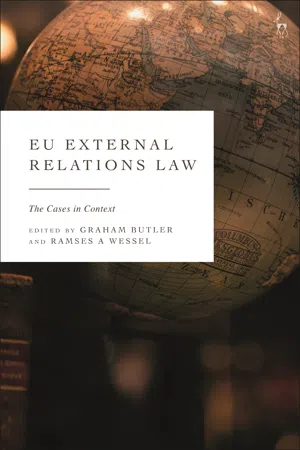
Marking the 50th anniversary of the influential ERTA doctrine, this book analyses and contextualises the entire breadth of the jurisprudence of EU external relations law through a systematic, case-by-case account of the field.
The entire framework of EU external relations law has been built from the ground up by the jurisprudence of the Court of Justice of the European Union. At the beginning of the field's emergence, the legal questions to be answered concerned the division of powers and competence between, firstly, the Member States and that of the Union; and secondly, the division of powers and competence between the different institutions of the Union. Questions on such matters continue to be asked, but more contemporarily, new legal questions have arisen that have been in need of adjudication, including questions concerning the autonomy of Union law; the relationship between the Union and other international organisations; the relationship between Union law and international law; the scope and breadth of international agreements; amongst others.
The book features established academic scholars, judges, agents of institutions and Member States, and legal practitioners in the field of EU external relations law, analysing over 90 cases in which the Court has legally shaped the theory and practice of the external dimension of legal Europe.
Cited in Opinion of Advocate General Nicholas Emiliou in Case C-516/22, European Commission v United Kingdom of Great Britain and Northern Ireland, ECLI:EU:C:2023:857 (Judgment of the UK Supreme Court), Court of Justice of the European Union, 9 November 2023; and, Opinion of Advocate General Nicholas Emiliou in Case C 728/23 P, Kingdom of Spain v Robert Stockdale, Council of the European Union, European Commission, European External Action Service (EEAS), European Union Special Representative in Bosnia and Herzegovina, ECLI:EU:C:2025:710, Court of Justice of the European Union, 18 September 2025.
eBook - ePub
EU External Relations Law
The Cases in Context
- 1,048 pages
- English
- ePUB (mobile friendly)
- Available on iOS & Android
eBook - ePub
EU External Relations Law
The Cases in Context
About this book
Information
1
Implied Powers of the EU, Limits to Political Expediency and Internationally Inspired Pragmatism: Commission v Council (ERTA)
INGE GOVAERE
Case 22/70, Commission of the European Communities v Council of the European Communities, ECLI:EU:C:1971:32 (ERTA), delivered 31 March 1971.
KEYWORDS
Legal personality – Capacity of the Union to conclude international agreements – Implied competence of the Union to negotiate and conclude international agreements – Effet utile doctrine – Exclusive and shared competence – in foro interno, in foro externo – Transport – Limits to political expediency – Conferment of powers in the course of negotiations entered into by the Member States – International context – Joint action by the Member States in the interests of the Union.
I.INTRODUCTION
ERTA (or AETR) is a landmark case, if not the most important case, in EU external relations law. The ongoing impact of the case can hardly be overestimated. Not only was it the very first of a long line of cases of the Commission opposing the Council; ERTA is synonymous with the doctrine of implied EU powers. The Court famously ruled that EU external competence is not limited to what is expressly provided, but extends potentially to all fields covered by the EU Treaties. The original ERTA test held that ‘Member States may no longer act externally if this would affect internal rules or alter their scope’.1 As such, it is a perfect illustration of the effet utile doctrine and may lead to exclusive or shared EU competence. The ERTA doctrine of affectation was subsequently elaborated upon to include respectively ‘an area which is already covered to a large extent by Community rules’2 as well as ‘its future development, insofar as that is foreseeable’.3 The Treaty of Lisbon codified only the original ERTA test in Articles 3(2) and 216 TFEU. This triggered the question of the necessity to discontinue those subsequently broader interpretations of ERTA post-Lisbon to respect the principle of conferral – an argument which was forcefully rejected by the Court.4
ERTA paved the way for the so-called ‘second track’ of implied powers introduced a few years later in Opinion 1/76. In the absence of the internal measures necessary to trigger the ERTA test, exceptionally, the Union has implied powers to conclude an agreement where ‘necessary for the attainment of one of the objectives’ of the EU Treaties.5 This second implied powers track was also codified by the Treaty of Lisbon in both Article 3(2) TFEU and Article 216 TFEU.
Codification of the two implied powers tracks by the Treaty of Lisbon logically entails that the nature of such powers fundamentally transforms from ‘implicit’ into ‘express’ competence with the same legal value as other provisions of the EU Treaties. The potential impact thereof on the scope of application of other express powers, in particular the Common Commercial Policy (CCP), was illustrated pre-Lisbon in relation to environmental protection.6 Not surprisingly, the express inclusion of both the ERTA and Opinion 1/76 tests, coupled with the catalogue of competences introduced in the Treaty of Lisbon in Articles 2–6 TFEU, has exponentially increased the need for clarification by the Court. Instead of offering certainty and transparency, the Treaty of Lisbon thus provoked a relaunch and exponential growth of case law related to EU competence and legal basis of EU external action. The odd one out is the field of transport. As the two tracks of implied powers rest on respectively road and waterway transport, the Court firmly stated that transport services remained exclusively subject to the transport chapter and could not come under the CCP.7 The codification of the EU Treaties as rubber stamped in Article 207(5) TFEU established a ‘fundamental parallelism’ between internal and external competence under the transport chapter of the EU Treaties, also post-Lisbon.8
Although best known for implied powers, ERTA was also groundbreaking for shaping EU external relations law beyond this doctrine. For the first time, the Court spelled out the limits to pure political expediency by firmly claiming jurisdiction on ‘whether to proceed through intergovernmental or Community channels’.9 Post-Lisbon, this important division between areas of political discretion and judicial control is reflected, inter alia, in Article 275 TFEU, which grants the Court jurisdiction with respect to Article 40 TEU and thus enables it to delineate between CFSP and other EU external action. In ERTA, the Court further offered a pragmatic solution to tackle the concurring dynamics of EU competence and international negotiations.10 Having regard in particular to the international context and position of third countries, Member States jointly could continue to act ‘on behalf of’ and ‘in the defence of the EU interest’, despite the fact that competence had shifted to the EU, pursuant to the principle of sincere cooperation.11 Although the latter principle was later on deftly invoked especially to facilitate EU participation in other international organisations,12 its early potential to solve practical conundrums pertaining to dynamics of EU external relations law has remained underexplored.
II.FACTS
The ERTA case related to the negotiation and conclusion of the European Agreement on Road Transport (ERTA/AETR)13 concerning the work of crews of vehicles engaged in international road transport under the auspices of the United Nations Economic Commission for Europe. Negotiations for a revised agreement resumed in 1967, after the first 1962 agreement concluded by five out of the six Member States failed to meet the requisite ratification numbers. On 19 May 1970, the Commission lodged an application before the Court whereby it requested the annulment of the proceedings of the Council of 20 March 1970 allowing for the Member States to negotiate and conclude this international agreement. In essence, the Commission claimed that since the EU had in the meantime adopted an internal EU measure on similar matters relating to standardising driving and rest periods of drivers of road transport vehicles, namely Regulation No 543/69 of the Council of 25 March 1969 on the harmonisation of certain social legislation relating to road transport,14 the competence to deal with this international agreement had, from that moment in time, shifted to the EU on an exclusive basis.
The Commission pointed out that it simply transposed to international agreements the reasoning also applicable to unilateral measures relating to transport policy. According to the Commission, Member States could no longer act only if and to the extent that the Union has exercised its competence. EU competence was therefore necessarily and progressively exclusive in pace with the adoption of internal measures. To underscore its argument, the Commission alleged that the Council had infringed the provisions in the EU Treaties on the common transport policy (now Article 91(d) TFEU), combined with the procedural provision for the conclusion of agreements (now Article 218 TFEU).15 It further argued that the Council had failed to indicate a legal basis, nor had it given a statement of reasons pertaining to the link between its contested decision and the EU Treaties.
The Council mainly retorted that its contested proceedings were not a decision with binding legal effects which could be contested before the Court, but merely constituted the ‘recognition’ of an existing situation of coordination between the Member States. It pointed, inter alia, to the fact that the proceedings were neither published in the Official Journal (OJ) nor notified to the Member States. The Council was also firmly opposed to the proposed deduction of EU exclusive external competence, by analogy, to the adoption of unilateral measures, by pointing out that ‘The EEC Treaty does not confer on the Community treaty-making powers precisely co-extensive with its internal authority’. Instead, the Council argued that ‘The power of the Community to promulgate legal measures was deliberately confined to unilateral measures except where unequivocal provisions such as [Article 207 TFEU and Article 217 TFEU]16 has conferred authority on the Community to enter into international agreements’.17 The Council thus called for the Commission’s application to be dismissed as inadmissible or, alternatively, as unfounded.
III.THE COURT
The competence issue was dealt with before the admissibility question. In line with the position taken by Advocate General (AG) Dutheillet De Lamothe, who had invoked a dual function fulfilled by the Council,18 the Court held that whether or not the contested proceedi...
Table of contents
- Cover
- Title Page
- Outline Table of Contents
- Detailed Table of Contents
- List of Contributors
- List of Abbreviations
- EU External Relations Law and Navigating the Case Law of the Court of Justice of the European Union
- 1. Implied Powers of the EU, Limits to Political Expediency and Internationally Inspired Pragmatism: Commission v Council (ERTA)
- 2. International Agreements in the EU Legal Order: International Fruit
- 3. International Agreements as an Integral Part of EU Law: Haegeman
- 4. Common Commercial Policy and the Determination of Exclusivity: Opinion 1/75 (Local Cost Standard)
- 5. The EU Customs Union, International Agreements of EU Member States, and the Doctrine of Substitution: Nederlandse Spoorwegen
- 6. Establishing Direct Effect of Provisions in International Agreements: Bresciani
- 7. Refining and Expanding Implied Powers of the Union: Kramer
- 8. Linking Internal and External Trade in a Perfect Customs Union: Donckerwolcke
- 9. EU External Competence in the Absence of Internal Rules, and the Sleeping Beauty: Opinion 1/76 (Laying Up Fund for Inland Waterway Vessels)
- 10. The Birth of the Principle of Close Cooperation, Declaration of Competences, and the Ruling Procedure: Ruling 1/78 (Convention on Nuclear Protection)
- 11. Defining the Scope of the Treaty-Making Competence for the Formulation of the Common Commercial Policy: Opinion 1/78 (Natural Rubber)
- 12. International Agreements Concluded by Member States Prior to their EU Accession: Burgoa
- 13. The Purpose of International Agreements and their Direct Effect: Polydor
- 14. Status and Enforceability of EU International Agreements within the Domestic Legal Systems of the Member States: Kupferberg
- 15. The EU’s Common Customs Tariff, Uniform Application of International Agreements, and the Demarcation between EU and Member State ‘Spheres of International Law’: SPI/SAMI
- 16. Direct Effect of Association Agreements and the Meaning of ‘Association’: Demirel
- 17. Judicial Review of EU Measures in the Light of WTO Rules: Fediol and Nakajima
- 18. The Integration of Decisions of Association Councils in EU Law: Greece v Commission (Special Aid to Turkey)
- 19. The Legal Effects of Decisions of Autonomous Bodies Established under an International Agreement: Sevince
- 20. The Union’s Participation in Legally Binding International Third-Party Dispute Settlement: Opinion 1/91 (EEA I) and Opinion 1/92 (EEA II)
- 21. Setting the Multiple Functions of Customary International Law in the EU Legal Order: Poulsen
- 22. ERTA, Mixity and the Duty of Cooperation in the Conclusion of International Agreements: Opinion 2/91 (ILO Convention)
- 23. The Reviewability of Acts Adopted by the Member States Meeting within the Council: Parliament v Council and Commission (Bangladesh Aid)
- 24. Legality of the European Development Fund and the European Parliament’s Prerogatives: Parliament v Council (European Development Fund)
- 25. Unrecognised ‘States’ and EU Law: Anastasiou I
- 26. No General Treaty-Making Power of the Commission to Conclude International Administrative Agreements: France v Commission I
- 27. Consistent Interpretation and Continuous Dialogue between the EU and the WTO: Germany v Council (Bananas)
- 28. A Setback in a Never-Ending Expansion to External Competence? Opinion 1/94 (WTO)
- 29. The Scope of the Union’s Exclusive External Competences and the Verification of Competence: Opinion 2/92 (OECD)
- 30. Unilateral Measures of Member States Affecting the Internal Market and the Law/Politics Divide in External Relations: Commission v Greece (FYROM)
- 31. EU Membership in International Organisations and the Joint Exercise of Membership Rights: Commission v Council (FAO)
- 32. The First Attempt at EU Accession to the ECHR: Opinion 2/94
- 33. Enforcement of International Sanctions within the EU Legal Order: Bosphorus
- 34. Scope of EU Development Policy: Portugal v Council (India Cooperation Agreement)
- 35. Legal Certainty and Customary International Law: Opel Austria
- 36. Invoking Customary International Law before the Court: Racke
- 37. The Effect of WTO Law in the EU Legal Order: Portugal v Council
- 38. The Member States’ Duty to Denounce Anterior Treaties: Commission v Portugal (Maritime Policies)
- 39. The Relationship between the Common Commercial Policy and Other External Competences of the EU: Opinion 2/00 (Cartagena Protocol)
- 40. Autonomy of the EU Legal Order and International Agreements Extending the Acquis: Opinion 1/00 (European Common Aviation Area)
- 41. Clarification of Exclusive Implied External Competence of the Union: Open Skies
- 42. Respect for Institutional Balance in the Adoption of Non-legally Binding Agreements: France v Commission II
- 43. The Effect of WTO Dispute Settlement Body Decisions in EU Law: Van Parys
- 44. Direct Effect of the EU–Russia Partnership and Cooperation Agreement, Non-discrimination and the Beautiful Game: Simutenkov
- 45. The Indissociable Link between Environmental Policy and the Common Commercial Policy: Commission v Council (Rotterdam Convention I)
- 46. Lowering the Threshold for Finding Implied Powers: Opinion 1/03 (Lugano Convention)
- 47. The Exclusive Jurisdiction of the Court and International Courts: Commission v Ireland (Mox Plant)
- 48. Judicial Protection in Autonomous Restrictive Measures Involving Composite Administrative Procedures: OMPI
- 49. The Autonomy of EU Law vis-à-vis International Law: Kadi I and Kadi II
- 50. Laying the Foundation for a Broad Scope of EU Development Cooperation Policy and its Delimitation with Other EU External Competence: Parliament v Commission (Philippines Border Management)
- 51. The Pre-Lisbon Machinery for the Delimitation of the CFSP: Commission v Council (ECOWAS)
- 52. The Legal Effects of the MARPOL Convention and the UN Convention on the Law of the Sea: Intertanko
- 53. Implied External Exclusivity and the Duty of Loyal Cooperation in International Organisations: Commission v Greece (International Maritime Organisation)
- 54. Visa Requirements for Turkish Citizens: Soysal & Savatli and Demirkan
- 55. The Application of EU Law in an Unrecognised Entity: Apostolides v Orams
- 56. Potential Incompatibility of International Agreements Concluded by Member States before Accession: Commission v Austria, Commission v Sweden and Commission v Finland
- 57. The Application of EU International Agreements to Occupied and Disputed Territories: Brita
- 58. Union Loyalty in Mixed External Relations and the Weight of Informal Preparatory Acts: Commission v Sweden (PFOS)
- 59. The Ambivalent Clarification of the Effects of International Conventional and Customary Law in the European Union: Air Transport Association of America
- 60. The Choice of Legal Basis between the AFSJ and the CFSP: Parliament v Council (Smart Sanctions)
- 61. Common Commercial Policy or Internal Market Rules as the Legal Basis for the Conclusion of International Agreements after Lisbon: Commission v Council (Conditional Access Convention)
- 62. The Choice of Legal Basis for Coordination of Social Security Systems with Associated Third Countries: UK v Council (EEC–Turkey)
- 63. Jurisdiction of the EU Courts in the CFSP when Linked to the EU Budget: Elitaliana
- 64. Intellectual Property and the Post-Lisbon Common Commercial Policy: Daiichi Sankyo
- 65. The Application of EU Internal Competences in an External Context: UK v Council (EEA)
- 66. The Normalisation of CFSP International Agreements in the EU Legal Order: Parliament v Council (Mauritius) and Parliament v Council (Tanzania)
- 67. The Legal Basis for International Agreements in the field of Development Cooperation Post-Lisbon, and its Potential as a Catch-All Provision: Commission v Council (Philippines PCA)
- 68. Member States as Trustees of the Union in International Organisations: Germany v Council (OIV)
- 69. The ERTA Doctrine Post-Lisbon: Opinion 1/13 (Convention on the Civil Aspects of International Child Abduction)
- 70. The Second Attempt at EU Accession to the ECHR: Opinion 2/13
- 71. The Impact of Obligations under International Agreements on the (Judicial) Review of EU Measures: Stichting Natuur en Milieu and Pesticide Action Network Europe
- 72. Hybrid Acts of the EU and its Member States Concerning International Agreements: Commission v Council (US Air Transport Agreement)
- 73. Balancing Institutional Powers in Negotiating Directives and EU External Environmental Relations: Commission v Council (Australia ETS)
- 74. EU Representation in International Litigation: Council v Commission (International Tribunal for the Law of the Sea)
- 75. The Compatibility of EU International Agreements Extending to Occupied Territories with International Law: Front Polisario and Western Sahara Campaign UK
- 76. The Scope of the Court’s Jurisdiction in the CFSP: H v Council and Others
- 77. Institutional Balance in the Conclusion of Non-binding International Agreements Revisited: Council v Commission (Swiss MoU)
- 78. The Concept of (Non-)Commerciality and the ERTA Doctrine Post-Lisbon: Opinion 3/15 (Marrakesh Treaty)
- 79. Attribution of Authorship of ‘EU’ Legal Acts: NF and Others v European Council
- 80. The Absence of Rights to Humanitarian Visas, and Missions of EU Member States in Third Countries: X and X v Belgium
- 81. Securing a Coherent System of Judicial Protection in Relation to Restrictive Measures: Rosneft
- 82. The EU Competence to Conclude the New Generation of Free Trade Agreements: Opinion 2/15 (EU–Singapore FTA)
- 83. International Agreements Assessed Through the Prism of the Charter of Fundamental Rights: Opinion 1/15 (EU–Canada PNR)
- 84. The Unitary Representation of the Union in an International Forum and Clarification of Shared Competence and Facultative Mixity Post-Lisbon: Germany v Council (COTIF I) and Commission v Germany (COTIF II)
- 85. The Web of Autonomy of the EU Legal Order: Achmea
- 86. The Delineation between CFSP and Non-CFSP Matters: Commission v Council (Kazakhstan)
- 87. Mixity and Exercising Shared Competence in International Fora: Commission v Council (Antarctic Marine Protected Areas)
- 88. Investor–State Dispute Tribunals Established under EU International Agreements: Opinion 1/17 (EU–Canada CETA)
- 89. Ensuring Respect for International Humanitarian Law Through Labelling Requirements: OJE and Vignoble Psagot
- 90. Inter se Agreements between Member States, and the Outer Limits of the Court’s Jurisdiction in Infringement Proceedings: Slovenia v Croatia
- 91. Jurisdiction of the Court for Non-contractual Liability and Actions for Damages Claims within the CFSP: Bank Refah Kargaran
- 92. The Right of Third States to Challenge EU Restrictive Measures before the Court: Venezuela v Council
- Copyright Page
Trusted by 375,005 students
Access to over 1.5 million titles for a fair monthly price.
Study more efficiently using our study tools.
Frequently asked questions
Yes, you can cancel anytime from the Subscription tab in your account settings on the Perlego website. Your subscription will stay active until the end of your current billing period. Learn how to cancel your subscription
No, books cannot be downloaded as external files, such as PDFs, for use outside of Perlego. However, you can download books within the Perlego app for offline reading on mobile or tablet. Learn how to download books offline
Perlego offers two plans: Essential and Complete
- Essential is ideal for learners and professionals who enjoy exploring a wide range of subjects. Access the Essential Library with 800,000+ trusted titles and best-sellers across business, personal growth, and the humanities. Includes unlimited reading time and Standard Read Aloud voice.
- Complete: Perfect for advanced learners and researchers needing full, unrestricted access. Unlock 1.5M+ books across hundreds of subjects, including academic and specialized titles. The Complete Plan also includes advanced features like Premium Read Aloud and Research Assistant.
We are an online textbook subscription service, where you can get access to an entire online library for less than the price of a single book per month. With over 1.5 million books across 990+ topics, we’ve got you covered! Learn about our mission
Look out for the read-aloud symbol on your next book to see if you can listen to it. The read-aloud tool reads text aloud for you, highlighting the text as it is being read. You can pause it, speed it up and slow it down. Learn more about Read Aloud
Yes! You can use the Perlego app on both iOS and Android devices to read anytime, anywhere — even offline. Perfect for commutes or when you’re on the go.
Please note we cannot support devices running on iOS 13 and Android 7 or earlier. Learn more about using the app
Please note we cannot support devices running on iOS 13 and Android 7 or earlier. Learn more about using the app
Yes, you can access EU External Relations Law by Graham Butler, Ramses A Wessel, Graham Butler,Ramses A Wessel in PDF and/or ePUB format, as well as other popular books in Law & International Law. We have over 1.5 million books available in our catalogue for you to explore.