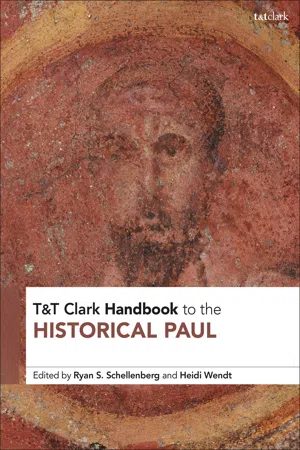
The T&T Clark Handbook to the Historical Paul gathers leading voices on various aspects of Paul's biography into a thorough reconsideration of him as a historical figure. The contributors show how recent trends in Pauline scholarship have invited new questions about a variety of topics, including his social location, his mode of subsistence, his cultural formation, his place within Judaism, his religious experience and practice, and his affinities with other religious actors of the Roman world. Through careful attention to biographical detail, social context, and historical method, it seeks to describe him as a contextually plausible social actor.
The volume is structured in three parts. Part One introduces sources, methods, and historiographical approaches, surveying the foundational texts for Paul and the early Pauline tradition. Part Two examines key biographical questions pertaining to Paul's bodily comportment, the material aspects of his career, and his religious activities. Part Three reconstructs the biographical portraits of Paul that emerge from the letters associated with him, presenting a series of "micro-biographies" pieced together by leading Pauline scholars.
- 512 pages
- English
- ePUB (mobile friendly)
- Available on iOS & Android
eBook - ePub
T&T Clark Handbook to the Historical Paul
About this book
Information
CHAPTER ONE
Introduction
RYAN S. SCHELLENBERG AND HEIDI WENDT
As an object of critical inquiry, the subject of this handbook is at once very old and surprisingly new. In one sense, reclaiming the historical Paul has been a central preoccupation of biblical scholarship since the dawn of modern criticism. But for the most part this endeavor has had very specific and quite narrow aims. As Albert Schweitzer’s classic history of interpretation makes plain, the prevailing assumption of scholars from the eighteenth century through the early twentieth (when he wrote) was that, in studying Paul, the historian’s task was to reconstruct and contextualize Paul’s theology; in this way, Schweitzer claimed, Paul’s true place in the history of Christian thought would be revealed.1 Subsequent scholars have debated at length the contours and even the coherence of Paul’s theology, but seldom its centrality to the study of Paul, who is rarely examined as a historical subject in his own right.2
This fixation on the theology of Paul is of course residue of the Reformation and the fundamental role played by Pauline interpretation in the construction of Protestant doctrine. Yet it has persisted even among scholars who claim for Paul’s letters no normative status. Aware of the anachronism of construing Paul as a Christian theologian, many now prefer to speak of his thought rather than his theology; still, the assumption remains that the chief interest of studying Paul lies in the conceptual content of his letters. Thus the basic parameters of Pauline scholarship continue to be defined by the conventional Christian image of Paul the apostle, whose essential role was the generation and transmission of moral and religious teaching. In practice, then, the search for the historical Paul has in fact meant the search for historical Paulinism—the quest, as one recent title has it, for “What Saint Paul Really Said.”3 The historical person himself has been of comparatively little interest, except insofar as his biography might shed light on the nature or the origins of the ideas he came to possess.
Similarly, historical inquiry into Paul’s social and cultural context, though ubiquitous, has occupied a somewhat auxiliary role, restoring complexion to representations of his thought but seldom sponsoring redescription of Paul himself as a plausible figure of the Greco-Roman world. As a result, the very studies that succeed at staging Paul within a convincing Greco-Roman milieu often stop short of bringing that context to bear on traditional assumptions about him. Paradoxically, then, historical contextualization can act as a protective barrier, fortifying a conventional image of Paul with “objective” data while leaving it largely intact.
As the chapters in this volume attest, this paradigm is now beginning to show signs of strain. Recent scholarship on the social formation of early Christ groups has denaturalized the singularly Christian category “church” by comparing the assemblies (ἐκκλησίαι) attested in the New Testament with the various other groups and associations woven into the fabric of the ancient city.4 Such work invites a similarly comparative reevaluation of the social role occupied by the founders of these assemblies—the itinerant Christ purveyors, among them Paul, who termed themselves apostles. How might Paul, like the assemblies he founded, be mapped onto the landscape of the Roman world, with the latter taken not merely as backdrop but as dynamic social and cultural terrain that Paul and his contemporaries at once inhabited and actively shaped? Here the familiarity and apparent self-evidence of the category “apostle” tends to insulate Paul from meaningful contextualization. When this category is subjected to comparative scrutiny, his peculiarity as a historical figure reemerges, and with it a new set of historical questions.5
Another challenge to the prevailing paradigm derives from renewed attention to what might conveniently be called Paul’s religious experience, here understood not merely as background or sideshow to his gospel proclamation but as a constitutive element of it. Recent studies highlight the significance of revelations, divination, “signs and wonders,” and spirit engagement in his practices.6 These foci rebalance the weight assigned to Paul’s verbal gospel—a message he received, he insists, through a revelation (Gal 1:12)—so that this emerges as but one feature of a broader program of divine communication.7 In a very different methodological vein, others have taken up the textual expressions of ecstatic experience in Paul’s letters, drawing on neurocognitive study to inquire not only into Paul’s mind but also his brain.8 One implication of this sort of approach is that the ideational content of his letters cannot responsibly be abstracted from the pneumatically inclined body in which it took form. Altogether these studies give rise to a more textured image of Paul, one in which his discourses are integral components of a robust religious program.
Another set of historiographical interventions might loosely be called biographical. Recent studies of Paul’s itinerancy, education, and means of sustenance have sharpened the question of his social location, as, too, has fresh scrutiny of the punitive beatings and imprisonments to which he was subjected.9 Meanwhile, attempts to tease out the chronology of Paul’s writing and activity continue unabated.10 These topics are not new pursuits but have been of perennial interest in Pauline studies. Collectively, however, such studies attest to a renewed resolve to shrug off the weight of traditional images of Paul and revisit the evidence on its own terms.
Finally, a burst of interest in the early reception of Paul has fueled fresh discussion of his ancient memorialization, beginning with but by no means limited to his portrayal in the Acts of the Apostles and the deutero-Pauline letters. These ancient depictions of Paul have alternately been understood to distort our view of the historical figure or to preserve the collective memory of early Christ groups. However one construes this evidence, attention to the various prisms through which our images of Paul have been refracted contributes new resources for redressing the theological and ideological biases that have long shaped modern scholarship.11
This volume represents an initial attempt to consolidate these various strands of research into a thorough reconsideration of Paul as a historical figure. Its origins lie in the work of the Historical Paul section of the Society of Biblical Literature, which the editors of this volume co-chair and to which several of its authors have contributed. The basic objective of this handbook replicates that of the section, namely to reinvigorate the study of Paul as a historical figure. Through attention to biographical detail and social context, careful consideration of historical method, and engagement with a diverse range of comparanda, it seeks to describe him as a contextually plausible social actor, both within the specific landscape of the Greco-Roman world and a broader history of religious practice.12 Building on the detailed historical work scholars of Paul have always valued, yet attempting to shed what has been the governing paradigm, we aim for a thoroughgoing redescription, one that redraws the boundaries of what counts as evidence for the historical Paul with all dimensions of that person subject to scrutiny and revision.
The individual chapters that follow pursue this objective in three main ways. In Part One, contributors take up key methodological and theoretical issues in describing Paul as a historical figure. These include the general constraints common to any historiographical venture, but also challenges specific to the study of Paul, especially those entailed by the nature of the relevant sources and the history of their transmission and interpretation. Each chapter in Part Two addresses a discrete biographical problem, taking up questions that range from the chronology of Paul’s activity to the evidence for his death. We have made no attempt here to be comprehensive, but have aimed rather to offer thorough reevaluations of those aspects of Paul’s life and work most critical to historical contextualization and reconstruction.13 Finally, Part Three consists of what we have termed epistolary micro-biographies, each of which takes up the evidence from one canonical letter or letter set on its own terms.14 Although the portraits of Paul that emerge are necessarily fragmentary, they offer a clarity of focus seldom seen in biographical treatments of Paul.
Readers anticipating an emerging consensus on Paul as a historical figure are likely to be disappointed. Contributors to this volume assess the evidence differently, and differ, too, in their judgments concerning which evidence should be given priority. There is no agreement, for example, concerning the historical utility of Acts: in Chapter 18, Douglas Campbell exemplifies precisely the critically selective use of Acts that Christopher Mount seeks in Chapter 3 to contest. Nor does a consensus emerge regarding which letters should be taken as authentic. Here it is particularly striking that although Leif Vaage (Chapter 2) and Benjamin White (Chapter 4) diagnose in complementary terms the inadequacy of traditional judgments regarding authenticity, the solutions they propose move in opposite directions, with Vaage advocating a sharper and more rigorous focus on Papyrus 46 (𝔓46)—the earliest extant Pauline letter collection—and White arguing instead for a broadening of the evidentiary basis to encompass the residue of Paul’s memorialization in the second century. Irreconcilable judgments regarding specific features of Paul’s biography are numerous but, in our view, stand in productive tension.
If the contributors to this volume arrive at no single historical reconstruction, nevertheless they lay the groundwork, we hope, for coherent inquiry into a set of questions that have long been pursued mostly ad hoc—which is to say, only insofar as they impinge on the project of understanding Paul’s thought. For although significant disagreements persist, still this volume reflects broad agreement on a set of key historiographical principles that together fuel our quest for the historical Paul. These we would summarize briefly as follows: that ideas have no life in the world apart from the individual and social bodies in which they dwell, and that, consequently, to study them unmindful of these bodies is necessarily to distort their historical significance; that Paul was fully implicated in the basic human struggle to keep, as it were, body and spirit together—a struggle that, in his case (by no means uniquely, but certainly with special urgency) pressed upon him from both sides; that any useful description of Paul as a historical figure must locate him plausibly within the first-century Roman world; and that the preceding historiographical move requires restoring Paul’s letters to the same footing as other texts from the period and treating them as evidence for religion more generally in this context.
The careful studies that follow give ample illustration of the fruitfulness of these principles.
1Albert Schweitzer, Paul and His Interpreters: A Critical History, trans. William Montgomery (London: A&C Black, 1912).
2For an early exception, perceptive if also ultimately problematic, see Adolf Deissmann, St. Paul: A St...
Table of contents
- Cover
- Half-Title Page
- Series Page
- Title Page
- Contents
- List of Tables
- Note on Translations
- List of Abbreviations
- 1 Introduction
- Part One Sources and Methodology
- 2 The Corpus Paulinum
- 3 Acts
- 4 The Pauline Tradition
- 5 The Manuscript Tradition
- 6 Person, Character, Self
- Part Two Biographical Problems
- 7 Travel and Homelessness
- 8 Manual Labor and Sustenance
- 9 Beatings and Imprisonments
- 10 Appearance and Health
- 11 Singleness and Celibacy
- 12 Ioudaios, Pharisee, Zealot
- 13 Literacy and Education
- 14 Mythmaking and Exegesis
- 15 Divination and Miracles
- 16 Religious Experience
- 17 Death
- 18 Chronology
- Part Three Epistolary Micro-Biographies
- 19 Romans
- 20 The Corinthian Correspondence
- 21 Galatians
- 22 Philippians and Philemon
- 23 1 & 2 Thessalonians
- 24 Colossians and Ephesians
- 25 The Pastoral Epistles
- Bibliography
- Notes on Contributors
- Subject Index
- Index of Ancient Sources
- Copyright
Trusted by 375,005 students
Access to over 1.5 million titles for a fair monthly price.
Study more efficiently using our study tools.
Frequently asked questions
Yes, you can cancel anytime from the Subscription tab in your account settings on the Perlego website. Your subscription will stay active until the end of your current billing period. Learn how to cancel your subscription
No, books cannot be downloaded as external files, such as PDFs, for use outside of Perlego. However, you can download books within the Perlego app for offline reading on mobile or tablet. Learn how to download books offline
Perlego offers two plans: Essential and Complete
- Essential is ideal for learners and professionals who enjoy exploring a wide range of subjects. Access the Essential Library with 800,000+ trusted titles and best-sellers across business, personal growth, and the humanities. Includes unlimited reading time and Standard Read Aloud voice.
- Complete: Perfect for advanced learners and researchers needing full, unrestricted access. Unlock 1.5M+ books across hundreds of subjects, including academic and specialized titles. The Complete Plan also includes advanced features like Premium Read Aloud and Research Assistant.
We are an online textbook subscription service, where you can get access to an entire online library for less than the price of a single book per month. With over 1.5 million books across 990+ topics, we’ve got you covered! Learn about our mission
Look out for the read-aloud symbol on your next book to see if you can listen to it. The read-aloud tool reads text aloud for you, highlighting the text as it is being read. You can pause it, speed it up and slow it down. Learn more about Read Aloud
Yes! You can use the Perlego app on both iOS and Android devices to read anytime, anywhere — even offline. Perfect for commutes or when you’re on the go.
Please note we cannot support devices running on iOS 13 and Android 7 or earlier. Learn more about using the app
Please note we cannot support devices running on iOS 13 and Android 7 or earlier. Learn more about using the app
Yes, you can access T&T Clark Handbook to the Historical Paul by Ryan S. Schellenberg,Heidi Wendt in PDF and/or ePUB format, as well as other popular books in Theology & Religion & Biblical Studies. We have over 1.5 million books available in our catalogue for you to explore.