Despite widespread skepticism on the matter, a significant number of people today have stories of religious experience—moments of inexplicable terror or rapturous joy, visions, near-death experiences of the afterlife, encounters with angels, heavenly voices, and premonitions. How should rationally minded people respond?
What would your reaction be if someone told you that, one night while sitting alone, she saw through the window a brilliant light descend from the sky until it was so large that it filled the room—and that it radiated a feeling of "pure love"? And what would you say if a friend confided that one night he woke up and could not move, felt he was being suffocated, and sensed an evil spirit in the room?
By default in the secular age we are skeptical about anything mysterious or supernatural. More likely than not, most people would respond to the stories above with embarrassment and concern about the person's grasp of reality, or they would attempt to explain them away through rational or scientific means. But the truth is that religious experiences like these are not as uncommon as they seem—although
talking about such experiences often is. This is the case even in a faith tradition such as Christianity, despite the Bible's numerous accounts of miraculous and mysterious happenings.
In
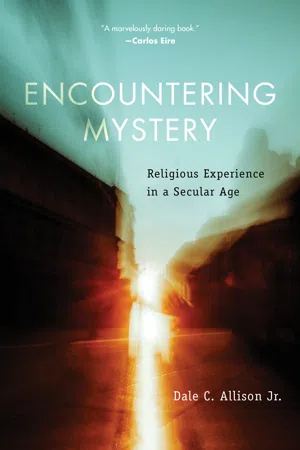
Encountering Mystery, noted biblical scholar Dale Allison makes the argument that stories of religious experience are meaningful and not to be marginalized—and that we have a moral prerogative to lovingly engage with such stories regardless of whether we have had similar experiences. Through a close look at phenomena such as moments of inexplicable terror or rapturous joy, visions, near-death experiences of the afterlife, encounters with angels, heavenly voices, and premonitions, Allison shows how ordinary practices of faith need not be at odds with individual religious experiences. Above all, he enjoins us to be honest about the persistence of religious experience in a secular age and to make space for those who encounter mystery in their lives.
- 280 pages
- English
- ePUB (mobile friendly)
- Available on iOS & Android
eBook - ePub
About this book
Information
Topic
Theology & ReligionSubtopic
Christian Theology1
Stars Descending
“Nature loves to hide itself.”
I entered college without having planned a career or thought about how I might, down the road, make a living. My mind was on other things. Moving on from high school to college was exactly like moving on from junior high to high school: it was nothing but the expected next step. I took that step without reflection.
During freshman orientation at the nearby state university, a young man asked me about my major and my minor. I had no answer. What, I asked, is a major? What is a minor? After he explained the terms, he handed me a piece of paper with a long list of academic disciplines. I scanned the options. I then checked the two that seemed most personally relevant: philosophy for the major, religion for the minor.
I was drawn to those two topics because of what had happened a little over a year before, when I was sixteen. I was sitting by myself on my parents’ back porch, under the Kansas night sky. What I was thinking about I fail to remember. I have not, however, forgotten the magical incident that redirected my life. In a moment, and seemingly without preparation on my part, the stars were not far away but close to hand. Having somehow forsaken the firmament, they were all around me. If not quite animate, they were also not wholly inanimate. These engulfing lights then announced, by what mechanism I know not, the arrival of an overwhelming, powerful presence. This presence was forbidding yet benevolent, affectionate yet enigmatic. It suffused me with a calm ecstasy, a sublime elation, “a genial holy fear” (Coleridge).
The experience awakened me from what I then deemed, in retrospect, to have been a lifelong slumber. It electrified awareness and bestowed meaning. Given my cultural context, a word came straightway to mind for this fantastic Other: God. When the moment, which lasted maybe twenty seconds, had passed, I believed that I had run into God, or that God had run into me.
Of course, as I write these words, nearly fifty years after the event, not everything is perfectly vivid. Not only has time dimmed lucidity, but speech betrays the transcendent. Private event and public discourse are not the same. Yet I soon enough translated my experience into words, and I have, over the years, rehearsed them to myself. So I have, I believe, retained the gist of what took place.
I also remember what followed. My Bethel-like vision left me firmly persuaded that the word “God” refers to something more than optimistic imagination, and further that this something matters in a way nothing else does. These, however, were naked convictions, bare-boned thoughts. How was I to respond? What was I supposed to do? There was no imperative in my experience.
I soon began to speak with others about what had happened. Those who were sympathetic did not hesitate to interpret my experience for me. Jesus, they eagerly and confidently avowed, had saved me from my sins. I had been born again. I had been rescued from the domain of darkness and transferred to the kingdom of God’s beloved Son. From now on I was to live, out of gratitude, a Christian life.
I accepted their interpretation even though I had already been attending a church, saying my prayers, and leading a tame life—and even though my experience had no christological component (a fact that, curiously, occurred to me only later, after I came to think for myself). Sundays thereafter found me not in my parents’ liberal church but in my friends’ evangelical church. Those in charge taught me what I should believe about many, many things.
Not all my high-school friends appreciated my new zeal. One in particular assailed me with questions. How do you know that anything in your miracle-filled Bible is history as opposed to fable? Given what we now know about the brain, how can you believe in a soul? Is hell not an outdated myth sensible people discarded long ago? Is it reasonable to accept the tenets of one religion when other religions hold different and contradictory tenets?
These were, to my mind, excellent questions, and I had unsatisfying answers. Soon, then, my friend’s questions became my questions, his doubts my doubts, his objections my course of study. And with that I began to read. I read evangelical apologists and modern theologians, hostile atheists and biblical critics. I read philosophers and psychologists, archaeologists and biologists, scholars of Hinduism and proponents of Buddhism, as well as the parapsychologists and their critics. This is why I decided, when asked, that I would major in philosophy and minor in religion. Why not use college to investigate further the epistemological puzzles and religious quandaries that already consumed me?
After that, one thing led to another, and I eventually ended up with a PhD in biblical studies.
My meeting with the mysterium fascinosum in 1972 is not a parenthetical moment but rather the existential center of my entire life. I have spent my days trying to understand it and all that has flowed from it. It is the experiential foundation upon which I have built everything else. It is the source of my deep-seated curiosity about all matters religious and countless affiliated topics. Without that experience, I do not know where I would be today, but my life would not, I am sure, have been the same. Ultimately, then, I am a professor at a seminary not so much because I have the requisite credentials but because the stars came down one night when I was sixteen years old.

When I was twenty-three and in graduate school, I had another profoundly moving experience. Here is what I wrote soon after it happened:
The day before yesterday I stood in my bedroom before a window that overlooks a [cemetery with a] grove of trees, evergreen, oak, maple. The sun, close to the horizon, still lit the landscape. A cool breeze moved the trees and, blowing through the open window, stirred the air in my room. The only sound was the song of seemingly happy crickets. A few moments passed—and then, suddenly, an emotion laid hold of me. I think I should … call it “joy,” though the word falls far short. This “joy” welled up from deep within, rapidly filled me entirely, and then passed beyond my body. No longer did I contain it, it contained me. And somehow I was enabled to see through the world, perceiving the depths below the shallow surface. Thus I saw, for the first time, the colors of the green things of the earth—colors brighter and more distinct than can be imagined, and yet at the same time soft: their intensity did not blind but delighted the eyes. The wind revealed itself to be a sparkling élan, and its appearance was like a multi-colored crystal, clear and luminous. And it spoke to me, saying: The world is full of life, overflowing from God’s hand. The Golden Age, Eden, has not passed from the world; rather, people are blind, they cannot see. This that you see is always here, and always will be here. Indeed, this is what the saints shall see, walking upon the lawn of heaven.
The feeling of “joy” and my vision of nature’s depth endured only a few seconds and soon began to fade. Then an odd thing happened. I did not seek to retain the experience. I no longer wished to look. Instead I wished that others might look. And in a moment of time the faces of my family and friends appeared before my mind, and I clasped my hands and prayed that they might feel what I felt and see what I saw—if not in this world then in the world to come. Having offered this prayer, I turned away from the window, assured that my petition had been heard.
With the reader’s indulgence, I wish to relate one more personal experience, and then I will get to the point. The following event occurred when I was in my mid-forties. I wrote it up in an email to a friend a few hours later:
I was still in bed Sunday morning when my wife turned on some classical music (unfortunately I don’t know the piece). It didn’t wake me but rather brought me to that fascinating state between waking and sleeping. I entered some sort of place that was—please recall all the times you have heard mystics say that what they experienced is ineffable—entirely sky blue, composed of softly pulsating diamond crystals with large bird shadows or souls flitting through it. It was like being in the sea—this stuff surrounded me, but I wasn’t exactly floating. The place itself was joy unbounded, ecstasy without compare. The music was part of it, and the bird shapes were overflowing with, singing with, happiness, as was the place itself, which I can’t think of as either organic or inorganic (maybe it’s like First Peter—living stones). Along with the joy was profound peace, the only thing comparable in my experience being one night in the hospital when I floated around in a morphine stupor. I experienced all this for three, four, or five seconds and then was so overwhelmed that I began to cry. My crying then brought me out of that state.
Words can’t begin to describe what this was like. It will stay with me for the rest of my life. It confirms me in my belief that underneath all this mess is absolute joy. I perked up when the sermon three hours later told me that creation was the overflowing of love from the members of the Trinity; this made perfect sense. It also confirms me in my eschatological solution—an experiential solution, not an intellectual solution to be sure—to the problem of evil. As I lay in bed, I thought that if all the world and its miseries were suddenly dumped into that sky blue land, the joy would be so overwhelming and complete that all evils and regret and anger and hatred and revenge would dissipate in a second. It is so immense that it would make everything else matter less than a hill of beans. I think someone in that state would really feel that the sufferings of the present time are not worthy to be compared, etc.
This incident has helped me to appreciate Paul’s uncertainty when he wrote, concerning one of his ecstatic experiences: “whether in the body or out of the body I do not know” (2 Cor. 12:3).
Having recounted my three experiences, I am wholly cognizant that many would deem them to be purely subjective and so of scant interest. They would explain them away as hallucinations of some sort, as visions without external stimulus, byproducts perhaps of glitches in my neuronal machinery. In doing so they could not only appeal to all sorts of scientific facts but also quote Shakespeare:
Such tricks hath strong imagination,
That if it would but apprehend some joy,
It comprehends some bringer of that joy.1
While I would resist going along, I do not here mount a case to the contrary. My interest in this chapter lies elsewhere, in one undeniable fact. Whatever the causes—be it imagination, my cerebral circuit board, extramundane realities, or (as I think) an even mixture of all three—my experiences have mattered profoundly. While the nature of the events is open to debate, the biographical effects are not.
I have a small piece of paper in my desk drawer. On it is a list of several out-of-the-ordinary experiences. The first line reads simply: Stars 1972. On another line is this: Cemetery 1978. The final entry is: Bird souls 1999. There are (from other years) six additional entries. I take this paper out once in a while and stare at it, mulling over the unexpected events that the key words and dates represent. Such recall imbues my life with meaning and generates gratitude.
The three experiences I have herein recounted—which, added up, occupied less than a minute of my life—have not just imparted certain feelings. They have also, via reflection, led to certain thoughts—or, more precisely, to four stanch convictions. The first is that the transcendent reality that descended from the Kansas night sky is not a curiosity, something about which I could choose to be indifferent. Not only is it, as I initially intuited, connected in some mysterious way to everything else, but nothing by comparison counts for much, or at least fails to count in the same superlative way.
Second, the theological idea of grace is not uninformed theory. Perhaps indeed grace is built into the structure of things. My experiences were in no way consciously sought, planned, or manufactured, nor were they the effects of fasting or ingesting drugs. They were not rewards for this or that, nor were they linked to a personal crisis. They seem instead to have come out of nowhere, like Paul’s vision on the road to Damascus. Uninvited, they just happened. So I experienced them as surprises and received them as gifts.
My third conviction is that God can speak through the natural world. I met the maker in the stars. I beheld the divine in a cemetery garden. I experienced transcendence in shadowy birds. That the psalmist thought the heavens to declare the glory of God makes perfect sense to me, and I am inordinately fond of the passage where “I Am” speaks to Moses from a bush. I believe that a mystical presence rolls through all things, and that
The soul can split the sky in two,
And let the face of God shine through.
These last words are from Edna Saint Vincent Millay’s wonderful poem, “Renascence,” which my father asked to have read as death drew near. If, on my deathbed, I likewise have my wits, I will make the same request.
Finally, it is not that appearances can be deceiving. Rather, appearances are deceiving. Things are not what they seem to be most of the time. We are like Pharaoh when he looked at Moses: he had no idea what was really going on. The mysterious hierophany at the heart of the world is concealed. Seeing we do not see. “Verily thou art a God that hidest thyself” (Isa. 45:15, King James Version). Behind, beneath, and beyond the mundane face of the world, and secreted within our daily lives, is some fundamental, magical, mystical, affectionate reality.
These four convictions are not, for me, abstractions acquired from books. They are instead truths I have gathered from immediate experience. I may, I freely admit, be deluded in all this. Perhaps my brain has conspired against me, landing me in baseless fantasies. Maybe my subjective experiences have no objective correlates beyond my skull’s atoms and so my beliefs are without substance. The human proclivity for error and self-deception is, speaking conservatively, enormous. Still, it is hard for me to feel that the skeptical take is more than a theoretical possibility. I have never been able to disown my experiences, to stand back and attribute them, without remainder, to tricks of the mind. They were too profoundly real, too perceptually tangible, for trouble-free reductionism. The upshot is that I cannot but perceive and interpret the world through them.
2
Behind the Scenes
“I often remember this exp...
Table of contents
- Cover
- Title Page
- Copyright
- Dedication
- Contents
- Preface
- 1. Stars Descending
- 2. Behind the Scenes
- 3. Bliss from Somewhere, Terror from Nowhere
- 4. The Hidden World of Prayer
- 5. The Lore of Angels
- 6. Approaching Death
- 7. Death from Within
- 8. Rational Analysis
- 9. Some Theological Issues
- 10. The Pastoral Imperative
- Notes
- Suggested Reading
Trusted by 375,005 students
Access to over 1.5 million titles for a fair monthly price.
Study more efficiently using our study tools.
Frequently asked questions
Yes, you can cancel anytime from the Subscription tab in your account settings on the Perlego website. Your subscription will stay active until the end of your current billing period. Learn how to cancel your subscription
No, books cannot be downloaded as external files, such as PDFs, for use outside of Perlego. However, you can download books within the Perlego app for offline reading on mobile or tablet. Learn how to download books offline
Perlego offers two plans: Essential and Complete
- Essential is ideal for learners and professionals who enjoy exploring a wide range of subjects. Access the Essential Library with 800,000+ trusted titles and best-sellers across business, personal growth, and the humanities. Includes unlimited reading time and Standard Read Aloud voice.
- Complete: Perfect for advanced learners and researchers needing full, unrestricted access. Unlock 1.5M+ books across hundreds of subjects, including academic and specialized titles. The Complete Plan also includes advanced features like Premium Read Aloud and Research Assistant.
We are an online textbook subscription service, where you can get access to an entire online library for less than the price of a single book per month. With over 1.5 million books across 990+ topics, we’ve got you covered! Learn about our mission
Look out for the read-aloud symbol on your next book to see if you can listen to it. The read-aloud tool reads text aloud for you, highlighting the text as it is being read. You can pause it, speed it up and slow it down. Learn more about Read Aloud
Yes! You can use the Perlego app on both iOS and Android devices to read anytime, anywhere — even offline. Perfect for commutes or when you’re on the go.
Please note we cannot support devices running on iOS 13 and Android 7 or earlier. Learn more about using the app
Please note we cannot support devices running on iOS 13 and Android 7 or earlier. Learn more about using the app
Yes, you can access Encountering Mystery by Dale C. Allison in PDF and/or ePUB format, as well as other popular books in Theology & Religion & Christian Theology. We have over 1.5 million books available in our catalogue for you to explore.