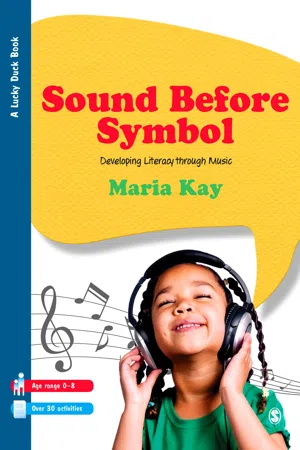
Sound Before Symbol
eBook - PDF

Sound Before Symbol

Developing Literacy Through Music

  1. 112 pages
  2. English
  3. PDF
  4. Available on iOS & Android
eBook - PDF

Sound Before Symbol

Developing Literacy Through Music

About this book

This book demonstrates how musical activities can support the development of literacy skills for young children aged from birth to 8 years. The relationship between music and literacy is investigated, and through a wealth of ideas and resources, guidance is given on how to use music as a practical tool to develop skills vital to literacy. As music is naturally inclusive, the activities are suitable for all children.

Each chapter includes activities to explore, and the book covers:

- the myriad of skills which may be elicited through music making

- the importance of sound discrimination to literacy

- the links between how the brain processes both music and language

- how to develop literacy skills through musical activities

- ideas to support teaching literacy through phonics

Written for teachers, practitioners, teaching assistants and childminders, as well as for anyone working with children in nursery and primary schools, children?s centres and at home, this book provides a wealth of information. It is an invaluable resource to support the development of children?s literacy skills in an enjoyable and effective way.

Maria Kay is a teacher and music and literacy specialist, currently developing and delivering literacy- through-music programmes.

Frequently asked questions

Yes, you can cancel anytime from the Subscription tab in your account settings on the Perlego website. Your subscription will stay active until the end of your current billing period. Learn how to cancel your subscription.
No, books cannot be downloaded as external files, such as PDFs, for use outside of Perlego. However, you can download books within the Perlego app for offline reading on mobile or tablet. Learn more here.
Perlego offers two plans: Essential and Complete
  • Essential is ideal for learners and professionals who enjoy exploring a wide range of subjects. Access the Essential Library with 800,000+ trusted titles and best-sellers across business, personal growth, and the humanities. Includes unlimited reading time and Standard Read Aloud voice.
  • Complete: Perfect for advanced learners and researchers needing full, unrestricted access. Unlock 1.4M+ books across hundreds of subjects, including academic and specialized titles. The Complete Plan also includes advanced features like Premium Read Aloud and Research Assistant.
Both plans are available with monthly, semester, or annual billing cycles.
We are an online textbook subscription service, where you can get access to an entire online library for less than the price of a single book per month. With over 1 million books across 1000+ topics, we’ve got you covered! Learn more here.
Look out for the read-aloud symbol on your next book to see if you can listen to it. The read-aloud tool reads text aloud for you, highlighting the text as it is being read. You can pause it, speed it up and slow it down. Learn more here.
Yes! You can use the Perlego app on both iOS or Android devices to read anytime, anywhere — even offline. Perfect for commutes or when you’re on the go.
Please note we cannot support devices running on iOS 13 and Android 7 or earlier. Learn more about using the app.
Yes, you can access Sound Before Symbol by Maria Kay,SAGE Publications Ltd in PDF and/or ePUB format, as well as other popular books in Education & Early Childhood Education. We have over one million books available in our catalogue for you to explore.

Table of contents

  1. COVER
  2. Contents
  3. Preface
  4. Acknowledgements
  5. How to use this book
  6. Activities
  7. Figures and tables
  8. Key for icons
  9. About the author
  10. Introduction
  11. 1. The magic of music
  12. 2. Investigating literacy development
  13. 3. Evidence of analogies between music and literacy
  14. 4. The processing of music and language in the brain
  15. 5. The way forward: literacy through music
  16. Conclusion
  17. Glossary
  18. References
  19. Index