A new account of how Portugal fought a bush war in Mozambique for over a decade.
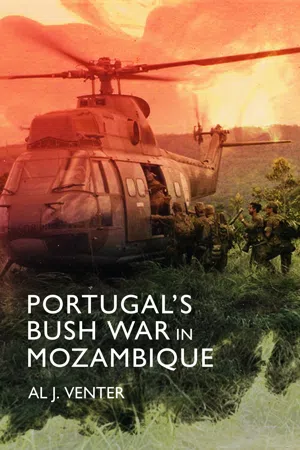
Portugal fought a bush war in Mozambique — one of the most beautiful countries in the world — for over a decade. The small European nation was ranged against formidable odds and in the end was unable to muster the resources required to effectively take on the might of the Soviet Union and its collaborators—every single communist country on the planet and almost all of Black Africa. Yet, Al Venter argues, Portugal did not actually lose the war, and indeed fought in difficult terrain with a good degree of success over an extended period. It was radical domestic politics that heralded the end. Mozambique is once again embroiled in a guerrilla war, this time against a large force of Islamic militants, many from Somalia and some Arab countries, and unequivocally backed by Islamic State and the lessons of Mozambique's bush war are still relevant today.
- English
- ePUB (mobile friendly)
- Available on iOS & Android
eBook - ePub
Portugal's Bush War in Mozambique
About this book
Information
Subtopic
20th Century HistoryIndex
HistoryCHAPTER 1
Mozambique Today
Mozambique is a remarkable country. Beautiful almost beyond compare as it lies on the Indian Ocean, undisturbed almost forever and, in the days before the colonial war, regarded by many who made their lives in that part of Africa as a minor paradise.
This is a country that I and my family have visited many times and often enthused about. My father was a regular visitor between the wars, to the point that he was to lose his first wife to malaria, contracted during a 1930s visit to Lourenço Marques. She died while still on the train on their way home to Johannesburg, something that my dad never quite got over.
My own movements throughout this former Portuguese territory have been extensive, from the country’s Ponto do Ouro “deep south,” all the way north through Xai Xai, Inhambane, Vilanculo, Beira, Quelimane and on to the present-day Pemba, not to be confused with Tanzania’s Pemba Island of 1960s revolutionary fame. In between we also have Mozambique Island, a sanctuary for those looking for a remote corner of Africa to which to escape, along with Ibo Island and the stunning Quirimbas: I have scuba-dived off many of these still-exotic locations.
***
Stroll around the streets of modern Maputo—it was called Lourenço Marques not all that long ago—and the military presence remains manifest. There may not be as many roadblocks as there were when the colonial war ended almost half a century ago but the visitor is left in little doubt as to who is in charge.
As one heads north along Mozambique’s relatively recently surfaced EN1 highway, it is impossible to avoid noticing that the military presence becomes more obtrusive. That stems largely from an Islamic-backed insurgency that has been troubling parts of the north of the country.
This insurrection—which the guerrillas liked to refer to as Guerra de Libertação—had nothing to do with the civil war of old that was linked to RENAMO. It is something quite new and those involved are radical Jihadists linked to Somalia’s al-Shabaab. For now, Mozambique’s military is trying to deal with the insurrection but without much success. There are people getting killed and nobody in the capital can lay a finger on how this debacle escalated to the extent that the country now faces a full-blown civil war in the north.
Nor does it seem that anybody in the capital is losing any sleep about the insurrection because killings are mainly Black-on-Black and the tourists keep coming to what was once one of the most beautiful wildlife parks in Africa, the Lugenda Wildlife Reserve, or quite simply, “Luwire.”
Everything changed in the entire region once Islamic State started sending its recruits southwards into Mozambique from Tanzania.
The almost 2,000km-long road runs from Maputo to the city of Pemba not far from the Tanzanian frontier. It can take several days to cover the distance or, if you have the time, a month; apart from the north and their troubles, there is so much to do along the way.
The drive is an experience: part good, part bad, because conditions can be unpredictable, especially in the start-of-year rainy season which can end with cyclones.
Contrasts along the way—tiny villages that almost always have makeshift booths that offer their own versions of chicken peri peri, along with varieties of palm wine—are part of an astonishingly varied fare. Much of what is available is customarily set alongside the road, usually on the way in or out of town and almost always offset by the local clinic and school (both almost always squeaky clean and running efficiently). And, of course, the roadblocks, which rarely stop tourists for questioning and become more prevalent the further north you go.
More salient, you are never far from the sea and impromptu fresh fish dishes cooked over open fires alongside the road. And there is always time for a dip either in the local lagoon or surf, having parked your car in an adjacent village in perfect safety. A small clutch of meticals, the local currency, always does the trick. You need to watch for stonefish if you are strolling in bare feet in the shallows though: they are commonplace in most tidal waters.
Traveling about the country, what often impresses visitors from other African countries is the number of schools, all reasonably efficient and running to strict schedules. The schoolchildren in Mozambique are almost always immaculately clad in their spotless uniforms—it says a lot that this homogeny is achieved in a country where a man has to work several days in order to buy his son or daughter a new shirt and, sometimes a week for a new pair of shoes.
Cheek by jowl with these measures of privation are many larger towns that make for the unusual: like the seaside resorts of Xai Xai, Inhambane, Tofo (with magnificent shoals of whale sharks—dozens of them, many times of the year) and that remarkable backpacker’s hideaway, Vilanculo, historic gateway to the Bazaruto Archipelago. The irrepressible Martha Gellhorn spent memorable times swimming alone off the shore in Bazaruto, nobody plucky enough to stop her.
You can stop almost anywhere along the way and find a place to stay—unlike Maputo—safe enough not to have to lock your bedroom door at night. And it’s not expensive, because Mozambique is the one African country where the marketplace is one gigantic souk. If the price of a meal, or even of hotel rooms, is too high, no blinks if you try to barter your way downwards…
Beyond the great Save River bridge, sometimes only partially in use because of structural problems, is Beira—to my mind still a drab and dusty place and to be avoided if possible—even if not everybody agrees with me. After that come Quelimane and Nacala—with their gently sloping crystal-white sand beaches—and finally Pemba, now pivotal to a burgeoning oil center in the north. Along the way, there are any number of small seaside hotels and pint-sized lodges waiting, and the diving is always great.
For all that, it needs more than a modicum of courage to tackle the distance, but then Mozambique—even in colonial times—has never been taken lightly, nor should it. Nor can political instability be ignored. In recent times political tensions have triggered a series of attacks on civilian vehicles, even overland buses, some quite close to Beira, the country’s second city.
Shortly before the new Islamic-linked war started in the north in 2017, one traveler reported, “I arrived in Beira after an enormous delay following a holiday in the stunningly beautiful region around Vilanculo.” The reason was simple, or was it? Somewhere on the road, he explained, his bus had to wait for a military convoy to cross a particularly dangerous district…
The truth is that while there is some banditry—there is not a country in Africa that is not faced with similar problems—there is rarely loss of life. People steal, and you might be pick-pocketed, as happens everywhere, but local criminals (except in the Islamic-orientated far north of the country) really do respect human life.
What is astonishing is that with the country’s open roads, wildlife reserves where there are animals in abundance and more stopping points along the way than can be imagined, is that Mozambique has never quite caught on with the youthful transient communities of either Europe or America.
Kerouac and his friends across the United States, had they been alive, would have loved the place. It’s cheap, it’s friendly and accessible and while there is palm wine just about everywhere, so is weed. And if you are not averse to “going native” for a spell, at prices that would buy you a pair of hamburgers in other parts of the world, you’ve got it made.
Obviously, it helps if you fala português.
***
In reality, life in present-day Mozambique—the country that produced Eusébio da Silva Ferreira, one of the all-time greats in world football (more commonly known, quite simply as Eusébio)—is both interesting and, depending on your predilections, can be rewarding. Like any country, it also has its quirks.
Big money from abroad—much of it brought in illegally to acquire private real estate—has come into the country in recent years, a good deal of it from South Africa, and there has been a proliferation of luxury homes built along one of the most exotic coasts in the world. The names on exclusive show-pages in some major international newspapers include Praia da Barra, Tofo, Ponta do Ouro, Bilene, Pomene Bay and others.
On pristine Bazaruto Island, perched on the coast between Beira and Maputo—and still very much like it was in the colonial epoch, except for the luxury resorts and its own air strip connecting it to Vilanculo—speculators have built a succession of exclusive estates where the price for a simple two-bed single-story house starts at several hundred thousand dollars.
But that is the reverse side of the coin in a country, where earning US$20 a day suggests a good measure of success in the run-down shanty towns that surround every significant conurbation. Most don’t even have running water or sewage systems and here we’re talking of homes to millions of locals, almost all Black or Mestiço. There are so many people of mixed ancestry in Mozambique that the country even has its own Dia do Mestiço, celebrated on June 27 each year.
Mozambique’s downside can be severe, as we saw with Cyclone Idia that roared in across the Indian Ocean from Madagascar in early 2019 and not only leveled thousands of villages and towns (Beira suffered exceptionally badly) but caused more deaths than anybody is ever likely to know. Should it happen, it will take years to organize a proper census to establish exactly how many died, the majority indigent tribal people in the interior.
Bad weather apart, there has been very little attention given to the infrastructures of almost all of the county’s residential areas: sidewalks, Maputo especially, collapsed decades ago and in some areas the potholes are so numerous that residents sometimes make their own tracks alongside main roads to avoid damage to their vehicles. There was a maxim doing the rounds during my last visit that suggested that if you saw the ears of a rabbit in a pothole on the road ahead, take care because it could be a donkey…
That said, Mozambique is not always gloom and doom. Take this blog from an Austrian aid worker based in Beira, employed by an NGO and enjoying the expat life. It is one of hundreds, perhaps thousands of similar comments on the Web, but the writer imparts something personal, even intimate about it.
In her report, titled “A Day in the Life of Someone Out There—in Mozambique,” she provides us with a handful of unbiased insights to community life within the society where she lives. I quote:
Mozambique is wonderful. But not everything is pleasant. Abstract problems deploy visible impacts. Take diseases: Mozambique has an HIV prevalence of more than ten percent; it was even higher in the past. The enormous shortage of teachers is not unique, but to an important extent a tragic result of the AIDS epidemic: Teachers get terminally ill and die and the same goes for other professional guilds.
In contrast to most other lethal diseases, AIDS mainly affects young to middle-aged adults—parents of young children, an economically highly productive age group. ‘Double Recruitment’ is a common strategy in companies: Two people are hired and trained for one job—because chances are that one of them will pass away prematurely.
But at times, I feel like a stranger, an alien from a different world. Most of the time, I know that I stick out, but every now and then I feel like a part of the ecosystem here.
I have never been made unwelcome and I do accept that there are situations where I will never ever blend in. I did learn very quickly that my necessities and ideas of a fulfilled life do not fundamentally differ from those of my friends and acquaintances here—we all want to wake up in a good mood, we all have people we care about, we like to laugh and sometimes simply relax.1
It wasn’t always so, especially during the colonial war that started in 1964 and lasted ten years, when a group of radical young officers in Lisbon ousted the government and ordered all the troops fighting in Africa to return.
Though the Portuguese colonies had become far more multiracial than before—of necessity, because the government needed the manpower to fight the guerrillas—race invariably dictated policies of state and it was usually with the Whites at the top of the pile.
All that changed dramatically when Samora Machel’s ragtag (and often barefoot) army won the day and most of the White Portuguese that had made the country their home, some for centuries, fled back to Europe.
Change, when it came, was cathartic for many, but for a time the government seemed to make it work. David Ottaway, one of the Washington Post’s best-known foreign correspondents, reported while traveling in recently independent Maputo, on December 18, 1977, in an article headed “Races Mix Well in Mozambique.”
He wrote his piece 30 months after the country had become independent and though there was much strife and bitterness when Machel began his tenure, things improved with time, though almost all private business had been nationalized by the state as part of RENAMO’s program of divesting the people (which meant people with money) of their assets. Almost overnight thousands of businesses, factories and enterprises were stripped, a prelude to what has been happening in Venezuela in recent years. Yet, he maintains:
For the 20,000 to 25,000 new and old Portuguese now living here [but only if they accepted the government’s Marxist policies, if only nominally] a new, more peaceful era in race relations seems to be dawning.
The sight of whites mingling easily with blacks and mixed-blood Mestiços in the bars, restaurants and even in many homes in Maputo is a common one … the exclusive Polana Hotel serves afternoon tea and cakes indiscriminately to chic Portuguese women wearing the latest fashions and to impeccably dressed black Mozambicans.
In addition to the highly visible community of Mestiços, there is a surprisingly large number of “white Mozambicans.” Indeed, the new high society of independent Mozambique is becoming a broad mixture of races including a small number of highly influential Indian Goans.
For a while, the Maputo government turned to outsiders to replace those Portuguese who had “taken the gap” (as the majority of White Angolans had done). The Luanda government resorted to bringing in Cubans by the thousands (which didn’t work), even though the initial focus, as might have been expected, was on education and medicine. What resulted in Maputo was that the regime used its Lisbon Embassy to recruit thousands of badly needed teachers, doctors, civil servants and technicians.
Sadly, Ottaway made ...
Table of contents
- Front Cover
- Half-Title Page
- Title Page
- Copyright Page
- Dedication
- Contents
- Acknowledgements
- Foreword by Brigadier-General Nuno Lemos Pires
- Introduction
- 1 Mozambique Today
- 2 Portugal’s Illustrious Maritime and African History
- 3 The Challenges that Faced Portugal
- 4 Portugal’s Enemies
- 5 Mozambique’s Military Contradictions
- 6 How Others Viewed Mozambique’s War
- 7 Daniel Roxo—Legend of a Guerrilla Fighter
- 8 The Role of African Troops in Lisbon’s Wars
- 9 The Portuguese Air Force in Mozambique
- 10 The Alouette III—A Magnificent Flying Machine
- 11 The Zambezi River—Focal Point of the War
- 12 Rhodesia in the War in Mozambique
- 13 The Landmine War—Ultimately the Deciding Factor
- 14 A Personal Experience of the War in Mozambique
- 15 War Wounded
- 16 Why Portugal Lost its African Possessions
- 17 Portugal’s Forces Leave Africa
- Epilogue
- Glossary
- Select Bibliography
- Endnotes
Trusted by 375,005 students
Access to over 1.5 million titles for a fair monthly price.
Study more efficiently using our study tools.
Frequently asked questions
Yes, you can cancel anytime from the Subscription tab in your account settings on the Perlego website. Your subscription will stay active until the end of your current billing period. Learn how to cancel your subscription
No, books cannot be downloaded as external files, such as PDFs, for use outside of Perlego. However, you can download books within the Perlego app for offline reading on mobile or tablet. Learn how to download books offline
Perlego offers two plans: Essential and Complete
- Essential is ideal for learners and professionals who enjoy exploring a wide range of subjects. Access the Essential Library with 800,000+ trusted titles and best-sellers across business, personal growth, and the humanities. Includes unlimited reading time and Standard Read Aloud voice.
- Complete: Perfect for advanced learners and researchers needing full, unrestricted access. Unlock 1.5M+ books across hundreds of subjects, including academic and specialized titles. The Complete Plan also includes advanced features like Premium Read Aloud and Research Assistant.
We are an online textbook subscription service, where you can get access to an entire online library for less than the price of a single book per month. With over 1.5 million books across 990+ topics, we’ve got you covered! Learn about our mission
Look out for the read-aloud symbol on your next book to see if you can listen to it. The read-aloud tool reads text aloud for you, highlighting the text as it is being read. You can pause it, speed it up and slow it down. Learn more about Read Aloud
Yes! You can use the Perlego app on both iOS and Android devices to read anytime, anywhere — even offline. Perfect for commutes or when you’re on the go.
Please note we cannot support devices running on iOS 13 and Android 7 or earlier. Learn more about using the app
Please note we cannot support devices running on iOS 13 and Android 7 or earlier. Learn more about using the app
Yes, you can access Portugal's Bush War in Mozambique by Al J Venter,Al J. Venter in PDF and/or ePUB format, as well as other popular books in History & 20th Century History. We have over 1.5 million books available in our catalogue for you to explore.