"A clear, brisk writer, Pearson is also quite thorough, taking a holistic attitude to the many facets of a confused, turbulent period." —
NYMAS Review
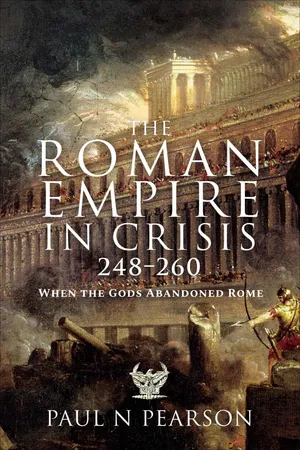
This book is a narrative history of a dozen years of turmoil that begins with Rome's millennium celebrations of 248 CE and ends with the capture of the emperor Valerian by the Persians in 260. It was a period of almost unremitting disaster for Rome, involving a series of civil wars, several major invasions by Goths and Persians, economic crisis, and an empire-wide pandemic, the "plague of Cyprian." There was also sustained persecution of the Christians.
A central theme of the book is that this was a period of moral and spiritual crisis in which the traditional state religion suffered greatly in prestige, paving the way for the eventual triumph of Christianity. The sensational recent discovery of extensive fragments of the lost Scythica of Dexippus sheds much new light on the Gothic Wars of the period. The author has used this new evidence in combination with in-depth investigations in the field to develop a revised account of events surrounding the great Battle of Abritus, in which the army of the emperor Decius was annihilated by Cniva's Goths. The Roman Empire in Crisis, 248-260 sheds new light on a period that is pivotal for understanding the transition between Classical civilization and the period known as Late Antiquity.
eBook - ePub
The Roman Empire in Crisis, 248–260
When the Gods Abandoned Rome
- 320 pages
- English
- ePUB (mobile friendly)
- Available on iOS & Android
eBook - ePub
About this book
Information
Subtopic
Military & Maritime HistoryIndex
HistoryPart I
Philip to Decius, 248–251 CE
Chapter 1
Empire at the Millennium
Organization and Economy
There is a saying about the third century Sassanian (Persian) Empire which might just as well apply to Rome: ‘The kingdom relies on the army, and the army on money, and money on the land tax, and the land tax on farming’.1 As in all ancient empires, wealth was generated mainly from working the land where the vast majority of the population toiled, producing enough to feed themselves and, ideally, a small surplus. Because of this, prosperity and population were correlated.
The total number of people in the Roman Empire in the 240s is hard to estimate because the rural poor leave little in the way of an archaeological footprint. Estimates suggest that it probably stood at around 65 million people, about its highest ever level. That is equivalent to the current population of countries like France or the United Kingdom, although of course distributed over a far larger area. A slightly better comparison is the population of the United States around the Year 1900, but that is also very misleading because numbers in the empire were not in the process of booming: endemic diseases, climatic fluctuations and the carrying capacity of the land put a check on further growth.2
The empire was, above all, a stupendous feat of organization (Map 1). Its size and longevity are astonishing when one considers the cultural and religious diversity that it encompassed, the tardiness of communications, and the limited means of law enforcement available. The great theme of the empire’s decline and fall has famously captivated historians for centuries, but in some ways its capacity for survival and reinvention is just as interesting to contemplate.
One reason for the system’s durability was the balance between devolved administration and central authority. Most decisions were made in the cities, towns and villages, where local dignitaries wielded great power and influence. In many cases these people were the direct descendants of the civic or tribal elites that had existed before incorporation into the empire. Settlements were grouped into a hierarchy and ultimately into provinces. Elite officials would serve fixed-term appointments in the provincial administration, moving around and advancing their careers, a major factor that helped maintain cohesion as well as loyalty to the imperial centre. By the third century it was no longer the case that the leading citizens were all, or even mostly, native Romans or Italians: they were drawn from the ambitious aristocracy of the whole empire, albeit disproportionately from the wealthier parts.

Map 1. The Roman Empire in the mid-third century (modified from Pearson 2016).
The famous Roman army, which provided the security, has been a source of endless fascination to historians and the popular imagination alike. It was, as everyone knows, a well-equipped and professional military machine. Its organization and internal culture were wonderfully uniform such that senior commanders and even mere foot soldiers could be switched from one end of the empire to the other and know their job. By the mid-third century it was still divided into scores of legions (each, nominally, of about 4,000 men), plus a wide variety of smaller auxiliary units, but the segmented plate armour and curved shields treasured by modern re-enactment groups had mostly been replaced by other types of standard issue kit. Recruits were drawn from the varied peoples of the empire but were organized and paid for by the central administration. As long as the army remained loyal and united, and the flow of pay was maintained, this arrangement was quite resilient and had proved itself sufficient to protect the borders and police the internal workings of the state.3
The basic level of military pay (stipendium militum) was set by government and was the main outlet for distributing coin. Emperors could win favour with the army by increasing pay across the board, but as the monetary value of all other labour was benchmarked against it, such an act would cause general inflation. So instead of permanent increases, a scheme of one-off payments (donatives) gradually became the norm, although if repeated too often they too would have an inflationary effect. The issuing of a donative was preceded by a vow of loyalty to the emperor, something that would have made good sense to any ruler who was in a position to fund major handouts, but it did establish a direct link between money and loyalty. Woe betide the emperor who found himself unable to sustain the supply of pay to the frontiers or fund a donative when the troops expected it.
The state clawed its money back through taxation, either in coin or in kind. From early imperial times the coinage had been based on gold, silver and bronze (the aureus, denarius and sestertius, respectively) which exchanged at the ratio of 1 to 25 to 100. Critical to this system is that the coins had value as bullion, in contrast to modern paper or electronic money which is intrinsically worthless. This seems to have made the currency effective at limiting inflation so long as the weight and purity of the coins could be maintained. Losses of precious metals were made good from the imperial mines – dire pits of human misery that existed in various parts of the empire. But economic tensions could arise if the productivity of the mines failed or if large amounts of precious metal exited the empire as payment to foreign powers. The imperial administration might attempt to ‘print money’ by slowly debasing the weight or precious metal content of the coins or by manipulating the ‘face value’ and/or exchange ratio, but the economic impact of such moves could be far-reaching and unpredictable. By Philip’s reign the monetary system functioned much as it had done for centuries although by that time the old single denarius had been replaced by a double which was only about fifty per cent pure. Its value seems to have slipped against gold such that one aureus was by now worth about twenty of these doubles.4
The idea that the empire had been in a state of stagnation during the decades running up to Rome’s millennium seems to have some basis in fact, although it is very difficult to quantify. There seems to have been a general absence of innovation in science, technology, literature and art, which contrasts markedly with previous centuries and has led to the period being described as an ‘age of anxiety’. The yearning for renewal and a new Golden Age seems understandable in retrospect.5
The gods
The intellectual poverty of the early third century does not apply to the sphere of religious thought. Perhaps it is inevitable that people turned to the gods in difficult times, hence there was much debate, discussion and innovation in matters spiritual across the empire. The formal state religion had a dual focus on the traditional gods of Rome and the imperial cult which were expected to be revered everywhere. The so-called ‘Capitoline Triad’ of Jupiter, Juno and Minerva were the most senior of the gods, but there were countless other deities around the empire which might rise and fall in popularity with the times.
Religious activity was as much about observance as it was belief, and was both private and public. It was very pluralistic, even tolerant, which is one reason the empire was generally acceptable across so wide a range of cultures. In a single day one could honour the memory of one’s ancestors and household gods, revere the light of some woodland glade as the expression of a local sylvan deity, make communal worship involving procession, music and dance, give donations at a temple of healing, file a sacred curse to inflict hideous revenge on the person who stole one’s cloak, sacrifice to a fashionable foreign deity, pray for the deified emperors and the genius of the current one, and then argue the meaning of it all with a diverse range of itinerant sages and philosophers.6
We have already mentioned the Stoics as being in vogue during the period. Their focus was on personal introspection, the simple life, and doing the right thing to achieve spiritual peace in accordance with nature and the will of the gods. The higher virtues such as wisdom, justice, and fortitude should dictate one’s actions along with logic and reason rather than emotion and the appetites of the body. The inner strength thus gained allowed one to cope with the trials and tribulations of life, which were many. Health and wealth were appropriate goals for any person to aspire to but the Stoics taught that illness, disability and poverty are also an inevitable part of existence that had to be accepted. The Stoic focus on manly self-reliance could easily align with traditional Roman discipline so as to lead a father to expose an unwanted baby to die or a resolute commander to reluctantly order the genocidal massacre of an entire unruly tribe.7
Stoicism had been around in one form or another for hundreds of years, but a new philosophical movement that is today (although not then) identified as ‘Neoplatonism’ was emerging. The famous Egyptian philosopher Plotinus had just set up his school at Rome, attempting to merge and take the best from all the schools of philosophy, both eastern and western, using the works of Plato and Aristotle as central reference points. According to Plotinus, the entire universe and everything within was in a process of unfolding, driven from above by a divine and benevolent principle. Evil was explained as somehow external to this divine will, arising from chaos. Some strains of Neoplatonism had mystical or magical elements, straddling the boundary between philosophy and religion. An allied group were the so-called Neopythogoreans who expanded on the symbolic geometry and number theory of Pythagoras to argue that there was a natural scale from universal one-ness to the infinite, with the mortal world in between. A prominent figure among these had been the sage Apollonius of Tyana who is said to have travelled to India, interacted with Buddhist monks, and regularly worked miracles such as casting out demons, healing the sick and raising the dead.
As is well known, the Roman deities paralleled the Greek gods of Mount Olympus insofar as Jupiter was identified with Zeus, Juno with Hera, Minerva with Athena, and so on. The so-called ‘syncretic’ identification of the gods went much deeper, however, such that local tribal deities across the empire could readily be incorporated to the pantheon, and hence be accorded due respect. In many cases regional forms of worship continued virtually unaltered beneath a new veneer of imperial respectability. Even the ancient Egyptian gods were regarded as manifestations of the same set of deities (Horus was Mars, Anubis was Mercury, Osiris was Pluto, and so on, although the fit seems somewhat contrived).
The syncretic custom meant that foreign religions could easily spread far and wide within the empire. Examples that were popular at the millennium are the cults of Jupiter Dolichenus, which had its origin in the worship of Baal at Dolichene on the Euphrates, and Serapis, who was a Graeco-Egyptian god worshipped at Alexandria. These two movements were mystery cults wherein initiates were promised access to escalating levels of arcane power and knowledge to be imparted via once-in-a-lifetime ceremonies as they progressed through various grades of enlightenment. Other mystery cults were those of Mithras, which was of Persian origin with roots in Zoroastrianism, and Cybele, the ‘Great Mother’ from Asia Minor.
This whole system was famously rejected by the Jews who worshipped just one god, their own. As is well known, this had been the source of enormous tension between them and their Roman overlords, ultimately leading to the Jewish revolt of 66 CE and the destruction of the city of Jerusalem along with its great temple in 70 CE. A temple to Jupiter Capitolinus was later built on the ruins and Jews were banished from the city, contributing to the so-called ‘Jewish diaspora’ in which emigrant communities developed in many places across the eastern empire. Despite this, the Roman authorities conceded that the Jews were following the religion of their ancestors (however misguided it may have seemed to them) and accepted Judaism as religio licita (permitted religion), allowing its practitioners special exemption from public communal ceremonies and worship. They were tolerated as long as they paid special taxes and were willing to pray for the good of the empire and the imperial family.8
Christians
Although Judaism undoubtedly gained occasional converts, it was, on the whole, confined to one ethnic group. A much greater problem for the Roman authorities was an offshoot whose devotees worshipped a Jewish holy man and preacher called Jesus of Nazareth. This man had been executed around 30 CE and was believed to have been bodily resurrected and taken to heaven. Jesus was regarded as the ‘Christ’ (anointed one) foretold by the prophets and the ‘son of God’. Christian thinkers increasingly came to identify him as a living manifestation of the one true God. This radical religious group features very prominently in the story of Rome’s crisis so it is worth considering them in a little detail. The religion had spread rapidly through non-Jewish communities, largely due to the efforts of the Apostle Paul, an early convert, who preached Christianity as a universal religion. By the mid-third century there were over a million adherents distributed through most of the empire. Christianity was generally regarded as an innovation and a cult (superstitio) as opposed to a permitted religion although different emperors undoubtedly varied in their attitude towards it.
Christianity retained many aspects of Judaism including a reverence for its texts, but as a trans-cultural movement it also absorbed influences from many other religions and philosophies. The writings of the so-called ‘gnostic’ Christians, for instance, were strongly influenced by Neoplatonism and the mystery cults. Modern Christianity is of course extremely diverse but in the third century it was arguably more so, as communities in different places developed their own theologies, concepts, rituals and practices. Many gospels (lives and sayings of Jesus), accounts of the deeds of his apostles and visionary tracts were in circulation that were later purged as unorthodox or heretical, some of them presenting a very different concept and personality of Jesus and his followers that can be startling today. The Infancy Gospel of Thomas, for example, features a malevolent child Jesus who demonstrates his powers by killing a boy who punched him and then blinding the boy’s par...
Table of contents
- Cover
- Title
- Copyright
- Contents
- Acknowledgements
- List of Plates
- List of Maps
- Introduction
- Prologue: Millennium
- Part I: Philip to Decius, 248–251 CE
- Part II: Gallus to Valerian, 251–260 CE
- Epilogue: Rome Abandons the Gods
- Literature Cited
- Notes
- Plate section
Trusted by 375,005 students
Access to over 1.5 million titles for a fair monthly price.
Study more efficiently using our study tools.
Frequently asked questions
Yes, you can cancel anytime from the Subscription tab in your account settings on the Perlego website. Your subscription will stay active until the end of your current billing period. Learn how to cancel your subscription
No, books cannot be downloaded as external files, such as PDFs, for use outside of Perlego. However, you can download books within the Perlego app for offline reading on mobile or tablet. Learn how to download books offline
Perlego offers two plans: Essential and Complete
- Essential is ideal for learners and professionals who enjoy exploring a wide range of subjects. Access the Essential Library with 800,000+ trusted titles and best-sellers across business, personal growth, and the humanities. Includes unlimited reading time and Standard Read Aloud voice.
- Complete: Perfect for advanced learners and researchers needing full, unrestricted access. Unlock 1.5M+ books across hundreds of subjects, including academic and specialized titles. The Complete Plan also includes advanced features like Premium Read Aloud and Research Assistant.
We are an online textbook subscription service, where you can get access to an entire online library for less than the price of a single book per month. With over 1.5 million books across 990+ topics, we’ve got you covered! Learn about our mission
Look out for the read-aloud symbol on your next book to see if you can listen to it. The read-aloud tool reads text aloud for you, highlighting the text as it is being read. You can pause it, speed it up and slow it down. Learn more about Read Aloud
Yes! You can use the Perlego app on both iOS and Android devices to read anytime, anywhere — even offline. Perfect for commutes or when you’re on the go.
Please note we cannot support devices running on iOS 13 and Android 7 or earlier. Learn more about using the app
Please note we cannot support devices running on iOS 13 and Android 7 or earlier. Learn more about using the app
Yes, you can access The Roman Empire in Crisis, 248–260 by Paul N Pearson,Paul N. Pearson in PDF and/or ePUB format, as well as other popular books in History & Military & Maritime History. We have over 1.5 million books available in our catalogue for you to explore.