- 208 pages
- English
- ePUB (mobile friendly)
- Available on iOS & Android
eBook - ePub
About this book
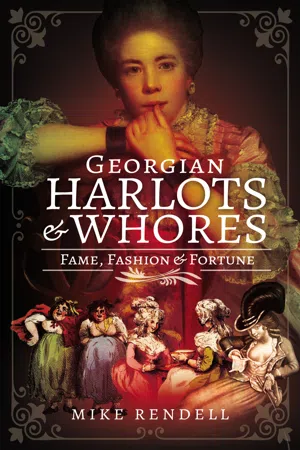
This book will look at the phenomenon of celebrity hookers in the eighteenth century – all of them the subject of extraordinary press scrutiny and comment. They were the fashion icons of the age, and what they wore was copied and put on sale in the high street within days. Many of them were passed around within the same small circle of aristocratic lovers. They were the object of constant gossip and whether they were flaunting their fame by taking a box at the opera for the entire season, or by parading through Hyde Park in a phaeton pulled by matching cream ponies, or returning from Paris wearing the very latest fashions, they enjoyed a celebrity status nowadays bestowed on TV reality stars and footballers' wives.
Information
Topic
Scienze socialiSubtopic
Primordi della storia modernaPart I
Components of Celebrity – Then and Now

Liberality and Desire, by Thomas Rowlandson.
So, what makes celebrity? Is it just fame – or is it rather more than that? Can you be a celebrity if you are poor? Or not beautiful? Can you ever be a celebrity if you follow a ‘serious’ profession such as being a doctor or an accountant?
In most definitions, celebrity status is generally awarded to people who are not renowned for their importance to society. They may well donate large sums of money to charity, but that is not why they became celebrities. And it is hard to think of a poor celebrity. Some may achieve star status, for instance, by winning a talent competition – Susan Boyle, winner in 2009 of Britain’s got Talent, would be an example. But she is not a ‘typical celebrity’. Celebrities are the ‘Beautiful People’, people who live aspirational lives, who are followed by the paparazzi and are featured on television programmes. A celebrity has to be ‘open to view’, not shut away as a wealthy recluse. And nowadays you get celebrity status because of a fortuitous coming together of the power of television – especially reality TV programmes – and social media. The reach of celebrities is astonishing – it encompasses the whole world.
Three centuries ago celebrity was a much more parochial affair, and in reality was confined to London. Fashion and manners were highly esteemed and as the idea of ‘ton’ developed more and more people aspired to join those arbiters of taste and style. The ‘haut ton’ – literally, ‘high tone’– was perhaps represented by as few as 400 families. It covered the absolute crème de la crème of people of high fashion and manners. The ‘haut ton’ had, since 1769, referred to the prevailing mode or style and to fashionable ways. Later, the term ‘haut ton’ might be extended to those whom the Lady Patronesses deemed eligible for inclusion as members at Almacks, and for that you needed to have impeccable manners, good breeding and, preferably, a title. But that can be distinguished from the other phrase used at the time – the ‘bon ton’. In 1823 a Dictionary of Slang was published by John Broadcock and it defined ‘bon ton’ as follows:
The Bon-ton: Highflier Cyprians, and those who run after them; from “Bon” – good, easy – and “ton”, or tone, the degree of tact and tension to be employed by modish people; frequently called ‘the ton’ only. Persons taking up good portions of their hours in seeking pleasure, are of the Bon-ton, as stage-actors and frequenters of playhouses, visitors at watering-places, officers, &c &c. In Paris they are both called “le bon genre”. The appellation is much oftener applied than assumed. High life, particularly of whoredom: he who does not keep a girl, or part of one, cannot be of the Bon-ton; when he ceases, let him cut. Bon ton – is included in haut-ton, and is French for that part of society who live at their ease, as to income and pursuits, whose manners are tonish.
For some, the idea of the ton was interchangeable with the phrase ‘the beau monde’. It meant the fashionable world, or high society, and clearly the pursuit of pleasure was not in any way limited to people with titles. It had nothing to do with education or refinement. It had everything to do with an ostentatious display of wealth, of time spent at the gaming tables, of drinking and fine dining – and, of course, whoring. The ton involved being bang up to date with fashion. It was shallow and uncaring – think ‘airheads’ – but it was also incredibly aspirational. Those at the pinnacle of tonishness were the courtesans themselves – the girls who could afford to be seen dripping with diamonds, dressed up to the nines, occupying the best boxes at the theatre, cavorting with the rest of the beau monde. Those who did not possess ‘ton’ wanted it badly, were dazzled by it, were fascinated by those who possessed it – and were delighted to read every minute detail about what these hedonists got up to. The ton comprised relatively few people and although some were famous, only a few were celebrities in the modern sense of the word. These exotic few did not of course have television to make their faces famous – but they had the next best thing: they had their portraits painted by the leading artists.
They were helped by an explosion in the market for prints – especially mezzotints – enabling their image to be purchased by all and sundry. And they had newspapers, in particular scandal sheets with gossip columns, giving the public details of their everyday life. It was this coming together of newspapers, prints and portraits which provided the breeding ground for celebrity status, in much the same way as reality TV programmes and social media create celebrities today. There was an insatiable desire for information about ‘how the rich live’. You needed public arenas where celebrities could be seen – the theatre and places such as Ranelagh, the Pantheon and Vauxhall Gardens – but you also needed exclusivity and privacy, leading to a sort of ‘what are they getting up to behind closed doors’ mentality. You needed extreme wealth – or at least the ostentatious display of wealth – and you needed style and an awareness of fashion, because more than ever before, the Georgian era was one where fashion was king. Celebrity status, then and now, was earned by those who flaunted their success, who revelled in their place in the spotlight and who made little or no attempt to hide from the press. Shy introverts cannot be celebrities, but they can be stars. It takes an extrovert, someone who says ‘look at me, I’m famous for being famous’ to fuel the fires of celebrity. And in the eighteenth century that sort of attitude was most likely to be exhibited by the trollops who filled the gossip columns, sat for the leading artists, packed out the print shop windows, and entertained the onlookers at the opera.
Dealing with those various elements – portraits, prints, newspapers, wealth, public places and fashion – leads inevitably to the world of the demi-monde, to the sex workers who strutted their stuff across the London scene. Because they ticked all the boxes: after all, they were rich, they were beautiful, they were highly visible, and they were fashion icons to a remarkable extent. And they not only occupied acres of type in the newspapers of the day but actively manipulated the press by releasing stories about themselves, or by going out of their way to flaunt their success and to be seen in all the right places, where the hacks were bound to observe and comment on their activities.
Chapter 1
The Press: Newspapers, Magazines and Gossip Columns

Eighteenth century newspapers gave the public information about the great and the good – here, the Evening Post of 26 September 1761 listing the precise order of attendance at the coronation of George III. But what would fill those column inches when there was nothing going on?
Newspapers were not born in the eighteenth century, but in many ways that was when they came of age. Tracing their origins back to partisan broadsheets in the Civil War (known as corantos, or notebooks) they developed into organs for disseminating government notices and information (e.g., the Oxford Gazette from 1666, which eventually emerged as the London Gazette, still in use today). By 1702 the first daily newspaper had been launched in London (the Daily Courant) but the first ‘modern’ journalist (in the sense we know today, of a person who gathers information and opinions and tries to present them as an accurate picture of events) was probably Daniel Defoe. His story of the Great Storm of 1703 was based on eye-witness accounts from across the country. But newspapers tended to concentrate on bare facts. Some specialised in shipping movements, for instance Edward Lloyd’s thrice-weekly Lloyd’s News which was first published in 1703 and then grew to become Lloyds List. The papers themselves were expensive – roughly half of the cost equated to taxation – and therefore information in the papers was shared around, in coffee houses and in lending libraries. In time, weekly periodicals appeared such as The Tatler (1709) and The Spectator two years later.
More and more titles were launched with an anti-government bias. The Weekly Journal, or, Saturday’s Post was launched in 1716 . It later became known as Mist’s Weekly Journal and developed a tradition of including a front-page essay giving opinions about the news, a tradition followed by the Craftsman in 1727. All newspapers were subject to the payment of a stamp tax linked to the number of pages in the publication. The Universal Spectator came out in 1728 followed by the Grub Street Journal two years later, both consisting of four pages of which the front page was an essay (often highly critical and vitriolic). Two pages of news were then followed by a back page containing advertisements.
Up until then the papers tended to concentrate on events at court, at home and abroad, and on major news stories. They were not, at that stage, heavily reliant on gossip or tittle-tattle about the rich and famous. The list of titles became an avalanche as the public appetite for news grew exponentially, as shown by the amount of revenue generated by the Stamp Acts. A combined circulation figure of perhaps just under two-and-a-half million copies a year in 1713 grew to over seven million in 1750, eleven million by 1773 and a whopping sixteen million copies by the start of the next century. By the time The Morning Post was launched in 1772 it was one of fifty-three titles produced in London alone, with many provincial cities having their own titles.
The pressure was on to fill those column inches, and gossip was to emerge as one of the principle topics. The Morning Post was in effect a scandal sheet, produced by John Bell, who went on to launch a number of newspapers and magazines, particularly with an emphasis on fashion and prevailing style. Two of its early editors were vicars, given the respective nicknames of ‘Reverend Bruiser’ and ‘Dr Viper’, which gives some idea of their determination and zeal used when attacking their chosen targets.
The full title of The Morning Post underwent numerous changes while it developed a reputation for gossip-mongering. It mattered little to the editor whether the stories were true or false, as long as the revenue from sales exceeded the fines and bribes paid to the parties being defamed. It was not the first or only scandal sheet. The Town & Country Magazine first appeared in 1769 (so called because the paper had offices in urban Clerkenwell as well as in rural Highgate). Whereas its founder, Alexander Hamilton, may have originally intended to concentrate on politics, it quickly built up a following on account of its Tête-à-Tête series, featuring aristocratic rakes and their adulterous liaisons. The têtes-à-têtes always started off with a facing pair of oval portraits of the lovers, their names thinly disguised either by omitting letters from their true names or by giving hints as to their identity by referring to their occupation or to historical characters. There then followed a brief history of the exploits of the parties, not necessarily entirely true, but often based on shrewd guesswork and a vivid imagination. The public lapped it up, and indeed they worried that the paper would run out of scurrilous rumours, only to be reassured by the publisher that they had enough stories in the bag to last at least for the following two years. In practice the Town & Country ran until 1796.
At much the same time, caricaturists started to hint at sexual impropriety between those suspected of adultery – for example by showing a couple sharing a meal at the breakfast table together, perhaps with the lady’s husband in the background, identified as a cuckold by the addition of a pair of horns. In such a way the inference of adultery could be expressed without the likelihood of prosecution for libel. In those days, before the Libel Act of 1843, the truth of the allegation was not in itself a defence to a charge of libel, but a successful prosecution would necessarily involve a huge amount of ‘dirty linen being washed in public’. The party claiming to be libelled was much more likely to keep quiet and hope to avoid publicity.
This undoubtedly gave rise to some scurrilous newspapers writing deliberately false stories of alleged indiscretions. A messenger could then be sent to the home of the victim of the false allegation, explaining that the story would appear in the paper later that week, unless a payment was made to hush the whole thing up. Even The Times newspaper, founded in 1785 under its original title of The Daily Universal Register, was not averse to printing scandals and fake news. Its founding publisher, John Walter, went too far when he libelled the Prince of Wales and two of his brothers by suggesting that they were consorting with enemies of their father, the king, and were seeking to promote the republican cause. For that, Walter was sentenced to a spell in the pillory (never carried out) fined heavily and forced to spend sixteen months in prison. In those days, incarceration did not prevent Walter from continuing to publish his scandal sheet, which makes it all the more remarkable that The Times survived to be given the nickname of ‘The Thunderer’, one of the most respected newspapers in the whole world. Back in the 1780s it was no different to any of the other scandal sheets, meaning that for nearly a hundred years journalists were generally regarded as the lowest of the low, echoing Ned Ward’s comments in 1693:
The condition of an Author, is much like that of a Strumpet, both exposing our Reputations to supply our Necessities. The only difference between us is, in this particular, where the jilt has the Advantage, we do our business first, and stand to the Courtesie of our Benefactors to Reward us after; whilst the other, for her Security, makes her Rider pay for his Journey, before he mounts the Saddle … and if the Reason be requir’d, Why we betake our selves to so Scandalous a Profession as Whoring or Pamphleteering, the same … Answer will serve us both, viz. That the unhappy circumstances of a Narrow Fortune, hath forc’d us to do that for our Subsistence, which we are much asham’d of.
That link, between the literary hack and the brazen whore, was to work to the mutual advantage of both parties. The whore thrived on the publicity and the journalist could profitably spend his time rootling around in the gutter looking for more tales of intrigue, corruption, sexual incontinence and venal behaviour.
The 1770s saw an explosion of what were known as ‘crim. con.’ cases. Criminal conversation, to give it its full name, was in effect a precursor to divorce and was based on the idea that a man could be sued for damages if he led a married woman astray. The ball had really started rolling in 1769 when the Duke of Cumberland, brother to the king, was sued by Lord Grosvenor after the Duke was found in flagrante with Lady Grosvenor. It wasn’t the size of the damages (£10,000, equivalent nowadays to over a million pounds) which shocked and intrigued the public – it was the minutiae which the trial revealed in terms of the royal lifestyle. Details as to when he rose for breakfast, when he went to his club, what he ate and drank, and so on, helped feed a frenzy for more and more intimate details about how royalty and the aristocracy lived. The fact that they were ‘no better than the rest of us’ was an added bonus. Reports of the trial were avidly read, and books were written containing transcripts of the love letters which passed between the amorous pair, along with witness reports from servants about what they had observed through the bedroom keyhole. Accounts as to whether or not the bolster had been rumpled merely added to the frisson of excitement for the reader: everyone could be a voyeur at this act of illicit fornication.
Magazines were published devoted almost entirely to the more low-brow elements of the beau monde. So, you had The Rambler’s Magazine: Or, The Annals of Gallantry, Glee, Pleasure and the Bon Ton, which was published between 1784 and 1791. Not to be confused with Samuel Johnson’s The Rambler, the magazine boasted that it was ‘calculated for the entertainment of the polite world, and to furnish the man of pleasure with a most delicious banquet of amorous, bacchanalian, whimsical, humorous, theatrical and polite entertainment.’ Each issue came out monthly, and consisted of around forty pages, brim-full of bawdy anecdotes, letters, poems, songs, and general gossip. There were engravings to lighten the text, usually tongue-in-cheek depictions of such things as ‘Abelard studying the use of Eloise’s globes.’ It was the precursor to the sort of gossip magazines that supermarket bosses place nowadays by the checkouts, designed to catch the eye with lurid tales and screaming headlines. The public, then as now, happily paid their pennies and got their fix. As stated in the June 1787 issue of the newspaper World and Fashionable Advertiser: ‘Scandal, if related in an entertaining manner, will always be acceptable.’
It was a century ...
Table of contents
- Cover
- Title
- Copyright
- Dedication
- Contents
- Preface
- Part I: Components of Celebrity – Then and Now
- Part II: Toasts of the Town
- Epilogue
- Bibliography
- Credits and Acknowledgements
- Plates section
Trusted by 375,005 students
Access to over 1.5 million titles for a fair monthly price.
Study more efficiently using our study tools.
Frequently asked questions
Yes, you can cancel anytime from the Subscription tab in your account settings on the Perlego website. Your subscription will stay active until the end of your current billing period. Learn how to cancel your subscription
No, books cannot be downloaded as external files, such as PDFs, for use outside of Perlego. However, you can download books within the Perlego app for offline reading on mobile or tablet. Learn how to download books offline
Perlego offers two plans: Essential and Complete
- Essential is ideal for learners and professionals who enjoy exploring a wide range of subjects. Access the Essential Library with 800,000+ trusted titles and best-sellers across business, personal growth, and the humanities. Includes unlimited reading time and Standard Read Aloud voice.
- Complete: Perfect for advanced learners and researchers needing full, unrestricted access. Unlock 1.5M+ books across hundreds of subjects, including academic and specialized titles. The Complete Plan also includes advanced features like Premium Read Aloud and Research Assistant.
We are an online textbook subscription service, where you can get access to an entire online library for less than the price of a single book per month. With over 1.5 million books across 990+ topics, we’ve got you covered! Learn about our mission
Look out for the read-aloud symbol on your next book to see if you can listen to it. The read-aloud tool reads text aloud for you, highlighting the text as it is being read. You can pause it, speed it up and slow it down. Learn more about Read Aloud
Yes! You can use the Perlego app on both iOS and Android devices to read anytime, anywhere — even offline. Perfect for commutes or when you’re on the go.
Please note we cannot support devices running on iOS 13 and Android 7 or earlier. Learn more about using the app
Please note we cannot support devices running on iOS 13 and Android 7 or earlier. Learn more about using the app
Yes, you can access Georgian Harlots & Whores by Mike Rendell in PDF and/or ePUB format, as well as other popular books in Scienze sociali & Primordi della storia moderna. We have over 1.5 million books available in our catalogue for you to explore.