A comparison of the development of expertise in preschool teaching in China, Japan, and the United States.
In Teaching Expertise in Three Countries, Akiko Hayashi shows how teachers from Japan, China, and the United States think about what it means to be an expert teacher. Based on interviews with teachers conducted over the span of fifteen years and videos taken in their classrooms, Hayashi gives us a valuable portrait of expert teachers in the making. While Hayashi's research uncovered cultural variations in the different national contexts, her analysis of how teachers adapted their pedagogy throughout their careers also revealed many cross-national similarities. Younger teachers often describe themselves as being in a rush, following scripts, and "talking too much," while experienced teachers describe themselves as being quieter, knowing children better, and being more present.
Including a foreword by scholar of early childhood education Joseph Tobin, Teaching Expertise in Three Countries provides a foundation for understanding the sequence and pathways of development over the first decade of teaching in three national contexts, demonstrating the value of the field of comparative education in the process.
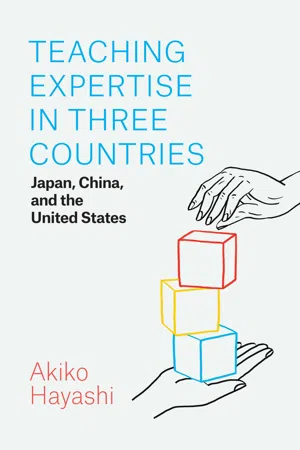
- English
- ePUB (mobile friendly)
- Available on iOS & Android
eBook - ePub
About this book
Trusted by 375,005 students
Access to over 1.5 million titles for a fair monthly price.
Study more efficiently using our study tools.
Information
Publisher
University of Chicago PressYear
2022Print ISBN
9780226818672
9780226818658
eBook ISBN
9780226818665
Topic
EducationSubtopic
Comparative Education1
Introduction
In 2015, I went to Komatsudani Hoikuen in Kyoto and showed Chisato Morita a video our research team shot in her classroom in 2002, when she was in her third year of teaching. As she watched a scene in the video in which she leads her students through an origami activity, Morita commented, “Yoyū ga nakatta” (I lacked composure). At another of the old field sites in 2015, Sinan Road Kindergarten in Shanghai, I showed Jian Wang a video shot in her classroom thirteen years earlier. When the video ended, Wang commented, “When I was young, my focus was on teaching lessons. But I came to understand that the caring part of the job is much more important.” In 2015, at St. Timothy’s Child Center in Honolulu, after watching a video made in her classroom in 2002, a video in which we see her repeatedly intervening in children’s disputes, Jannie Umeda summarized how she has changed with experience: “Now I let things go more than I used to.”
In this book, I analyze these and other statements made by experienced teachers interviewed in Japan, China, and the United States about how they have changed between their earlier and later years in the classroom. At the center of this book are video-cued interviews conducted in 2015 with Chisato Morita, Jian Wang, Jannie Umeda, and three other preschool teachers (Mariko Kaizuka, Jingxiu Cheng, and Fran Smith) who were videotaped in 2002 for the study that became the book Preschool in Three Cultures Revisited: China, Japan, and the United States (Tobin, Hsueh, and Karasawa 2009). In 2002, these six teachers (two each from China, Japan, and the US) were early in their careers. In 2015, when we interviewed them again, they were veterans. At the core of this book are the reflections of these six teachers on how they changed with experience and what helped them change. I combine these teachers’ self-reflections with comments from colleagues who have known them since the beginning of their careers and with video-cued interviews we conducted with other experienced early childhood educators in all three countries, whom we asked to reflect on differences between early-career and veteran teachers and on what helps teachers change.
Looking beyond Induction
In an interview for an earlier study on embodied teaching (Hayashi and Tobin 2015), Director Ritsuko Kumagai of Senzan Yōchien in Kyoto emphasized the importance of mimamoru, a pedagogical approach of holding back and not giving children who are struggling more help than they need. She then added, “For a teacher to be able to really do mimamoru, it takes at least five years.” This comment by Kumagai gave me the idea for the research project that became this book: Why does it take so long to become good at mimamoru and other skills for preschool teaching? What is it that happens during these (at least) five years that allows teachers to improve?
There is a large literature on induction into teaching, but there has been less research on the development of expertise after this initial stage. Most induction studies focus on how effectively beginning teachers employ content-area and pedagogical knowledge and the impact on their teaching of in-service professional development opportunities (for example, Feiman-Nemser et al. 1999; Ingersoll and Strong 2011; Wang, Odell, and Schwille 2008; Luft, Roehrig, and Patterson 2003; Tatto and Senk 2011). My approach to studying expertise differs from induction studies in terms of time frame, as I focus not on the first one to three years of teaching but instead on change that occurs after the first five years. It also differs from most studies of teaching expertise in being internationally comparative and in focusing on early childhood rather than on primary or secondary education.
Experience and Expertise
In the three examples with which I began this book, experienced teachers described how they have changed over time. Chisato Morita reports that now, in contrast to when she began, she is in less of a rush and more composed. Jannie Umeda says that whereas she worked to direct children when she was an inexperienced teacher, she now focuses on being more present. Jian Wang summarizes the change over the years in her priorities from instructing children to caring for them.
Why did it take these teachers five or more years of experience before they could make these changes in their practice? Why couldn’t they do this kind of teaching earlier? I suggest that even if a more experienced colleague had urged Morita to slow down, Jannie to be less directive, or Wang to be less instrumental, the teachers could not yet have done so, because doing so required not just a different conscious understanding of good teaching but an ability they did not yet have to know when and how to be composed, present, and responsive to the needs of their students. In other words, the expertise of these veteran teachers could only be acquired through years of experience in the classroom.
In this book, I refer to the abilities of an experienced teacher as expertise, which I conceptualize as a combination of a teacher’s professional knowledge, skills, and disposition. While few interviewees were comfortable being called experts, all described themselves as having, with experience, become more capable practitioners. As one Japanese preschool director commented, “Some teachers, even after many years, don’t become all that great at their jobs, but they become better than they were at the beginning. They become better versions of themselves.” I would add that there are some teachers who are very capable even at the beginning of their careers, but that such teachers are rare and that they, too, change with experience.
Scholars in a range of disciplines use different terms to describe what I suggest are similar conceptualizations of expertise. The philosopher of science Eric Polanyi (1962) uses the term tacit knowledge; the philosopher Gilbert Ryle (1949) know-how (as opposed to know-that); the sociologist Pierre Bourdieu (2000) professional habitus; the philosopher of education Max van Manen (1991) pedagogical tact; and the cognitive anthropologist Maurice Bloch (1991) non-linguistically processed practical skills. The educational psychologist David Berliner describes experienced teachers as “arational”:
If novices, advanced beginners, and competent performers are rational, and proficient performers are intuitive, we might categorize experts as “arational.” They have an intuitive grasp of a situation and seem to sense in nonanalytic, nondeliberative ways the appropriate response to make. They show fluid performance, as we all do when we no longer have to choose our words when speaking or think about where to place our feet when walking. (1988, 5)
The cognitive psychologist Rand J. Spiro and his colleagues Brian P. Collins and Aparna R. Ramchandran refer to skilled practitioners as having the “complex, open, and flexible habits of mind” needed to negotiate “ill-structured domains”:
In complex and more ill-structured arenas of knowledge—counters the tendencies just described with approaches that foster the building of knowledge characterized by multiple representation, interconnectedness, and contingency (context-dependence, a tendency to recognize when it is appropriate to say “it depends” and to acknowledge that many situations are not “either/or,” but rather shades of gray in between). (2007, 20)
I find each of these conceptualizations helpful, but as an educational anthropologist, I set them aside as I entered into this study, and I do so once again now, as I write this book, to make room for the Chinese, Japanese, and US teachers’ emic constructs. In my interviews with experienced early childhood educators, I generally did not use the terms expertise or expert (or their Japanese and Chinese equivalents). Instead, I asked “How have you changed with experience?” “How are experienced teachers generally different from beginners?” and “What helped you change?” In this book, I use the word expertise to connect with concepts from other domains of professional practice, while keeping in mind that my goal is not to apply a priori concepts to ethnographic data but instead to discover our participants’ conceptualizations of how they change with experience.
What Helps
Malcolm Gladwell, in his 2008 book Outliers, made famous the “ten-thousand-hour rule,” which suggests that it takes at least ten thousand hours of practice to become an expert at anything. Ten thousand hours at forty hours a week comes out to about Director Kumagai’s five years. Gladwell’s book was based largely on the work of the psychologists Anders Ericsson, Ralf Krampe, and Clemens Tesch-Römer (1993). In a book published in 2016, Ericsson and Robert Pool argued that Gladwell had misrepresented the findings, and that while ten thousand hours may be enough to make one competent, the number of hours required to become an hour is closer to twenty thousand, and these hours need to be spent in focused, “deliberative practice.”
The Ericsson study was of violinists and pianists. I suggest that preschool teaching is a very different sort of domain of practice. For such ill-structured domains as emergency room medicine, police work, and—I would add—preschool teaching, deliberative practice is not practical. You can practice scales on the violin and repeatedly go over the sections of a Bartok concerto, but you cannot practice preschool teaching alone, and this professional field is not easily broken down into isolated parts that can be mastered one at a time through deliberative practice.
What, then, most helps preschool teachers improve? Possible answers include structured professional development activities, mentoring, and on-the-job learning. There is a robust literature on teachers’ professional development, including studies on the impact of workshops, advanced coursework, and lesson study. Most of my interviewees mentioned having participated in one or more of these forms of structured professional development.
Few, however, cited such formal activities as having played a large part in their growth. Many of my interviewees told me that mentoring had played a key role in their development. While none reported having had a formal mentor, most described having learned from one or more experienced teachers they had the good fortune to work alongside. When I asked them to reflect on how they learned from their more experienced colleagues, they mentioned observing, asking for help, being offered unsolicited advice and feedback, and reflecting on events that had transpired and planning for the days to come.
The most common answer to our question “What helped you change between your early years in the classroom and now?” was, in a word, “experience.” This response prompts the following questions: What kinds of experiences? With what kinds of reflection? And with what kinds of scaffolding from others? The scaffolding of experience can take many forms, including reflection guided by a mentor, informal discussions with colleagues, and a preschool providing an atmosphere that encourages young teachers to take chances and not be afraid to fail. One of the biggest areas of difference I found across the three countries was the ways in which mentors scaffolded younger teachers’ experience along a continuum that runs from frequent direct advice and critique to minimal feedback. In the chapters that follow, I present what experienced early childhood educators in Japan, China, and the US reported as having been most impactful in their own professional growth.
How to Study Expertise
The most common approaches to studying expertise rely on cross-sectional comparisons of novice and expert teachers, based on observations of beginning and experienced teachers in their classrooms, questionnaires or interviews administered to beginning and experienced teachers, or quasi-experimental studies. For example, Schempp et al. (1998) asked novice and more experienced teachers to explain the logic behind hypothetical lessons. They found that more experienced teachers teach less by the book and more by improvisation. David Berliner (1986, 1987, 1988) and his colleagues showed beginning and experienced teachers photos of classrooms and then asked them to recall what they had seen. They found that expert, experienced teachers are more intuitive and more skilled at reading students and contexts. A limitation of these studies is that the comparisons are of different cohorts of teachers rather than of the same teachers over time.
I have used several original methods to tackle the question of how teachers change with experience, each a version of a video-cued ethnographic interview (Tobin, Wu, and Davidson 19891; Tobin 2019). The participants are the two Japanese, two Chinese, and two US preschool teachers who were videotaped in 2002 for the Preschool in Three Cultures Revisited study. These teachers were near the beginning of their careers in 2002 and were veterans when interviewed in 2015 (table 1).
We began by showing these teachers the videos the research team had made of them teaching when they were younger and asked them, each in the company of a more senior teacher or administrator they identified as a mentor, to reflect on how they have changed and what has helped them change in the intervening years. We interviewed each teacher alongside a colleague because our pilot interviews suggested that even with the help of a video that shows them teaching years earlier, it can be difficult for practitioners to pinpoint the ways they have changed. This task becomes easier when someone who has worked closely with the teacher over the years was also present, to help them remember what they were like when they got started, and to reflect on how they have changed and what helped them change.
Without a cue to structure their reflections, it would have been difficult for interviewees to identify how they have changed with experience. The videos functioned as a memory stimulus, a mnemonic that brought these six veteran teachers back, cognitively and emotionally, to versions of themselves they only dimly remembered. As they watched these videos alongside their old colleagues, the six teachers would invariably make comments such as “I was so young!” and “I didn’t remember that I had set my room up li...
Table of contents
- Cover
- Title Page
- Copyright Page
- Contents
- Preface
- Foreword by Joseph J. Tobin
- 1 Introduction
- 2 Japan
- 3 China
- 4 United States
- 5 Looking across Three Countries
- Acknowledgments
- Notes
- References
- Index
Frequently asked questions
Yes, you can cancel anytime from the Subscription tab in your account settings on the Perlego website. Your subscription will stay active until the end of your current billing period. Learn how to cancel your subscription
No, books cannot be downloaded as external files, such as PDFs, for use outside of Perlego. However, you can download books within the Perlego app for offline reading on mobile or tablet. Learn how to download books offline
Perlego offers two plans: Essential and Complete
- Essential is ideal for learners and professionals who enjoy exploring a wide range of subjects. Access the Essential Library with 800,000+ trusted titles and best-sellers across business, personal growth, and the humanities. Includes unlimited reading time and Standard Read Aloud voice.
- Complete: Perfect for advanced learners and researchers needing full, unrestricted access. Unlock 1.5M+ books across hundreds of subjects, including academic and specialized titles. The Complete Plan also includes advanced features like Premium Read Aloud and Research Assistant.
We are an online textbook subscription service, where you can get access to an entire online library for less than the price of a single book per month. With over 1.5 million books across 990+ topics, we’ve got you covered! Learn about our mission
Look out for the read-aloud symbol on your next book to see if you can listen to it. The read-aloud tool reads text aloud for you, highlighting the text as it is being read. You can pause it, speed it up and slow it down. Learn more about Read Aloud
Yes! You can use the Perlego app on both iOS and Android devices to read anytime, anywhere — even offline. Perfect for commutes or when you’re on the go.
Please note we cannot support devices running on iOS 13 and Android 7 or earlier. Learn more about using the app
Please note we cannot support devices running on iOS 13 and Android 7 or earlier. Learn more about using the app
Yes, you can access Teaching Expertise in Three Countries by Akiko Hayashi in PDF and/or ePUB format, as well as other popular books in Education & Comparative Education. We have over 1.5 million books available in our catalogue for you to explore.