Was Paul silent on the injustices of the Roman Empire? Or have his letters just been misread?
The inclusion of anti-imperial rhetoric in Paul's writings has come under scrutiny in recent years. Pressing questions about just how much Paul critiques Rome in his letters and how publicly critical he could have afforded to be have led to high-profile debates—most notably between N. T. Wright and John M. G. Barclay.
Having entered the conversation in 2015 with his book
Hidden Criticism?, Christoph Heilig contributes further insight and new research in
The Apostle and the Empire, reevaluating the case for Paul hiding his criticism of Rome in the subtext of his letters. Heilig argues that scholars have previously overlooked passages that openly denounce the empire—for instance, the "triumphal procession" in 2 Corinthians, which Heilig discusses in detail by drawing on a variety of archaeological data.
Furthermore, Heilig takes on larger issues of theory and methodology in biblical studies, raising significant questions about how interpreters can move beyond outdated methods of reading the New Testament toward more robust understandings of the ways ancient texts convey meaning. His groundbreaking work is a must-read for Pauline scholars and for anyone interested in how one of Christianity's most important teachers communicated his unease with the global superpower of his day.
eBook - ePub
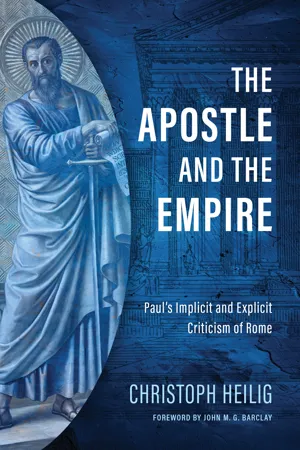
The Apostle and the Empire
Paul's Implicit and Explicit Criticism of Rome
- 208 pages
- English
- ePUB (mobile friendly)
- Available on iOS & Android
eBook - ePub
About this book
Information
Topic
Theology & ReligionSubtopic
Roman Ancient HistoryTable of contents
- Cover
- Title Page
- Copyright
- Dedication
- Contents
- List of Figures
- Foreword by John M. G. Barclay
- Preface
- List of Abbreviations
- Introduction
- 1.| The Classical Subtext-Hypothesis
- 2.| Beyond Hidden Criticism
- 3.| Rediscovering Contemporary Contexts
- 4.| Reconstructing Unease
- 5.| Sharpening Our Exegetical Senses
- Conclusion
- Bibliography
Trusted by 375,005 students
Access to over 1.5 million titles for a fair monthly price.
Study more efficiently using our study tools.
Frequently asked questions
Yes, you can cancel anytime from the Subscription tab in your account settings on the Perlego website. Your subscription will stay active until the end of your current billing period. Learn how to cancel your subscription
No, books cannot be downloaded as external files, such as PDFs, for use outside of Perlego. However, you can download books within the Perlego app for offline reading on mobile or tablet. Learn how to download books offline
Perlego offers two plans: Essential and Complete
- Essential is ideal for learners and professionals who enjoy exploring a wide range of subjects. Access the Essential Library with 800,000+ trusted titles and best-sellers across business, personal growth, and the humanities. Includes unlimited reading time and Standard Read Aloud voice.
- Complete: Perfect for advanced learners and researchers needing full, unrestricted access. Unlock 1.5M+ books across hundreds of subjects, including academic and specialized titles. The Complete Plan also includes advanced features like Premium Read Aloud and Research Assistant.
We are an online textbook subscription service, where you can get access to an entire online library for less than the price of a single book per month. With over 1.5 million books across 990+ topics, we’ve got you covered! Learn about our mission
Look out for the read-aloud symbol on your next book to see if you can listen to it. The read-aloud tool reads text aloud for you, highlighting the text as it is being read. You can pause it, speed it up and slow it down. Learn more about Read Aloud
Yes! You can use the Perlego app on both iOS and Android devices to read anytime, anywhere — even offline. Perfect for commutes or when you’re on the go.
Please note we cannot support devices running on iOS 13 and Android 7 or earlier. Learn more about using the app
Please note we cannot support devices running on iOS 13 and Android 7 or earlier. Learn more about using the app
Yes, you can access The Apostle and the Empire by Christoph Heilig in PDF and/or ePUB format, as well as other popular books in Theology & Religion & Roman Ancient History. We have over 1.5 million books available in our catalogue for you to explore.