This book reviews the contributions of Earth Observation (EO) to public health practices. It examines how EO is being used to understand, track, predict, and manage infectious and chronic diseases, and it provides discussion on the current challenges and the significant development potential of EO to a One Health approach. Its objective is to address a set of questions: How does EO currently assist public health activities? What are the challenges for operational use of EO in public health? What are the opportunities for EO to benefit public health in the near future? This review concentrates on the following priority themes to which EO and geomatics can make important contributions: mosquito-borne and tick-borne diseases; water-borne diseases; air quality and extreme heat effects; and geospatial indicators of vulnerable human populations. EO has also demonstrated potential during the COVID-19 pandemic as an efficient provider of data on rapid environmental and socio-economic changes and impacts. Remotely sensed data are particularly useful for risk modelling and mapping projects to help generate information on occurrence and spatio-temporal trends of disease risk. Similarly, EO can be used to identify risk factors for disease risk or emergence detected in surveillance, and support development of early warning systems. Risk maps enable public health professionals to anticipate and prepare for health threats, and they can support responses to infectious disease epidemics or existing endemic conditions. This book emerged from the collaboration of the Public Health Agency of Canada and the Canadian Space Agency with contributions of international experts. Their findings will be of great value to public health and EO professionals interested in developing and applying geospatial applications in the risk assessment and management of public health issues.
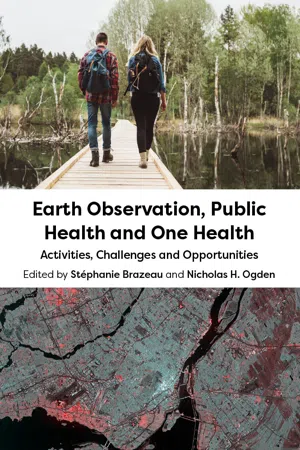
eBook - ePub
Earth Observation, Public Health and One Health
Activities, Challenges and Opportunities
- 208 pages
- English
- ePUB (mobile friendly)
- Available on iOS & Android
eBook - ePub
Earth Observation, Public Health and One Health
Activities, Challenges and Opportunities
About this book
Information
1 Introduction to Public Health and Earth Observation
1.1 Public Health and Earth Observation
Infectious and chronic diseases are issues of concern for public health on a global, regional, and local level. Key to managing these diseases and reducing their impact is having timely, evidence-based knowledge. Earth Observation (EO) provides data at multiple spatial scales and is becoming a vital tool in helping us understand, track, and predict these diseases, allowing public health to proactively plan and implement informed interventions. This book will illustrate current and possible future contributions of EO to public health practice.
Most emerging infectious diseases of significance to public health originate in wildlife and then spill over into human populations. Research has led to improved detection and control of infectious diseases and has expanded our knowledge of how these diseases emerge and re-emerge as driven by a combination of factors that include genetic change in causal pathogens, climate and other environmental changes, and changing human behavior. Emerging infectious diseases pose continuous challenges to public health preparedness and policies and to programs for surveillance, prevention, and control (Jones et al., 2008).
The increasing risk of disease emergence, epidemics, and pandemics has been documented, even before the COVID-19 pandemic swept across the globe. Worldwide, infectious diseases are responsible for 14 million deaths every year. More than 90% of these deaths occur in low- and middle-income countries in the Global South, where infectious diseases account for 43% of all causes of death versus only 1% in high-income countries in the Global North (Sénat, 2012). However, the incidence of emerging diseases in high-income countries has risen from 10 to 20% over the first decade of the 21st century, and a total of 335 new infectious diseases were discovered between 1940 and 2004. Infectious diseases create serious economic barriers to global development due in part to their association with increasing societal and financial costs (Sénat, 2012). Approximately two out of three human infectious diseases are zoonotic, meaning they are (or were originally) animal diseases that are transmitted to humans. In addition, at least three out of four emerging infectious diseases among the human population are or were zoonoses, and on average five new diseases appear every year (World Organisation for Animal Health [OIE], World Health Organization [WHO]).1
Global environmental change and biodiversity loss are exerting major pressure on human health (United Nations Environment Programme [UNEP] et al., 2015; UNEP, 2020). According to the WHO’s fact sheets2: rabies transmitted by vampire bats to cattle and humans has been linked to forest activities in South America; the spread of Nipah virus has been linked to intensification of pig farming and fruit production in Malaysia; the emergence of Japanese encephalitis virus has been linked to irrigated rice production and pig farming; and the emergence of avian influenza has been linked to intensive poultry farming (WHO, 2018). The cholera bacteria transmitted in water and the dengue virus and malaria parasites transmitted by mosquitoes infect 3–4 billion people every year, and outbreaks of disease associated with these pathogens are often driven by environmental factors (WHO, 2021a, 2021b).
Key drivers of infectious diseases and the One Health approach
Infectious diseases emerge and re-emerge under the influence of key drivers. By understanding how these drivers affect diseases, we may be able to predict when, how, and where disease will emerge and to identify the populations that are most at risk. Examples of drivers include environmental, climatic, demographic, socio-economic, or human behavioral changes. While “risk” is truly the combination of rates of exposure to a “hazard” (e.g. a vector-borne disease) and the “susceptibility/sensitivity” of a population to that hazard, in this book, the term “risk” is sometimes used instead of “hazard” when this has been commonplace in the literature.
The world’s human population – presently exceeding 7.5 billion people – is expected to reach 9.7 billion by 2050. Many people will continue to concentrate in megacities and large metropolitan areas, which facilitates human-to-human disease transmission (Neiderud, 2015). Ecosystem changes in land use and agricultural practices, such as deforestation, intensive livestock farming, and the movement of animals between forests and cities will likely increase people’s exposure to wildlife-borne diseases directly or indirectly through infected livestock (Jones et al., 2013).
Global environmental change, including climate change, is accelerating species loss, leading toward a biodiversity crisis, and this loss in biodiversity is associated with the emergence of infectious disease (Keesing et al., 2010; Ostfeld and Keesing, 2012; Altizer et al., 2013). Global increase of trade in goods and animals can also contribute to the spread of disease vectors (Tatem et al., 2006). Increased air transport accelerates the movement of people into and out of risk areas, and “naïve” populations in countries free from a particular disease are increasingly threatened by infected tourists and business people returning from countries where the disease is endemic (WHO3). Climate change is likely to change the geographic range where climate is favorable for multiplication of arthropod disease vectors, such as mosquitoes and ticks. Examples include the observed expansion of Lyme disease in northern North America and the possible expansion of risk from dengue and chikungunya into regions that were previously temperate (Ogden, 2017). Displacement of populations as a result of natural disasters, scarcity of water resources, famine, or wars is confronting us with new diseases as people move into new geographical areas (WHO, 2006). Also, resistance to antibiotics and increase in virulence of pathogens may drive disease emergence (WHO4; Beceiro et al., 2013).
Given the close and complex relationships between the environment, ecosystems, and the etiological agents of disease in human and animal populations, integrated approaches following the One Health approach5 are most likely to be successful as they take into consideration human, animal, and environmental health with interdisciplinary collaborations and communication in all aspects of health. In this context, many parameters and geospatial characteristics relevant to the interconnected fields of environmental, human, and animal health can be assessed via proxy measurements from space. However, efficient methods and pertinent One Health partnerships need to be developed in order to adopt satellite-based remote sensing as a suitable tool for characterizing, mapping, and monitoring risk factors for infectious disease emergence and re-emergence. Partnerships between the EO community and the public health community would be a first step toward this goal.
Use of EO data in public health practice
EO data have proven to be a valuable source of geospatial information for public health, particularly in the realm of “tele-epidemiology.” Based on EO products adapted to the needs of health actors, tele-epidemiology studies the links between the environment, ecosystems, and etiological agents responsible for diseases in human, animal, and plant populations. This approach combines the physical, biological, social sciences, and humanities, and aims to understand the factors and mechanisms that affect the spread of pathogens and diseases (Marechal et al., 2008). Environmentally linked diseases, including vector-borne, water-borne, and air-borne diseases, have geographic distributions at global, national, regional, local, and neighborhood scales that are associated with the geographic distributions of the climatic, habitat, and land use factors that determine their transmission (Eisen et al., 2015; Kilpatrick et al., 2017). Surveillance is the gold standard method of identifying disease risk (Ogden et al., 2014; Bouchard et al., 2015), but the vastness of the Earth renders surveillance at every location all but impossible. Consequently, for environmentally linked diseases, point data obtained in surveillance are increasingly being used to calibrate and validate models that identify associations between environmental variables and environmentally linked disease occurrence. These associations can then be used to extrapolate occurrence of risk onto surfaces to create risk maps (e.g. Soucy et al., 2018), provided the environmental variables are present as a continuous surface. The continuous surfaces of EO data proxies for environmental variables, which have the same precision across the globe, are a significant reason why they are so useful for creating risk maps of disease emergence and spread (Michel et al., 2011; Cheng et al., 2017).
EO data furnish the development of proxies for environmental drivers of diseases, such as habitat (e.g. forest type and density, presence of wetlands), agricultural areas and types, surface temperature, soil moisture, and urban areas. With the recent improvement of satellite EO systems, it is now possible to increase observations and monitoring of land and water parameters (i.e. weather, climate, population distribution, animal habitat identification, etc.) in repeated, synoptic, low- to large-scale ways. These recent innovations increase spatio-temporal precision of EO data and offer the possibility of improved model-based identification of risk in public health research. Greater spatial precision allows more detailed risk maps to be produced, while greater temporal precision (i.e. near-real-time EO data) raises the possibility that EO data proxies for weather may facilitate disease forecasting (e.g. Ogden et al., 2019) and EO data may be used to assist on-the-ground activities in response to outbreaks. As EO data can provide proxy measurements for socio-economic factors that may be determinants regarding the sensitivity and adaptive response capacity of the human population, EO data can in theory measure and communicate all aspects of disease risk.
Mandate and role of public health organizations and the importance of geospatial information
In order to address public health issues with relevant geospatial approaches, technology for detailed data collection is an essential component of fulfilling the mandate and role of public health organizations. Public health encompasses the organized efforts of society to keep people healthy and to prevent illness, injury, and premature death (Feinleib, 2001). In the Canadian context, the Public Health Agency of Canada (PHAC), in collaboration with all three levels of government, the private sector, non-governmental organizations, health professionals, and the public, contributes to: the prevention of disease and injury; the promotion of health; and sharing public health expertise across Canada and with international partners. Below is a summary of related activities (from the PHAC mandate6 ...
Table of contents
- Cover
- Title Page
- Copyright
- Contents
- List of Tables
- List of Figures
- List of Contributors
- List of Acronyms and Abbreviations
- Foreword – P. Guillaume Poliquin, Public Health Agency of Canada
- Foreword – Éric Laliberté, Canadian Space Agency
- Acknowledgments
- Executive Summary
- 1 Introduction to Public Health and Earth Observation
- 2 Earth Observation and Public Health Priority: Applications and Research Areas by Theme
- 3 Needs, Challenges, and Opportunities: A Review by Experts
- 4 Conclusions and Opportunities
- Appendix A – Summary of Expert Presentations and Consultations
- Appendix B – Spatial, Spectral, and Temporal Resolutions
- Index
- Back Cover
Trusted by 375,005 students
Access to over 1.5 million titles for a fair monthly price.
Study more efficiently using our study tools.
Frequently asked questions
Yes, you can cancel anytime from the Subscription tab in your account settings on the Perlego website. Your subscription will stay active until the end of your current billing period. Learn how to cancel your subscription
No, books cannot be downloaded as external files, such as PDFs, for use outside of Perlego. However, you can download books within the Perlego app for offline reading on mobile or tablet. Learn how to download books offline
Perlego offers two plans: Essential and Complete
- Essential is ideal for learners and professionals who enjoy exploring a wide range of subjects. Access the Essential Library with 800,000+ trusted titles and best-sellers across business, personal growth, and the humanities. Includes unlimited reading time and Standard Read Aloud voice.
- Complete: Perfect for advanced learners and researchers needing full, unrestricted access. Unlock 1.5M+ books across hundreds of subjects, including academic and specialized titles. The Complete Plan also includes advanced features like Premium Read Aloud and Research Assistant.
We are an online textbook subscription service, where you can get access to an entire online library for less than the price of a single book per month. With over 1.5 million books across 990+ topics, we’ve got you covered! Learn about our mission
Look out for the read-aloud symbol on your next book to see if you can listen to it. The read-aloud tool reads text aloud for you, highlighting the text as it is being read. You can pause it, speed it up and slow it down. Learn more about Read Aloud
Yes! You can use the Perlego app on both iOS and Android devices to read anytime, anywhere — even offline. Perfect for commutes or when you’re on the go.
Please note we cannot support devices running on iOS 13 and Android 7 or earlier. Learn more about using the app
Please note we cannot support devices running on iOS 13 and Android 7 or earlier. Learn more about using the app
Yes, you can access Earth Observation, Public Health and One Health by Stéphanie Brazeau,Nicholas H. Ogden, Stéphanie Brazeau, Nicholas H. Ogden in PDF and/or ePUB format, as well as other popular books in Technology & Engineering & Public Health, Administration & Care. We have over 1.5 million books available in our catalogue for you to explore.