The unwritten contract of the internet, that a user is what is used, extends from the well-examined issue of data privacy and consent to the very selves women are encouraged to create in order to appear. Invited to self-construct as 'girls online', vloggers, bloggers and influencers sign a devil's bargain: a platform on the condition they commodify themselves, eternally youthful, cute and responsibility-free, hiding offline domestic, professional and emotional labour while paying for their online presence with 'accounts' of personal 'experience'. Can a Girl Online use these platforms not only to escape meatspace oppressions, but as spaces for survival, creativity and resistance?
Told via the arresting personal narrative of one woman negotiating the (cyber)space between her identities as girl, mother, writer, and commodified online persona, Girl Online is written in a plethora of the online styles, from programming language to the blog/diary, from tweets to lyric prose, taking in selfies, social media, celebrity and Cyberfeminism.
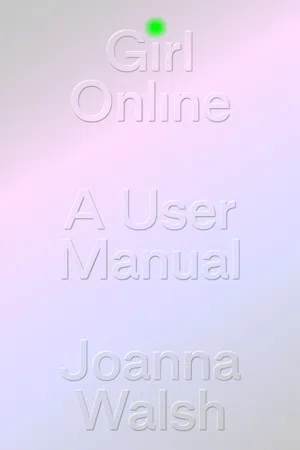
- 176 pages
- English
- ePUB (mobile friendly)
- Available on iOS & Android
eBook - ePub
About this book
Information
Thought Experiment #1: Switch
I hope you understand what thinking in chorus means—for I must confess that I don’t.—Lewis Carroll, Through the Looking-Glass
Functionalists hold that mental states are defined by the causal role they play in a system.1 In the Chinese Nation thought experiment, pain is a point in time. It occurs when enough components say it does.
Say there’s a woman working alone in a room at a screen and the screen screens her privacy—the privacy she also is. She is sitting in front of logic gates that have not yet closed behind her. Let’s say this logic gate is a pain switch.
In programming, a logic gate has a single binary function. From a dual input it produces a single output. It does this by way of conjunctions, like AND, which has the symbol ‘∧’, or OR, which has the symbol ‘∨’ —which is a non-exclusive or—and XOR, which is an exclusive or, where only one thing is true, or the other. This switch’s XOR logic gate is PAIN/NOTPAIN. The pain is not any specific sort, physical or mental; it is the pain the woman is feeling. Any sort of pain may go through the gate so long as she is willing to call it pain.
Say there are enough women sitting alone, each in a room, each in front of a logic gate. Say their switches form a system and if enough switches flip at the same time, something exists that can be called pain. If enough women sitting in front of enough screens flip the pain switch, will pain have been felt? And how many is enough?
If enough women flip enough switches to cause pain, where is this pain located? Is it located in each woman, her particular pain, or is it located in the system? If it is located in the system, in what sense can the system be said to feel pain? How many women in front of how many screens must make the decision to flip the switch before the system can be said to be in pain? And how much in pain does the system have to be in order that the pain of the women be acknowledged? In what part is pain allowed to each of the women, and ‘is it evenly distributed yet’ if some of the women are more in pain than others but each has only one switch?2
What about the pain caused by making the decision to flip the pain switch or not? This might be a slight pain, pain as by-product, or might be a major part of the pain, or greater than the pain registered.
Does the amount of pain each woman feels change once the woman feels herself to be part of a system? In her prison memoir, the writer and activist Margaretta D’Arcy describes how women political prisoners dealt with pain that might otherwise cause them to ‘go under’.3 They dealt with it as a system. They mentioned the incidence of pain to each other in strictly unemotional terms, like flipping a switch. Thus, the pain was dispersed as a system across space and time.
The effect of switches flipped is felt across the system, but each woman sitting in front of a screen makes the decision to flip the switch alone. No woman knows what difference her decision will make. Any woman may refuse to flip the switch and choose instead a default screen face that does not look like it has undergone any pain whatsoever, which is the most fortunate female interface, the face of a girl online.
To lay claim to pain is to lay claim to experience. It is also to have the option to claim experience only as pain. Flip the switch together ⇒ gain power ⇒ claim pain. Flip the switch alone ⇒ claim pain ⇒ lose face: a prisoner’s dilemma. To save face, there is something to be said for staying in front of the logic gate refusing to go in.
1
Screen Goods
How nice it would be if we could only get through into Looking-glass House! I’m sure it’s got, oh! such beautiful things in it!—Lewis Carroll, Through the Looking-Glass
All the good things in my life have come to me through screens.
They were goods of various kinds, in material and virtual form, and some of them were bought with money and others with attention paid. The goods were virtual and material, though some of them were both. The material things were the usual stuff, things I couldn’t get hold of locally: books, clothes, small household objects, small decorative objects. And as for the virtual, there was publication, that was one of them. Some of that was onscreen and some off—which, yes, turned my material, material—and with it came a sense of myself as a person of a certain sensibility, which I had not had offscreen. Then there were common goods, like a sense of community, and there was friendship and sex, lots of sex, and sometimes love, sometimes only one or the other and very occasionally both together.
Ok, a screen is a good, as in a commodity, and it is utile—good for something. But is it good in itself, or good for anything or anyone else? Or is it good for nothing, being the locus of much of my ‘useless’ as well as ‘useful’ time?
My screen is the size and shape of a pack of playing cards in my pocket, slightly rounded at the edges. Like the playing cards in Alice’s Wonderland, it sometimes seems to have voices and sometimes appears to be an actual living being. It contains so much. This is the smallest screen I own, and I know there are smaller, yet I can’t see to the edge of it.
Any screen aspires to full-screen mode. The ideal screen is an infinity pool, onscreen spilling into what’s off. Transparent when in use, it becomes what appears on it. It is, as Derrida says of signs, something that demonstrates, a verb etymologically linked to the noun monster.1
But screen is also a verb: to screen from view, as well as the opposite, to cause something to appear. Some screen demonstrations (cookery, product) inform: I know and you do not, but I will show you! Others (political, protest) put on screen monstrosities that have been screened from view. Both forms of demonstration involve paying attention, and also other forms of paying. Either kind of demonstration gains value when seen on screen.
In Notes toward a Performative Theory of Assembly, Judith Butler endorses the value of demonstrators appearing on the street in a body.2 At the same time, she’s telling Hannah Arendt that demonstrators don’t have to be demonstrably part of the polis—which is now the screen mediapolis (pics or it didn’t happen!)—to participate in the body politic. Those who make demonstration possible, the people who cook and wash and care offscreen, are demonstrating something, too.
It is hard to demonstrate in private, where ‘screening’ suggests only the privations of privacy as Jeanne Dielman knew, servicing johns between washing clothes and kneading meat for meatloaf, in Chantal Akerman’s 1975 movie. Akerman’s sex/houseworker was pre-internet, and the film was screened to non-participating audiences via the one-way street of the big screen: the public event of cinema. The director’s fixed camera keeps its distance across Dielman’s kitchen counter so her private household activities look just like an onscreen cookery demonstration with no immediate audience but the camera. The gap of space and time, and the nature of Akerman’s medium, never allow us and Jeanne to get in touch.
But, as screens became smaller, they crossed into private space—television > laptops > phones—until even housewives carried one. And right at that moment, something about the division between public and private split.
I, myself, stepped through this crack in the looking glass. Phew! My change in position was made without taking a step.
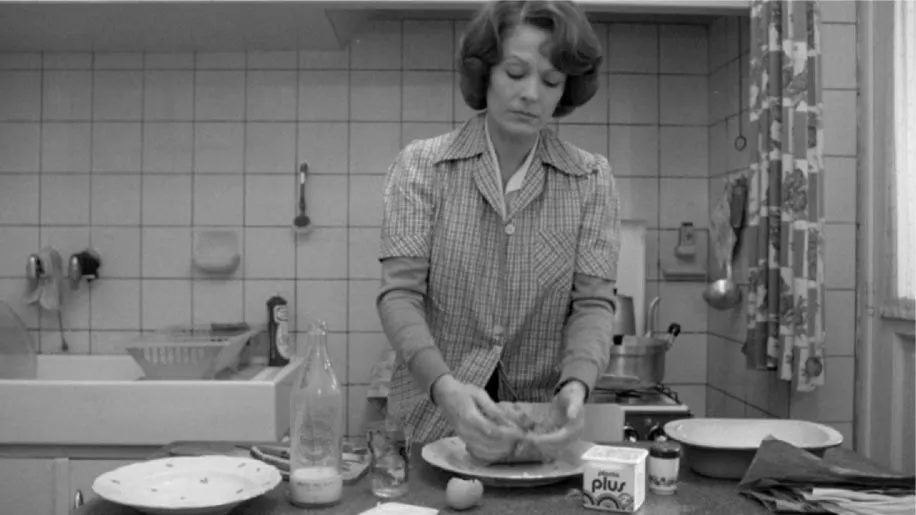
A still from Chantal Akerman’s 1975 film, Jeanne Dielman: 23, quai du Commerce, 1080 Bruxelles
Where am I now?
Or should the question be, what?
I begin in media res, in the middle of media, as though my screen had always reflected me (though my generation is famous—as are others—for being the last to grow up in pre-internet privacy), a woman sitting in front of a screen. Like Alice in Through the Looking-Glass, behind me is a window, which shows me Dielman’s meatspace, in front of me a screen, which shows me something else. My screen is set up on a table, just below head height, the position of a mirror on a dressing table. Like a mirror, I look into it, hoping to see—what? But I—unlike Alice—am not a girl. And my screen is not a looking glass, though it is a glass for looking. And, while I see myself in it, I never see myself exactly as I am offline.
Onscreen, woman defaults to girl—for who has more power to manifest via the pure appearance that is screen mode? White, able-bodied, not quite old enough for the screen to entirely refuse my face, I superficially resemble the images of girls that slipped from big screen to small, to digital, their functions carried over as the faces of a brand, a generation, a revolution. Like it or not, I am identified with the opportunities, the constraints, these images offer.
A girl online is an avatar for everyone. A woman onscreen represents the particular: a second-hand subject, things are ‘about’ her. Screen-stripped of context as a girl online, the singularities of my domestic and paid work do not manifest unless I work at demonstrating them, which is work in addition to the work hidden by my onscreen appearance. Demanding that attention be paid to these screened functions is a form of objection. As identity online is formed by repeated actions, my self becomes this demonstration.
What’s the alternative? If I do not demonstrate my work, I work in order to appear at leisure. Offscreen, I have demonstrable experience that cannot be denied: age, class, race seed in my body as visible values. Only onscreen can I stand in that girl position limited only by eternal potential, an AI Alice, whatever my situation on the other side of the looking glass.
If a woman’s all context, a girl is all concept—an idea is always easier with a girl to demonstrate human scale. But the labour of this appearance is screened from view, and even her potential for revolution demands this double work.
Here is a demonstration of two demonstrations: Eugene Delacroix’s 1830 Liberty Leading the People, painted as quickly during that year’s revolution as a pre-photographic viral tweet could be, shows a fictional girl demonstrating. Though the models for some of the male figures in Delacroix’s painting have been identified, the identity of the model for ‘Liberty’ is unknown.
Below it, Lana H. Haroun’s 2019 photo shows Sudanese demonstrators recognising a similar iconic girl moment IRL. Nesrine Malik wrote in the Guardian that the photo collapsed political complexity into an icon that ‘simplified a complicated story’ of class, gender and ethnicity, and that, once her identity was made public, the ‘girl’ herself became the target of harassment from opponents to a movement she involuntarily came to represent.3
For some, it’s a leap to become a girl; for others it’s already where they appear to stand. But who would refuse the temptation to appear, by association, as wealth, power, art? The face of a brand, the face of a revolution—always the face of girlness itself—a girl is only sometimes paid for this work but always pays for it in time.
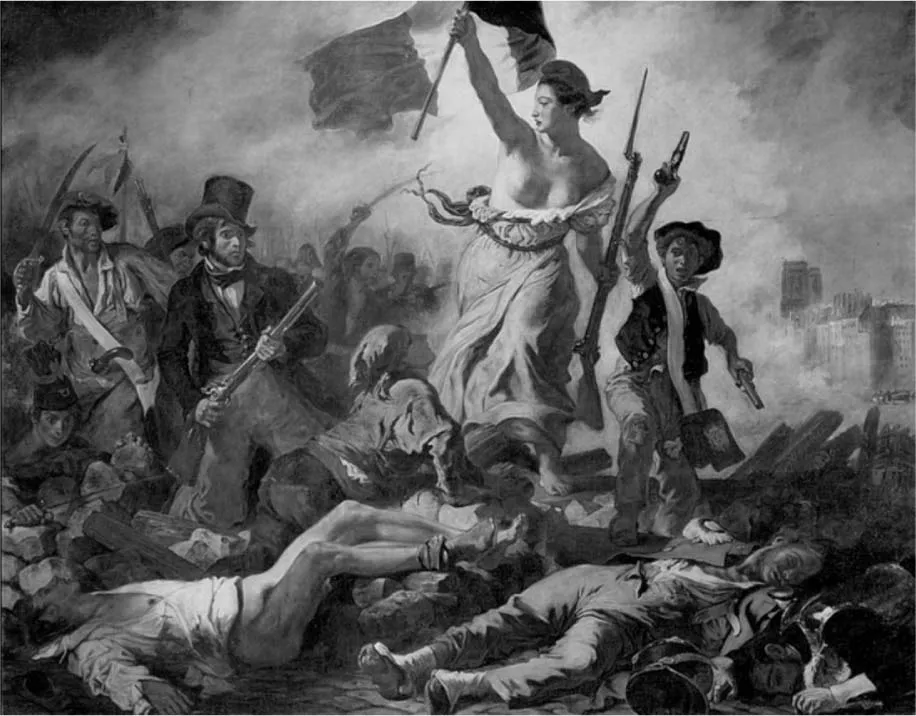
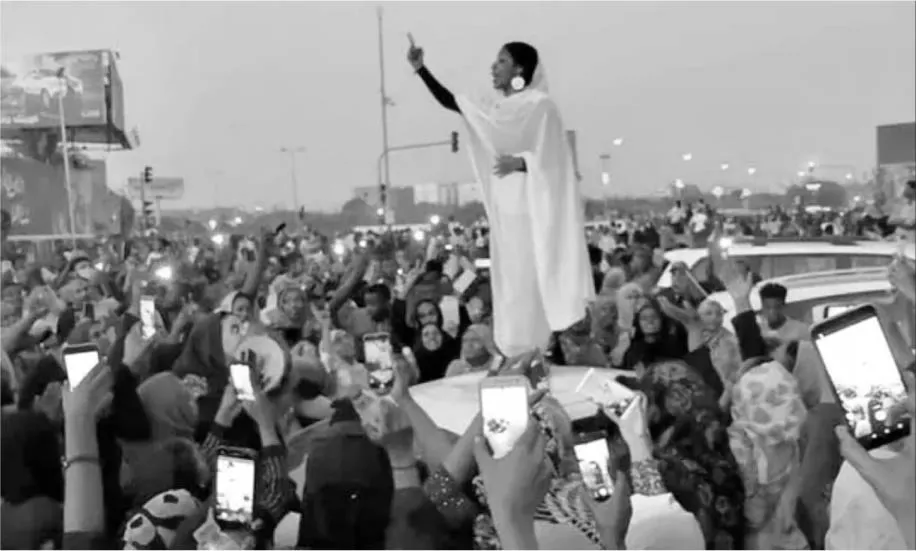
To move across time from girl to woman is to land in the place where payment is taken. A woman may pay attention—as audience, carer, reader—but is not expected to appear, and so loses her platform to demonstrate. A girl, taken up with the act of appearing, is less free to act than to be an icon for action by others.
Girl? Woman? This is hardly a choice. Could I object to this unchosen choosing? Yes, but first I must find a platform from which to demonstrate. Having none offline, I may be able to appear onscreen. In order to demonstrate, my identity must first be demonstrated. To establish a recognisable identity, I must find an example with which to identify.
Looking for identity online, I become an example to myself. I am shown the self-similar, similar to the self the algorithms I enter record, until I am like what I like onscreen. On Tumblr, Instagram, Pinterest I am making a self through photographs of things that self would like to have.
A girl online is an alphabet of things: pure exemplarity! IFTTT (‘If this, then that’) is an algorithm that gives the illusion of subjectivity. It will synch my preferences across websites and show only what it thinks I’ll like, basing what I’m like on what I’ve liked. Desire creates an oriented, mobile subject-as-continuous-process, in which virtual objects provide expanded but set vocabularies for self until I want ‘Recommended for You’ and ‘Twelve Boards Like Yours’. These virtual goods don’t have to be material things, matter that matters to me, that I have seen with my own eyes or touched with my own hand...
Table of contents
- Cover Page
- Halftitle Page
- Title Page
- Copyright Page
- How to read this book
- Contents
- Thought Experiment #1: Switch
- 1. Screen Goods
- Part I: Woman Working in Front of a Screen / Alice Underground
- Part II: Girl Online / Alice Through the Looking Glass
- Part III: A User Manual for Alician Subjects
- Acknowledgements
- Notes
Trusted by 375,005 students
Access to over 1.5 million titles for a fair monthly price.
Study more efficiently using our study tools.
Frequently asked questions
Yes, you can cancel anytime from the Subscription tab in your account settings on the Perlego website. Your subscription will stay active until the end of your current billing period. Learn how to cancel your subscription
No, books cannot be downloaded as external files, such as PDFs, for use outside of Perlego. However, you can download books within the Perlego app for offline reading on mobile or tablet. Learn how to download books offline
We are an online textbook subscription service, where you can get access to an entire online library for less than the price of a single book per month. With over 1.5 million books across 990+ topics, we’ve got you covered! Learn about our mission
Look out for the read-aloud symbol on your next book to see if you can listen to it. The read-aloud tool reads text aloud for you, highlighting the text as it is being read. You can pause it, speed it up and slow it down. Learn more about Read Aloud
Yes! You can use the Perlego app on both iOS and Android devices to read anytime, anywhere — even offline. Perfect for commutes or when you’re on the go.
Please note we cannot support devices running on iOS 13 and Android 7 or earlier. Learn more about using the app
Please note we cannot support devices running on iOS 13 and Android 7 or earlier. Learn more about using the app
Yes, you can access Girl Online by Joanna Walsh in PDF and/or ePUB format, as well as other popular books in Social Sciences & Feminism & Feminist Theory. We have over 1.5 million books available in our catalogue for you to explore.