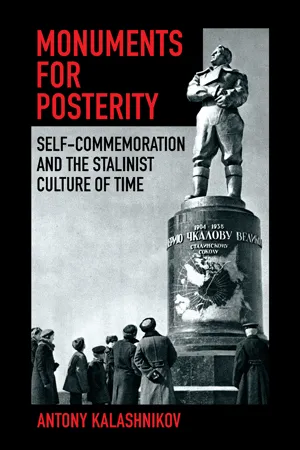
Monuments for Posterity
eBook - ePub

Monuments for Posterity

Self-Commemoration and the Stalinist Culture of Time

  1. 216 pages
  2. English
  3. ePUB (mobile friendly)
  4. Available on iOS & Android
eBook - ePub

Monuments for Posterity

Self-Commemoration and the Stalinist Culture of Time

About this book

Monuments for Posterity challenges the common assumption that Stalinist monuments were constructed with an immediate, propagandistic function, arguing instead that they were designed to memorialize the present for an imagined posterity. In this respect, even while pursuing its monument-building program with a singular ruthlessness and on an unprecedented scale, the Stalinist regime was broadly in step with transnational monument-building trends of the era and their undergirding cultural dynamics.

By integrating approaches from cultural history, art criticism, and memory studies, along with previously unexplored archival material, Antony Kalashnikov examines the origin and implementation of the Stalinist monument-building program from the perspective of its goal to "immortalize the memory" of the era. He analyzes how this objective affected the design and composition of Stalinist monuments, what cultural factors prompted the sudden and powerful yearning to be remembered, and most importantly, what the culture of self-commemoration revealed about changing outlooks on the future—both in the Soviet Union and beyond its borders.

Monuments for Posterity shifts the perspective from monuments' political-ideological content to the desire to be remembered and prompts a much-needed reconsideration of the supposed uniqueness of both Stalinist aesthetics and the temporal culture that they expressed. Many Stalinist monuments still stand prominently in postsocialist cityscapes and remain the subject of continual heated political controversy. Kalashnikov makes manifest monuments' intentional attempts to seduce us—the "posterity" for whom they were built.

Frequently asked questions

Yes, you can cancel anytime from the Subscription tab in your account settings on the Perlego website. Your subscription will stay active until the end of your current billing period. Learn how to cancel your subscription.
No, books cannot be downloaded as external files, such as PDFs, for use outside of Perlego. However, you can download books within the Perlego app for offline reading on mobile or tablet. Learn more here.
Perlego offers two plans: Essential and Complete
  • Essential is ideal for learners and professionals who enjoy exploring a wide range of subjects. Access the Essential Library with 800,000+ trusted titles and best-sellers across business, personal growth, and the humanities. Includes unlimited reading time and Standard Read Aloud voice.
  • Complete: Perfect for advanced learners and researchers needing full, unrestricted access. Unlock 1.4M+ books across hundreds of subjects, including academic and specialized titles. The Complete Plan also includes advanced features like Premium Read Aloud and Research Assistant.
Both plans are available with monthly, semester, or annual billing cycles.
We are an online textbook subscription service, where you can get access to an entire online library for less than the price of a single book per month. With over 1 million books across 1000+ topics, we’ve got you covered! Learn more here.
Look out for the read-aloud symbol on your next book to see if you can listen to it. The read-aloud tool reads text aloud for you, highlighting the text as it is being read. You can pause it, speed it up and slow it down. Learn more here.
Yes! You can use the Perlego app on both iOS or Android devices to read anytime, anywhere — even offline. Perfect for commutes or when you’re on the go.
Please note we cannot support devices running on iOS 13 and Android 7 or earlier. Learn more about using the app.
Yes, you can access Monuments for Posterity by Antony Kalashnikov in PDF and/or ePUB format, as well as other popular books in History & Architecture General. We have over one million books available in our catalogue for you to explore.

Table of contents

  1. Acknowledgments
  2. Introduction
  3. 1. Stalinist Monuments in Context
  4. 2. Historicist Aesthetics
  5. 3. Synthetic Composition
  6. 4. The (Un)contested Politics of Stalinist Monument Building
  7. 5. The Cultural Foundations of Stalinist Monument Building
  8. 6. Self-Commemoration and the Interwar Culture of Time
  9. Epilogue
  10. Notes
  11. Bibliography
  12. Index