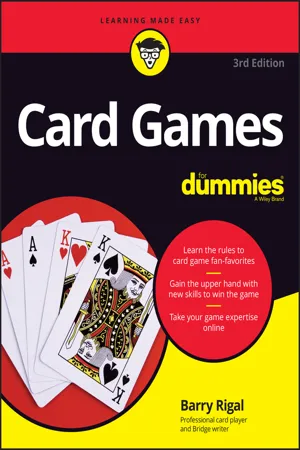
Card Games For Dummies
eBook - ePub

Card Games For Dummies

  1. English
  2. ePUB (mobile friendly)
  3. Available on iOS & Android
eBook - ePub

Card Games For Dummies

About this book

The perfect book for when you're ready to move beyond 52-card pickup

Feeling rummy? Ready to bridge the gap? In the mood to go fish? Card GamesForDummies is your source for rules, strategy, and fun. You'll learn everything you need to know to play and win at your family's favorite games, plus a bunch of others that are probably new to you. If you're the gambling kind, you can get started with poker, blackjack, and other casino favorites, right here.This handy guidetakescard game enthusiasm to the next level and explainsthe tips and tricks that can turn game night into some serious competition.

  • Learn the official rules for all your favorite card games
  • Discover strategies for winning at bridge, poker, hearts, and many more
  • Play easy games that are perfect for the whole family
  • Get started in the world of online card gaming

Card GamesForDummies will whet your appetite for play. Start shuffling!

Frequently asked questions

Yes, you can cancel anytime from the Subscription tab in your account settings on the Perlego website. Your subscription will stay active until the end of your current billing period. Learn how to cancel your subscription.
No, books cannot be downloaded as external files, such as PDFs, for use outside of Perlego. However, you can download books within the Perlego app for offline reading on mobile or tablet. Learn more here.
Perlego offers two plans: Essential and Complete
  • Essential is ideal for learners and professionals who enjoy exploring a wide range of subjects. Access the Essential Library with 800,000+ trusted titles and best-sellers across business, personal growth, and the humanities. Includes unlimited reading time and Standard Read Aloud voice.
  • Complete: Perfect for advanced learners and researchers needing full, unrestricted access. Unlock 1.4M+ books across hundreds of subjects, including academic and specialized titles. The Complete Plan also includes advanced features like Premium Read Aloud and Research Assistant.
Both plans are available with monthly, semester, or annual billing cycles.
We are an online textbook subscription service, where you can get access to an entire online library for less than the price of a single book per month. With over 1 million books across 1000+ topics, we’ve got you covered! Learn more here.
Look out for the read-aloud symbol on your next book to see if you can listen to it. The read-aloud tool reads text aloud for you, highlighting the text as it is being read. You can pause it, speed it up and slow it down. Learn more here.
Yes! You can use the Perlego app on both iOS or Android devices to read anytime, anywhere — even offline. Perfect for commutes or when you’re on the go.
Please note we cannot support devices running on iOS 13 and Android 7 or earlier. Learn more about using the app.
Yes, you can access Card Games For Dummies by Barry Rigal in PDF and/or ePUB format. We have over one million books available in our catalogue for you to explore.

Information

Publisher
For Dummies
Year
2022
Print ISBN
9781119880424
eBook ISBN
9781119880448
Edition
3
Part 1

Discovering Card Games

IN THIS PART …
After I explain some of the basics of cards (along with some tidbits about the history of cards and the etiquette of card games), I introduce a diverse range of games for you to deal out. If you don’t have anyone to play cards with, don’t worry. I provide an entire chapter of Solitaire card games. And if you’re a beginning card player, teaching children to play cards, or just a kid at heart, check out the chapter on popular children’s games, including War and Go Fish. Enjoy!
Chapter 1

Card Game Basics

IN THIS CHAPTER
Bullet
Speaking card game lingo
Bullet
Following the rules and etiquette of card games
Bullet
Hand-picking the best card game
I’m sure that if you’ve ever played cards at all, you don’t need me to explain what fun 52 pieces of pasteboard can be. But just in case, here goes …
Because you don’t know what the other players have in their hands in almost every card game, playing cards combines the opportunity for strategy, bluffing, memory, and cunning. At the same time, you don’t have to play cards all that well in order to enjoy yourself. Cards allow you to make friends with the people you play with and against. A deck of cards opens up a pastime where the ability to communicate is often of paramount importance, and you get to meet new faces and talk to them without having to make the effort to do so.
If you want to take the plunge and start playing cards, you encounter a bewildering range of options to choose from. Cards have been played in Europe for the last 800 years (see the sidebar ā€œCard Games Through the Agesā€ for more details), and as a result, you have plenty of new games to test out and new rules to add to existing games.
One of the features of Card Games For Dummies, 3rd Edition, is the diversity of card games covered in it. I can’t hope to list all the rules of every card game within the chapters, so this chapter discusses the general rules that apply to most card games. Get these basics under your belt so you can jump in to any of the games I describe in detail later in the book.

Talking the Talk

Card gamers have a language all their own. This section covers the most common and useful lingo you encounter as you get to know various card games.
Remember
When card games come together, the players arrange themselves in a circle around the card-playing surface, which is normally a table. I describe it as such for the rest of this section.

Getting all decked out

You play card games with a deck of cards intended for that game, also referred to as a pack in the United Kingdom. The cards should all be exactly the same size and shape and should have identical backs. The front of the cards should be immediately identifiable and distinguishable.
A deck of cards has subdivisions of four separate subgroups. Each one of these subgroups has 13 cards, although the standard deck in France and Germany may have only 8 cards in each subgroup. The four subgroups each have a separate identifiable marking, and in American and English decks, you see two sets of black markings (spades and clubs) and two sets of red markings (hearts and diamonds). Each of these sets is referred to as a suit.

Ranking card order

Each suit in U.S. and U.K. decks has 13 cards, and the rankings of the 13 vary from game to game. The most traditional order in card games today is ace, king, queen, jack, and then 10 down to 2.
Variation
As you find throughout this book, the ranking order changes for different games. You see numerous games where 10s or perhaps jacks get promoted in the ranking order (such as in Pinochle and Euchre, respectively), and many games have jacks gambol joyfully from one suit to another, becoming extra trumps (as in Euchre).
Also, Gin Rummy and several other games such as Cribbage treat the ace exclusively as the low card, below the two.

Preparing to Play

Before you can start any card game, you need to ration out the cards. Furthermore, in almost every game, you don’t want any other players to know what cards you have been dealt. That is where the shuffle and deal come into play.

Shuffling off

Before the dealer distributes the cards to the players, a player must randomize, or shuffle, them in such a way that no one knows what anyone else receives. (Shuffling is particularly relevant when the cards have all been played out on the previous hand.)
The shuffler, not necessarily the player who must distribute the cards, mixes up the cards by holding them face-down and interleaving them a sufficient number of times so that the order of all the cards becomes random and unpredictable. When one player completes the task, another player (frequently in European games, the player to the right of the dealer) rearranges the deck by splitting it into two halves and reassembles the two halves, putting the lower half on top of the other portion. This is called cutting the deck.

Getting a square deal

In most games, one player is responsible for distributing the cards to the players — this player is the dealer. For the first hand, you often select the dealer by having each player draw a card from the deck; the lowest card (or, perhaps, the highest) gets to deal. After the first hand is complete, the rules of most games dictate that the player to the dealer’s left deals the next hand, with the deal rotating clockwise.
Remember
Before the deal for the first hand, a process may take place to determine where the players sit. In games in which your position at the table is important, such as Poker or Hearts, you often deal out a card to each player and then seat the players clockwise in order from highest to lowest.
The player to the dealer’s left, frequently the fir...

Table of contents

  1. Cover
  2. Title Page
  3. Table of Contents
  4. Introduction
  5. Part 1: Discovering Card Games
  6. Part 2: Getting Rid of Cards
  7. Part 3: Taking Tricks
  8. Part 4: Scoring or Avoiding Points
  9. Part 5: Adding and Climbing
  10. Part 6: Playing Poker
  11. Part 7: The Part of Tens
  12. Index
  13. About the Author
  14. Advertisement Page
  15. Connect with Dummies
  16. End User License Agreement