This lavishly illustrated guide to iconography explains through words and pictures the history, meaning, and purpose of Christian icons as well as the traditional methods that religious painters use to create these luminous, spiritually enlivened works of art.
Solrunn Nes, one of Europe's most admired iconographers, illuminates the world of Christian icons, explaining the motifs, gestures, and colors common to these profound symbols of faith. Nes explores in depth a number of famous icons, including those of the Greater Feasts, the Mother of God, and a number of the better-known saints, enriching her discussion with references to Scripture, early Christian writings, and liturgy. She also leads readers through the process and techniques of icon painting, showing each step with photographs, and includes more than fifty of her own original works of art.
Deeply inspiring and utterly unique,
The Mystical Language of Icons will inform both those who are familiar with the rich tradition of religious art and those who are not. It also serves as a powerful devotional resource in its own right, one that Christians everywhere can turn to again and again.
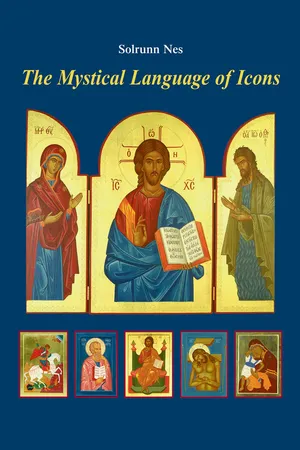
- 112 pages
- English
- ePUB (mobile friendly)
- Available on iOS & Android
eBook - ePub
The Mystical Language of Icons
About this book
Information
Topic
Theology & ReligionSubtopic
Religious ArtPRESENTATION OF ICON MOTIFS
Christ Pantocrator
Serbian variant
Egg tempera on oak. 27 x 35 cm (1997)

Christ Pantocrator (The All-ruler) is an icon of the Creator, the Saviour and the Judge. Here he is portrayed frontally as a half figure. The face is authoritative, but also gentle, the eyes are wide open looking directly at us. The two-piece robe he is wearing, a red tunic (chiton) and a blue cape (himation), symbolises the two natures of Christ: the divine and the human. The broad band over the right shoulder, a so-called clavus, is a remnant from the Roman imperial court which indicates high official status. Christ’s right hand is raised in blessing, while he holds the book of the Gospels in his left one.
The halo surrounding his head is a well-known symbol which denotes a sanctified state. The Greek letters ὁ ὤN inscribed on the arms of the cross are the present tense of the verb to be, and may be translated as the abiding one or the one who is. The perfect, indescribable and absolutely transcendent God, who presented himself to Moses as ‘I am who I am’ (Ex 3,14), is, so to say, invisibly present behind the Son by virtue of his own name. The initials IC - XC are the first and last letters of Jesus Christ.
The sign of the blessing may be interpreted as a dogmatic statement; the joining of the three fingers refers to the Holy Trinity, whereas the two that are crossed symbolise the two natures of Christ and his death on the cross.
According to Orthodox tradition, an icon shall be honoured, because it manifests and actualises the spiritual reality towards which the faithful turn. In this way an icon may be a reminder of God’s presence and an aid in prayer. Characteristics such as frontality and eye contact emphasise the I - thou relationship.
The use of gold leaf is an important aesthetic agent in the art of icons, but it is also a symbol with a specific theological significance. The gold symbolises what is known as ‘the uncreated light’. The uncreated light stands in contrast to the created light, for example sunlight, lamplight or candlelight which all have the quality of lighting an object, which again casts a shadow.
Christ Pantocrator
Round, Greek variant. Cretan school.
Model: fresco from the Monastery of Kaisariani, Greece.
Egg tempera on turned beech. 68 cm diameter (1989)

On an icon the outer, created light sources are subordinate to the uncreated light which expresses a fundamental quality of God’s nature. Nobody has created the Creator; in other words God is uncreated. God is the only one who exists by virtue of himself. Everything else exists because it is created. Only of the Son is it said that ‘he is born, not created, in the likeness of the Father’ (from the Nicene Creed).
The Scriptures say of God that ‘It is he alone who… dwells in unapproachable light’ (1 Tim 6, 16) and that ‘God is light’ (1 Jn 1, 5). Christ speaks of himself as ‘the light of the world’ (Jn 8, 12). All who come near God are illuminated and transformed by the uncreated light. The holy persons portrayed on an icon are illuminated from the inside and made translucent because their light comes from God himself. As light is thought to ‘slip through’ matter, the phenomenon of cast shadows is unknown. This idea may also be transferred to the painting technique itself. Egg tempera colour is partly transparent, so that each layer of colour has an effect on the next layer. In this manner light penetrates through the colour physically as well.
All theological reflection on the art of the icon has its origin in that ‘God created man in his image - in his icon’ (Gen 1, 26). However, because of the fall, a disintegration of man occurred and the divine image was tarnished. The divine image was not lost, but enveloped in darkness. According to this metaphor, the person who surrenders to sin may be said to allow layers of soot to darken the icon, so that it loses its radiance and vitality. For God, the image was reinstated through the life of Jesus Christ, his sacrificial death and resurrection. Redeemed man, for his part, is called upon to realise his likeness with God - to become a living icon. In Greek this lifelong process is called theosis (deification). A transformation into greater likeness with God gives the icon back its splendour. It is this light that radiates from the faces of the saints.
Standing, Greek variant.
Egg tempera on driftwood. 17 x 95 cm (1993)

The Greek word Pantokrator is used in several places in The Revelation of St John. In two of the quotes, we find both the verb form ὁ ὤN - the abiding or the one who is (used as an inscription of the cross halo), and the name Pantocrator - translated as The Ruler of All or The Almighty (the title of the icon):
‘“I am the Alpha and Omega”,
says the Lord God,
who is (ὁ ὤN - the one who is)
and who was
and who is to come,
the Almighty (Pantocrator)’ (Rev 1, 8).
‘Holy, holy, holy,
the Lord God the Almighty (Pantocrator),
who was and is (ὁ ὤN - the one who is)
and is to come’ (Rev 4, 8).
Triptych with Deesis
Greek variant. Cretan school. Egg tempera on wood. 61 x 49 cm (1989)

A triptych is a set of three, hinged paintings which may be opened and closed like a cupboard. On this triptych Christ Pantocrator is flanked by the Mother of God and John the Baptist, or the ‘Forerunner’ as he has been called in the Eastern Church. Both are turned towards Christ with their hands raised in prayer. The text in the open book is taken from John 8, 12: ‘I am the light of the world. Whoever follows me will never walk in darkness, but will have the light of life’. As well as Christ speaking about himself as the light, the symbolicism of light is further emphasised by the gilded background. Christ is the light and is surrounded by light, and all the saints radiate this divine light.
According to old Church Tradition, it was intended that Mary and John should have a special assignment and act as intercessors for mankind, which is why they are found by Christ’s throne and future judgement seat in heaven. This position indicates how close they were to Christ during his earthly life. No-one was as close to God’s Son as Mary, who carried him under her heart. Jesus gave John the following unusual tribute: ‘Truly, I tell you, among those born of women no one has arisen greater than John the Baptist’ (Mt 11, 11).
A three figure group such as the above constitutes a central motif on an iconostasis, the picture screen which marks the transition between the nave and the sanctuary. The Greek word deesis means intercession. On the iconostasis, the row of intercessors is usually extended with the archangels Michael and Gabriel, the apostles Peter and Paul, the Church fathers Basil the Great and John Chrysostom and other saints.
King and High Priest
Greek variant. Egg tempera on beech. Guilded silver work on frame. 29.5 x 35 cm (1999)

In this icon Christ is depicted as a representative of officialdom; he is both King and High Priest. An Orthodox bishop wears similar liturgical robes when he celebrates a service. Over the sakkos (a tunic with wide sleeves decorated with small crosses) the bishop wears a broad white stole of wool or silk (omoforion) which is similar to the stole used in Latin ritual. When this icon is placed on the back of a bishop’s throne, his high official function becomes clear. The Christian king, the bishop and the priest get their mandates from Christ himself.
The texts in the open book refer to Christ’s kingdom and the words used to introduce the sacrament of the Eucharist; ‘My kingdom is not from this world.’ (Jn 18, 36), and ‘Take eat; this is my body… for this is my blood of the covenant, which is poured out for many for the forgiveness of sins’ (Mt 26, 26-28).
In the Letter to the Hebrews the story of the Old Testament king and priest Melchizedek is explained as a prefiguration, a symbolic model, of Christ. The pre-existence of Christ as well as his divine status and priestly office are foreshadowed in this remote figure: ‘Without father, without mother, without genealogy, having neither beginning of days nor end of life, but resembling the Son of God, he remains a priest for ever’ (Heb 7, 3).
Further it is said that ‘… we have such a high priest, one who is seated at the right hand of the throne of the Majesty in the heavens, a minister in the sanctuary and true tent that the Lord, and not any mortal has set up’ (Heb 8, 1-2). The perfect, divine liturgy, where Christ is the priest, may be interpreted as a model for its earthly counterpart.
Greek variant, Macedonian school.
Egg tempera on pine.
Text: Jn 8, 12. Diameter 43 cm (1988)
...Table of contents
- Cover
- Title Page
- Copyright
- Contents
- The Icon - A Glimpse of the Divine
- Presentation of Icon Motifs
- The new Crucifix in St Paul’s Church, Bergen
- Reviews
- Curriculum Vitae
- Bibliography
Trusted by 375,005 students
Access to over 1.5 million titles for a fair monthly price.
Study more efficiently using our study tools.
Frequently asked questions
Yes, you can cancel anytime from the Subscription tab in your account settings on the Perlego website. Your subscription will stay active until the end of your current billing period. Learn how to cancel your subscription
No, books cannot be downloaded as external files, such as PDFs, for use outside of Perlego. However, you can download books within the Perlego app for offline reading on mobile or tablet. Learn how to download books offline
Perlego offers two plans: Essential and Complete
- Essential is ideal for learners and professionals who enjoy exploring a wide range of subjects. Access the Essential Library with 800,000+ trusted titles and best-sellers across business, personal growth, and the humanities. Includes unlimited reading time and Standard Read Aloud voice.
- Complete: Perfect for advanced learners and researchers needing full, unrestricted access. Unlock 1.5M+ books across hundreds of subjects, including academic and specialized titles. The Complete Plan also includes advanced features like Premium Read Aloud and Research Assistant.
We are an online textbook subscription service, where you can get access to an entire online library for less than the price of a single book per month. With over 1.5 million books across 990+ topics, we’ve got you covered! Learn about our mission
Look out for the read-aloud symbol on your next book to see if you can listen to it. The read-aloud tool reads text aloud for you, highlighting the text as it is being read. You can pause it, speed it up and slow it down. Learn more about Read Aloud
Yes! You can use the Perlego app on both iOS and Android devices to read anytime, anywhere — even offline. Perfect for commutes or when you’re on the go.
Please note we cannot support devices running on iOS 13 and Android 7 or earlier. Learn more about using the app
Please note we cannot support devices running on iOS 13 and Android 7 or earlier. Learn more about using the app
Yes, you can access The Mystical Language of Icons by Solrunn Nes in PDF and/or ePUB format, as well as other popular books in Theology & Religion & Religious Art. We have over 1.5 million books available in our catalogue for you to explore.