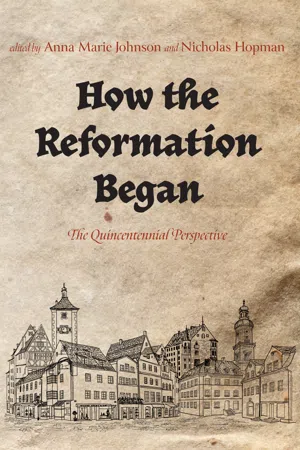
eBook - ePub
How the Reformation Began
The Quincentennial Perspective
- 122 pages
- English
- ePUB (mobile friendly)
- Available on iOS & Android
eBook - ePub
How the Reformation Began
The Quincentennial Perspective
About this book
The beginning of the Protestant Reformation is often dated to Luther's Ninety-five Theses in 1517, but those theses might have been forgotten if not for the events that followed. This book begins with the Ninety-five Theses and outlines the subsequent events that shaped the Reformation at least as much as the Ninety-five Theses, and quite possibly more. It provides a trove of primary documents by Luther and his opponents, along with commentary by historians who understand the theological issues at stake. Spanning the major milestones from 1517 to 1521, it concludes with the edicts that excommunicated Luther and the judgment against him with the imperial Edict of Worms. By drawing attention to these texts and events, the book gives a more complete picture of how the Reformation began.
Information
Topic
Theology & ReligionSubtopic
Christian Theology1
The 95 Theses (1517)
The year 2017 is the year to talk about the 95 Theses or, rather, talk around them, despite this author’s translation and commentary. The usual suspects for such wandering around Luther’s brief sentences are convinced that they have found either the first movement toward individual freedom by consciences bound in the twilight of the dark ages, or the clarion, religious call to reject all things Roman, or an invitation to be nice to our neighbors, whatever they may believe (the fallback position of American civil religion). Instead, lectures on the Theses should try to convince people to put them in their proper historical context rather than using them as an excuse to worship ourselves and our enlightened times.
The history of the 95 Theses and their medieval context may be found in other sources.1 This essay concentrates instead on something of a conundrum, namely, why does Luther quote so little from the Bible? For someone, whom later generations wedded to the slogan sola Scriptura, this may seem rather odd. To be sure, these are theses, which Luther was then to prove using scripture passages, so that, indeed, there are many more references to scripture in Luther’s defense, the so-called Explanations of the 95 Theses, printed in August 1518.2 But such a facile explanation does little to solve the riddle. The few important places where Luther directly deals with scripture come at the beginning and end of the document—a clue that will help us unravel how Luther is using scripture here.
Preliminary Remarks
Before going any further, however, readers need to be disabused of the centrality of sola Scriptura as a slogan describing Wittenberg’s theology then or now. Philip Melanchthon never used the term, and Luther employed it in his Latin writings only twenty times (as opposed to 1200 for sola fide and 120 for sola gratia and 500 times for solus Christus).3 Now, to be sure, he does use the phrase solo Verbo [by God’s Word alone] on occasion, but there it is often hard to know whether Luther is talking about the preached word, the written Word, or both. In any case, as Scott Hendrix proved in his book on Luther and the papacy, Luther never abandoned other authorities besides scripture, so that the church fathers, the decrees of the councils and, above all, the catholic creeds also were authoritative for him throughout his life—as they should be for later Lutherans.4 Peter Fraenkel, the Melanchthon scholar, writing in the 1960s, found a far better Latin phrase in Melanchthon’s writings—one that could more accurately replace sola Scriptura in stained-glass windows.5 For Luther and his colleagues, scripture was the primum et verum, the first and true authority, the other authorities being always derivative, resting upon their ability to witness, like John the Baptist, to the Lamb of God who takes away the sin of the world.
Of course, there are certain allusions to scripture scattered throughout the Theses. In Thesis 11, the bishops were sleeping when some evil person sowed such bad theology regarding papal power to grant indulgences (Matt. 13:25). Thesis 26 refers to papal authority as the power of the keys, echoing Matthew 16:19. Giving to the poor and lending to the needy, mentioned in Thesis 43, reflect Matthew 5:42. Fishing for the wealthy with the nets of the gospel and making the first last, while clearly scriptural (Matt. 13:47; 19:30), are simply employed to underscore the evil motives of indulgence preachers. Even so, outside of the very first and last theses, these are nearly all the clear allusions to scripture.
Luther’s reticence at this point cannot be chalked up to his lack of experience with the scripture. Instead, his limited use of scripture in this setting demonstrates his respect for reading the biblical text in context. Moreover, as he will later plead against Karlstadt and other “ravers” as he nicknamed them, when one reads something in scripture, one cannot simply ask, “Is it the Word of God?” but rather, “Is it the Word of God for us?”6
Luther’s example also clears the way for Lutheran Christians to use their heads. His fierce logic and remarkable rhetoric in the 95 Theses remind us of that saying in Proverbs 25:11: “A word fitly spoken is like apples of gold in settings of silver.” In short, the 95 Theses is death to all manner of specious proof texting. Indeed, when Luther or Melanchthon refer to a single verse of scripture, one must first search out and understand their interpretation of the text in its exegetical context before dismissing their arguments.7
The Rhetoric of the 95 Theses
So, Luther puts his most important scriptural arguments at the beginning and end of the Theses. Why? Here a recent insight in the study of the 95 Theses may help.8 Luther’s work has a rhetorical shape. This is not to say that Luther did not also use logic or dialectics, as he called it. But the overall shape of the Theses is imbued with important aspects of Renaissance rhetoric—much as in Freedom of Christian, as Birgit Stolt demonstrated in the 1960s, or as in the Invocavit Sermons of 1522, as Neil Leroux has proved more recently.9 This means that we can identify the typical parts of a Renaissance speech here, an argument strengthened by the fact that in his Explanations Luther labels two sections with technical names and writes his defense as if his arguments were meant to be read in this rhetorical light. These parts are traditionally, in this order, the exordium (introduction), the narration (basic, commonly accepted facts), the main thesis (summarized in Thesis 5), the proof or confirmation of this thesis and its corollaries, the refutation of anticipated objections, and the peroration.10 In the exordium, on which Luther puts great weight in his prefatory letter for the Explanations addressed to Pope Leo X, Luther writes that he is presenting these theses “out of love and zeal for the truth.”11 The proof of his work stretches from theses 1–80, and a rejection or confutation of other opinions—placed in the mouth of a sharp layperson—comes in theses 81–91. Crucial for Luther’s interpretation of scripture, however, comes in the narration and the peroration: theses 1–4 and 91–95. Precisely where Luther sets forth the incontrovertible facts at the beginning and a summary of his argument at the end, he calls upon scripture.
The Narration: Matthew 4:17
In traditional rhetoric, the narration is an exposition of the facts of the case, on which both the main thesis and its confirma...
Table of contents
- Title Page
- Preface
- Abbreviations
- Contributors
- Chapter 1: The 95 Theses (1517)
- Chapter 2: The Heidelberg Disputation (1518)
- Chapter 3: The Diet of Augsburg (1518)
- Chapter 4: The Leipzig Debate (1519)
- Chapter 5: Treatise on Good Works (1520)
- Chapter 6: To the Christian Nobility (1520)
- Chapter 7: On the Babylonian Captivity of the Church (1520)
- Chapter 8: The Freedom of a Christian (1520)
- Chapter 9: Excommunication: Exsurge Domine (1520) and Decet Romanum Pontificem (1521)
- Chapter 10: The Edict of Worms (1521)
- Original Publications of Respective Quincenntennials
Trusted by 375,005 students
Access to over 1.5 million titles for a fair monthly price.
Study more efficiently using our study tools.
Frequently asked questions
Yes, you can cancel anytime from the Subscription tab in your account settings on the Perlego website. Your subscription will stay active until the end of your current billing period. Learn how to cancel your subscription
No, books cannot be downloaded as external files, such as PDFs, for use outside of Perlego. However, you can download books within the Perlego app for offline reading on mobile or tablet. Learn how to download books offline
Perlego offers two plans: Essential and Complete
- Essential is ideal for learners and professionals who enjoy exploring a wide range of subjects. Access the Essential Library with 800,000+ trusted titles and best-sellers across business, personal growth, and the humanities. Includes unlimited reading time and Standard Read Aloud voice.
- Complete: Perfect for advanced learners and researchers needing full, unrestricted access. Unlock 1.5M+ books across hundreds of subjects, including academic and specialized titles. The Complete Plan also includes advanced features like Premium Read Aloud and Research Assistant.
We are an online textbook subscription service, where you can get access to an entire online library for less than the price of a single book per month. With over 1.5 million books across 990+ topics, we’ve got you covered! Learn about our mission
Look out for the read-aloud symbol on your next book to see if you can listen to it. The read-aloud tool reads text aloud for you, highlighting the text as it is being read. You can pause it, speed it up and slow it down. Learn more about Read Aloud
Yes! You can use the Perlego app on both iOS and Android devices to read anytime, anywhere — even offline. Perfect for commutes or when you’re on the go.
Please note we cannot support devices running on iOS 13 and Android 7 or earlier. Learn more about using the app
Please note we cannot support devices running on iOS 13 and Android 7 or earlier. Learn more about using the app
Yes, you can access How the Reformation Began by Anna Marie Johnson,Nicholas Hopman, Anna Marie Johnson, Nicholas Hopman in PDF and/or ePUB format, as well as other popular books in Theology & Religion & Christian Theology. We have over 1.5 million books available in our catalogue for you to explore.