eBook - ePub
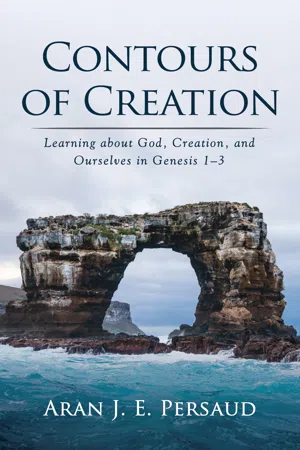
Contours of Creation
Learning about God, Creation, and Ourselves in Genesis 1–3
- 130 pages
- English
- ePUB (mobile friendly)
- Available on iOS & Android
eBook - ePub
About this book
If we pick up the Bible as God's word and at the beginning read with trepidation, then the whole of the Bible is so read. This book was written to help Christians navigate some of the forces of modernity, which have crept into the church and influenced the way Christians view the reliability of the biblical creation account and more generally the Bible. Its purpose is to encourage readers to see the steadfastness of God's word as a way of making sense of our lives and the world we live in. It hopes to show that a faith-based-historical-reading of Gen 1-3 provides a more trustworthy explanation of reality than atheistic evolutionary theories or reading the Genesis story as a make-believe myth. But the book is not a polemic, per se. It proposes a faith-based-historical-reading of the creation story in hopes of learning more about God, creation, and ourselves.
Information
Topic
Theology & ReligionSubtopic
Biblical Studies1
Introduction
A Measured Response to Natural Selection and Modern History
Skeptical Readers
The book of Genesis is read with much skepticism in our present time. The very first two chapters make claims about how the world we see, experience, and think about originated. Scientists offer proposals that seem to contradict any straightforward reading of this story. At best, the implication is that science is based on objective facts and Genesis is a “religious” book about faith. Science as a discipline is not alone. Many historians, archaeologists, and ancient Near Eastern (ANE) scholars are skeptical as to whether the stories in Genesis, which come in different literary forms, contain any historically “objective” facts. Ironically, many of these scholars and scientists claim their theories best describe the phenomena we see and know in our world “free” from bias. For those who read the text as a truthful and trustworthy testimony about God, creation (including humans), and his claim on creation (including humans), the result can be confusion.
To be certain, Genesis is a religious book about faith. However, critics usually mean by this that Genesis offers the religious reader warm, fuzzy feelings of encouragement regardless of whether the events that lie behind the text really happened. The idea of “faith” in this understanding is a subjective phenomenon generated by the reader. Faith is something that religious readers bring to these ancient “myths and folk stories.”
This may be understating the importance of how faith has shaped the actual events and their recording in the Bible. The stories in the book of Genesis predominantly tell of people in relationship with God. When people live in response to God in love, obedience, and worship regardless of their circumstances, they are living by faith. Abel, Enoch, Noah, Abraham, and Joseph are all well-known examples. In contrast, there are other groups of people who do not acknowledge God or willfully rebel against him. Cain, Lamech, those at Sodom, those at the tower of Babel, and Potiphar's wife, to name a few, fall into this group.
The biblical story mostly follows one particular group of people, the “spiritual seed.” In Genesis, we follow along as Adam and Eve are sent away from the garden of Eden. People spread out and begin to populate the world. Then we follow one man, Abraham, who, responding to God’s voice, leaves Mesopotamia and travels to Canaan. We read about the lives of these biblical people with anticipation as to whether they will acknowledge God in obedience and worship or willfully reject God and go the way of the nations surrounding them. We are given all the gritty details of real people struggling to live out real belief about God in the real world. In all these stories, this faith or absence of it centers on the God who created all things and has not abandoned his creation.
At the beginning of the story God speaks and acts directly. He speaks creation into existence. He walks and talks with Adam and Eve in the garden of Eden. He speaks with the recalcitrant Cain. He has intimate fellowship with Enoch. Generations later, he judges the increasingly wicked human race by opening the floodgates of heaven, but only after giving instructions to Noah on how to escape the coming judgment. After the flood, he tells Noah about his covenant to never universally judge the earth in such a way again. He becomes a friend of and often talks with the Mesopotamian Abraham. God now judges on a case-by-case basis and sends his angelic messengers to root out the wickedness of Sodom and Gomorrah. But by the time we arrive at the last figure, Joseph, God has become the “unseen mover.” God speaks to Joseph and Pharaoh through dreams. Pharaoh and his court of magicians cannot interpret the dreams. Joseph is able to interpret the dreams because their interpretation belongs to God alone. As a man of faith, Joseph is able to tell Pharaoh that a famine will soon come upon the land of Egypt. Remove the God of faith from the story and there is no story.
The selection of these faith-based people and events, the recording of their lives in different genres, and the gathering of these stories into the canonical Scriptures was done by people who shared in the same biblical faith. In other words, the same faith-centered perspective has been part of the process whether in the lives of the biblical people, or those who recorded stories about them, or those who collected them into the final book we call the Bible, or those who interpret these stories today. Christians who claim to read the book of Genesis as a religious text about faith are not bringing some new and subjective perspective to the text. They are really just reading the text sympathetically.
Did the “faith” perspective of those who recorded the stories make the events in the stories any less “objectively” true? My short answer is no. But perhaps a better question to ask is: how are the account of creation, the early history of the human race, and the stories of the patriarchs truthful and trustworthy? To what extent do the stories in Genesis speak about events and people who lived in the same world that we live in? Biblical faith, whether for those whom the Scriptures tell us about or ourselves, is never an abstract idea, but always centers on the reality of people living in a particular relationship to God in a real world. This faith-centered perspective is the hermeneutical link that we share with our spiritual forefathers.
Christian readings are not the only ones with particular beliefs and assumptions about the stories in Genesis. Modern scientific and historically “objective” readings bring their own assumptions to the text as well. Below, I try to point out what I believe to be some of these forces of modernity, which have crept into the church and influenced the way Christians read Genesis. I then propose a faith-based historical reading of Genesis as a means of encountering the Living God through the text.
Evolutionary Readings and Genesis: Three Reasons for Caution!
The greater number [the younger and rising naturalists] accept the agency of natural selection; though some urge, whether with justice the future must decide, that I have greatly overrated its importance. Of the older and honoured chiefs in natural science, many unfortunately are still opposed to evolution in every form.1
“The older and honored chiefs in natural sciences,” whom Darwin speaks of in the quote above, were not convinced by his evolutionary proposals in On the Origin of Species (1st ed. 1859) and The Descent of Man (1st ed. 1871).2 It would be a mistake to assume that those whom Darwin deferred to as “honored chiefs” were any less capable of making sense of his data than he was or that they weren’t as smart as we are. For many who haven’t read his works, Darwin’s theory of natural selection can seem to have been as novel a proposal as Columbus’s discovery of America. However, Darwin’s proposals borrowed from and built on a general body of thought that had been percolating since at least the Enlightenment.3 The French naturalist, Jean Baptiste de Lamarck had proposed a comprehensive biological theory of evolution in 1809, the same year Darwin was born.
The Enlightenment provided the ideological framework for Darwin’s theories. Its proponents made sense of the world by pitting ancient paganism (classical thought) against Christian tradition in order to gain “autonomy” in a new form of paganism.4 Perhaps the most influential way of making sense about our world that came out of the Enlightenment was articulated by the German philosopher Emanuel Kant.5 Spurred on by David Hume’s proposal that knowledge comes from our sensory experience alone (empiricism), Kant challenged existing notions about what people can know and how they can know it. Essentially, he argued that people can only know the things their minds (rationally) can actively synthesize from their sensory experiences. So, anything we cannot sense, e.g., the spiritual realm and God, must be excluded because it cannot be known. Kant’s proposal placed human rationality as the absolute arbitrator of all that we can know and how we can know it. Humankind came to occupy a role that had been traditionally ascribed to God. Kant’s philosophy represents the outcome of the rationalism that the Enlightenment is known for.6
Not everyone was convinced of the new “Godless” narrative for human origins. One example of the tension between Enlightened ideas and traditional Christ...
Table of contents
- Title Page
- Preface
- Chapter 1: Introduction
- Chapter 2: Creation’s Creator
- Chapter 3: Ontology and Darkness
- Chapter 4: A Poetry-Prose Hybrid
- Chapter 5: Words that Matter
- Chapter 6: The Glory of God
- Chapter 7: The Certainty of God’s Word
- Chapter 8: Missing the Good God Sees in Creation
- Chapter 9: Complete Image Bearers
- Chapter 10: The Corruption of Humanity
- Chapter 11: Entering into Sabbath Rest
- Chapter 12: Some Final Thoughts
- Bibliography
Trusted by 375,005 students
Access to over 1.5 million titles for a fair monthly price.
Study more efficiently using our study tools.
Frequently asked questions
Yes, you can cancel anytime from the Subscription tab in your account settings on the Perlego website. Your subscription will stay active until the end of your current billing period. Learn how to cancel your subscription
No, books cannot be downloaded as external files, such as PDFs, for use outside of Perlego. However, you can download books within the Perlego app for offline reading on mobile or tablet. Learn how to download books offline
Perlego offers two plans: Essential and Complete
- Essential is ideal for learners and professionals who enjoy exploring a wide range of subjects. Access the Essential Library with 800,000+ trusted titles and best-sellers across business, personal growth, and the humanities. Includes unlimited reading time and Standard Read Aloud voice.
- Complete: Perfect for advanced learners and researchers needing full, unrestricted access. Unlock 1.5M+ books across hundreds of subjects, including academic and specialized titles. The Complete Plan also includes advanced features like Premium Read Aloud and Research Assistant.
We are an online textbook subscription service, where you can get access to an entire online library for less than the price of a single book per month. With over 1.5 million books across 990+ topics, we’ve got you covered! Learn about our mission
Look out for the read-aloud symbol on your next book to see if you can listen to it. The read-aloud tool reads text aloud for you, highlighting the text as it is being read. You can pause it, speed it up and slow it down. Learn more about Read Aloud
Yes! You can use the Perlego app on both iOS and Android devices to read anytime, anywhere — even offline. Perfect for commutes or when you’re on the go.
Please note we cannot support devices running on iOS 13 and Android 7 or earlier. Learn more about using the app
Please note we cannot support devices running on iOS 13 and Android 7 or earlier. Learn more about using the app
Yes, you can access Contours of Creation by Aran J. E. Persaud in PDF and/or ePUB format, as well as other popular books in Theology & Religion & Biblical Studies. We have over 1.5 million books available in our catalogue for you to explore.