The Starmer Project is a forensic and revealing account of Keir Starmer's rise to the top of British politics. Oliver Eagleton paints a fascinating picture of a human-rights barrister turned chief prosecutor and his handling of a number of cases involving the police and security services. He traces Starmer's political alliances and his leading role in Labour's Brexit agony. When Starmer stood for party leader, he pledged to revitalise Corbynism with a dose of lawyerly competence. The Starmer Project details how he instead purged Jeremy Corbyn and pulled Labour to the right.
Helped into power by the Conservatives' collapse in 2024, Starmer was soon as unpopular as his Tory predecessors. Embroiled in austerity and allegations of sleaze, he has further alienated the public and disappointed business interests as well. He stands accused by critics on the left and right alike of lacking principles. But although devoid of charisma, Starmer is anything but an empty political vessel. Indeed, the implications of his authoritarian politics for a country in need of renewal, not retrenchment, appear dire.
This is the definitive, updated and revealing biography of the Labour Prime Minister.
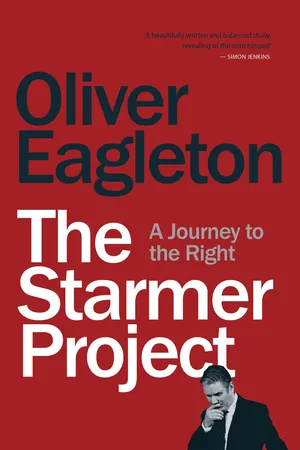
- 240 pages
- English
- ePUB (mobile friendly)
- Available on iOS & Android
eBook - ePub
About this book
Information
1
The Lawyer
The Lawyer
On 25 October 2003, residents of the southern English hamlet of Firle gathered for the centuries-old festivity that has made their area famous: a torchlit procession and bonfire, replete with occultic costumes and folk dancing. The ritual is usually themed around an issue that has ‘troubled the local community’ over the past year, so on this occasion the Firle Bonfire Society decided to address the creation of a nearby traveller encampment.1 They commandeered a caravan, slapped on a number plate that read ‘P1KEY’, and wheeled it through the streets while playing wooden fifes and brandishing burning crosses. When they reached a field outside the village, effigies of traveller children were placed inside the vehicle and it was set alight, to cheers from local onlookers.
The incident took place amid a campaign of intimidation against the Sussex traveller population, which had twice been targeted by arson attacks in recent months. Travellers were forced off their site in Peacehaven when a Molotov cocktail was thrown at a caravan with young children asleep inside. Shortly after, a petrol-soaked firework was set off in a Crawley camp.2 The director of public prosecutions, Ken Macdonald, was keen to charge the bonfire organizers with incitement to racial hatred. He asked a staffer at the Crown Prosecution Service to find a QC who could advise on the case. ‘But not just any QC,’ he said. ‘There’s this young lawyer who’s all about human rights – you must get him.’
Keir Starmer was forty-one years old and had recently been named Human Rights Lawyer of the Year by the campaign group Liberty.3 He was known as an ambitious left-wing barrister who worked pro bono for environmental activists, trade unionists and poll tax protesters. Yet when he returned his judgement on the Firle incident, it was not what Macdonald expected. The advice stated unequivocally that the organizers should not be prosecuted. Starmer argued that their actions were not intended to stoke prejudice, nor serious enough to merit legal sanction, and called for the charges to be scrapped. The DPP deferred to his opinion and the Merry England mob walked free.
Young socialist
Starmer’s career up to that point had been a curious blend of progressive litigation and service to the British state. Born in Southwark, London, in 1962, his mother was a nurse and his father ran a small toolmaking business. Both were Labour supporters from industrial working-class backgrounds who may have named him after the Keir (Hardie), although Starmer never confirmed this assumption.4 The family settled in Oxted, an affluent commuter town in Surrey, where Starmer spent his childhood – attending Reigate state grammar school from 1974 to 1981, and taking weekend trips to the Junior Guildhall School of Music for flute lessons. Reigate became a fee-paying institution in Starmer’s third academic year, but his cohort was allowed to stay on free of charge, creating a two-tier student body. Classmates recall Starmer debating Thatcherism with wealthier peers on the school-bus journey. At sixteen he joined a local chapter of the Labour Party Young Socialists, showing up at sparsely attended meetings every month in the outbuilding of a friend’s parents’ house. He and his comrades heckled Geoffrey Howe at an Oxted fun-run and canvassed for James Callaghan during the 1979 election campaign. The East Surrey Constituency Labour Party was dominated by the Left, but its youth wing was more closely aligned with proto–social democratic forces. When a regional party official came to vet the Young Socialists for ‘extremism’ as part of a national initiative to stamp out Bennite influence, he reported back to his superiors that the group was a beacon of moderation.5
Starmer’s ambition was to read politics at Leeds, but his parents convinced him to pick a more employable degree. After receiving a bachelor’s in law in 1985 he ascended to St Edmund Hall, Oxford, for postgraduate study, where he deepened his interest in international human rights and decided to become a barrister. Along with his friends in the Oxford Labour Club, Starmer supported striking print-workers on the picket lines at Wapping in 1986 as they tried to obstruct the distribution of the Sunday Times, provoking a backlash from student activists on the Labour Right including David Miliband and Stephen Twigg.6 A year later, while attending the Bar Vocational Course, Starmer surveyed the Wapping dispute in the pages of Socialist Alternatives, a small magazine affiliated with the International Revolutionary Marxist Tendency. He wrote that the paramilitary policing methods deployed to crush the strike illustrated Thatcher’s reliance on coercion to push through her market reforms. For Starmer, the printworkers’ defeat was not only an emblem of Britain’s neoliberal turn; it was also an opportunity for socialists to rethink fundamental questions of state power, such as ‘the role the police should play, if any, in civil society. Who are they protecting and from what? Who controls them and for whose benefit?’ He argued that ‘policing of any sort that is unaccountable stands directly in the path of social emancipation’, and encouraged the labour movement to develop an institutional critique that went beyond flaccid denunciations of police violence, calling for greater community oversight as the antidote to such abuses.7
Socialist Alternatives was produced by a collective called Socialist Self-Management, a tiny post-Trotskyist grouplet with links to the Pabloite factions of Labour and the Green Party, which sought to build a coalition rooted in new social movements, queer politics and ecologism. Peter Tatchell, the LGBT campaigner whom Starmer got to know during this period, described the group as ‘anti-Stalinist’ and ‘anti-statist’.8 Starmer joined the editorial collective in summer 1986, evidently at the suggestion of his Oxford contemporary Benjamin Schoendorff. During his brief involvement with this ‘Red-Green’ front, he read Laclau and Mouffe’s Hegemony and Socialist Strategy (1985) and was convinced by its vision of an open, heterogeneous struggle for egalitarian democracy.9 His writings explored models of grassroots organizing that could resist the Thatcherite onslaught, from pluralistic trade unionism to municipal self-government.10 He approved of Neil Kinnock’s break with a bygone model of ‘state socialism’, but in its place he called for ‘participatory socialism based on democratic planning’ rather than an embrace of the market. ‘Self-managing socialism aims at reducing the role of the state to its coordinating functions whereby various self-managing initiatives can be brought together’, he wrote at age twenty-four. ‘What is important is that any state level “coordination” must, by very definition, come and be controlled from the “bottom up”.’11
Progressive lawyer
Starmer was called to the Bar in 1987 and hired as a legal officer by Liberty, shedding his association with the Socialist Alternatives, which folded after its fifth issue. Several of his co-editors joined the steering committee of the Socialist Society, a group of radical intellectuals including Hilary Wainwright, Michael Rustin and the writers clustered around New Left Review, which aimed to forge links between the Labour Left and the wider socialist movement. Starmer attended their meetings into the late ’80s, co-authoring a policy paper on judicial reform for the Society’s third conference (co-sponsored by Tony Benn).12 In 1990 he became a founding member of Doughty Street Chambers – established by thirty liberal barristers who broke with tradition by moving outside the Inns of Court – and was elected secretary of the Haldane Society of Socialist Lawyers. Starmer wrote for the Haldane’s in-house magazine on topics ranging from collective bargaining legislation to human rights jurisprudence. One of his earliest contributions was a defence of the ‘acid house’ scene which stressed the need to protect it from Thatcher’s joyless legacy, and claimed – with some naivety – that drugs and alcohol were entirely absent from rave culture.13 A year later, in a critical piece on the political philosopher Christine Sypnowich, Starmer urged the Left to consider the role of legal institutions in post-capitalist society, writing, ‘Only when a concept of socialist law is developed will socialist lawyers join their liberal colleagues in the unfolding theoretical debates of the 1990s.’14 A follow-up for the magazine’s special ‘Human Rights Issue’ analysed international human rights treaties as a tool for tackling material inequality, contra denunciations of ‘rights discourse’ as an outgrowth of bourgeois individualism. Starmer welcomed the prospect of a UK human rights act, asserting: ‘Our task, as socialist lawyers, is to begin on the difficult road of drafting an instrument worthy of our conception of democracy which holds out the promise of an equal (or at any rate more equal) distribution not only of political power, but also of economic power.’15
The lawyer’s gradual mutation can be seen in these essays from the early ’90s, as an emphasis on legislative fixes supplants the short-lived dalliance with street-level activism. Other members of the Haldane executive committee were suspicious of what they described as his attempt to ‘NGOify’ the organization by remaking it in the image of Liberty – focusing on charitable work, professional development courses, press relations and political lobbying. In their view, Starmer’s aim was to weaken the Haldane’s links with Communist groups such as the International Association of Democratic Lawyers and refashion it as a ‘human rights-ist’ institution with a high media profile. His peers rebuked him when he suggested excising ‘socialism’ from the society’s name and replacing it with ‘progressive’ or ‘democratic’.16 Bill Bowring, the Haldane’s former chair, told me that Starmer’s politics were more naturally aligned with the centre-left Society of Labour Lawyers, but that he joined the Haldane because he was more able to rise through the organization’s ranks and reshape it from within. ‘He was motivated by ambition,’ said Bowring. ‘He was never going to get involved in anything revolutionary, and he had no sympathy whatsoever for Militant. But in Haldane he saw an opportunity to create something.’
Starmer spearheaded this internal overhaul while starting up his own successful private practice and taking on reams of pro bono work. He assisted Greenpeace campaigners Helen Steel and David Morris during the ‘McLibel trial’, later the subject of an award-winning Ken Loach documentary. The defendants were sued by McDonald’s for distributing a fact-sheet detailing its environmentally destructive practices. Unable to access legal aid, they relied on Starmer’s cost-free advice to construct their argument, which was pitted against the multi-million-pound case brought by the fast-food giant. Steel and Morris fought McDonald’s from the lowest to the highest courts between 1990 and 1999 (the longest trial in English legal history), substantiating most of the accusations in the Greenpeace leaflet with the help of expert witnesses. After putting the corporation on the backfoot and whittling down its compensation claim, Starmer acted as their representative at the European Court of Human Rights, where he successfully argued that their fundamental rights had been breached by the denial of legal aid.17
The Belfast connection
With the McLibel case ongoing, Starmer accompanied thirteen other Haldane lawyers on a 1992 fact-finding mission to Northern Ireland, investigating allegations of police brutality under the government’s Emergency Provisions.18 The delegation sat in on Diplock trials (which took place without a jury), interviewed prisoners who had been mistreated by the Royal Ulster Constabulary, and examined the implications of removing the right to silence.19 Their evidence was collected in a scathing report which called for a return to due process and an end to enhanced interrogation tactics by police. Starmer later represented a group of IRA inmates who had been beaten and humiliated by British prison officers after an unsuccessful breakout attempt at HMP Whitemoor in Cambridgeshire. (Thanks to his efforts they were awarded thousands of pounds in damages by the High Court, sending the right-wing press into meltdown.)20 But he also surprised some of his comrades on the London Left by agreeing to defend Private Lee Clegg: a British soldier who had shot dead a young Catholic woman in west Belfast. Clegg was manning an army checkpoint when a car full of joyriders passed through at high speed. He and his squadron fired nineteen bullets into the vehicle, killing two of its passengers. The soldier received a life sentence but was released under licence in 1995 after a campaign led by the Daily Mail, the Telegraph and the Sun – amplified by backbench Tory MPs.21 When the case went to a retrial, Starmer managed to get Clegg cleared of murder, and he later returned to active service. The barrister refused to share his views on the Troubles or Irish reunification while representing Clegg, but he would reportedly take weekly trips to the Belfast garrison to play football with the troops.22
In 1997, Starmer was enlisted by Amnesty International to convince British politicians of the virtues of the European Convention on Human Rights. He co-authored a pamphlet explaining the concrete steps that could be taken to incorporate ECHR provisions into UK law, and found that many of its recommendations were adopted by the Blair government following the passage of the 1998 Human Rights Act. This put Starmer in a privileged position to grasp the implications of New Labour’s human rights reforms, which redrew the relationship between domestic law and the Strasbourg institutions. He became one of the foremost interpreters of the HRA’s wide-ranging effects on British jurisprudence, sought out by barristers who had previously considered him part of the profession’s ‘lefty fringe’.23 His research culminated in European Human Rights Law (1999): a fine-grained analysis of the HRA, reviewing 1,500 Strasbourg cases which created new protocols for domestic civil and criminal prosecutions.24 The book was a best-seller in legal circles, and on the strength of its scholarship Starmer – now a QC – was hired as an adviser to the Northern Irish Policing Board (NIPB): a by-product of the Good Friday Agreement, established to calm communal tensions over police powers in Ulster.
The NIPB job required Starmer to monitor the activities of the recently created Police Service of Northern Ireland (PSNI), oversee its compliance with human rights protocols and write a series of reports setting out his recommendations for the force, as well as delivering the keynote speech at the Northern Irish ‘Confidence in Policing’ conference. This was an opportunity to implement the reforms recommended in the 1992 Haldane document, yet by this time Starmer’s priorities had changed. When he accepted the position in 2003, the NIPB was facing a boycott over concerns that the police were still under the sway of a British security establishment hostile to the peace process. Sinn Féin refused to engage with the PSNI until a number of conditions were met: devolving control over policing and justice from Westminster to Northern Ireland; ratifying the provisions set out in the Patten Report (which aimed to establish a truly desectarianized police service); and launching an inquiry into collusion between Northern Irish police and loyalist terrorist...
Table of contents
- Cover
- Title Page
- Copyright Page
- Contents
- Introduction
- 1. The Lawyer
- 2. The Politician
- 3. The Candidate
- 4. The Leader
- 5. The Prime Minister
- Acknowledgements
- Notes
- Index
Trusted by 375,005 students
Access to over 1.5 million titles for a fair monthly price.
Study more efficiently using our study tools.
Frequently asked questions
Yes, you can cancel anytime from the Subscription tab in your account settings on the Perlego website. Your subscription will stay active until the end of your current billing period. Learn how to cancel your subscription
No, books cannot be downloaded as external files, such as PDFs, for use outside of Perlego. However, you can download books within the Perlego app for offline reading on mobile or tablet. Learn how to download books offline
Perlego offers two plans: Essential and Complete
- Essential is ideal for learners and professionals who enjoy exploring a wide range of subjects. Access the Essential Library with 800,000+ trusted titles and best-sellers across business, personal growth, and the humanities. Includes unlimited reading time and Standard Read Aloud voice.
- Complete: Perfect for advanced learners and researchers needing full, unrestricted access. Unlock 1.5M+ books across hundreds of subjects, including academic and specialized titles. The Complete Plan also includes advanced features like Premium Read Aloud and Research Assistant.
We are an online textbook subscription service, where you can get access to an entire online library for less than the price of a single book per month. With over 1.5 million books across 990+ topics, we’ve got you covered! Learn about our mission
Look out for the read-aloud symbol on your next book to see if you can listen to it. The read-aloud tool reads text aloud for you, highlighting the text as it is being read. You can pause it, speed it up and slow it down. Learn more about Read Aloud
Yes! You can use the Perlego app on both iOS and Android devices to read anytime, anywhere — even offline. Perfect for commutes or when you’re on the go.
Please note we cannot support devices running on iOS 13 and Android 7 or earlier. Learn more about using the app
Please note we cannot support devices running on iOS 13 and Android 7 or earlier. Learn more about using the app
Yes, you can access The Starmer Project by Oliver Eagleton in PDF and/or ePUB format, as well as other popular books in Politics & International Relations & Modern British History. We have over 1.5 million books available in our catalogue for you to explore.