- 320 pages
- English
- ePUB (mobile friendly)
- Available on iOS & Android
eBook - ePub
About this book
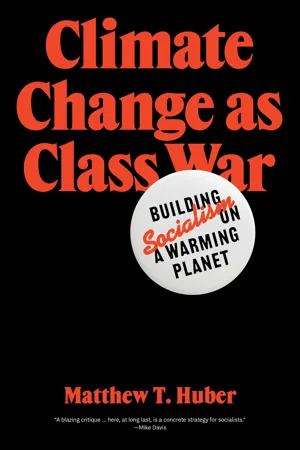
The climate crisis is not primarily a problem of 'believing science' or individual 'carbon footprints' - it is a class problem rooted in who owns, controls and profits from material production. As such, it will take a class struggle to solve. In this ground breaking class analysis, Matthew T. Huber argues that the carbon-intensive capitalist class must be confronted for producing climate change. Yet, the narrow and unpopular roots of climate politics in the professional class is not capable of building a movement up to this challenge. For an alternative strategy, he proposes climate politics that appeals to the vast majority of society: the working class. Huber evaluates the Green New Deal as a first attempt to channel working class material and ecological interests and advocates building union power in the very energy system we so need to dramatically transform. In the end, as in classical socialist movements of the early 20th Century, winning the climate struggle will need to be internationalist based on a form of planetary working class solidarity.
Key takeaways
AI-Generated Insights
Insight 1
Analyze how the climate crisis is fundamentally a class problem rooted in capitalist production, identifying the specific mechanisms through which industrial capital and carbon exploitation contribute to environmental degradation.
Insight 2
Critique the limitations of professional-class approaches to climate politics, contrasting them with a working-class strategy that prioritizes collective material and ecological interests.
Insight 3
Formulate strategies for building a working-class climate movement, focusing on the strategic importance of electrifying the energy system and leveraging union power within key sectors.
Information
Notes
Introduction: Climate Change as Class War
1Intergovernmental Panel on Climate Change, “Summary for Policymakers of IPCC Special Report on Global Warming of 1.5°C approved by governments,” October 8, 2018.
2Bill McKibben, “Winning slowly is the same as losing” Rolling Stone, December 1, 2017.
3Nina Chestney “IEA says global CO2 emissions rising again after nearly 6% fall last year,” Reuters, March 2, 2021.
4International Energy Agency, Net-Zero by 2050: A Roadmap for the Global Energy Sector (Paris: International Energy Agency, 2021).
5“Renewables 2021 Status Report: Key Messages for Decision Makers.” ren21.net.
6Myles McCormick, “US producers begin to follow Europe with emissions pledges” Financial Times, December 6, 2020.
7Lizzy Gurdus, “Climate change will be a ‘really big’ focus for ESG investors in 2021, market analyst says,” December 16, 2020. CNBC.com.
8White House, “Fact Sheet,” January 26, 2021, “Fact Sheet,” April 22, 2021. Whitehouse.gov.
9See, Adam Tooze, “America’s race to net-zero,” New Statesman, April 21, 2021.
10Branko Marcetic, “Joe Biden Is Almost as Pro-Drilling as Trump,” Jacobin, June 3, 2021.
11Jane McAlevey, No Shortcuts: Building Power in the New Gilded Age (Oxford: Oxford University Press, 2016), 4.
12United States Environmental Protection Agency, “Sources of Greenhouse Gas Emissions.” epa.gov.
13I proposed this book in 2017. In the meantime, the concept of the “Professional-Managerial Class” (PMC) has exploded as a central and polarizing topic both between left and liberal politics and within different factions on the left (e.g., the Bernie Sanders–vs.–Elizabeth Warren policy debate of the 2019–20 primary campaign). I will review this debate in Chapter 3, but my general position is that a class politics for our time clearly needs to pay attention to the role of education in creating either divisions within the broadly defined working class or creating separate classes in themselves. (The political and ideological divisions remain regardless of whether we call the PMC a “class” or not.) While I think the debate over class can become pedantic—and not particularly useful politically—I will argue for a conception of the professional class as defined by a specific relationship to production.
14During the peak of working-class power in the twentieth century, socialist movements were embedded in industrial factory production. The prospect of “seizing” the means of production and transforming capitalist scarcity to socialist abundance seemed viscerally possible. Much of the “proletarian” workforce by definition had directly experienced, or had cultural memories of, their agrarian past (and had little interest in going back). In contrast, professional-class climate politics emerged in what Aaron Benanav calls the “postindustrial doldrums” where postmodern thought and ecological crisis have led many to reject industrial modernity tout court. These sentiments come out of lived reality completely severed from industrial production, which is either automated or offshored and totally invisible to the professional class. See, Aaron Benanav, Automation and the Future of Work (London: Verso, 2020, 56).
15See, e.g., Nick Dyer-Witheford, “Struggles in the Planet Factory: Class Composition and Global Warming,” in jan jagodzinski (ed.) Interrogating the Anthropocene: Ecology, Aesthetics, Pedagogy, and the Future in Question (Cham, Switzerland: Palgrave Macmillan, 2018), 75–103; 85–8.
16See, Thomas Piketty, Capital and Ideology (Cambridge, MA: Harvard University Press, 2020).
17Eitan D. Hersh, Politics Is for Power: How to Move Beyond Political Hobbyism, Take Action, and Make Real Change (New York: Simon and Schuster, 2020).
18Stefania Barca, Forces of Reproduction: Notes for a Counter-Hegemonic Anthropocene (Cambridge, UK: Cambridge University Press).
19Adaner Usmani calls this “disruptive capacity.” Adaner Usmani, “Democracy and Class Struggle,” American Journal of Sociology, Vol. 124, no. 3 (2018): 664–704. See also, Tarun Banerjee, Michael Schwartz, and Kevin A. Young, Levers of Power: How the 1% Rules and What the 99% Can Do About It (London: Verso, 2020).
20Andreas Malm, How to Blow Up a Pipeline (London: Verso, 2021), 68.
21As I write this, Extinction Rebellion Cambridge offered a useful thread on Twitter, compiling a list of ongoing and new projects in the works.
twitter.com/xr_cambridge/status/1404010271094579203?s=20. (June 13, 2021).
22However, the idea of nationalizing the fossil fuel industry has finally started to appear in socialist left circles. Peter Gowan, “A Plan to Nationalize Fossil-Fuel Companies,” Peoples Policy Project, March 21, 2018.
23Karl Marx, Capital, Vol. 1. (London: Penguin, 1990), 929.
24Ibid., 930.
25David Roberts, “Transmission week: why we need more big power lines,” Volts. Wtf, January 25, 2021.
26Avery Ellfeldt, “Kerr...
Table of contents
- Cover Page
- Halftitle Page
- Title Page
- Copyright Page
- Dedication
- Contents
- Introduction: Climate Change as Class War
- I. The Capitalist Class
- II. The Professional Class
- III. The Working Class
- Conclusion: Species Solidarity at the Climate Crossroads
- Notes
- Acknowledgments
- Index
Trusted by 375,005 students
Access to over 1.5 million titles for a fair monthly price.
Study more efficiently using our study tools.
Frequently asked questions
Yes, you can cancel anytime from the Subscription tab in your account settings on the Perlego website. Your subscription will stay active until the end of your current billing period. Learn how to cancel your subscription
No, books cannot be downloaded as external files, such as PDFs, for use outside of Perlego. However, you can download books within the Perlego app for offline reading on mobile or tablet. Learn how to download books offline
Perlego offers two plans: Essential and Complete
- Essential is ideal for learners and professionals who enjoy exploring a wide range of subjects. Access the Essential Library with 800,000+ trusted titles and best-sellers across business, personal growth, and the humanities. Includes unlimited reading time and Standard Read Aloud voice.
- Complete: Perfect for advanced learners and researchers needing full, unrestricted access. Unlock 1.5M+ books across hundreds of subjects, including academic and specialized titles. The Complete Plan also includes advanced features like Premium Read Aloud and Research Assistant.
We are an online textbook subscription service, where you can get access to an entire online library for less than the price of a single book per month. With over 1.5 million books across 990+ topics, we’ve got you covered! Learn about our mission
Look out for the read-aloud symbol on your next book to see if you can listen to it. The read-aloud tool reads text aloud for you, highlighting the text as it is being read. You can pause it, speed it up and slow it down. Learn more about Read Aloud
Yes! You can use the Perlego app on both iOS and Android devices to read anytime, anywhere — even offline. Perfect for commutes or when you’re on the go.
Please note we cannot support devices running on iOS 13 and Android 7 or earlier. Learn more about using the app
Please note we cannot support devices running on iOS 13 and Android 7 or earlier. Learn more about using the app
Yes, you can access Climate Change as Class War by Matthew T. Huber in PDF and/or ePUB format, as well as other popular books in Politics & International Relations & Political Economy. We have over 1.5 million books available in our catalogue for you to explore.