eBook - ePub
Design Manual for Pitched Slope Protection
CUR-Reports 155
- 298 pages
- English
- ePUB (mobile friendly)
- Available on iOS & Android
eBook - ePub
Design Manual for Pitched Slope Protection
CUR-Reports 155
About this book
This manual describes current methods for designing dike revetments of pitched blocks and block mattresses. The use of such revetments on river canal banks is also considered briefly. Guidelines are discussed for preparing designs for new revetments; Methods are also given for checking existing revetments. The manual is aimed at the practical application of the result of basic research into block pitching. Pitched dike revetments include following revetments systems: Basalt and other natural rock; Concrete blocks, column and other small cement concrete elements and Block mattresses.
Information
CHAPTER 1
INTRODUCTION
1.1 General
Early in the 1980’s an investigation began into the stability of pitched block slope revetments; the investigation was planned to take several years. This investigation led to a fundamental understanding of stability, supplementing the practical experience acquired in the last century in dike construction and the restoration of often damaged and neglected dikes.
The investigation was undertaken by Delft Hydraulics and Delft Geotechnics and was commissioned by the Netherlands Technical Commission for Hydraulic Structures (TAW). The results of the investigation have been presented in many scientific publications. These publications mainly give the results of particular studies and there is a need for a more practical manual. In the present publication the information obtained in the investigation has been made more readily accessible and directly applicable by concentrating on practical design methods themselves rather than by the investigations leading to the design methods.
PITCHED DIKE REVETMENTS
Pitched dike revetments comprise the following systems:
- – basalt and other natural stone placed in a single layer,
- – concrete blocks, concrete prisms and other small concrete elements placed in a single layer,
- – block mattresses, comprising small concrete elements bonded together by cables, or a geotextile.
Revetment slabs, comprising elements greater than about 1 m2 are not included in the definition of pitched dike revetment.
The areas of application include:
- – slope revetments on dikes and the banks of rivers and canals, and
- – revetments on the berms and crests of dikes and banks.
In an early stage of the investigation a set of guidelines on pitched dike revetments was published, which was mainly descriptive, [Guidelines for Concrete Dike Revetments, 1984]. Sufficient progress has now been made for the present manual to be published on the subject. This manual is aimed principally at the design aspects of pitched dike revetments.
The present publication replaces the 1984 guidelines although this still fulfils a function as a qualitative description of the performance of this type of dike revetments under wave attack.
There are many references to the reports on the 1989 investigation which provide the foundations to the present investigations, for example, [BEZUIJEN et al., 1990]. The latter report furnishes those interested with the background to the work. The present manual has been laid out in such a way that it is not necessary to consult the earlier works when making a design. The aim of the manual is to help the designer to make the correct choice and to enable him to foresee the consequences of his selection. This is achieved by, for instance, using worked examples. The preparation of a good design, however, is more than the application of worked examples. Because of the conditions, considerations and preferences there is no one all embracing design and each slope protection design has to be made to measure. Because of this the designer must be creative in order to produce a suitable design.
Within the framework of this manual a pitched dike revetment is defined as a protection to the body of a dike against the erosive effects of waves and currents and comprises prefabricated elements placed adjacent to each other in a particular way, see Figure 1. These elements are small so that any deformations which occur in the dike body over the course of time are readily adapted to.
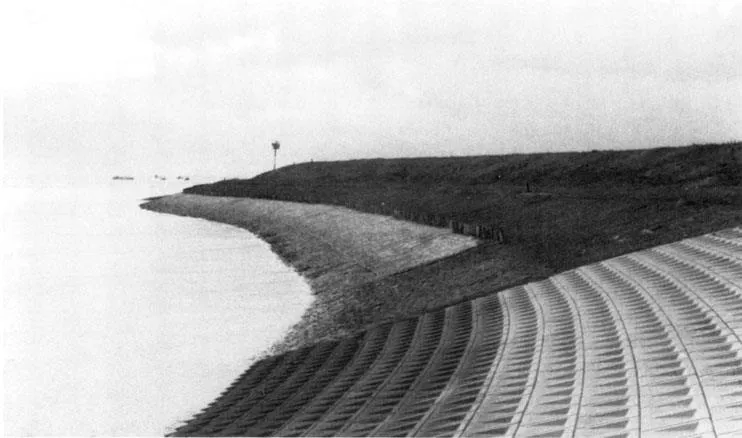
Although this definition precludes revetments of natural stone such as basalt, the design techniques described can also be applied to this type of revetment. Today, however, natural stone revetments are no longer used, except where the material is available locally, for example, when old slopes are being repitched.
The manual is written for engineers familiar with the basic concepts of hydraulic structures and who are involved in the design and management of such structures. The main emphasis in the manual is on the design of new pitched revetments on a sea or lake dike; the design of revetments for the banks of rivers and canals is only treated briefly. Assessment of the safety of existing dikes is considered within the framework of present experience. However since this topic has not been investigated comprehensively the results cannot be readily applied.
1.2 The layout of the manual
The intention of the manual is to guide the reader, step by step, to a reliable design for a new pitched dike revetment. The various revetment alternatives are described and compared, in principle, with revetment systems which are not pitched, see Chapter 2. In this connection reference is made to [Selection Methodology Guidelines, 1988, in Dutch]. In the latter publication distinction is made between paved stones, such as blocks and prisms, block mattresses and interlocking blocks, such as tongue and grooved units. The manual stresses that revetments comprise not only the cover layer of pitched stone but also, for example, any sublayers of, granular material, rubble, minestone, etc. and possibily a geotextile and/or clay layer, see Figures 2 and 3.
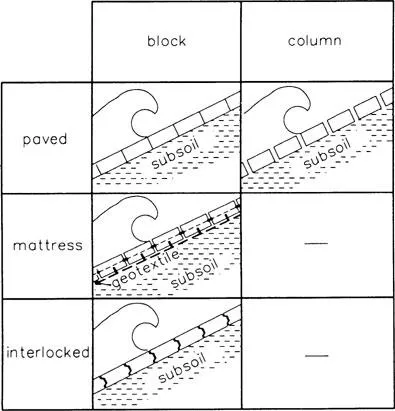
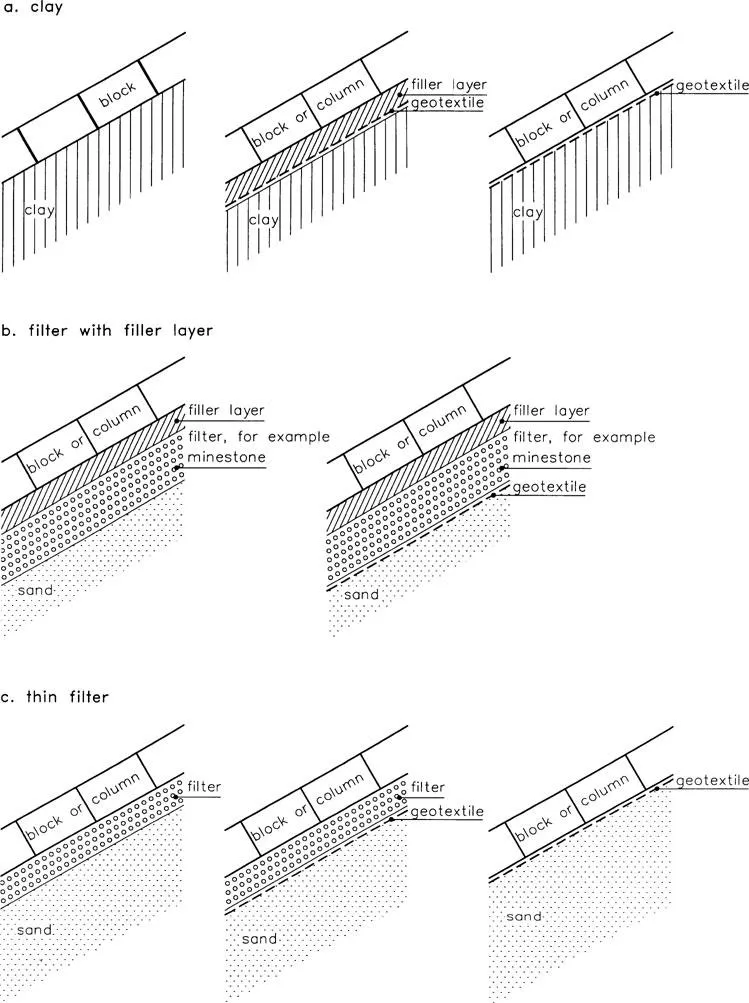
The areas of application, described in Chapter 3, are sea dikes, lake dikes and river and canal banks. The specifications required for revetment structures are described in Chapter 4. The materials which can be used in revetment construction, including the sublayers, are discussed in Chapter 5. Quantative design is discussed in Chapter 6, beginning with a method for determining the wave height and period for both wind and ship waves. The size of the loads which occur when the crest is overtopped and as a result of wave impact are presented very schematically.
General design aspects, treated in Chapter 7, include the determination of wave runup, the height of the berm(s), the choice of slope angle, the level at which the revetment can be replaced by grass and the application of a camber to the slope.
Chapter 8 describes the physical processes which contribute to revetment failure. The reader is then taken step by step through the design graphs and equations used to design a stable structure.
The methods discussed indicate whether or not the revetment structure designed is sufficiently stable. Optimum economic solutions are not worked out. Since a structure can also fail if the base, for example the sand core directly under the revetment, is insufficiently stable, graphs and equations are given in Chapter 9 for evaluating geotechnical stability. This information relates to the geotechnical instability caused by an unsuitable revetment structure and not that due to the dike as a whole. Chapter 10 considers the form of the transition from one type of revetment to another and also toe structures. Chapter 11 discusses the alternatives available to the designer for producing a revetment design which is stable and forms a guide to selecting the various structural components. Examples of structures which have been found to be unstable are given in Chapter 12.
Chapter 13 treats the concept of safety and differentiates between dikes, the safety of which is based on the stability of the cover layer (the pitching), and dikes the safety of which is based primarily on a thick clay layer. Parameters which are not clearly understood and for which safety factors have to be selected are indicated. This method of safety analysis is identified as an instrument for assessing the reliability of the design and for identifying those particular structural components which must be constructed with great care.
Although the manual is primarily aimed at the design of new pitched dike revetments the design approach can also be used to evaluate existing revetments; this subject is discussed in Chapter 14. The examination of the whole flood protection system is described in [Testing Guidelines, 1991]; a design example is worked out in Chapter 15. Gaps in present knowledge are discussed in the last chapter of the manual, Chapter 16. The conclusion drawn is that present knowledge, which can now be considered to be well developed, generally favours paved blocks overlying a granular filter. The terms most frequently used are listed in a glossary which follows immediately after the Contents List.
CHAPTER 2
REVETMENT SYSTEMS
Pitched dike revetments (block pitching) are a form of protection lying between revetments comprised of elements which are disconnected, such as rubble, and monolithic revetments, such as asphalt, see Figure 4. Individual elements of rubble typically do not support adjacent elements; in contrast, a monolithic revetment can only work as one single unit.
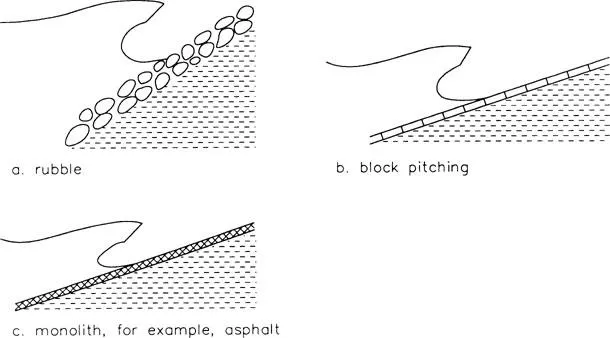
The individual elements of a pitched revetment, referred to in this manual as “blocks”, are placed tightly together in a smooth pattern. This ensures that external forces such as waves and currents can exert little drag on the blocks [BEZUIJEN et al. (1990), page 26] and also that stones su...
Table of contents
- Cover
- Title Page
- Copyright Page
- Table of Contents
- Notation
- Summary
- Glossary
- Chapter 1 Introduction
- Chapter 2 Revetment Systems
- Chapter 3 Areas of Application
- Chapter 4 Specifications for Revetments and Sublayers
- Chapter 5 Materials and their Specifications
- Chapter 6 External Loads
- Chapter 7 Design and Construction Aspects for the Structure as a Whole
- Chapter 8 Revetment Stability
- Chapter 9 Geotechnical Aspects of Revetment Design
- Chapter 10 Transition Structures
- Chapter 11 Design Considerations
- Chapter 12 Examples of Damage to Pitched Block Revetments
- Chapter 13 Safety Considerations
- Chapter 14 Checking the Safety of Existing Structures
- Chapter 15 Calculation Examples
- Chapter 16 Gaps in Present Knowledge
- References
- Appendices
Trusted by 375,005 students
Access to over 1.5 million titles for a fair monthly price.
Study more efficiently using our study tools.
Frequently asked questions
Yes, you can cancel anytime from the Subscription tab in your account settings on the Perlego website. Your subscription will stay active until the end of your current billing period. Learn how to cancel your subscription
No, books cannot be downloaded as external files, such as PDFs, for use outside of Perlego. However, you can download books within the Perlego app for offline reading on mobile or tablet. Learn how to download books offline
Perlego offers two plans: Essential and Complete
- Essential is ideal for learners and professionals who enjoy exploring a wide range of subjects. Access the Essential Library with 800,000+ trusted titles and best-sellers across business, personal growth, and the humanities. Includes unlimited reading time and Standard Read Aloud voice.
- Complete: Perfect for advanced learners and researchers needing full, unrestricted access. Unlock 1.5M+ books across hundreds of subjects, including academic and specialized titles. The Complete Plan also includes advanced features like Premium Read Aloud and Research Assistant.
We are an online textbook subscription service, where you can get access to an entire online library for less than the price of a single book per month. With over 1.5 million books across 990+ topics, we’ve got you covered! Learn about our mission
Look out for the read-aloud symbol on your next book to see if you can listen to it. The read-aloud tool reads text aloud for you, highlighting the text as it is being read. You can pause it, speed it up and slow it down. Learn more about Read Aloud
Yes! You can use the Perlego app on both iOS and Android devices to read anytime, anywhere — even offline. Perfect for commutes or when you’re on the go.
Please note we cannot support devices running on iOS 13 and Android 7 or earlier. Learn more about using the app
Please note we cannot support devices running on iOS 13 and Android 7 or earlier. Learn more about using the app
Yes, you can access Design Manual for Pitched Slope Protection by The Netherlands CUR-Gouda,CUR-Gouda,The Netherlands in PDF and/or ePUB format, as well as other popular books in Technology & Engineering & Civil Engineering. We have over 1.5 million books available in our catalogue for you to explore.