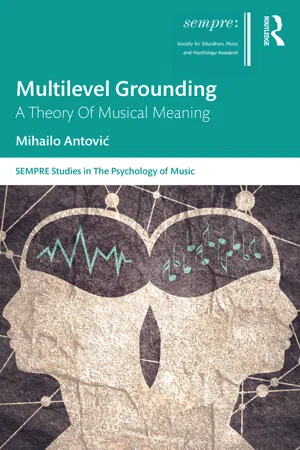
Multilevel Grounding develops a new approach to musical meaning—Multilevel-Grounded Semantics, addressing the well- known paradox that music seems full of meaning yet there is little consensus among listeners on what exactly it is that this meaning communicates. Offering a balance between formalist and referentialist approaches, Antovi ? 's theory proposes that musical signifi cation emerges from constant cross- space mappings between the musical structure and the listener's experience. The process is crucially constrained by several hierarchical and partly recursive levels of grounding: perceptual, schematically embodied, affective, conceptual, culturally elaborated, and individual. These levels are responsible for a range of phenomena that increase in complexity, from involuntary bodily responses to the manipulation of musical expectancies over cross- modal inferences relating the musical parameters to spatial domains to full- fl edged experiential narratives accompanying the music, as in opera or fi lm scoring. The book combines cutting edge insights from the fi elds of philosophy of mind, cognitive science, semiotics, linguistics, and music cognition, using a broad range of examples from traditional, classical, and popular world musics, into a theoretical system that shows how the focus on the grounding problem may help researchers convincingly resolve the apparent ungraspability of musical semantics.
- 158 pages
- English
- ePUB (mobile friendly)
- Available on iOS & Android
eBook - ePub
About this book
Information
1 Defining the Problem Formalism, Referentialism, and Other Dichotomies
DOI: 10.4324/9781003030768-2
In my experience, a linguist uninterested in music is a rare occurrence. Yet, few of us in the field have embarked on the systematic attempt to describe how semantics can work similarly in the two forms. Thus, explaining musical signification has more often been the job of philosophers, music theorists, semioticists, or—more recently—psychologists, cognitive, and neuroscientists. The number of music-and-meaning contributions from these disciplines throughout history has been overwhelming, from perhaps Plutarch to Jean-Jacques Rousseau to modern-day scholars such as Philip Tagg. As my goal is much more narrowly defined—to propose a theory of musical meaning based primarily on some established frameworks of linguistics and linguistic semantics—I cannot hope to analyze in detail all those significant insights coming from adjacent fields. Therefore, this chapter will provide only the briefest survey of some important achievements in the music-and-meaning world from the last century, touching upon issues of language not coming from the language science, aiming to inform a linguist reader of several key questions on the phenomenon that are typically relevant to non-linguists. Conversely, the second part of the chapter will be dedicated to my selection of interesting problems of meaning in linguistic semantics (not originally related to music) in the last half-century, with an aim to provide a non-linguist reader some elementary, historical background for the chapters that follow. (The full conceptual apparatus that I will be using, based on such a background, will be given in Chapter 2.) As always in this book, the “grand goal” is to present the two traditions in parallel so as to show both how linguistic semantics can “help” a semantics of music, but also—what is usually less obvious to practitioners—the other way round.
One immediate revelation for linguists interested in music, whether sympathetic of a musical semantics or not, is that in the non-linguist community, too, the question of semiosis has radically divided theorists. In fact, opponents of the idea that music can “mean,” at all, have been numerous. In the 20th century, this rejection typically originated from Modernist renunciation of all things Romantic, including the previous movement’s fascination with program (“descriptive”) music. Music means “only itself,” stark opponents of externalist musico-semiotics would retort, including composers such as Schoenberg, Stravinsky, Webern, practicing-musicians-and-theorists such as Pierre Boulez, and finally philosophers such as Kivy (2002, p. 150). The more surprising development is that even “supportive” scholars, those accepting musical semiosis in some form, have often been further sharply divided along the “formal/referential” line, a duality dating back to at least the (apparent) clash between Kantian and Hegelian aesthetics. For formalists, musical meaningfulness is “self-referential,” pertaining only to music-internal constructs such as theses, antitheses, resolutions, or repetitions. According to the more cognitively oriented among these people, listening to music induces some sort of psychological reaction that is probably epiphenomenal to the parsing of structures and therefore not “just grammatical,” yet still not explicit enough to refer to anything outside of music itself. This is sort of like getting the shudders every time I hear Freddie Mercury hit the high D in “Ooon with the show,” yet without thinking of Freddie, Queen, shows that must go on, or all sorts of musical and textual references to his imminent tragic demise flowing from every second of that powerful song. The shudders alone show a phenomenon of meaning. In fact, they do so even without my conscious experience of them; if my intuitive reaction to the high-pitched moment is something like “Aha, here’s that peak” (and without saying it!), I have grasped the formal meaning of the phrase. This tradition of “semantic formalism” in music analysis may have started with German and Austrian idealist music theorists of the early 20th century—perhaps Heinrich Schenker, Eduard Hanslick, and (in the States) Albert Gehring—yet in the music-and-language world, it would have been decisively taken over by US scholars inspired by the Chomskian generative program in the 1970s. This was the time of the rise of “musicolinguistics,” a term coined by the Indian-American linguist and anthropologist Anoop Chandola around 1973, but taken over and made somewhat famous within cognitivistic circles by composer Leonard Bernstein in his notable six talks for Harvard students (Bernstein, 1976). In these lectures, the maestro made an early attempt to translate Chomsky’s principles of generative grammar to music. Crucially, his talk on semantics insisted that musical meaning is not about extramusical referents (such as peasants in The Pastorale), but really just inherent to the manipulation of structure—the rejuggling of musical anagrams, as he called it. In fact, he even used the term “metaphor” for what traditional music analysts might call “motivic variation”: namely, the repetition of the same phrase with some slight changes. While the recognition that the varied motive is “essentially identical” to its previous manifestation is a tricky and interesting cognitive task, calling the phenomenon a “metaphor” (even with Bernstein’s occasional qualification of it as “intrinsic”) is a bit weird from the perspective of the hugely influential, and starkly non- formalist, conceptual metaphor theory in linguistics, which would come onto the scene about 5 years after Bernstein’s talks. Hence just one example of the terminological chaos that we in the field are trying to disentangle almost half a century later.
The formalist approach to musical meaning probably received its strongest support from the most important musicolinguistic book to date, Lerdahl and Jackendoff’s (1983) A Generative Theory of Tonal Music. In fact, while the grammatical contribution of this work to the field is immeasurable, in the previous introduction I was slightly unfair to Ray Jackendoff with regard to the question of signification. He does not really reject musical semantics, yet his position is just slightly (if at all) less formalist than Bernstein’s. Regarding music’s impact on listeners, “if one wishes to call this meaning,” he says, it should be sought not in metalinguistic constructs but in affect, often associated with an activity (Jackendoff, 2009, p. 197). There have been debates about this concept in music psychology (and I will return to some of them in Chapter 5), yet Jackendoff sees affect as a sort of pre-emotional, automatic, unconscious reaction to the sequencing of (un)expected elements in the musical flow, like that flinch I always get after hearing Freddie hit the high note. In fact, illustrating Jackendoff’s point, I like to hear this musical moment so many times precisely due to the unconscious nature of the parsing, which causes the affective reaction. My awareness really has nothing to do with it; otherwise, I would have probably gotten bored after 30 years of hearing the song at least once a week. The concept, actually derived from the notion of expectancy by American music psychologist Leonard Meyer (1956), relates to endless debates on music and emotion, of which some are very formalist, others less or not at all so (more on this again in Chapter 5). Jackendoff does not go beyond affect in his writing, so far as I know, yet for the sake of the truth—and in further support of his open mind and broadness of insight—I should add that, in personal correspondence with me some 20 years ago, he did also allow that people have intuitions of the suitability of music in extramusical contexts, so that the interpretation of the same visual events may change when the background music changes. This is today a topic of frequent research in the subfield sometimes called “musical multimedia” (Tan et al., 2013). Such thinking may have nicely cleared the way for recent developments, in which prominent formal semanticists have been—to my great enthusiasm—developing music semantic theories, getting dangerously close to a full reconciliation with more referential approaches (Schlenker, 2019). To avoid any methodological confusions stemming from the word “formal,” many in the music cognition world prefer to call the formalist’s phenomenon of interest “intramusical meaning” (e.g., Koelsch, 2012). The idea is the same: a psychological reaction coming from the internal manipulation of musical structures, without any reference to the “outside world.” To show how self-explanatory terms from one discipline can be counterintuitive to the other, I add that the editor of a major journal—and one of the most famous cognitive linguists of the day—loved and published a paper of mine on musical semantics. Yet in his remarks he also insisted he “still did not quite get my distinction between intrinsic and extrinsic metaphors.” This was partly lack of familiarity with Bernstein, but partly also credo: cognitive linguistics famously rejects the distinction between grammar and meaning, form and content, to which I return several paragraphs below.
So, formalists (may) accept the notion of musical meaning but insist that it not be sought outside of music. To a non-linguist, this may seem totally different from what linguistic semantics is about. After all, we use the term [chair] to refer to actual chairs around us, right? Well, not necessarily. To be precise, in ordinary situations we do, and this is where music and language are not commensurable in terms of the ontology of their constituents, which I mentioned in the introduction. While I know what “Sit on that chair!” means, much as I enjoy Beethoven’s sonatas, they have never given me an order. But many linguistic semanticists would label such an “externalist” approach to meaning in language as folk psychology. Doctrinally, they would hold that a “scientific” semantics should also refrain from studying any impact words may have on the outer world. On such thinking, my experiential knowledge of what chairs are is extraneous to linguistic meaning, much as my connecting Freddie Mercury’s death to the sad feeling of “The Show Must Go On” is extraneous to the song’s formal musical meaning. All there is to the concept [chair] is its sense, perhaps expressible by the rephrasing I used in the introduction, that it corresponds to “a four-legged object used for sitting.” But even that should be viewed as a purely intralinguistic relation, the replacement of a single word by a set of related words: that is, something to do with language as a computational system and the processing of this system’s interlocked elements in my mind. It certainly does not deal with my knowledge of chairs, objects, or sitting altogether. In a way, if musical formal semantics is intuitive because music is not really about anything, linguistic formal semantics, especially lexical, is counterintuitive since it is extremely difficult to (1) analyze language by (2) using the very language (at least the technical jargon of linguistics) and simultaneously (3) exclude its referentiality. But the underlying logic of the two approaches is quite similar.
In linguistic semantics, this formal/referential chasm has given rise to a series of dichotomies (some now old-fashioned and many really predating modern language science) to help researchers distinguish between language-internal (definitely semantic) and language-external (perhaps experiential, psychological, or sociological, but most likely not semantic) phenomena. Some of these include the distinction between sense and reference (i.e., an intralinguistic rewriting, transforming our chair lexeme into that four-legged-object-used-for-sitting phrase, as opposed to the relationship between the word “chair” and that thing in my room I can sit on), coming from German logician Gottlob Frege’s (1892) distinction between “Sin” and “Bedeutung.” Another dichotomy is denotation and connotation (i.e., the set of all real, imaginary, and possible chairs in the universe as opposed to what that chair in my room affords, how it feels to sit on, and what emotions the concept may arouse in me), presented here as it is usually viewed in modern formal semantics (e.g., Hofmann, 1995), although this use somewhat differs from the original proposal by John Stewart Mill (1872). Finally, one often finds intension (language-internal properties of the concept, e.g., “chairness”) and extension (its capacity to name actual entities from the outer world), nicely explained in an early article by the today world-famous philosopher David Chalmers (2002). Ultimately, in some schools, this has split the discipline into semantics (all the former) and pragmatics (all the latter, plus the social impact of using language)—a cleft that can be conceptually contributed to philosopher Rudolf Carnap (1959), but which broke out in linguistics full-scale with the work of Paul Grice (1975). In fact, the disdain of the latter concepts among some theorists has made them give up on trying to explain word meanings altogether and revert to the—apparently—safe haven of sentence semantics. This, at least, was the original focus of formal semanticists following Chomsky, who looked only at the truth-conditions of propositions and refused to discuss word meanings at all (Heim & Kratzer, 1998). On such a view, “John Malkovich is talking” is true if and only if we can computationally prove that John Malkovich is talking, through a formal process involving relationships of dominance among syntactic constituents and their positions in generative trees—thus, without explaining the “ontology,” let alone extralinguistic impact, of either being John Malkovich (sic!) or talking. Sounds a bit like Bernstein, with music generating meaning without referring to anything outside of itself, right?
Music generally does not have the former concepts in the above dichotomies. Thus, formal musical semantics cannot be about the senses, denotations, or intensions of musical elements—not to mention any truthfulness or propositional quality arising from musical sequences. This is probably the reason why formal musical semantics has developed its own strongly metaphorical vocabulary, talking of augmentation, diminution, expectancies, arousals, implications, and even Bernstein’s “intrinsic metaphors”—which really use the term “metaphor” metaphorically. Again, this incommensurability of concepts does not mean that the underlying logic of the formalist approaches to linguistic and musical semantics has not been strikingly similar all these years. Some such connections shall be discussed in Chapter 2.
Unlike the formal team, referential musical semantics has profited enormously from employing the latter group of concepts from the classic linguistic semantic dualities mentioned above. Obviously, then, referentialists believe musical semantics must extend beyond music in one way or another. Sometimes this approach is known as expressionist, representativist, or externalist. In many languages, including my Serbian, the typical term would be “contentual” after the German “Inhaltsästhetik,” discussed at length, for instance, by Theodor Adorno (1977). That label probably more precisely defines referentialists’ frequent search for “content” in music, although the adjectival form is probably only borderline acceptable in English. In any event, referential theories have persevered throughout the 20th and early 21st centuries in numerous incarnations, many of which derive from two sources: the obsession of some movements in music history, such as Romanticism, wherein properties of music are experienced, again metaphorically, as textual, verbal, or descriptive, and the rise of the discipline of semiotics, with a strong interest in (extraneous) meaningfulness in all kinds of human behavior, from non-verbal communication to fashion to art. Like formal theories, referential approaches to musical meaning from non-linguists are too numerous to even list. For some prominent, Anglo-American representatives, one may recall the work of British music critic Deryck Cooke (1959). Appropriately to my topic, his book is labeled The Language of Music, although by this he actually means musical emotion, adding to the long list of scholars using terms, this time “language” itself, metaphorically. In particular, Cooke focused on the interaction of musical pitch, time, and tonal harmony to end up with almost a catalogue of emotions that sequences of sound might arouse in Western listeners. A typical such paragraph would describe the upward movement in the lower tetrachord of a minor scale, accompanied by appropriate harmony, as expressing “sorrow, a complaint, a protest against misfortune” (Cooke, 1959, p. 122). An even more semanto-centric approach was that of the American philosopher Susanne Langer, who insisted musical significance is “semantic, not symptomatic [emotion-invoking]” so that music has “conceptual content… symbolically” (Langer, 1957, p. 176). Far from a naive parallel with language, this symbolic nature of music was meant to distinguish between the erroneous idea that a composer conveys his own emotion in the score and the more plausible concept that the music contains an abstract structure from which suitable emotions may be inferred. This symbolism Langer labeled “presentational,” as if through symbolism music can be known even without being named, an idea that later prompted many in cognitive science to accept that music is simply “ineffable” (Raffman, 1993, following Jan...
Table of contents
- Cover
- Half-Title Page
- Series Page
- Title Page
- Copyright Page
- Table of Contents
- Acknowledgments
- Introduction
- 1 Defining the Problem: Formalism, Referentialism, and Other Dichotomies
- 2 The Conceptual Framework
- 3 Grounding Box 1: Formal Musical Meaning
- 4 Grounding Box 2: Cross-Modal Musical Meaning
- 5 Grounding Box 3: Affective Musical Meaning
- 6 Grounding Box 4: Conceptual Musical Meaning
- 7 Grounding Box 5: Culturally Rich Musical Meaning
- 8 Grounding Box 6: Personal Musical Meaning and a Complex Analysis
- 9 Conclusions
- References
- Index
Trusted by 375,005 students
Access to over 1.5 million titles for a fair monthly price.
Study more efficiently using our study tools.
Frequently asked questions
Yes, you can cancel anytime from the Subscription tab in your account settings on the Perlego website. Your subscription will stay active until the end of your current billing period. Learn how to cancel your subscription
No, books cannot be downloaded as external files, such as PDFs, for use outside of Perlego. However, you can download books within the Perlego app for offline reading on mobile or tablet. Learn how to download books offline
Perlego offers two plans: Essential and Complete
- Essential is ideal for learners and professionals who enjoy exploring a wide range of subjects. Access the Essential Library with 800,000+ trusted titles and best-sellers across business, personal growth, and the humanities. Includes unlimited reading time and Standard Read Aloud voice.
- Complete: Perfect for advanced learners and researchers needing full, unrestricted access. Unlock 1.5M+ books across hundreds of subjects, including academic and specialized titles. The Complete Plan also includes advanced features like Premium Read Aloud and Research Assistant.
We are an online textbook subscription service, where you can get access to an entire online library for less than the price of a single book per month. With over 1.5 million books across 990+ topics, we’ve got you covered! Learn about our mission
Look out for the read-aloud symbol on your next book to see if you can listen to it. The read-aloud tool reads text aloud for you, highlighting the text as it is being read. You can pause it, speed it up and slow it down. Learn more about Read Aloud
Yes! You can use the Perlego app on both iOS and Android devices to read anytime, anywhere — even offline. Perfect for commutes or when you’re on the go.
Please note we cannot support devices running on iOS 13 and Android 7 or earlier. Learn more about using the app
Please note we cannot support devices running on iOS 13 and Android 7 or earlier. Learn more about using the app
Yes, you can access Multilevel Grounding by Mihailo Antović in PDF and/or ePUB format, as well as other popular books in Psychology & Music. We have over 1.5 million books available in our catalogue for you to explore.