With this book, you get a really complete seminar for the new Regulations on medical devices and IVDs in the EU, ready at hand, at any time.These EU regulations create new rules for medical technology and laboratory diagnostics in Europe. Concise regulatory know-how is now required to keep or reposition medical devices and in vitro diagnostics on the European market, from syringes, contact lenses, medical device apps, pregnancy tests, nuclear magnetic resonance tomography to cancer tests, genetic diagnostics, HIV tests, hip implants, heart catheters, artificial spinal discs, stents and pacemakers. Concise regulatory training and further education of employees in companies and health care facilities is the order of the day. This also applies to biomedical and medical technology students at universities of applied sciences and biomedical universities, start-ups and spin-offs, who must make use of this know-how from the initial product idea through the further stages of product development to market access.The book provides a thorough, compact course on the new regulations, starting with perfect overview and easy navigation and going into depth where you need it: this book will make you fit and confident for the new European challenges!344 pages; 47 col. figures; 26 tables
eBook - ePub
Medical Devices and IVDs
Fit for the new EU-Regulations: Your complete seminar for projekt, study and job
- 344 pages
- English
- ePUB (mobile friendly)
- Available on iOS & Android
eBook - ePub
Medical Devices and IVDs
Fit for the new EU-Regulations: Your complete seminar for projekt, study and job
About this book
Information
Chapter 1. Overview of the New Regulatory System for Medical Devices and In Vitro Diagnostics in the EU
Let us first take a look at the transition from the current system of EU directives to the new EU regulations for medical devices and IVDs (chapter 1.1.). Then we look at the construction principles of the new regulatory system (chapter 1.2.) and finally further to its central concepts for EU internal market access (chapter 1.3.). The most important documents of the new (and partly old) regulatory system are systematically discussed (section 1.4.). We then need a short regulatory compliance walkthrough along the product life cycle, from product development, preparation for market access, conformity assessment to the obligations when keeping the product on the EU market (section 1.5.). This fundamental orientation is concluded by the transition regime from the old directives to the new regulations with relevant time frames (section 1.6.) which have been adapted recently by the EU legislators to address urgent issues of the covid-19 crisis.
1.1. Transition from Directives to Regulations
In 2017, the EU legislator transformed the previous regulatory system for medical devices, consisting of 3 EU directives and their national implementations, into a new system of 2 EU regulations. as now directly applicable EU law (see Fig. 1):
Regulation (EU) 2017/745 on medical devices (MDR)4, and
Regulation (EU) 2017/746 on in vitro diagnostic medical devices (IVDR)5.
Both regulations were developed in parallel and each consist of (see Fig.2+3)
- Recitals, i.e. intentions and objectives of the EU legislator which can be used as an aid to interpretation in the event of legal uncertainties,
- the Chapters and their Articles, with the core of both legal texts, and
- the Annexes, the binding, more technically oriented legal text, which supplement the chapters (for example Annex I on General Safety and Performance Requirements [GSPR; Annex II and III on technical documentation or Annexes IX to XI on conformity assessment modules [= modules of "European Premarket Approval"]).
The MDR/IVDR entered into force at EU level on 25 May 2017; the date of application for the MDR has been – after an amendment of the MDR - 26 May 2021 (4-year transitional period); for the IVDR, the date of application will be 26 May 2022 (5-year transitional period). For the more special transition periods and regimes, see chapter 1.6. in this book.
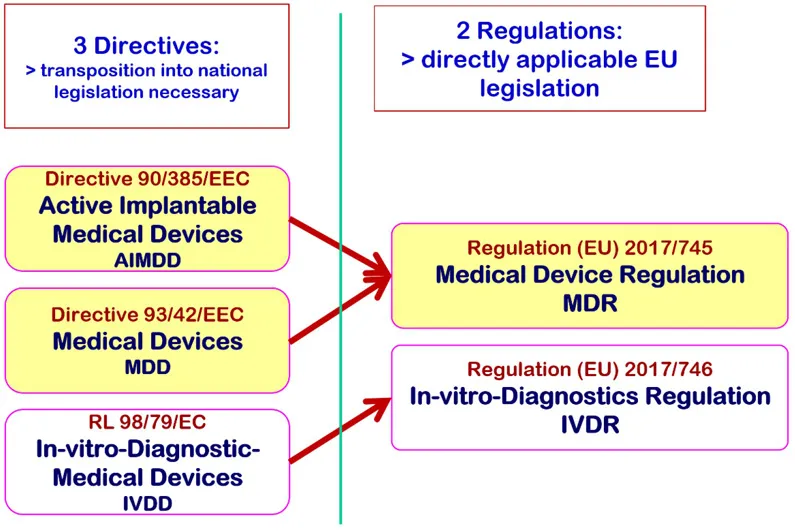
Fig. 1 From Directives to Regulations
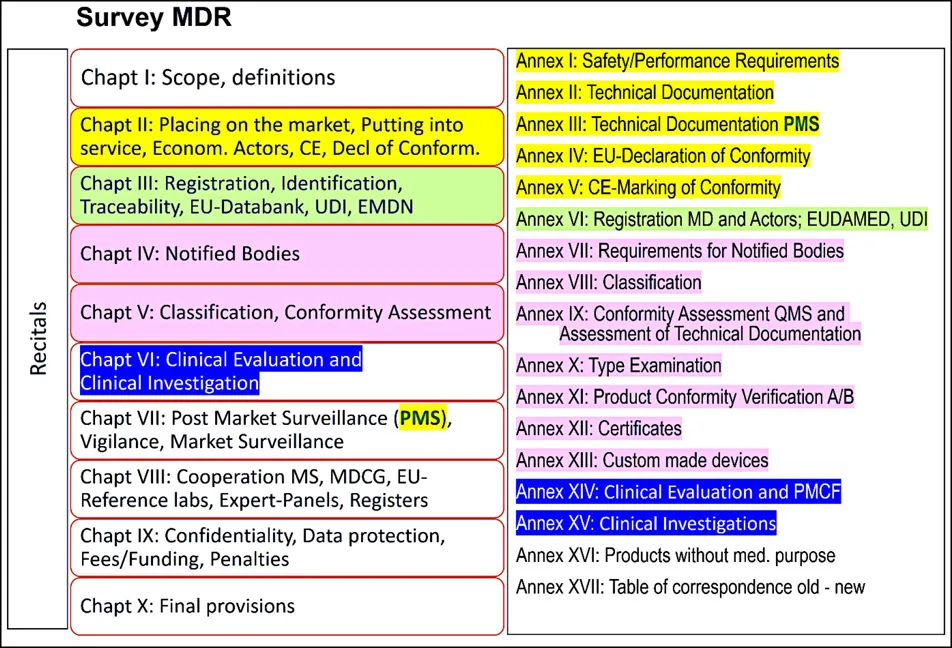
Fig. 2 MDR: Structure and Content Overview
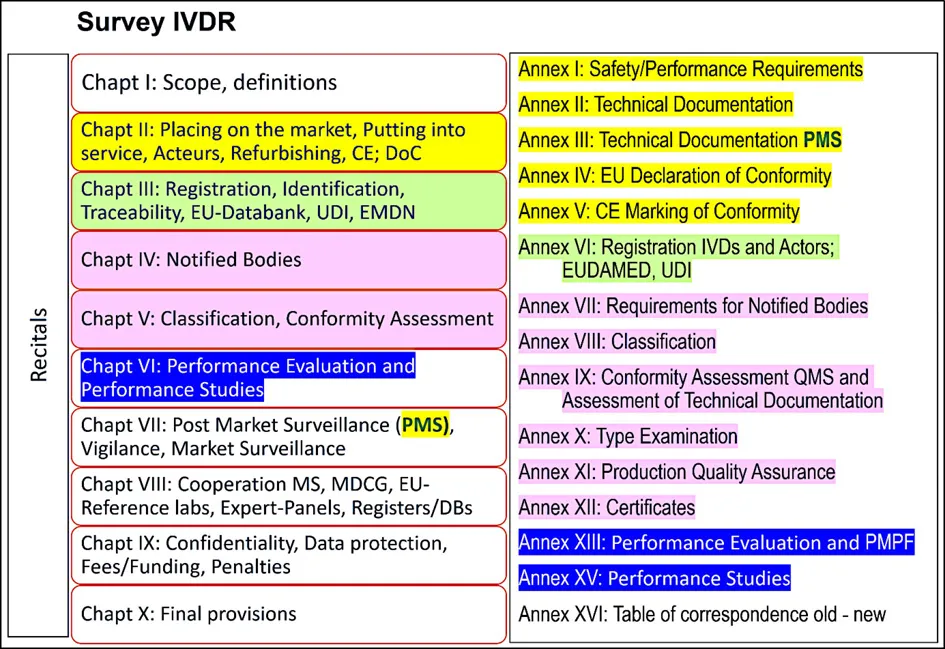
Fig. 3 IVDR: Structure and Content Overview
1.2. The New EU Regulatory System for Medical Devices and IVDs: The Building Principles
(See in particular Fig. 4) Both regulations are based on fundamental legal principles of the EU: the internal market concept and health protection (which primarily aims at safety and effectiveness, a high level of health protection, a positive clinical benefit/risk ratio according to the state of the art and minimization of risks and side effects). Both regulations follow basic regulatory principles of the internal market concept6, as is the
1.2.1. New legal framework for EU product legislation
This is about the new general legal framework for (many) EU product regulations (New Legislative Framework - NLF), which constitute the background philosophy of MDR and IVDR. NLF builds in a modernized form on important legal construction principles, which are essential for the understanding of both regulations: These are the
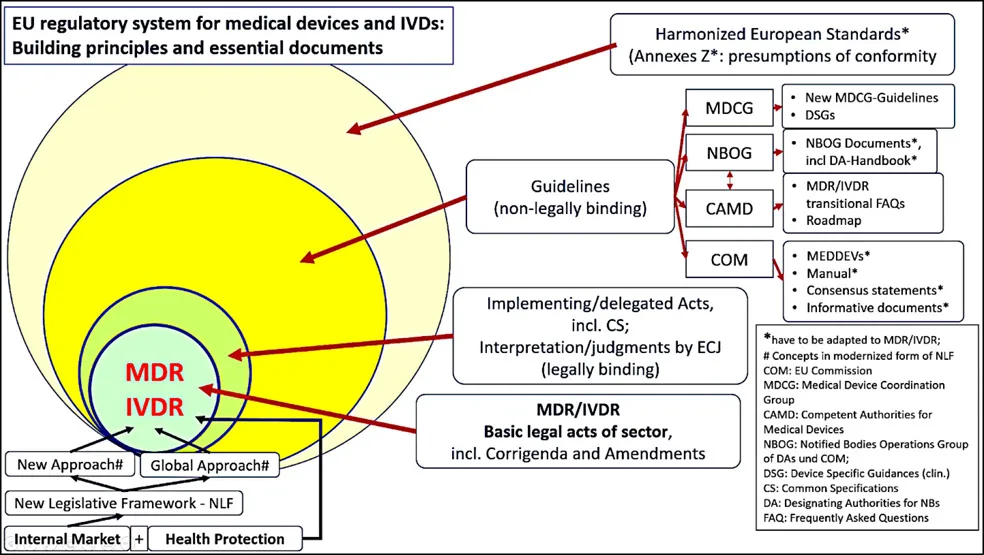
Fig. 4 MDR-IVDR: Building Principles and Documents - Survey
- New Approach and the
- Global Approach.
1.2.2. The New Approach Under the New Legal Framework
The New Approach is essentially about the following: The two Regulations7 define in their respective Annexes I checklist-like the General Safety and Performance Requirements (GSPR; previously called Essential Requirements - ER) of the MDs or IVDs, which, insofar as they apply to a certain MD/IVD, must be fulfilled by the products on placing on the market or on putting into service. The details to these requirements incl. eventual verification procedures and tests, or on certain processes and procedures of the regulatory system, are provided outside the legal texts by harmonized European standards, the references (titles) of which are published in the Official Journal of the EU for the respective Regulation or Directive. These harmonized standards are not binding8, but contain in their Annexes Z (ZA, ZB, …) very specific presumptions of conformity with regard to the GSPR mentioned there for an MD/IVD; i.e. if the manufacturer follows the presumptions of conformity set out in Annexes Z (ZA, ZB,...) of the standards for the fulfilment of certain GSPR, the manufacturer is entitled to a presumption of conformity in this respect from its Notified Body (NB; "European Conformity Assessment Body") or from the market surveillance authority (this presumption may be falsified under certain conditions). The manufacturer may deviate from harmonized standards but must then sufficiently justify his alternative solutions for compliance with the relevant GSPR, which usually is associated with increased work load. In the absence of harmonized European standards, current international ISO or IEC standards will often be used alternatively9. Harmonized European standards can also provide presumptions of conformity in important processes and procedures (e.g. quality management systems, clinical investigations, usability, risk management, performance studies).
The Harmonised Standards are drawn up by the European standardization bodies CEN and CENELEC (the latter for the electrotechnical sector) on the basis of standardization mandates of the EU Commission with the help of the standardization bodies of the Member States; they are jointly agreed and harmonized for certain regulations or directives after examination by the Commission. Their references (titles) are published 1-2 times a year in the Official Journal of the EU10. European standards are usually developed jointly with the global standards institutions ISO (<> CEN) and IEC (<> CENELEC); however, Appendices Z with the presumptions of conformity are only valid for the Harmonized European Standards.
Further presumptions of conformity can now be provided for certain MD/IVD groups within the framework of both regulations, especially in the clinica...
Table of contents
- Table of Contents
- Preface
- Acknowledgement
- Chapter 1. Overview of the New Regulatory System for Medical Devices and In Vitro Diagnostics in the EU
- Chapter 2. The Scope of the Two New Regulations: Product Delineation as a MD/IVD (Qualification)
- Chapter 3: General Obligations of Economic Operators
- Chapter 4. European Databank EUDAMED and its Modules; UDI-System; Identification and Traceability of MD/IVD; European Medical Device Nomenclature (EMDN)
- Chapter 5. General Safety and Performance Requirements for Medical Devices and IVDs
- Chapter 6. Clinical evaluation of medical devices
- Chapter 7. Performance Evaluation of In Vitro Diagnostics
- Chapter 8. Clinical investigation of medical devices
- Chapter 9. Performance studies of IVDs
- Chapter 10. Technical Documentation (TD)
- Chapter 11. Classification
- Chapter 12. Conformity Assessment of MDs
- Chapter 13. Conformity Assessment of IVDs
- Chapter 14. Surveillance After the Start of Placing on the Market, Responsibilities
- Chapter 15. Post-Market Surveillance (PMS), PMS System
- Chapter 16: The Vigilance System
- Chapter 17. Service Part
- Copyright
Trusted by 375,005 students
Access to over 1.5 million titles for a fair monthly price.
Study more efficiently using our study tools.
Frequently asked questions
Yes, you can cancel anytime from the Subscription tab in your account settings on the Perlego website. Your subscription will stay active until the end of your current billing period. Learn how to cancel your subscription
No, books cannot be downloaded as external files, such as PDFs, for use outside of Perlego. However, you can download books within the Perlego app for offline reading on mobile or tablet. Learn how to download books offline
Perlego offers two plans: Essential and Complete
- Essential is ideal for learners and professionals who enjoy exploring a wide range of subjects. Access the Essential Library with 800,000+ trusted titles and best-sellers across business, personal growth, and the humanities. Includes unlimited reading time and Standard Read Aloud voice.
- Complete: Perfect for advanced learners and researchers needing full, unrestricted access. Unlock 1.5M+ books across hundreds of subjects, including academic and specialized titles. The Complete Plan also includes advanced features like Premium Read Aloud and Research Assistant.
We are an online textbook subscription service, where you can get access to an entire online library for less than the price of a single book per month. With over 1.5 million books across 990+ topics, we’ve got you covered! Learn about our mission
Look out for the read-aloud symbol on your next book to see if you can listen to it. The read-aloud tool reads text aloud for you, highlighting the text as it is being read. You can pause it, speed it up and slow it down. Learn more about Read Aloud
Yes! You can use the Perlego app on both iOS and Android devices to read anytime, anywhere — even offline. Perfect for commutes or when you’re on the go.
Please note we cannot support devices running on iOS 13 and Android 7 or earlier. Learn more about using the app
Please note we cannot support devices running on iOS 13 and Android 7 or earlier. Learn more about using the app
Yes, you can access Medical Devices and IVDs by Wolfgang Ecker in PDF and/or ePUB format, as well as other popular books in Law & Law Theory & Practice. We have over 1.5 million books available in our catalogue for you to explore.