The Ethiopian Evangelical Lutheran Church (EELC) was formed in 1960 as a fruit of the mission work of Swedish Mission Bibeltrogna Vänner (SMBV), founded in 1911, its roots dating back to the evangelical revival that swept across Sweden in the 19th century. The main goal of the society was to reach the Oromo people in Ethiopia with the Gospel.In 1911 mission work began in Eritrea and in 1921 the first SMBV missionaries reached Addis Ababa, from where work was expanded into the cities of Harar and Dire-Dawa as well as into the Arsi province.When EELC was founded, members were few, estimated to around 500. Since then the church has grown and today has a membership of about 25, 000. This book covers the first part of EELC: s history, describing the development from 1921 to 1935, ultimately leading up to the establishment of the church in 1960. As a background the development leading to the establishment of SMBV and the mission work of SMBV in Eritrea are described
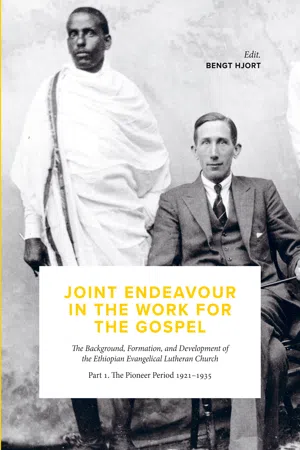
eBook - ePub
Joint Endeavour in the Work For the Gospel
The Background, Formation and Development of the Ethiopian Evangelical Lutheran Church. Part 1. The Pioneer Period 1921 - 1935
- 230 pages
- English
- ePUB (mobile friendly)
- Available on iOS & Android
eBook - ePub
Joint Endeavour in the Work For the Gospel
The Background, Formation and Development of the Ethiopian Evangelical Lutheran Church. Part 1. The Pioneer Period 1921 - 1935
About this book
Trusted by 375,005 students
Access to over 1.5 million titles for a fair monthly price.
Study more efficiently using our study tools.
Information
1. INTRODUCTION
By Qes Mekonnen Gerremew and Bengt Hjort
1.1 The Ethiopian Evangelical Lutheran Church—History, Identity, and History-Writing
The Ethiopian Evangelical Lutheran Church (EELC) was formed in 1960. At the time, it was based on congregations that had emerged as a fruit of the work of Swedish Mission Bibeltrogna Vänner (SMBV) in central, eastern, and southern Ethiopia.1 When the Church was founded, the number of members was very limited, estimated to be about 500. Over time, however, the Church has grown and the number of members is currently estimated at about 25,000. This has been achieved through the growth of several of the original congregations, but above all by extending the church’s activities to new areas in southern Ethiopia.
At the time of the formation of the Church in 1960, SMBV carried out work based in eight stations. The school work included eight schools and the healthcare work three clinics and one hospital. The number of parishes was eight.
The 1960s brought some important changes for the newly formed Church. In 1962, a literacy campaign was launched by the evangelical churches in Ethiopia. The Lutheran Church participated and established many village schools. This was carried out with financial support from SMBV.2
In 1964, a large group of Christians from the Wollaita area of southern Ethiopia joined the Church. This meant that the number of members increased very significantly. In 1966, the mission hospital in Asella was closed.3 The old hospital buildings were, after some time, used for the Lutheran Theological Seminary.
In 1975, the Church took over responsibility for the work that SMBV had started and developed. However, the Church relied on financial support and staff support, in the form of missionaries, for many years to come. This support gradually decreased over the years, particularly in the case of missionary personnel.
The above sketchy description of the historical background of EELC shows that the Church was strongly influenced from the outset by SMBV’s previous and ongoing work in Ethiopia. It concerned the ”outer” work of school activities, medical work, church work and administration, but also the ”inner” work with theological preferences and theological values.
During the 60-year period EELC has existed, Ethiopia has undergone major changes at various levels. When the Church was founded in 1960, Emperor Haile Selassie was the country’s leader. Although his position had begun to be somewhat questioned, he was the autocratic ruler.
In 1974, just before the Church took over responsibility for the work previously carried out by SMBV, the Ethiopian revolution erupted. This led to the overthrow of the emperor. Eventually, a Marxist-Leninist group took power and kept it for about 15 years. This was a very difficult time, with persecution and suffering, for many Christians in Ethiopia. The EELC also experienced this and the challenge for the Church was to carry out spiritual work within the limits set by the authorities.
In 1991, the Marxist-Leninist regime fell and was replaced by a regime that was liberal in several respects. This was the case, for example, in the religious area where religious freedom was proclaimed and where various churches were given a great opportunity to engage in outreach activities, which had often been severely restricted in the past. For the EELC, the challenge was now to take advantage of the opportunities to reach out with the gospel into new areas and new places.
The newfound religious freedom also led to Islam advancing its positions. Many mosques have been built over the last 25 years. However, the openness and freedom of religion introduced in the country have also led to many new Christian currents. In addition to this, there is a religious influence from abroad through the internet and various media. Young people, perhaps especially in urban environments, are affected by this.
In 1960, Ethiopia had 20–25 million inhabitants. As a result of strong population growth, the population is now around 110 million. This sharp increase has given Ethiopia a very young population. About 60% of all Ethiopians are younger than 25!4
It is in this environment that the Church operates and also faces the challenge of preserving its Evangelical Lutheran identity. Part of this identity is expressed through the history of the EELC. The leadership is well aware of this and has for a long time wanted the history of the Church to be put on paper. A work aimed at writing this history began in 2017. It is described in more detail in the next section.
How, then, can a recorded history help preserve the identity of a church? The following answer can be given to this important question: The history of a church can be used as an explanation of the past, as a guide in the present, as a motivating force, and as a practical tool in daily work.5
- The history of a church provides an explanation of the past. By taking part of this history, one acquires knowledge and understanding of a church’s roots as well as of important events and development processes. It provides a better understanding of the current situation.
- Church history can also be used as a guide. Study of past events and developments provide guidance and assistance in contemporary situations in order to avoid evil and emulate good.
- Church history can also be used as a motivating force, that is, to motivate, to inspire, and to infuse life within a church.
- Church history can be used as a practical tool by evangelists, pastors, and teachers to impart information about their church, its doctrine, and its teachings.
1.2 Background: the History-Writing Project
In 2017, the Executive Committee of the Ethiopian Evangelical Lutheran Church appointed a working group whose task was to write the EELC’s history. The group, which was basically given freedom as to how it would tackle the assignment, decided its task was to present the roots, the formation, and the development of the Church. It came to the conclusion that the written history should deal with the period 1921 to 2003. The first date was chosen because the first SMBV missionaries began work in Addis Ababa in 1921. The end date was chosen because 2003 was the year in which the Church received its current constitution.
The objective of presenting the Church’s roots means that a certain background description must be included. This applies to developments in Sweden and Denmark in the second half of the 19th century, when the commitment to mission in other countries grew strong within the evangelical revival. This led to several attempts to reach the inner parts of Ethiopia and to the start of mission work first in Eritrea and later in Ethiopia. These developments must be described in a general way. The same applies to the creation of SMBV and the work of this organization in Eritrea 1911–1921.
This book forms a first part of this history-writing project, and deals with developments until 1935 when the war between Ethiopia and Italy broke out. The focus is on the years 1921 to 1935. In addition to the background descriptions mentioned above, a general description of developments in Ethiopia during the period 1880 to 1935 is included.
1.3 Sources and Source Criticism
This book is based exclusively on literature studies. The literature presented in detail in the bibliography can be divided into the following categories.
1. Official publications related to SMBV. This applies mainly to SMBV’s...
Table of contents
- Table of Contents
- Foreword
- 1. Introduction
- 2. Mission Revival (Sweden, Denmark) with Consequences in Eritrea & Ethiopia 1850–1911
- 3. A Scene That Changes: Developments in Ethiopia 1896–1935
- 4 Looking South—Mission in Eritrea: 1911–1919
- 5 Pioneering Work in Ethiopia 1921–1935
- Notes
- Appendix—The Pioneers
- References
- Index
- Copyright
Frequently asked questions
Yes, you can cancel anytime from the Subscription tab in your account settings on the Perlego website. Your subscription will stay active until the end of your current billing period. Learn how to cancel your subscription
No, books cannot be downloaded as external files, such as PDFs, for use outside of Perlego. However, you can download books within the Perlego app for offline reading on mobile or tablet. Learn how to download books offline
Perlego offers two plans: Essential and Complete
- Essential is ideal for learners and professionals who enjoy exploring a wide range of subjects. Access the Essential Library with 800,000+ trusted titles and best-sellers across business, personal growth, and the humanities. Includes unlimited reading time and Standard Read Aloud voice.
- Complete: Perfect for advanced learners and researchers needing full, unrestricted access. Unlock 1.5M+ books across hundreds of subjects, including academic and specialized titles. The Complete Plan also includes advanced features like Premium Read Aloud and Research Assistant.
We are an online textbook subscription service, where you can get access to an entire online library for less than the price of a single book per month. With over 1.5 million books across 990+ topics, we’ve got you covered! Learn about our mission
Look out for the read-aloud symbol on your next book to see if you can listen to it. The read-aloud tool reads text aloud for you, highlighting the text as it is being read. You can pause it, speed it up and slow it down. Learn more about Read Aloud
Yes! You can use the Perlego app on both iOS and Android devices to read anytime, anywhere — even offline. Perfect for commutes or when you’re on the go.
Please note we cannot support devices running on iOS 13 and Android 7 or earlier. Learn more about using the app
Please note we cannot support devices running on iOS 13 and Android 7 or earlier. Learn more about using the app
Yes, you can access Joint Endeavour in the Work For the Gospel by Bengt Hjort,Mekonnen Gerremew,Rune Imberg in PDF and/or ePUB format, as well as other popular books in History & World History. We have over 1.5 million books available in our catalogue for you to explore.