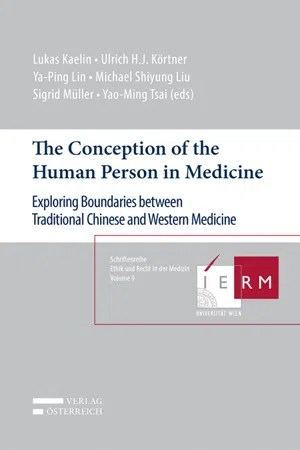
Unterschiedliche medizinische Disziplinen und Ansätze nehmen den Patienten in unterschiedlicher Weise wahr und hinter dieser Wahrnehmung steckt ein jeweils spezifisches Menschenbild. Dieses implizite Menschenbild ist in der Medizin je nach Disziplin verschieden - innerhalb der sogenannten westlichen Medizin und mehr noch darüber hinaus. Dieser Band geht der Frage nach den unterschiedlichen Menschenbildern in verschiedenen medizinischen Traditionen - Traditionelle Chinesische Medizin und Westliche Medizin - nach. Philosophen, Theologen, Ärzte, Ethnologen und Historiker aus Österreich und Taiwan entwerfen mit Ihren Beiträgen ein facettenreiches Menschenbild in der Medizin.Searching for medical assistance in case of sickness, one goes to see a doctor. Seeing a doctor implies some expectation on the part of the human-being-turned-patient in terms of anticipated treatments. The patient sees the doctor, but the doctor sees the patient too. The doctor applies a particular type of perception - medical perception - in the communication with and examination of the patient. It is this medical perception, and further conceptualization, that stands in the center of this anthology on The Conception of the Human Person in Medicine. This conception differs depending on the frequented doctor. Already with the large field of Western Medicine, the conception of the human person is considerably different among, for example, general practitioners, psychiatrists, gerontologists, and cardiologists. The differences in the conception of the human person are aggravated if we take different medical approaches into consideration. As expressed in the subtitle, this anthology addresses the ideas of the human being mainly in two medical traditions: Exploring Boundaries between Traditional Chinese and Western Medicine.The anthology thus deals with an implicit rather than explicit aspect of medicine, i.e. its underlying understanding of the human person. Medicine as a practical science builds equally upon elements from natural science and the humanities. Health and illness are not just brute facts "out there" to be detected by the empirical methods of natural science. Rather, they are also socially and culturally constructed. The conception of the human person thus depends on the particular medical tradition. Exploring the question at stake requires an interdisciplinary approach involving experts from the fields of Traditional Chinese Medicine (TCM), Western Medicine, Philosophy, Theology, Anthropology, and Medical History. This wide range of expertise allows for a multifaceted perspective on the way the human person is perceived in the different medical traditions.
eBook - PDF
The Conception of the Human Person in Medicine
Exploring Boundaries between Traditional Chinese and Western Medicine, Volume 9
- 254 pages
- English
- PDF
- Available on iOS & Android
eBook - PDF
The Conception of the Human Person in Medicine
Exploring Boundaries between Traditional Chinese and Western Medicine, Volume 9
About this book
Information
Print ISBN
9783704664099
Topic
JuraTable of contents
- Preface
- Table of Contents
- Index of Authors
- List of Abbreviations
- Introduction
- I. The Conception of the Human Person
- II. The Human Person as Patient
- III. The Intertwinement of Religion and Anthropology in Medicine
- IV. Contemporary Medical Practice and the Conception of the Human Person
- V. Conclusion
Trusted by 375,005 students
Access to over 1.5 million titles for a fair monthly price.
Study more efficiently using our study tools.
Frequently asked questions
Yes, you can cancel anytime from the Subscription tab in your account settings on the Perlego website. Your subscription will stay active until the end of your current billing period. Learn how to cancel your subscription
No, books cannot be downloaded as external files, such as PDFs, for use outside of Perlego. However, you can download books within the Perlego app for offline reading on mobile or tablet. Learn how to download books offline
Perlego offers two plans: Essential and Complete
- Essential is ideal for learners and professionals who enjoy exploring a wide range of subjects. Access the Essential Library with 800,000+ trusted titles and best-sellers across business, personal growth, and the humanities. Includes unlimited reading time and Standard Read Aloud voice.
- Complete: Perfect for advanced learners and researchers needing full, unrestricted access. Unlock 1.5M+ books across hundreds of subjects, including academic and specialized titles. The Complete Plan also includes advanced features like Premium Read Aloud and Research Assistant.
We are an online textbook subscription service, where you can get access to an entire online library for less than the price of a single book per month. With over 1.5 million books across 990+ topics, we’ve got you covered! Learn about our mission
Look out for the read-aloud symbol on your next book to see if you can listen to it. The read-aloud tool reads text aloud for you, highlighting the text as it is being read. You can pause it, speed it up and slow it down. Learn more about Read Aloud
Yes! You can use the Perlego app on both iOS and Android devices to read anytime, anywhere — even offline. Perfect for commutes or when you’re on the go.
Please note we cannot support devices running on iOS 13 and Android 7 or earlier. Learn more about using the app
Please note we cannot support devices running on iOS 13 and Android 7 or earlier. Learn more about using the app
Yes, you can access The Conception of the Human Person in Medicine by Lukas Kaelin,H. J. Körtner,Ya-Ping Lin,Schiyung Liu,Sigrid Müller,Yao-Ming Tsai, Lukas Kaelin, H. J. Körtner, Ya-Ping Lin, Schiyung Liu, Sigrid Müller, Yao-Ming Tsai in PDF and/or ePUB format. We have over 1.5 million books available in our catalogue for you to explore.